Qual é a sua dúvida sobre Depot?
Pergunte antes de baixar o manual: o assistente foi treinado neste arquivo e responde na hora, citando a página exata.
Tire dúvidas sobre o jogo
Pergunte qualquer coisa sobre Depot: regras, preparação, componentes, complexidade, preço ou se combina com seu grupo.
Escreva sua pergunta primeiro. Você criará sua conta grátis para ver a resposta — leva 20 segundos.
Manual completo
Navegue pelo manual ou baixe o PDF originalTexto completo do manual disponível para leitura Abrir texto
Components
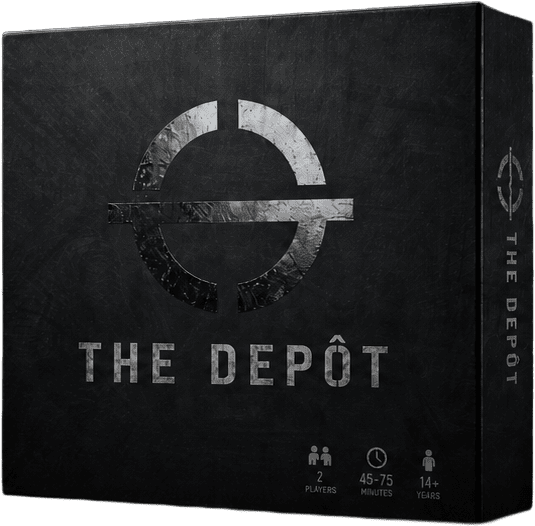
Depot is a card game in which you aim to discard all the cards in your hand faster than anyone else.
~ The rapidly growing e-commerce business. Our depots are in full operation today. Your sorting work is indispensable to ensure that packages are delivered on schedule. You will be in charge of the delivery of goods to the depots. ~
1 rulebook
80 cards
Game Preparation
(1) Deal the following number of cards to each player as a hand, keeping the cards hidden, according to the number of players.
For 3 players: 9 cards
For 4 players: 9 cards
For 5 players: 8 cards
(2) The remaining cards are placed in a deck in the center of the table. The space on the left next to the deck will be the discard.
(3) Draw the following number of cards from the deck according to the number of players and place them face up side by side in ascending numerical order near the deck.
For 3 players: 3 cards
For 4 players: 4 cards
For 5 players: 4 cards
Cards with the same value are placed in a row.
(*Please stack the cards of the same value on top of each other while shifting them upward.)
These cards are called the Storage.
The Storage is also placed in the center of the table.
(4) The player who plays the first card is decided by any method you like.
Value [1] ... 13 cards
Value [2] ... 12 cards
Value [3] ... 11 cards
Value [4] ... 10 cards
Value [5] ... 10 cards
Value [6] ... 9 cards
Value [7] ... 8 cards
Value [8] ... 7 cards
Flow of the game
The game is played over several rounds. (※The game may end after one round.)
In each round, starting with the start player, each player takes a turn in a clockwise direction.
On their turn, each player either [(1) Play a card] or [(2) Pass].
1. Play a card
The active player plays one or more cards from their hand and places them face up in front of them.
If more than one card is played, all of them must have the same number or sequential numbers.
(*Note that the numbers [1] and [8] are not consecutive.)
When a player plays cards with the same value, the maximum number of cards that can be played depends on the Storage: it is decided by the number of cards in the Storage that have the same numerical value.
When a player plays cards with sequential numbers, the maximum number of cards that can be played also depends on the Storage: it is decided by the number of cards in the Storage that have sequential values.
Example: There are two cards with the value [5] in the Storage, so the active player can play up to two cards with the same value. Also, there are cards with the numbers [4], [5], and [6], so the active player can play 2 or 3 cards as sequential numbers.
Each time one or more cards are played, the card(s) played by the previous player are discarded.
The starting player must [(1) Play a card] on their first turn.
The starting player can play any cards from their hand on their first turn.
(*A combination of cards may also be played depending on the Storage.)
(*For example, after the previous player has played the combination [1],[2], the next player can play the combination [2],[2])
Strengths of card combinations
Rule (1): Regardless of the number of cards, the higher the number of cards, the stronger the combination.
Rule (2): If the number of cards is the same, the combination with the higher total value is stronger.
Rule (3): Even if one of the combinations has the same number and the other has consecutive numbers, the strength of both cards is compared according to Rules (1) and (2).
The active player must play a card (or combination of cards) stronger than the one played by the previous player.
If there is only one card, the stronger card is the one with the higher number.
If there is more than one card, the strength of the cards is determined by the following rules:
---
If you want to play this game longer, you can choose the special rule of 3-game system.
In the special rules, the goal is to lose fewer points than anyone else.
Some of the rules in [End of Game] change as follows.
First, when the current game ends, the players are ranked according to the number of cards remaining in their hands. The fewer the number of cards, the higher the rank.
(*The player with zero cards in hand is in first place.)
If there are players with the same number of cards in hand, the player with the higher total value of cards in hand is ranked higher.
(*If the total value of cards in hand is also the same, then use the appropriate method to determine the ranking.)
Next, the player with the lowest ranking in the current game takes the card with the highest value in the Storage.
The player with the second lowest rank then takes the card with the second highest value in the Storage, and so on, until the player with the second highest rank takes the card with the lowest value.
(*The player in first place does not take any cards.)
If there is no card with a lower value in the Storage, the player takes the same card as the player one rank higher.
If there is no card in Storage that is the same as the card taken by the player one rank lower, that player does not take a card.
Each player places the card they have taken horizontally in front of them. The value of the card is the lost point.
[End of the game]
2nd 3rd 4th Last
Optional rules
The game ends when either player runs out of cards in hand during a round.
The winner is the player who runs out of cards in their hand first.
[1. Card Play]
- The active player cannot play cards of the same strength as those played by the previous player.
- The active player can always play more cards than the previous player.
- The active player may play any combination of cards that are not in the Storage, as long as it follows the rules.
(*For example, even if there are no cards with the numbers [1] and [2] in the Storage, if there are two cards that have sequential values in a row, the combination of [1] and [2] may be played as sequential numbers.)
- Only one combination of cards with the same number or sequential numbers can be played. You cannot play multiple combinations of cards at the same time.
(*For example, even if you have cards with the numbers [1],[1],[2],[2] in your hand, you cannot play two sets of cards with the same number: [1],[1] and [2],[2]. Similarly, two pairs of [1],[2] and [1],[2] as a combination of sequential numbers cannot both be played at the same time.)
[2. Pass]
If the player cannot or does not want to play a card from their hand, they pass.
First, the player chooses one number from the Storage, takes all cards of that number, and adds them to their hand.
Next, you may take only one card from your hand and place it in the Storage.
(*If you would rather keep your cards, add one from the deck instead.)
The card you take out from your hand must be a different number from the card you took from the Storage.
Finally, cards are drawn from the deck and placed in the Storage until the number of cards in the Storage is back to the set number.
(*When placing new cards in the Storage, make sure that the numerical values are in ascending order as in [Game Preparation (3)].)
As long as the current round has not ended, the player who passed can keep playing during this round.
[End of a round]
The round ends when one player [(1) Play a card] and all other players [(2) Pass] consecutively.
When the current round ends, the following steps are applied to prepare for the next round.
First, discard the cards played by the players.
Next, draw a card from the deck and arrange it in the Storage as in [Preparation for the Game (3)].
(*Every time a round ends, the number of cards in the Storage is increased by one.)
When ready, the new starting player takes their turn to start the new round.
The new starting player is the player who last [(1) Play a card] in the current round.
When the deck runs out, shuffle the discarded cards well to make a new deck.
when one player 1 Play a card and all other players 2 Pass consecutively When the current round ends the following steps are applied to prepare for the next round First discard the cards played by the players Next draw a card from the deck and arrange it in the Storage as in Preparation for the Game 3 Every time a round ends the number of cards in the Storage is increased by one When ready the new starting player takes their turn to start the new round The new starting player is the player who last 1 Play a card in the current round When the deck runs out shuffle the discarded cards well to make a new deck
[Example]
In the Storage, the numbers [2], [4], [5], [5], [6] are lined up. You have added both cards with the value [5] to your hand. Since you do not want to add any cards from your hand to the Storage, the number of cards you draw from the deck is two. You draw two cards, both of which have the value [6]. The Storage is now made out of the numbers [2], [4], [6], [6], [6], so the next player can play one, two or three cards with the same number. On the other hand, the next player can no longer play cards as sequential numbers.
(Card added to their hand / Card added from the deck to the Storage)
---
[(2) Pass]
- Players never add cards from the deck to the hand.
- After you have put a card from the deck to the Storage, you cannot then add a card from your hand into the Storage.
(*If you add a card from your hand to the Storage, it has to be the first card added.)
[Special rules]
- If you wish to play all three games with all the cards, write down the lost points at the end of each game.
---
Por que perguntar ao BoardGamesBot
Em vez de folhear o manual inteiro- Respostas precisas Baseadas exatamente neste manual, com a página de origem.
- Economize tempo Ache a regra em segundos, sem folhear 3 páginas.
- A qualquer hora Tire dúvidas no meio da partida, direto do celular.
- 100% grátis Crie sua conta grátis e comece a usar agora.
Como funciona
Três passos até a resposta- 1 Faça sua pergunta Digite sua dúvida sobre as regras deste jogo.
- 2 Crie sua conta grátis Leva 20 segundos — é só para guardar seu histórico.
- 3 Receba a resposta A IA encontra a regra exata e cita a página do manual.
Outros Jogos que Você Vai Gostar
Baseado em mecânicas e tema







Manual publicado pela editora · uso para consulta de regras. Mais sobre o jogo em BoardGameGeek e Ludopedia .