
/pic1788540.jpg)
Qual é a sua dúvida sobre Last Will: Getting Sacked?
Pergunte antes de baixar o manual: o assistente foi treinado neste arquivo e responde na hora, citando a página exata.
Tire dúvidas sobre o jogo
Pergunte qualquer coisa sobre Last Will: Getting Sacked: regras, preparação, componentes, complexidade, preço ou se combina com seu grupo.
Escreva sua pergunta primeiro. Você criará sua conta grátis para ver a resposta — leva 20 segundos.
Manual completo
Navegue pelo manual ou baixe o PDF originalTexto completo do manual disponível para leitura Abrir texto
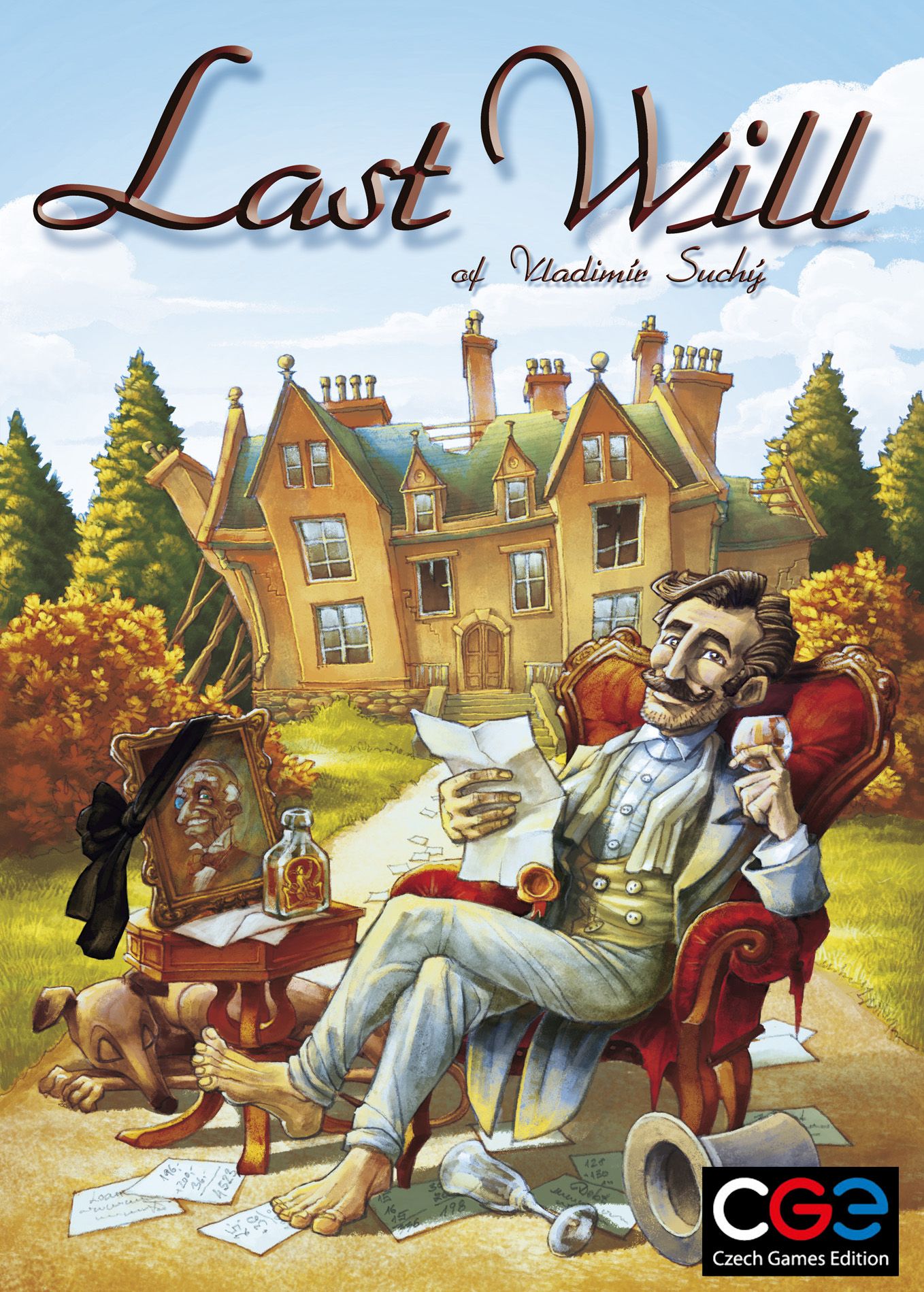
The lawyers have found a hidden clause in your uncle’s last will.
Spending money faster than all your relatives will not be enough.
To inherit your uncle’s fortune, you must also lose your job.
---
Components
ddnew planning board
ddadditional supplemental card offering board
dd16 double-sided plan tiles
dd50 new cards
dd1 additional errand boy figure per player
dddemotion tokens
ddmoney tokens
Overview
This expansion contains several parts. They are designed to work together, but it is possible to use some parts and not others. We suggest several variants on page 7.
Employment
dd20 employment cards
dd10 new last will cards
dd20 demotion tokens
Employment gives you an additional obstacle to overcome: you need to get sacked! You can't win until you have lost your job. As if that weren't bad enough, your job gives you extra income.
New Plans
ddA new planning board
dd An additional supplemental card offering board
dd16 double-sided plan tiles
dd1 additional errand boy figure for each player
The new planning options add variety to the game.
New Cards
ddA second set of 7 special cards
dd6 additional properties
dd6 additional event cards concerning your impending nuptials
dd1 additional helper
We've added a new set of special cards that your errand boys can fetch. Most decks from the original game get additional cards. And now you have a chance to get married.
side for 2 or 5 players
side for 3 or 4 players
side for 2–4 players
side for 5 players
employment cards
an additional helper
an additional set of special cards
additional properties
additional events
new last will cards
---
3
Setting Up the Game
Setting up the game requires several changes.
Unused Components
Leave these components in the box:
The original game's planning board.
The original game's last will cards.
They will not be needed.
Players' Components
Each player should have 3 errand boy figures instead of 2.
The Game Boards
Set up the boards as follows:
1. Use the planning board from this expansion.
(That's right, the one that has no plans on it.)
The numbers in the upper right corner tell you which side of the board to use. Pick the side corresponding to the number of players.
2. Set up the card offering board (and possibly the original supplemental board) as usual, depending on the number of players. Then add the supplemental card offering board from this expansion. The side you use depends on the number of players.
3. Mix up the plan tiles and draw them randomly, one at a time. Each tile tells you where it goes and the number of players for which it is intended.
Example
If the tile does not match the number of players, or if the indicated position is already occupied, set that tile aside and draw another. Otherwise, put it in the indicated position with a random side up. When all 8 positions are filled, the game board is set up. Unused tiles can be returned to the box. They will not be needed.
The Decks
Regular Decks
Add the new helper, the new property cards, and the new event cards to the corresponding decks. Shuffle the 4 regular decks and set them around the game board as usual.
Special Cards
The new special cards and the original special cards should be kept separate. Prepare the original special cards as usual.
The new special cards have either 1 or 2 crowns on the back. Separate the 1-crown cards from the 2-crown cards and shuffle each set separately. Then stack the 1-crown set atop the 2-crown set to make a single deck.
The Last Will Cards
These replace the last will cards from the original game. Choose one that everyone agrees on, or shuffle them all and draw one at random. Return the others to the box.
This card tells you how much money each player has at the beginning of the game. It also tells you which set of employment cards to use.
The Employment Cards
There are two kinds of employment cards: those with 4 lines of income and those with 5. Use the set specified by the last will card.
Shuffle the employment cards from the indicated set. Deal each player one at random. Return the unused cards to the box.
---
Employment
You begin the game with a randomly chosen
employment card which gives you income.
Each round, you may be able to reduce your
income by earning a demotion. You can never
earn more than one demotion per round. When
you get enough demotions to eliminate all your
income, you get sacked.
Income
When your uncle convinced his business associate to give you this job, you thought it was wonderful. But now you realise that you are grossly overpaid.
At the beginning of each round (during Setup)
you get income. Add up the numbers showing
on all lines of your employment card, and take
that many pounds from the bank.
This applies even to the first round of the game.
Each player will start the first round by taking
the same amount of money: 11 pounds or
7 pounds, depending on which set of employ-
ment cards you are using.
In later rounds, some lines may be covered by
demotion tokens. Your income will be less be-
cause you do not count covered lines when fi-
guring your income.
Example
This player must take 4 pounds of income at the begin-
ning of the round.
Demotions
It is very difficult to persuade your employer to give you the old heave-ho. When you miss work, he's inclined to be charitable because he liked your uncle and he's sorry for your loss. To make him angry, you need to get caught living it up when you should be working. He won't sack you straight away, but he will at least dock your salary.
To get rid of your income, you need to earn de-
motion tokens. You can earn at most one de-
motion per round. There are two ways to do so:
1. Play a matching card
Each line of income has a certain symbol. You can place a demotion token on that line if you play a card with that symbol in the upper left corner.
White-Bordered Cards
For white-bordered cards, this is straightforward.
You can place a demotion token on an income
line when you play a white-bordered card with
the matching symbol in its upper left corner.
Black-Bordered Cards
A black-bordered card can earn you a demotion
only when you first lay it down on your player
board. You cannot earn a demotion for activat-
ing a card you have already played. Nor can you
earn a demotion from using a helper's privilege.
In the case of a property, this means you can
earn the demotion only when you buy it – not
when you sell it, maintain it or depreciate it.
For properties, the colour of the symbol is im-
portant. For example, a symbol is matched
by a Mansion, not by a Manor or Town House.
Only the symbol in the upper left corner mat-
ters. This is important to remember with certain
---
5
helpers. For example, the Coachman matches
the symbol, not the symbol.
Companions
A companion card can earn you a demotion
when you play it with a white-bordered card, or
when you play it to put a token on a black-bor-
dered card.
The companion wild card works just like a regular
companion card. For example, you can place a de-
motion token on a line with a symbol if you
play the companion wild card as a dog (but not
when you play it as a different type of companion).
The companion wild card is the only card that
matches the symbol. A regular companion
card will not match this symbol.
Please note that the Breeders' Fair (a white-bor-
dered special card) has no symbol in its upper
left corner. It cannot match any line on your em-
ployment card, and you cannot earn a demotion
when you play it.
Remember: You can never earn more than one
demotion in a round. Even if you can play cards
to match multiple lines, you can only cover up
one of them. (And you can't cover up any of
them if you have already earned a demotion this
round with an errand boy.)
2. Send an Errand Boy
Some errands on the new boards give you a chance to earn a demotion.
Choosing this errand allows you to place a demotion token on any line of your employment card.
You cannot send your errand boy here if you got sacked already.
This errand allows you to either take a player board extension or place a demotion token on any line of your employment card. When playing with 5 players,
you may only use this errand to take a demotion token if the other errand space that gives you a demotion token is already occupied. The same applies to using this space to take a player board extension; you can only do so if the other errand space which gives a player board extension is already occupied.
When you go to the opera, in addition to spending 2 pounds, you may earn a demotion token to
place on a line with the symbol. (This is just
like playing a card with the symbol.)
Getting Sacked
Even your kindly old boss has his limits.
When you earn enough demotions to cancel out
every line of income, discard your employment
card. Congratulations: You have been sacked!
Now you are one step closer to winning the game.
Ending the Game
The goal is the same as the original game – get rid of all your money and property – but now you must also get the sack.
Having an employment card is similar to own-
ing property. You cannot declare bankruptcy or
go into debt until you get sacked.
Once you get rid of your property and your
employment card, you can declare bankruptcy
and go into debt according to the rules for the
original game.
The rules for determining the winner are the
same as in the original game, except for one
thing: At the end of the last round of the game
(either round seven or the round in which some-
one declares bankruptcy) all players with an em-
ployment card get their incomes one more time
before counting up their final totals.
Note: Because players can cover up only one
line of income per round, the game is guaran-
teed to go at least four or five rounds, depend-
ing on the employment cards.
---
6
New Plan Options
With this expansion, each game can have a different planning board.
Setting Up the Planning Options
When you set up the game boards, you randomly selected the 8 plan tiles that will be used in the game. See page 3 for details.
Choosing a Plan
You choose plans according to the same rules as in the original game. The plans farther to the right will be more advantageous, but those farther to the left will allow you to place your errand boys earlier.
Some plans allow you to place 3 errand boys. Players with such plans will place their third errand boy after all players have placed their first and second according to the original rules.
New Cards
This expansion includes several new cards. The back page of this rulebook has a key explaining the new symbols.
New Set of Special Cards
The new supplemental card offering board has a place for these new special cards. You can get a new special card only by sending an errand boy there.
The original special cards are still available on the main card offering board, as in the original game.
New Properties
Shuffle these into the properties deck.
Nuptial Cards
A wedding is such a romantic way to spend piles of money in a hurry.
The expansion has 8 nuptial cards marked with this symbol in the upper left corner. Shuffle the 6 white-backed cards into the event deck. The other 2 nuptial cards can be found in the new special deck.
These cards come with four names: Engagement Ring, Wedding, Wedding Gift and Bachelor Party. A nuptial card can be played like a regular event card – use an action and spend the money. But you can also play a set of 2, 3 or even 4 nuptial cards together for the cost of only one action, provided all the cards in the set have different names.
Example
If you have 2 Engagement Rings and 1 Wedding Gift, you can play 1 Engagement Ring plus 1 Wedding Gift as a single action. Then, if you wish, you can play the other Engagement Ring by using another action. You cannot play all 3 events with the same action because the 2 Engagement Rings have the same name.
You may play nuptial cards even if you have already played nuptial cards earlier in the game. (No, of course you don't go around proposing to multiple young ladies. You are not a cad.
---
7
Think of these cards as extra rings, extra gifts,
and extra receptions for your new bride. We as-
sure you, she will not object.)
Wedding Planner
Put this new helper in the helpers and expenses deck. His abilities are explained on the back page of this rule-
book.
Variants
The components of this expansion have been designed to be used together. Even so, you can choose to leave things out.
No Employment
Use the original last will cards.
When sending errand boys, ignore the space
that lets you earn a demotion. (The other space
can still be used to get a player board exten-
sion.)
Employment as Handicap
Employment makes the game trickier. You can handicap the more experienced players by giving each of them an employment card. The other players start the game with extra money: 15 pounds if you are using four-line cards, or 30 pounds with five-line cards.
Original Plans
If you prefer to play with the original plans, leave the plan tiles in the box. Place the original planning board underneath the new board so that the original plans are showing.
Summary of Changes
Setting Up the Game
Use the new planning board instead of the
original one.
Use the new supplemental card offering
board. (In a 3- or 5-player game, you will also use the original supplemental card offering board.)
Use the new special cards in addition to the
original special cards (but keep them separate).
Choose the available plans randomly.
Use the new last will cards to determine
starting money and set of employment cards.
Each player has 3 errand boy figures.
Add new cards to the appropriate decks.
During the Round
At the beginning of the round, you get
income for each line of your employment card that is not yet covered by a demotion token.
The supplemental card offering board offers
you one of the new special cards (in addition to the original special cards offered on the original board).
The new board has new errands:
Put a demotion token on the line of your
choice.
Put a demotion token on the line of your
choice, or take a player board extension.
Note: This errand has a special rule for the 5-player game.
You can place a demotion token on a line of
your employment card by playing a matching card. (Going to the opera is like playing a card with the mask symbol.)
Under no circumstances can you ever
earn more than one demotion token per round.
End of the Game
A player with an employment card can neither declare bankruptcy nor go into debt.
After the final round, all players who are still
employed get their income one last time.
---
8
Properties
This property can be either of the 2 indicated types. You choose its type when you buy it, and you can switch its type whenever you wish. It always has the type that is more convenient for you.
The property can never be both types at once.
e.g. You cannot get the Gardener bonus twice from the same Gardener card.
If you want to get a demotion token for buying it, you must use the price modifier that matches the line you want to cover.
You may add a companion token according to the original rules.
If this space has a companion token, the property depreciates down 2 spaces (instead of 1) at the end of a round in which you did not maintain it.
Either a horse or a dog meets the requirement for adding a companion token here. You choose.
If the farm has more than one symbol you can choose for each one.
This farm comes with a free horse token. Just put it on when you buy the property. You do not use a companion card, nor do you use an additional action to place this free token. The horse token cannot be used to earn you a demotion (but playing the farm can earn you a demotion, as usual).
Events
As a single action, you may play a set of multiple event cards with this symbol, as long as they all have different names. E.g., you can play up to 4 cards using one action.
You may discard cards with the helm symbol or the wine glass symbol, as many as you like. For each one discarded, spend 1 extra pound. The Sea Dog's bonus does not apply to cards discarded this way. Discarded cards cannot be used to earn a demotion.
This card has 4 symbols in its upper left corner. The Waiter, Coachman, Sea Dog, and Wedding Planner can all give you bonuses when you use it. (You can get a bonus from multiple helpers for the same use.) It can earn you a demotion on a line matching any one of the symbols.
You may sell one property (without using another action). For this sale, ignore the modifier tokens.
Helpers
When you play a card with the nuptial symbol (Engagement Ring, Wedding, Wedding Gift, or Bachelor Party) you may spend 1 extra pound. If you play a set, you may spend 1 extra pound for each card in the set.
Any time during your action phase turn, you may draw 6 cards and keep 1 of them. (Discard the other 5.)
Designer: Vladimír Suchý
Main illustrator: Tomáš Kučerovský
Card illustrations: Václav Šlajch
Graphic design: František Horálek
Rules: Vít Vodička
Main testers: Petr Murmak, Vít Vodička
© Czech Games Edition
October 2013
www.CzechGames.com
Testers: my wife Katka, Rychlík, Vodka, Tuko, Marcela, Vlaada, eklp, dilli, Roneth, Dunde, vytick, Jája, Pidgin, Radka, Honza, Pogo and many others.
Special thanks to: Paul Grogan and people from The Gathering of Friends.
---
Por que perguntar ao BoardGamesBot
Em vez de folhear o manual inteiro- Respostas precisas Baseadas exatamente neste manual, com a página de origem.
- Economize tempo Ache a regra em segundos, sem folhear 8 páginas.
- A qualquer hora Tire dúvidas no meio da partida, direto do celular.
- 100% grátis Crie sua conta grátis e comece a usar agora.
Como funciona
Três passos até a resposta- 1 Faça sua pergunta Digite sua dúvida sobre as regras deste jogo.
- 2 Crie sua conta grátis Leva 20 segundos — é só para guardar seu histórico.
- 3 Receba a resposta A IA encontra a regra exata e cita a página do manual.
Expansão de
Conteúdo adicional publicado
Manual publicado pela editora · uso para consulta de regras. Mais sobre o jogo em BoardGameGeek e Ludopedia .
