
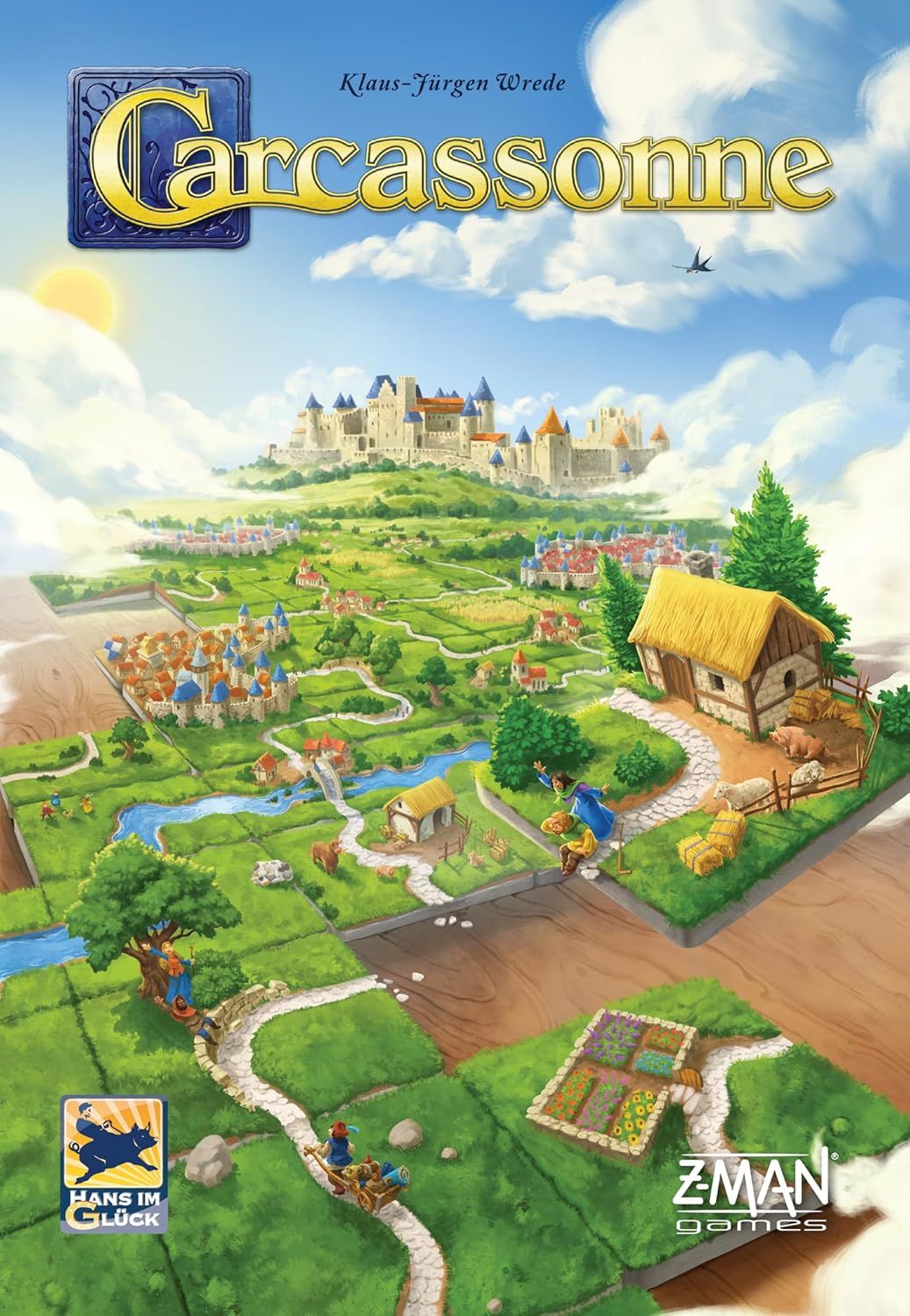
/pic7715668.jpg)
Qual é a sua dúvida sobre Carcassonne: The Wonders of Humanity?
Pergunte antes de baixar o manual: o assistente foi treinado neste arquivo e responde na hora, citando a página exata.
Tire dúvidas sobre o jogo
Pergunte qualquer coisa sobre Carcassonne: The Wonders of Humanity: regras, preparação, componentes, complexidade, preço ou se combina com seu grupo.
Escreva sua pergunta primeiro. Você criará sua conta grátis para ver a resposta — leva 20 segundos.
Manual completo
Navegue pelo manual ou baixe o PDF originalTexto completo do manual disponível para leitura Abrir texto
Klaus-Jürgen Wrede
The Wonders of Humanity
The wonders of humanity have reached
Carcassonne. Each of them brings you
individual advantages. But everyone
can only use one per game. Get the
wonder you want quickly to benefit
from it as often as possible!
Setup
This mini expansion was developed for the Carcassonne base game and its rules still apply. You can
combine The Wonders of Humanity with other expansions. However, there will be no official rules for these
combinations.
We recommend you to play with at least 90 tiles and one additional meeple (e.g. Base game + 1st expansion).
Ignore any additional expansion rules.
• Each player takes all 9 meeples of one color. Place 2 meeples of each color next to the
space 10 of the scoring track.
Note: One of these two meeples is used only to mark your wonder. You can use the big meeple of the
1st expansion or any other token of that color.
• Place a scoring meeple as usual on the space 0 on the scoring track. You start the game with
6 meeples in your supply.
• Pick 1 wonder tile per player. You can also combine wonders from different sets. Place them
face up next to the scoring track. Discard the remaining tiles, you do not need them for this game.
Note: Alternatively, you can also prepare as many wonders as you like. You'll have a bigger selection of
wonders and you can choose the right wonder for you, later in the game.
Components
4 wonder tiles with the Wonders of Humanity (Set I)
4 wonder tiles with the Wonders of Humanity (Set II)
Note: All wonder tiles count as 5 connected normal tiles.
Angkor Wat Terracotta Armee Tikal Abu Simbel
Get a wonder tile
There is one wonder for each player. So you can get a wonder tile only once (For a variation with two wonders per player
see pg. 4).
When your scoring meeple reaches or exceeds the space with the meeple pairs (the first time the space is 10), you perform
the following steps one after the other:
• Choose one of the wonder tiles and place it in front of you. You don't place it on the game board yet (see 1. Placing a
wonder tile).
• Take your two meeples that are next to the scoring track and put them into your supply.
Circus Maximus Alhambra Stonehenge Notre Dame
---
1. Place a wonder tile
If there is a wonder tile in front of you, you do not draw a tile, but instead place your wonder according to the usual placement rules. Once you have placed it, you have to mark your wonder with one of the 2 meeples you've unlocked before by placing it in the center of the wonder (not on a city, road or field). The marker meeple remains there until the end of the game. For a better distinction from other meeples you can put the marker meeple upside down.
Note:
In the very rare case that you can't place the wonder correctly, you draw a tile that you must immediately place so that you can then place your wonder tile next to it. If this is also not possible, the normal tile is removed from the game and you draw another tile and place it, until you can place your wonder tile. You do not place a meeple on the additionally drawn tile.
2. Place meeple on a wonder tile
After you have placed and marked your wonder, you may immediately place up to 2 meeples on different unoccupied areas (city, road, monastery or field) of this wonder. You can also place only one or no meeple. If you place 2 meeples, they may also be placed on the same tile-square.
2
3. Score with your wonder
• Move all remaining meeples next to the scoring track 5 spaces further (i.e. the first time next to the field 15, then 20 and then 25).
Attention: You must never move the meeple-pairs beyond the space 25, even if there are more than 4 players. The meeples remain at field 25 until they are reached by all other scoring meeples.
Special case:
If several players reach the space with the meeple pairs on the same turn, the person whose turn it is chooses which of them will take a wonder tile. After that, the meeple pairs are moved 5 spaces forward as usual. If there are still scoring meeples of other players (who have not taken a wonder yet) on or behind the meeple-pair-space, the person whose turn it is decides again who will take the next wonder, and so on.
Each wonder has its own function that can earn you points. Some wonders give you points during the game, while others give you points at the end of the game.
Scoring during the game
Notre Dame
During the game (not during the turn in which you place the Notre Dame), if you place a meeple on one of the 8 tiles around a monastery, you immediately score 3 points. Whether there is a monk on this monastery or not is irrelevant. Even if several monasteries are adjacent to the tile, you will "only" receive 3 points.
Stonehenge
If you complete one or more occupied roads during your turn (not when playing the Stonehenge tile itself), you immediately score 3 points for each road you complete (even if you don't have a meeple on the road yourself). After that, you score the road as usual.
You place the Alhambra.
Then place a meeple upside down on the wonder as a marker. Then you place a meeple on the city and another meeple on the free road.
You place your meeple on this tile and immediately score 3 points.
You complete a road with a meeple on it. You immediately score 3 points.
---
Circus Maximus
At the end of the game, depending on the number of
players, you will receive points for each meeple of
another color in still open cities:
2 players: 4 points
3-4 players: 3 points
5+ players: 2 points
Abu Simbel
When it's your turn, you can choose from 2 tiles. The first time you
draw 2 tiles. You choose one and place it as usual.
Place the other one face down in front of you for a later turn.
When it's your turn again, you draw another tile and choose from
2 tiles again, and so on.
If there are no more tiles for you to draw at the end of the game,
place the one in front of you.
If your unchosen tile is the last one in the game, it goes to the next
player for the last turn.
Tikal
If a city is scored that has at least 3 tiles and you have at least one
meeple in it, you receive 2 points for each of your own meeple in a
city on the playing field.
The following applies:
• You do not have to be the majority in the scored city.
• The meeple in the scored city also scores 2 points.
You draw a tile, look at it and
choose one. You decide which one
you want to play now. You place
the other one face down in front
of you.
Blue scores the city which is bigger than two tiles and in which you also have a meeple. Since blue has the majority there,
he receives the points for the city, but you receive points for your Tikal wonder. You currently have a total of 4 meeples in cities on
the board and therefore you receive (4x2=) 8 points.
At the end of the game, you first count all roads that
are at least 5 tiles long. In this section, you count 2
relevant streets that give you (2x5=) 10 points.
Alhambra
At the end of the game, you score 5 points for
each of your farmers, regardless of how many
points that farmer scores. If you play with at least
120 tiles you get 6 points. It is not relevant if it is
your own farmer, the field itself scores the points.
Angkor Wat
For each road (open or closed) that is at least 5
tiles long, you receive 5 points at the end of the
game. It doesn't matter whether the roads have
already been scored or are still open, whether there
are meeple on them or not.
Scoring at the end of the game
Detailed view at the end
of the game:
In a game with three
players you get 2x3
points for the yellow meeple
and 1x3 points for the blue
one. You don't get any points
for your own meeple.
Detailed view at the
end of the game:
You have 2 farmers
on the board. So you
receive 2x5 points.
---
4
Variation - 2 wonders per player
If you are already familiar with The Wonders of Humanity, you can also try out the following variant, in which each player
receives up to 2 wonders in the game. You now receive the effects of both wonders. Depending on the situation, you can
also build interesting combinations.
Note: All the rules of the game remain the same. We are only listing the changes here.
Setup
We recommend that you play with at least 120 or more tiles and 2 additional meeples (e.g. base game + river, + 1st
expansion and any other tiles from (mini) expansions). But ignore the expansion rules.
• Each player takes 10 meeples of one color. Place 2 meeples of each color next to space 10 outside the scoring board, and
1 meeple next to the 0/50 starting space.
• Choose 2 or any number of wonders per player and place them next to the scoring board.
Receive the 2nd wonder tile
If your counting meeple reaches or exceeds the 50 space, you choose your 2nd wonder, place it in front of you and take the
meeple next to the 0/50 starting space. After that, you use it to mark your 2nd wonder in your next turn, after you have
placed it.
Important!
At the end of the game, you first score the wonders that score at the end of the game. After that, you continue with the
normal final scoring. Each wonder tile counts as 5 individual normal tiles. Accordingly, the roads and cities can consist of
more than one tile. You must take this into account during the scoring.
Set I: Stonehenge and Notre Dame each have a road that spans 2 tiles. The Alhambra has a city that spans 3 tiles, and the
Circus Maximus has a city that spans 4 tiles.
Set II: Each wonder, except Tikal, has a road that extends over 2 tiles. Tikal has a road that even counts 3 tiles.
Stonehenge
The monument is a Neolithic megalithic structure. It is located near the river Avon
near Amesbury in southern England, and was erected in several stages (over several
hundred years) starting at least in 3000 BC. There are various hypotheses about the
occasion and purpose of this highly elaborate monument. Stonehenge has been a
UNESCO World Heritage Site since 1986.
Notre Dame
The Cathédrale Notre-Dame de Paris is a Roman Catholic church. It was built
between 1163 and 1345 and is one of the earliest Gothic church buildings in
France. It is located in the historic center of Paris on the Seine island of Île de la
Cité. On April 15, 2019, it was severely damaged by a major fire. Shortly after, the
French Parliament decided to rebuild it true to the original.
Terracotta Army
You receive 2 points for every at least 7 tiles that are in a
row or column on the board at the end of the game.
The following applies:
• You may score identical tiles for the column and
for the row.
• Each column and row is only scored once.
At the end of the game, go through column by column and row by row
and count how many of them consist of at least 7 tiles that are
adjacent to each other without a gap. In this section, there is one row
and one column. You get (2x2=) 4 points for this.
---
© 2023, 2024 Hans im Glück Verlags-GmbH
Birnauer Str. 15 / 80809 München
info@hans-im-glueck.de; www.hans-im-glueck.de
Author: Klaus-Jürgen Wrede & the Hans im Glück Team
Illustration of components: Marcel Gröber
Sales
Carcassonne & Co GmbH Birnauer Str. 15, 80809 München
Visit cundco.de for merchandise, mini-expansions
and our spare part service.
5
Circus Maximus
First built in stone as a permanent installation, construction began around 31 BC.
With a total length of about 600 meters and a width of 140 meters, the Circus
Maximus was the largest circus in ancient Rome. So it was even bigger than the
Colosseum and until modern times the largest stadium in the world. It was used
for chariot races until the 6th century. Its capacity is said to have been up to
250,000 seats, although this is only based on a story. More likely, but still very
impressive, is 150,000 seats.
Abu Simbel
The rock temples in the village of Abu Simbel were built in the 13th century BC.
The two temples - the large one for the glory of King (Pharaoh) Ramses II, and
the small Hathor-Temple in memory of his wife Nefertari - have been on the
UNESCO World Heritage List since 1979. To safe them from the rising waters of
Lake Nasser, they were demolished between 1963 and 1968 and rebuilt 64 meters
higher on an island in Lake Nasser.
Angkor Wat
The most famous temple complex in the Angkor region of Cambodia is located
around 240 km northwest of the capital Phnom Penh. When the country south of
China developed into a regional center of power in Southeast Asia in the 10th
century, the Khmer built large cities and enormous temples. Angkor Wat was built
under King Suryavarman II. The complex was built as the king's state temple and
was used to worship Vishnu. There is also evidence that it was the mortuary temple
of Suryavarman II.
Alhambra
On the Sabikah Hill in Granada, Andalusia, Spain, stands the Alhambra City
Castle. The castle complex in the Moorish style of Islamic art is about 740 meters
long and 220 meters wide. The most important parts of the Alhambra are the
Nasrid palaces with their gardens, the medina and the Renaissance palace of
Charles V. It is one of the most visited tourist attractions in Europe and was
declared a World Heritage Site in 1984.
Tikal
The ancient Mayan city is best known for its stepped temples. It is located in
northern Guatemala, in the rainforests of the Petén and was one of the most
important cities in the Classic Mayan period in the 3rd-9th century. Tikal
experienced its highlights in the 5th and 8th centuries. Since 2018, researchers
have assumed that the area around Tikal was home to at least one million people.
The city was completely abandoned by the 10th century at the latest.
Terracotta Armee
The so-called Terracotta Army comprises more than 7,000 life-size soldiers. It is
part of an early Chinese burial complex, the Qín Shihuángìs Mausoleum.
Construction began in 246 BC and Emperor Qín Shihuángìs was buried in it in
210 BC. It is one of the world's largest tombs, one of the greatest archaeological
discoveries of the 20th century and has been on the UNESCO World Heritage
List since 1987.
Note: The map printed on the back of the wonder tokens is only relevant for the
Carcassonne Game Festival 2023 in Carcassonne.
---
Por que perguntar ao BoardGamesBot
Em vez de folhear o manual inteiro- Respostas precisas Baseadas exatamente neste manual, com a página de origem.
- Economize tempo Ache a regra em segundos, sem folhear 5 páginas.
- A qualquer hora Tire dúvidas no meio da partida, direto do celular.
- 100% grátis Crie sua conta grátis e comece a usar agora.
Como funciona
Três passos até a resposta- 1 Faça sua pergunta Digite sua dúvida sobre as regras deste jogo.
- 2 Crie sua conta grátis Leva 20 segundos — é só para guardar seu histórico.
- 3 Receba a resposta A IA encontra a regra exata e cita a página do manual.
Expansão de
Conteúdo adicional publicado
Manual publicado pela editora · uso para consulta de regras. Mais sobre o jogo em BoardGameGeek e Ludopedia .
