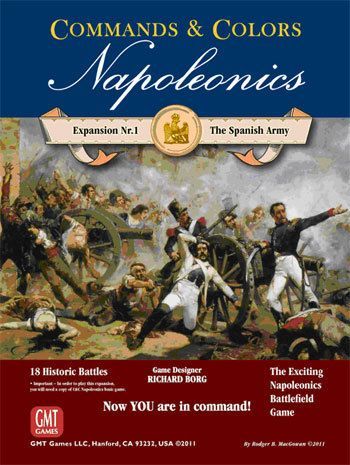
Qual é a sua dúvida sobre Commands & Colors: Napoleonics Expansion #1: The Spanish Army?
Pergunte antes de baixar o manual: o assistente foi treinado neste arquivo e responde na hora, citando a página exata.
Tire dúvidas sobre o jogo
Pergunte qualquer coisa sobre Commands & Colors: Napoleonics Expansion #1: The Spanish Army: regras, preparação, componentes, complexidade, preço ou se combina com seu grupo.
Escreva sua pergunta primeiro. Você criará sua conta grátis para ver a resposta — leva 20 segundos.
Manual completo
Navegue pelo manual ou baixe o PDF originalTexto completo do manual disponível para leitura Abrir texto
COMMANDS & COLORS
Napoleonics
EXPANSION # 1
The Spanish Army
Game Design by
Richard Borg
GMT
GAMES
GMT Games, LLC • P.O. Box 1308, Hanford, CA 93232-1308 • www.GMTGames.com
---
2 Command & Colors: Napoleonics
I don't know what effect these men will have upon the enemy, but by God, they frighten me.
—Duke of Wellington
1. INTRODUCTION
The Commands & Colors: Napoleonics game system allows players to effectively portray epic Napoleonic battles, as well as smaller historical actions. The scale of the game is flexible and varies from battle to battle. In some scenarios, an infantry unit may represent an entire division, while in others a unit may represent a single regiment or battalion. During play, the Command cards drive movement while creating a "fog of war" and the battle dice resolve combat quickly and efficiently. The stylized battlefield maps emphasize the important terrain features and highlight the historical deployment of forces in scale with the game system. Finally, the Napoleonic tactics you will need to execute to gain victory conform remarkably well to the advantages and limitations inherent to the various Napoleonic National Armies of the day and the battlefield terrain features on which they fought.
The Spanish Army is the first expansion for Commands & Colors: Napoleonics. In this expansion, you will find 18 historical scenarios that focus on Peninsular battles fought by the Spanish army from 1808 to 1813, plus all the new units you need to field for these engagements. A number of additional scenarios are also presented that involve the Anglo-Spanish alliance and will require British and Portuguese troop blocks from the core game.
Spanish troops and leaders, as many Napoleonic historians point out, performed badly on a large number of occasions. Yet there are a number of battles where the Spaniards fought valiantly and gained victory. Ironically, the point most historians overlook is the fact that the Spanish armies constituted a threat that Napoleon simply could not ignore. As good as Wellington's Anglo-Portuguese field army was, he could only take on one French army at a time. The Spanish forces and the accompanying guerrilla warfare against French troops tied down many French forces in the Peninsula, allowing the Anglo-Portuguese army to ultimately emerge victorious.
At the time of the Napoleonic Wars, Spain was only a shadow of its former power. The quality of Spanish troops varied, from very poor to good, and the Spanish National Unit Reference Card presents a wealth of subtle National unit characteristics that set the Spanish Army apart from all other Coalition armies that opposed Napoleon. Command of the Spanish Army, therefore, will truly challenge even the most experienced Commands & Colors: Napoleonics player.
Welcome and Enjoy!
Richard Borg
2. CONTENTS
1 Card Sheet containing:
• 1 Spanish Infantry in Square track sheet
• 4 Spanish Infantry Square counters
• 9 Spanish Victory Banner counters
• 6 Spanish Guerrilla counters
1 Card Sheet containing 15 double-sided Terrain tiles
4 Block Label sheets
2 Player Aid Cards (1 Allied [British/Portuguese/Spanish] National Unit Reference Card, and 1 French National Unit Reference Card)
1 Rule and Scenario Booklet containing 18 battle scenarios
195 Blocks: yellow Spanish units and dark blue French units, comprising:
• 107 small blocks, yellow and dark blue for infantry units
• 75 medium blocks, yellow and dark blue for cavalry units
• 13 rectangular blocks, yellow and dark blue for leaders and artillery units
There will be a few spare blocks of all sizes in each color.
[Image: Small Blocks 18x18x8 mm, Medium Blocks 22x22x8 mm, Rectangular Blocks 22x28x8 mm]
National Unit Reference Cards
Each of the major powers that fought in the Wars of Napoleon will have a National Unit Reference Card. A National Unit Reference Card details:
• The unit types and map set up codes.
• Sticker art portraying each listed unit.
• The number of blocks that are deployed in a unit.
Note: Not all nations had the same organization therefore the number of blocks for a specific unit type may differ.
• The unit's movement in hexes.
• Unit specific Battle Dice Modifications plus Command card Dice Modifications.
• Morale Modifications.
• National Notes.
© 2014 GMT Games, LLC
---
Command & Colors: Napoleonics 3
Units and Leaders
Visual Identification Aids. To assist players in set-up and unit recognition, several unit class icons are being introduced into this expansion. They will be retrofitted into the core game upon reprinting and will be carried forward into future expansions:
- Flaming grenade icon: Grenadier infantry: upper left or right of each sticker for the following unit types— Grenadier, Guard Grenadier, Old Guard
- Bugle icon: Light infantry: upper left or right of each sticker for the following unit types— Light, Rifle Light, Guard Light and Young Guard
- Cavalry helmet icon: Heavy cavalry: upper left or right of each sticker for the following unit types— Heavy, Guard Heavy, Cuirassier
- Horse artillery: upper left or right of each sticker for the following unit types— Horse artillery, Guard horse artillery
Line and militia infantry, light cavalry (Light, Light Guard and Light Lancers) and foot artillery (Foot and Guard Foot) classes of units are differentiated by the absence of any identifying icon.
Unit Composition
Each unit is composed of a certain number of blocks. The number of blocks in a unit may vary by unit type and Nation and is detailed on the National/Abbreviated Unit Reference Cards.
A General, Marshal or Field officer of any rank (hereafter referred to as a leader) is represented by one rectangular block. A single Leader block is not considered a unit.
Infantry in Square Track and Counters
The infantry in square track and the numbered counters are used to track infantry units that have formed square on the battlefield.
Victory Banner Counters
These counters track a player's quest for victory.
French Victory Banner
Spanish Victory Banner
Spanish Guerrilla Action Counters
When the scenario's special rules state that Spanish Guerrilla Action Rule is in effect, the Spanish Commander may attempt to intercept the French player's Command card on a turn by spending a Guerrilla Action counter.
3. NEW UNITS AND LEADERS
Spanish Line Infantry
Map ID code: S-LN
Blocks in Unit: 4
Movement in Hexes: 1
Battle:
- Ranged Fire Standing: 1 die per block
- Ranged Fire Moving: dice equal to 1/2 number of blocks rounded down, minus 1 die
- Melee Standing and Battle Back: 1 die per block
- Melee Moving: 1 die per block, minus 1 die
Morale: Retreat 2 hexes for each flag
Spanish Light Infantry
Map ID code: S-LT
Blocks in Unit: 5
Movement in Hexes: 1 or 2 and no battle
Battle:
- Ranged Fire Standing: 1 die per block
- Ranged Fire Moving: dice equal to 1/2 number of blocks rounded down
- Melee Standing and Battle Back: 1 die per block
- Melee Moving: 1 die per block, minus 1 die
Morale: Retreat 2 hexes for each flag
Spanish Grenadier Infantry
Map ID code: S-GR
Blocks in Unit: 4
Movement in Hexes: 1
Battle:
- Ranged Fire Standing: 1 die per block
- Ranged Fire Moving: dice equal to 1/2 number of blocks rounded down
- Melee: 1 die per block and Battle Back, plus 1 die
Morale: May ignore 1 flag, if unit does retreat, retreat 2 hexes for each flag
© 2014 GMT Games, LLC
---
4 Command & Colors: Napoleonics
French Units
Line Infantry
4 units
(16 blocks)
Grenadier Infantry
2 units
(8 blocks)
Light Cavalry
2 units
(8 blocks)
Light Lancer Cavaly
1 unit
(4 blocks)
Heavy Cavalry
4 units
(16 blocks)
Guard Light Cavarly
2 units
(8 blocks)
Spanish Units
Line Infantry
12 units
(48 blocks)
Light Infantry
3 units
(15 blocks)
Grenadier Infantry
2 units
(8 blocks)
Militia Infantry
3 units
(12 blocks)
Leaders
(4 blocks)
Light Cavalry
7 units
(21 blocks)
Heavy Cavalry
5 units
(15 blocks)
Cuirassier Heavy Cavalry
1 unit
(3 blocks)
Foot Artillery
3 units
(9 blocks)
Applying the Stickers: Apply appropriate unit stickers to the fronts and backs of the blocks for each unit. Place the Spanish unit labels on the yellow blocks, and French unit labels on the dark blue blocks. We suggest that you separate the blocks by color, then sort blocks by size. Start with the Spanish units. Pull out 48 small yellow blocks. Find the Spanish Line Infantry stickers on sheet 1 and 2 of 4. Peel and place a sticker on the front and back on the 48 small yellow blocks. When you run out of the 48 blocks, move on to the Spanish Light Infantry.
Pull out 15 small yellow blocks. Find the Spanish Light Infantry stickers on sheet 2 of 4. Peel and place stickers on the front and back on the 15 small yellow blocks. When you run out of 15 blocks, move on to the Spanish Grenadier Infantry units that need 8 blocks. Keep going in this fashion until all the Spanish units are completed. Then move on to the French units using dark blue blocks. It will take a little time but it will be worth the effort!
© 2014 GMT Games, LLC
---
Command & Colors: Napoleonics 5
Spanish Militia Infantry
Map ID code: S-MI
Blocks in Unit: 4
Movement in Hexes: 1
Battle:
• Ranged Fire Standing: 1 die per block
• Ranged Fire Moving: dice equal to 1/2 number of blocks rounded down, minus 1 die
• Melee Standing and Battle Back: 1 die per block, no saber hits except vs lone leaders
• Melee Moving: 1 die per block, minus 1 die, no saber hits except vs lone leaders
Morale: Retreat 3 hexes for each flag
Spanish Light Cavalry
Map ID code: S-LC
Blocks in Unit: 3
Movement in Hexes: 3
Battle (Melee only): 1 die per block
Morale: Retreat 2 hexes for each flag
Notes: May retire and reform when melee attacked by infantry or attacked by infantry/artillery Combined Arms
Spanish Heavy Cavalry
Map ID code: S-HC
Blocks in Unit: 3
Movement in Hexes: 2
Battle (Melee only): 1 die per block, plus 1 die
Morale: Retreat 2 hexes for each flag
Notes: May retire and reform when melee attacked by infantry or attacked by infantry/artillery Combined Arms
Spanish Cuirassier Heavy Cavalry
Map ID code: S-CU
Blocks in Unit: 3
Movement in Hexes: 2
Battle (Melee only): 1 die per block, plus 1 die
Morale: May ignore 1 flag, if unit does retreat, retreat 2 hexes for each flag
Notes: May retire and reform when melee attacked by infantry or attacked by infantry/artillery Combined Arms
Ignore one hit when attacked in ranged combat by infantry
Lancers do not re-roll flag results
Spanish Foot Artillery
Map ID code: S-FA
Blocks in Unit: 3
Movement in Hexes: 1 and no battle
Battle: Same as French, British or Portuguese artillery. See standard rule booklet.
Morale: Retreat 1 hex for each flag
Spanish Leader
Map ID code: Star
Movement in Hexes: 3 if alone; if attached to a unit it moves as the unit does.
Battle: If alone, it may not battle. If attached to a unit it will modify the number of dice a unit will roll when a Leadership card is played—unit rolls one additional die.
Morale:
• If alone = none (must retreat after surviving a melee attack, and will attempt to escape through enemy units, if retreat path is occupied by enemy units).
• Unit Leader is attached to may ignore one flag, if unit does retreat Leader must retreat with unit.
French Light Lancer Cavalry
Map ID code: LNCR
Blocks in Unit: 4
Movement in Hexes: 3
Battle (Melee only): 1 die per block. Ordered Lancer units re-roll all dice with flag results one time for additional unit hits, sabers or flags against any defending unit except Cuirassiers. Note the number of initial flags rolled in the initial melee and add this number to the number of flags rolled on the re-roll. Total number of flags rolled, plus all unit hits and sabers rolled are then applied to the defending unit. Defending Lancers do not re-roll flags unless a First Strike Command card is played.
Morale: Retreat 1 hex for each flag
Notes: May retire and reform when melee attacked by infantry or attacked by infantry/artillery Combined Arms
French Light Guard Cavalry
Map ID code: GLC
Blocks in Unit: 4
Movement in Hexes: 3
Battle (Melee only): 1 die per block
Morale: May ignore 2 flags, if unit does retreat, retreat 1 hex for each flag
Notes: May retire and reform when melee attacked by infantry or attacked by infantry/artillery Combined Arms.
© 2014 GMT Games, LLC
---
6 Command & Colors: Napoleonics
4. NEW GAME
MECHANIC
Spanish Guerrilla Action
When the scenario's special rules state that the
Spanish Guerrilla Action Rule is in effect, the
Spanish Commander may attempt to nullify the
French player's Command card on any French
turn by spending one Guerrilla Action counter (if available).
Guerilla Action counters cannot be spent to nullify a French
First Strike Command card played during the Allied player's
turn. When Spanish Guerrilla Action Rule is in effect, place the
unacquired Guerrilla Action counters near the Command card
deck before the start of the battle.
The number of Guerrilla Action counters the Spanish player will
start the game with is detailed in the scenario's special rules.
During a game, the Spanish player may acquire one additional
Guerrilla Action counter each time he plays a Scout card. Instead
of drawing two cards, he draws only one card and acquires one
Guerrilla Action counter. Acquired Guerrilla Action counters
should be kept near the player's hand of Command cards.
The Spanish player may elect to spend one Guerrilla Action
counter to stop all French orders from being issued on any given
French turn, after the French player plays a Command card, but
before the French player's order phase.
The French player may attempt to stop the Guerrilla action by
rolling 1 die. A saber roll eliminates the Guerrilla Action from
happening and the counter is returned to the pool of unacquired
Guerrilla Action counters. The Spanish player cannot play a
second Guerrilla Action counter this turn. The French player's
Command card is carried out normally. If the attempt to stop the
Guerrilla action is not successful, the French player's Command
card is discarded and no orders are issued. The French player
draws a new Command card, which ends his turn.
5. NEW TERRAIN TILES
Walled Farm
A Walled Farm has all the characteristics and effects
as a town tile. Please see the core rules booklet for
complete details.
4-Sided and 2-Sided Redoubts
Included in this expansion are 4-sided
and 2-sided redoubts. They have all
the same characteristics of the 3-sided
redoubts except for the number of hexsides they effect. Please
see the core rules booklet for complete details.
CREDITS
Creation and Development: Richard Borg
Art Director, Cover Art and Package Design:
Rodger B. MacGowan
Sticker Art: Pascal Da Silva
Card Design and Layout: Donal Hegarty
Rules Layout, Map and Tile Art: Mark Simonitch
Playtesting: Dave Arneson, Brad Bell, George Carson, Rik
Fontana, Roy Grider, Pat Kurivial, Steve Malecek, Grant
Malecek, Bill Massey, Steve May, Terry Mikrut, Paul Miller,
Wayne Minton, Steve Niedergeses, Stan Oien, Mike Panko,
Jeff Paszkiwicz, Anthony Ricardi, Louis Rotundo, Bob
Santiago, Ken Sommerfield, Rick Thomas, Dan Van Horn,
and the GMT Command Staff.
Rules Editing and Proofing: Kevin Duke and Tony Curtis
Production Coordination: Tony Curtis
Producers: Tony Curtis, Rodger MacGowan, Andy Lewis,
Gene Billingsley and Mark Simonitch
© 2014 GMT Games, LLC
---
Command & Colors: Napoleonics 7
Bailén - 19 July 1808
SPANISH
S-HC S-LC S-LN S-LN S-LN S-FA S-LN S-LC S-HC
S-LT LN LN S-LN S-FA S-GR S-FA S-LT S-LN
Schiamm Chabert
LN LN LN LN CU LN LN LN
LC FA FA LC HC
Rumblar River Pannetier LN MI MI GR
FRENCH
Historical Background
Large areas of Spain had rebelled against the French invasion. Dupont's French Corps advanced to occupy Cordoba and Sevilla. Most of Dupont's troops were newly formed conscript units. Soon Dupont found himself facing General Francisco de Castaños' force of 30,000 men to his front, and harassing guerilla forces that cut his line of communications until a reinforcing French division re-opened it. Fearing that his communications would be cut again, Dupont retreated, but did so too slowly, encumbered by a long baggage train. Half of Castaños' army under Reding executed a decisive flank march that placed them on high ground at Bailén, squarely across Dupont's line of retreat. Dupont remained unaware of their presence until too late.
On July 19th Dupont's advance guard (Chabert's brigade) made contact with Reding's defensive line. Without reconnaissance, Chabert sent his 3,000 infantry and cuirassiers forward against three times their numbers. The attack was driven back. Most of Dupont's corps marched behind the baggage train, making reinforcement difficult. Arriving units were thrown into a second French attack piecemeal, and were again repulsed. Dupont arrived on the field and assumed command. Led by the Marines of the Guard, the third understrength French attack also failed. Adding insult to injury, most of Dupont's Swiss infantry, originally in Spanish service, deserted back to their former employers. With no additional reserves and the rest of Castaños' Spanish army moving in behind the French, Dupont surrendered.
The stage is set. The battle lines are drawn and you are in command. Can you change history?
Battle Notes
Spanish Army
• Commander: Castaños
• 5 Command Cards
French Army
• Commander: Dupont
• 5 Command Cards
• Move First
Victory
7 Victory Banners
Special Rules
• The Spanish Guerrilla Action rule is in effect. The Spanish player does not start with any Guerrilla counters.
• French Swiss: Use British line infantry blocks for the units and a British leader for their leader. Spanish Swiss: Use Brown Portuguese line infantry blocks for the units and a Portuguese leader for their leader. Both Spanish and French Swiss line infantry units have 5 blocks each. All Swiss infantry units that move and engage in ranged combat battle with one-half the number of blocks rounding down. They melee with one die per block and retreat one hex per flag. When two French Swiss infantry units are eliminated, the 2 remaining French Swiss units are immediately removed from the battlefield. Their removal will not count as Victory Banners for the Spanish player.
Historic Note: Swiss regiments were highly regarded mercenaries purchased from the Swiss Cantons for service in European armies. The Spanish Swiss regiments were uniformed in blue coats. Napoleon's Swiss regiments were uniformed in red coats. At Bailén, Castaños' army had one Swiss regiment, the 3rd "Jung" Reding. Dupont's French corps had 5 Swiss battalions: One Swiss battalion in French service, and four in the Spanish Swiss regiments 2nd "Alt" Reding and 6th Preux. When the French occupied Madrid, both regiments were coerced into French service. During the Second French attack both of the Reding regiments came face-to-face and blazed away at each other. After the third French attack, the survivors of the 2nd and 6th Swiss regiments bolted en masse over to the Spanish lines. No longer trusted by either side, both regiments were quickly disbanded. Swiss policy about regimental deployment changed after the deadly Swiss battle at Bailén.
• The entire Rumblar River is fordable.
© 2014 GMT Games, LLC
---
8 Command & Colors: Napoleonics
Zornoza 31 - October 1808
[Mapa do cenário com unidades e nomes de líderes: Riquelme, Carbajal, Mendizabal, Rey, Villatte, Sebastiani, Leval]
SPANISH
FRENCH
Historical Background
The first French invasion of Spain had ended in failure, but the Spanish, without a functioning high command, failed to coordinate an advance by the closest Spanish armies to take advantage of the temporary weakness of the French position behind the Ebro River. French Marshals Bessières, Victor and Ney, knowing that Napoleon was on his way, chose not to act. Marshal Lefebvre, hungry for glory, observed that Blake's Spanish ‘Army of the Left’ was vulnerable to attack.
On October 31st Lefebvre launched a ferocious three-pronged attack on Blake's army as it was drawn up in front of Zornoza on a range of low hills. At first the entire Spanish line retreated to the heights of San Martín, but soon afterward, the Spanish center disintegrated. Blake reacted quickly, and ordered his two wings to retire and cover his center. Blake's army then retreated in good order.
Lefebvre's premature attack at Zornoza, coupled with Blake's rapid retreat, compromised the northern part of Napoleon's plan for a grand double envelopment of the Spanish armies.
The stage is set. The battle lines are drawn and you are in command. Can you change history?
Battle Notes
Spanish Army
• Commander: Blake
• 4 Command Cards
French Army
• Commander: Lefebvre
• 5 Command Cards
• Move First
Victory
6 Victory Banners
Special Rules
• Ordered Spanish units may move off the Spanish edge of the battlefield. After three ordered Spanish units have moved off, the Spanish player will gain one Victory Banner for each additional ordered Spanish unit that moves off the Spanish edge of the battlefield. Spanish Leaders that are ordered and are moved off the Spanish edge of the battlefield will not count as a Victory Banner for the Spanish player, but their exit may prevent the French player from gaining banners for their elimination if they remain on the battlefield.
• The Spanish Guerrilla Action rule is in effect. The Spanish player does not start the battle with any Guerrilla counters.
• The entire river is fordable.
© 2014 GMT Games, LLC
---
Command & Colors: Napoleonics 9
Gamonal - 10 November 1808
SPANISH
Henestrosa
De Alos
S-LC S-LC S-HC S-LN S-GR S-LC
S-GR S-LN S-LN S-FA S-LN S-FA S-LN S-MI
El Palacio
Pico River
Vellimar
HA LC LT FA LN LN LT LN FA LN
HC HC HC LC LN MI LN
Milbaud Lasalle Mouton
FRENCH
Historical Background
The Spanish commander at Burgos, Conde de Belveder, was an inexperienced and rash officer. He moved out of the strong defenses of Burgos to a weak defensive position in an open plain well in front of the village of Gamonal. Soult arrived with his advance guard at Gamonal on the 10th. Seeing the enemy's Spanish right, while his infantry used the cover of the woods to advance against the Spanish center and left. Milhaud's French cavalry drove off the Spanish horse and then proceeded to roll up the Spanish line. Belveder's attempts to rally his forces were in vain, and the Spanish army broke and fled. Gamonal was the opening action, and the first French victory, in Napoleon's second invasion and drive on Madrid in November, 1808.
The stage is set. The battle lines are drawn and you are in command. Can you change history?
Battle Notes
Spanish Army
• Commander: Conde de Belveder
• 5 Command Cards
French Army
• Commander: Soult
• 6 Command Cards
• Move First
Victory
6 Victory Banners
Special Rules
• The Spanish Guerrilla Action rule is in effect. The Spanish player starts with one Guerrilla counter.
• The Pico River is fordable.
© 2014 GMT Games, LLC
---
10 Command & Colors: Napoleonics
Espinosa de los Monteros - 10/11 November 1808
[MAPA]
Historical Background
After the escape from Zornoza, Blake's army was still in trouble. Marshal Victor was pressing forward through the mountains and in position to cut off one of Blake's divisions under the command of Pedro Caro, Conde de San Romana, but Blake halted his retreat and turned to join Romana at Espinosa. The 23,000 Spaniards occupied a strong position. Romana's division, composed entirely of regular Spanish regiments, held the Spanish right flank. After defeating the Prussians in 1806, Napoleon demanded and received this division to garrison the Baltic coast area. Upon learning of Napoleon's invasion of Spain, the entire division boarded Royal Navy ships and returned to Spain to fight. On the first day of battle, they repulsed General Villatte's advance division of Victor's corps. When Victor arrived later in the day with the rest of his corps, he launched a second attack on Romana's division, but once again the French were driven back with heavy losses on both sides, including Romana himself, killed leading his troops.
Victor was no Napoleon, but he realized the day's attacks had forced Blake to weaken his center and left to shore up Romana's weakened division on the right. The following day Victor ordered Lapisse's division to attack on the Spanish left at Las Peñucas ridge. It was a fortunate decision. General Acevedo's division held this ground, but most of his troops were newly raised, inexperienced and untrained. After a short struggle, the Spanish left flank broke and fled. With Lapisse in firm control of the heights above Espinosa, Victor ordered a general advance and the Spanish army collapsed. After the battle over 8,000 Spaniards drifted away to return home rather than reform with Blake's shattered army at Reinosa.
The stage is set. The battle lines are drawn and you are in command. Can you change history?
Battle Notes
Spanish Army
• Commander: Blake
• 5 Command Cards
French Army
• Commander: Victor
• 5 Command Cards
• Move First
Victory
7 Victory Banners
Special Rules
• Spanish Guerrilla Action Rule is in effect. The Spanish player starts with one Guerrilla counter.
• The River Trueba is impassable.
• The Shallow Stream is fordable.
© 2014 GMT Games, LLC
---
Command & Colors: Napoleonics 11
Somosierra - 30 November 1808
SPANISH
S-GR
S-LC
S-LC
S-FA
S-LT
S-GR
S-LN
S-FA
S-LN
S-LN
S-LN
S-LN
S-LN
Field Works with 4 hex sides
LN
LN
LN
LN
LN
LN
LT
LT
LT
Pires
LC
LC
GFA
GLC
GLC
Ruffin
LN
FRENCH
Historical Background
After success in the north, Napoleon marched on the Spanish capital of Madrid, but had to first push through Somosierra Pass in the Sierra de Guadarrama mountain range. The pass was defended by Don Benito San Juan's Spanish troops, who had been sent forward from Madrid. Both the terrain and troops constituted a formidable barrier to the French advance.
About 8A.M. on the 30th, Napoleon ordered forward the infantry of Ruffin's division, but their advance against a hail of cannon and musket fire, though steady, was too slow to suit Napoleon. He first ordered his 80-man personal cavalry escort to charge the guns, but most were killed or wounded, and the survivors retreated. Napoleon now ordered the Polish light guard cavalry to take the guns. The cavalry charge was made against the first enemy gun position and after a struggle, the guardsmen captured the battery. The Spanish musketry and cannon fire from the second battery could not stop the Poles and soon the second battery was also silenced. The surviving Poles then moved against the third battery, joined by the rest of the French cavalry, and together the last battery was taken.
It is not clear if Napoleon wanted the Poles to take just the first battery, or all the batteries, but the gallant charge can hardly be paralleled in the annals of military history. Immediately after the charge, Napoleon promoted the Polish light guard cavalry from the Young Guard to the Old Guard.
The stage is set. The battle lines are drawn and you are in command. Can you change history?
Battle Notes
Spanish Army
• Commander: Don Benito San Juan
• 4 Command Cards
French Army
• Commander: Napoleon
• 6 Command Cards
• Move First
Victory
7 Victory Banners
Special Rules
• The French player scores a sudden death win if all three Spanish Artillery units are eliminated.
• The Spanish Guerrilla Action rule is in effect. The Spanish player starts with one Guerrilla counter.
© 2014 GMT Games, LLC
---
12 Command & Colors: Napoleonics
Medellín - 28 March 1809
[Map labels: Albuquerque, S-LC, S-LN, S-FA, S-GR, S-LC, S-FA, S-GR, S-LC, S-LN, Henestrosa, S-LN, Trias, S-LN, S-FA, S-LN, S-HC, Mengabril, Lasalle, LT, LN, LC, HA, Villatte, LT, LC, LN, FA, LT, LN, Latour-Maubourg, LN, HA, HC, Guadiana River, Hortiga River, Ruffin, LT, LN, FRENCH, SPANISH]
Historical Background
General Cuesta's army was retreating in the face of Victor's advance after being forced out of its defensive positions on the Tagus River. On the 27th of March, Cuesta's army was reinforced by the Duke of Albuquerque, and Cuesta decided it was time to fight. Cuesta's plan was to strike both French wings and hope to catch the French army with their backs to the Guadiana River. Victor was outnumbered, but had veteran troops who knew how to win, so he willingly deployed for battle. Victor's plan was to keep withdrawing his flanks closer and closer to the center until a powerful counter-attack could shatter the Spanish line.
Cuesta formed his infantry into one long, thin unbroken line since his greatest fear was that French cavalry could destroy his infantry if there were gaps in the line. At first, Cuesta's plan seemed to be working. Lasalle's position on the French left was at risk, but his men held on to their tenuous positions. Spanish infantry formations were also pushing forward against the French batteries on Latour-Maubourg's hill position. Latour-Maubourg flung his cavalry into a counter attack, but the cavalry was forced into a disorganized retreat. As the Spanish infantry threatened to capture the French guns, Latour-Maubourg ordered his reformed cavalry to attack again - this time against the Spanish cavalry covering the end of the infantry line. Events now unfolded quickly. The French cavalry succeeded and the Spanish cavalry fled the field, exposing the thin Spanish line to a devastating flank attack. Cuesta's left flank dissolved in panic. Lasalle and Villatte, seeing the opportunity, ordered a counter-attack that caught the right flank of the Spanish army between infantry to their front and cavalry to their flanks and rear. The result was a massacre. Entire battalions were destroyed as they tried to stand and fight, and the French cavalry showed no quarter in their pursuit of fugitives. Over 7,500 Spaniards became casualties. In the aftermath, Cuesta's shattered army retreated to Monasterio.
The stage is set. The battle lines are drawn and you are in command. Can you change history?
Battle Notes
Spanish Army
• Commander: Gregorio de la Cuesta
• 6 Command Cards
• Move First
French Army
• Commander: Victor
• 5 Command Cards
Victory
6 Victory Banners
Special Rules
• The Spanish player's hand size is reduced by one Command card for each banner lost. The cards lost are selected at random by the French player when each banner is lost. The Spanish player's hand size, once it reaches three cards, will not be reduced further.
• The Spanish player may only form square with a maximum of two units during the battle.
• Spanish Guerrilla Action Rule is in effect. The Spanish player starts with one Guerrilla counter.
• The Guadiana and Hortiga Rivers are impassable except at the bridge.
© 2014 GMT Games, LLC
---
Command & Colors: Napoleonics 13
Alcañiz - 23 May 1809
SPANISH
Guadalope River
S-LC
S-LT
S-LC
S-LN
S-LN
S-LN
S-LN
S-LN
S-FA
S-FA
S-FA
LN
LN
LN
LN
LN
LN
LN
LN
LN
FA
FA
LC
CU
FRENCH
Historical Background
After the capture of Zaragoza, the majority of French forces in the area withdrew to France, for trouble with Austria was brewing. General Suchet, the newly arrived French commander, led a force of 20,000 men on paper. Sickness, lack of supply, garrisons and anti-guerrila operations left him with less than 10,000 men available to take the field against Blake's rebuilt army of equal strength. Blake's forces held the advantage, for they were drawn up in the hills west of Alcañiz with all the Spanish artillery massed in the center. Although this was a strong position, Blake was fighting with the River Guadalope at his back, and defeat would have meant almost certain destruction for his army.
Suchet's reconnaissance was poor. In the afternoon, he started the battle with an attack on the Spanish left - the strongest part of their line. Predictably, the French infantry were driven back by effective musket fire from Aréizaga's infantry division. Spanish cavalry dispatched to finish off the retreating infantry were themselves routed by counterattacking French light cavalry. In the center, several French infantry columns, including Polish infantry from the Vistula Legion, marched forward under heavy fire from the Spanish artillery. They never reached the guns, being turned back by close range canister fire. Realizing that the battle was lost, Suchet ordered his commanders to fall back on Híjar. Blake could not mount an effective pursuit for his cavalry was still recovering from their rout during the battle.
The stage is set. The battle lines are drawn and you are in command. Can you change history?
Battle Notes
Spanish Army
• Commander: Blake
• 5 Command Cards
French Army
• Commander: Suchet
• 5 Command Cards
• Move First
Victory
6 Victory Banners
Special Rules
• Spanish Guerrilla Action Rule is in effect. The Spanish player starts with one Guerrilla counter.
• The River Guadalope is impassable except at the bridge.
© 2014 GMT Games, LLC
---
14 Command & Colors: Napoleonics
María - 15 June 1809
SPANISH
S-GR S-FA S-LC
S-LN S-LN Lazan S-LN S-LN
Roca
S-LN S-LN S-FA S-LN S-LT
Habert
Abbey of
Santa Fe LN LN
Waltbier
CU LC LT
FRENCH
Historical Background
After the defeat at Alcañiz, Suchet fell back to Zaragoza to reorganize his dispirited troops, while Blake lingered for several days at Alcañiz waiting for reinforcements. Once his reinforcements arrived, Blake cut west across the mountains with 25,000 men and then turned north at the Huerva River to threaten Suchet's lines of communications and force Suchet to abandon Zaragoza. Inexplicably, Blake split his army, sending his best division to the far side of the Huerva. Suchet now had a chance to defeat Blake in detail. On the morning of 15th Blake's two remaining divisions formed up in line of battle on a series of ridges waiting for the inevitable French attack. It did not come. The French formed up on a parallel ridge to the north, waiting for 3,000 promised reinforcements. Despite wishing to fight a defensive battle, Suchet's inactivity provoked Blake into launching an attack against the French right, but the Spanish attack was repulsed. Suchet launched a counter attack across the ravine, trying to capitalize on the Spanish disruption. The attack was stalled by fire from artillery and infantry as the Spanish held firmly. Around 3pm there was a lull in the battle brought on by a hailstorm. During the hailstorm, the French reinforcements arrived and Suchet ordered an attack against the Spanish right. French infantry attacked first, and while they did not force the Spaniards into retreat, they opened gaps in their lines. Now the French cavalry poured through those gaps, routing the Spanish cavalry and effectively destroying the Spanish infantry on the right. The French cavalry then turned on the Spanish center, forcing the rest of the Spanish army to quit the field. The French did not pursue closely, but once again, a defeated Spanish army melted away. Only 12,000 troops reached the rallying point at Belchite.
The stage is set. The battle lines are drawn and you are in command. Can you change history?
Battle Notes
Spanish Army
• Commander: Blake
• 5 Command Cards
• Move First
French Army
• Commander: Suchet
• 5 Command Cards
Victory
6 Victory Banners
Special Rules
• Spanish Guerrilla Action Rule is in effect. The Spanish player starts with one Guerrilla counter.
• The Abbey of Santa Fe is treated as a Town.
© 2014 GMT Games, LLC
---
Command & Colors: Napoleonics 15
Talavera (Spanish Flank) - 28 July 1809
SPANISH
S-HC S-LN S-LN Cuesta S-LT S-LC S-LC LN
Talavera
S-LC S-FA S-LT S-GR S-FA S-LN S-LN S-LN FA LN GG
Pajar de Vergara
Milbaud
HA LN LN FA LN LN LT Sebastiani
LN FA LN
LN HC FA
FRENCH
Historical Background
Victor's reinforced French army faces off against a larger British/Spanish army in superb defensive positions. The French solution—attack! Ruffin's French division is wrecked in two unsupported assaults on the British positions atop the Cerro de Medellín. It is now mid-morning of July 28th, and the French commanders meet. They decide to launch concentric attacks. Victor shifts Ruffin's survivors to the right and supports them with one of Villatte's brigades. Sebastiani's fresh division fills the gap. The plan is for Sebastiani's division to attack first [see Talavera (French attack on British)]. Leval's division is to attack second following Sebastiani's frontal attack against the Allied lines, but Leval's troops lose sight of the French lines, and attack first. The French columns lose cohesion as they advance through the trees and emerge disorganized onto the open ground directly in front of the Spanish batteries on Pajar de Vergara. The French regiments still make some progress, but the central regiment finally breaks under the impact of the artillery fire. Seeing this, the Allies counter attack and Leval's depleted regiments retreat to avoid being isolated. On the French far left, Milhaud, the cavalry commander, recognizes the strength of the Spanish position in and around Talavera and is content to skirmish with the Spaniards in this part of the battlefield.
The British maintain their positions for twenty-four hours, and then retreat hurriedly when they learn that Soult and a second French army are marching to cut their lines of communication with Portugal. The French claim a victory, even though they were soundly beaten in all of their attacks.
The stage is set. The battle lines are drawn and you are in command. Can you change history?
Battle Notes
Spanish Army
• Commander: Cuesta (Wellesley)
• 5 Command Cards
French Army
• Commander: Joseph / Victor
• 5 Command Cards
• Move First
Victory
6 Victory Banners
Special Rules
• The Spanish Guerrilla Action rule is in effect. The Spanish player starts with one Guerrilla counter.
• The Portina Brook will stop movement, but does not cause any battle restrictions.
© 2014 GMT Games, LLC
---
16 Command & Colors: Napoleonics
Tamames - 18 October 1809
[Map labels: SPANISH, S-LN, S-LN, S-FA, Angiona, S-HC, S-HC, S-LC, Belveder, S-LN, S-GR, S-LC, S-LC, S-GR, Losada, S-LN, S-FA, S-LN, S-LT, S-IT, S-LN, S-FA, S-LN, S-LN, S-LN, S-LN, S-LN, S-LN, S-LT, Tamames, Maucune, LT, LN, LN, Marcognet, LT, LN, LT, LN, LN, LC, LC, LN, FA, LN, Labassee, FA, HA, LN, LC, LN, Lorcet, HC, FRENCH]
Historical Background
General Del Parque advanced toward Salamanca with the Spanish ‘Army of the Left’ as part of the Spanish Junta’s 1809 fall campaign to retake Madrid. Barring his way was the weak French 6th Corps. Marshal Ney, the commander, was away on leave. General Marchand, in temporary command of the corps, rashly moved forward to intercept Del Parque. Marchand knew he was outnumbered, but pride, ambition and contempt for Spanish fighting abilities induced him to attack. The Spanish drew up on a formidable defensive position behind the village of Tamames. Marchand correctly identified the Spanish left as the weak section, but did not mass enough troops to win decisively. Maucune’s attack broke through the front line Spanish division, but did not have enough strength to dislodge the reserve Spanish division behind it. Marcognet’s attack on the right quickly came to naught as it was pummeled advancing uphill against a larger force. Del Parque, seeing the confusion in Marcognet’s advance, ordered his infantry forward. Marcognet’s troops broke and retreated back to their original line of departure. Maucune realized he was now facing the entire Spanish army, so he wisely abandoned his attack and conducted an orderly retreat. The Spanish gained another morale-boosting victory, but unfortunately, the remainder of the fall campaign turned into disaster when the Army of La Mancha was utterly destroyed at Ocaña.
The stage is set. The battle lines are drawn and you are in command. Can you change history?
Battle Notes
Spanish Army
• Commander: Del Parque
• 6 Command Cards
French Army
• Commander: Marchand
• 6 Command Cards
• Move First
Victory
8 Victory Banners
Special Rules
• The Spanish Guerrilla Action rule is in effect. The Spanish player starts with one Guerrilla counter.
• The Stream is fordable.
© 2014 GMT Games, LLC
---
Command & Colors: Napoleonics 17
Ocaña (Cavalry Action) - 18 November 1809
SPANISH
Rivas S-HC S-HC S-HC S-HC S-CU S-HC
Bernuy
S-LC
S-LC S-LC S-LC S-LC S-LC S-LC
Paris
LC LC LC LC LC
Milhaud
HC HC HA HC HC HA HC
FRENCH
Historical Background
As the French and Spanish armies converged on Ocaña on the morning of the 18th, the French cavalry vanguard under Milhaud encountered three of General Freire's Spanish cavalry divisions. The French deployed with Paris' light cavalry in front of Milhaud's dragoons and horse artillery. Paris' light division executed a spirited charge that cut the Spanish light cavalry to pieces. Paris, in turn, was checked and forced back when Freire brought forward his heavy cavalry reserves. Milhaud then led his dragoons forward in a furious counter-charge that sent the Spanish cavalry fleeing from the field. Thus ended one of the largest cavalry actions in the Peninsular War. With the French cuirassiers fully engaged against the Austrians, the French dragoons established themselves as the premier heavy cavalry in the Peninsula.
The stage is set. The battle lines are drawn and you are in command. Can you change history?
Battle Notes
Spanish Army
• Commander: Freire
• 5 Command Cards
French Army
• Commander: Milhaud
• 6 Command Cards
• Move First
Victory
7 Victory Banners
Special Rules
• The Spanish Guerrilla Action rule is in effect. The Spanish player starts with one Guerrilla counter.
© 2014 GMT Games, LLC
---
18 Command & Colors: Napoleonics
Ocaña - 19 November 1809
SPANISH
Zerain
Freire
Giron
Zayas
Leval
Milhaud
Girard
Dessolles
FRENCH
Historical Background
The Spanish campaign of fall 1809 was unfolding successfully. The subsidiary Army of the Left had beaten the French at Tamames. Now the 55,000 man Army of La Mancha commanded by Juan de Aréizaga was a mere 35 miles from Madrid. The French were reacting quickly and soon assembled over 30,000 troops, with more approaching to cut off the Spaniards. Aréizaga realized the threat and began to fall back, but not quickly enough. The French army, under the tactical command of Marshal Soult, brought the Spanish army to bay near the village of Ocaña where it deployed in terrain unfavorable for the defense. The Spanish center and right were formed on an open plain - excellent terrain for the French cavalry. On the 19th Soult ordered Sebastiani to attack the Spanish right flank infantry with his German and Polish divisions. When the infantry was fully engaged, Milhaud's French cavalry attacked Freire's cavalry, severely battered in the previous day's cavalry battle, and quickly routed the Spanish horse. Meanwhile the Spanish were funneling reinforcements to the right and began to press back Sebastiani's troops. The Spanish advantage was only temporary. Soon the victorious French cavalry, including the feared diablos Polacos (the Polish Vistula Legion lancers), fell upon the rear of the Spanish right flank infantry. In minutes three Spanish divisions ceased to exist.
Marshal Soult advanced infantry on the newly exposed Spanish center divisions, pinning them in place. Soon the French cavalry descended on these troops too, scattering them to the wind. Dessolles' division then stormed Ocaña, and all remaining Spanish formations fled except for Zayas' division. It attempted to cover the Spanish retreat, and retained its formation for several miles, but it too collapsed later in the day to a French cavalry pursuit that could not be stopped. Over 5,000 Spaniards were casualties and another 14,000 were captured, along with virtually all of the army's artillery.
The stage is set. The battle lines are drawn and you are in command. Can you change history?
Battle Notes
Spanish Army
• Commander: Aréizaga
• 4 Command Cards
French Army
• Commander: Soult
• 5 Command Cards
• Move First
Victory
6 Victory Banners
Special Rules
• The Spanish Guerrilla Action rule is in effect. The Spanish player does not start the battle with any Guerrilla counters.
© 2014 GMT Games, LLC
---
Command & Colors: Napoleonics 19
Alba de Tormes - 28 November 1809
SPANISH
French
Objective
Tormes River
Losada
Belveder
S-LN
S-MI
S-LN
S-MI
S-LN
S-FA
S-LN
S-LN
S-MI
S-LN
S-LN
S-LC
S-LC
S-LC
Lorcet
LC
LC
LC
HC
HC
HC
HC
HC
HC
Kellerman
FRENCH
Historical Background
After the victory at Tamames, Del Parque's Army of the Left advanced from its mountain sanctuary, sparring with French forces. By mid November, Del Parque's 32,000 Spaniards were on the verge of attacking Kellerman's 16,000 man force when news of the Spanish disaster at Ocaña reached him. Del Parque retreated rapidly back towards the mountains. The French were caught flat-footed by the suddenness of the retreat. Confident that he had made a clean escape from the French, Del Parque set up camp at Alba de Tormes. Kellerman's cavalry, however, had kept pace with Del Parque, and on the 28th made contact with the Spanish army. Only two of the five Spanish divisions had crossed the River Tormes to safety on the far side.
Kellerman knew the Spanish would escape if he waited for his infantry to arrive, so he ordered his 3,000 troopers to attack the 16,000 Spaniards to his front. He reasoned that if his troopers could attack before the Spaniards could all form square, they would inflict significant loss on the Spanish infantry. With Lorcet's light cavalry in the lead, the French horsemen swept through the Spanish cavalry and into the unprepared Spanish infantry formations. Losada's division and most of Belveder's disintegrated under the onslaught, and the survivors ran for the bridge and safety on the far side. La Carrera's men were still in grave danger. Since the Spaniards could not move in square, they would be destroyed if the French infantry showed up in time. Fortunately it was a short November day, and the sun was setting as the French infantry units appeared on the horizon. In the gathering darkness, La Carrera ordered his units to make a run for the bridge, and most of the Spaniards made it across.
Spanish losses were about 3,000 for the battle, and another 3,000 who deserted on the retreat. French losses were negligible. Kellerman's bold gamble paid off. Worse yet for the Spaniards, Del Parque's army endured a savage winter in the mountains. Barely 16,000 men remained as the spring campaigning season began.
The stage is set. The battle lines are drawn and you are in command. Can you change history?
Battle Notes
Spanish Army
• Commander: Duke Del Parque
• 4 Command Cards
French Army
• Commander: Kellerman
• 5 Command Cards
• Move First
Victory
6 Victory Banners
Special Rules
• The Bridge hex is a Victory Banner objective for the French player. If a French unit occupies the objective hex at the start of the French player's turn, the French player gains a Victory Banner. As long as the unit remains on the objective hex the French player will keep the Victory Banner. If it moves or retreats off the hex or is eliminated, the banner no longer counts and is removed. If the French regain the hex, they again receive the Victory Banner.
• Spanish Guerrilla Action Rule is in effect. The Spanish player does not start the battle with any Guerrilla counters.
• The River Tormes is not fordable.
© 2014 GMT Games, LLC
---
20 Command & Colors: Napoleonics
Barrosa - 5 March 1811
[Map Image]
Historical Background
In early 1811, the French were engaged in a no-win siege against the Allies in the port of Cádiz. The French under Marshal Victor were not strong enough to reduce the port without a French sea blockade. After Soult drew off 8,000 of Victor's men for his invasion of Extremadura, the Allies saw an opportunity to raise the French siege using their sea power to land 14,000 British, Spanish and Portuguese troops on the coast south of Cádiz. If Victor remained in his siege lines, he would be trapped between Cádiz and the relief force. If he chose to fight the relief force, it would give the Cádiz garrison the opportunity to sortie and destroy the siege lines.
Victor soon learned of the Allied approach. He hoped to ambush the Allied column as they advanced, but the Allies advanced in strength and Graham's British division occupied Barrosa Ridge. Spanish General La Peña gave him a second opportunity, ordering the Spanish and British north now that communication had been established with Cádiz. A rearguard of several Spanish battalions remained on Barrosa Ridge.
Victor jumped at the opportunity and ordered Ruffin's division to attack the ridge with Leval's division advancing on his right. At the first sight of the French, the Spanish battalions bolted. Graham received news that the French were attacking and chose to disobey orders. While La Peña entrenched, Graham sent Dilkes' Guards brigade to retake the ridge and Wheatley's brigade to attack Leval. Dilkes' brigade came into contact with Ruffin's French battalions of infantry and grenadiers still advancing in column. The two forces engaged in a murderous firefight with British line firepower gaining the ascendancy. The gallant Ruffin was killed and his division retreated off the ridge. Meanwhile Wheatley's brigade advanced against Leval's division. Another firefight between a British line and French columns resulted in French defeat.
The Allies gave away the victory. Graham urged a new round of attacks to unhinge the French siege line - exactly what Victor feared would happen. General La Peña instead ordered a withdrawal back into Cádiz. Marshal Victor could not believe his good fortune and immediately re-established his siege lines. Other than confirming the valor of the soldiers on both sides, the battle had been a colossal waste of life.
The stage is set. The battle lines are drawn and you are in command. Can you change history?
Battle Notes
British Army
• Commander: Graham
• 6 Command Cards
French Army
• Commander: Victor
• 5 Command Cards
• Move First
Victory
7 Victory Banners
Special Rules
• The 11 Barrosa Ridge hill hexes serve as a Group Victory Banner objective for the side that occupies an absolute majority of these hexes at the start of its turn. Absolute majority means to occupy more of the hill hexes than your opponent. If your side occupies 1 hex and your opponent does not occupy any hill hexes, your side occupies the absolute majority. The Victory Banner is lost when a side no longer has absolute majority. The Victory banner may be gained or lost more than once by each side. At the start of the battle the Spanish player occupies 3 hexes of the hill group and starts the battle with one Victory Banner.
• The Spanish Guerrilla Action rule is not in effect.
• The River is not fordable.
© 2014 GMT Games, LLC
---
Command & Colors: Napoleonics 21
Albuera - 16 May 1811
[Diagrama de jogo com unidades militares e terreno]
Historical Background
The Fortress of Badajoz dominated the southern invasion route from Portugal into Spain. The British had invested the fortress, but had few engineers and no siege train to speak of. The French were not idle. Marshal Soult set out toward Badajoz with a relieving force. Beresford, the temporary army commander, marched a force larger than Soult's to the small town of Albuera to meet the French. Beresford placed his army on the ridge behind Albuera, expecting to receive a frontal assault to split his army. Soult, however, formed most of his army behind the high ground opposite the Spanish on the right flank.
On the morning of May 16th, General Godinot's brigade attacked Albuera as a diversion, while Soult's main force moved unobserved across the Albuera River and delivered a flank attack upon Blake's Spanish contingent. The first Spanish unit attacked was Zayas's division, a veteran unit under a good commander. Though pounded by superior French forces, the Spaniards held until Stewart's British division arrived. Stewart threw Colborne's British brigade at the French flank and checked French progress, but none of Colborne' regiments were in square. French cavalry charged and virtually destroyed three of the four regiments. The rest of Stewart's division went into line behind the embattled Spaniards. The French made a fatal pause to allow a fresh division to come forward. Zayas's survivors drew off under no pressure. Now a solid line of British muskets awaited the French columns that had been successful against Zayas. As the fresh French and British formations met, both did fearful execution to each other at close range, British line fire prevailed, causing the battered columns to retreat. French reserves (Werle's division) advanced toward Stewart's remnants, but help was coming. Sensing disaster, General Cole advanced his British division without orders. His action won the battle, as British line fire triumphed over the French columns, but again at a high cost in British casualties. Soult could see Harvey's fresh Portuguese division advancing, and with no more fresh troops available, ordered a French retreat.
Although considered a British victory, when Wellington heard he had lost almost 6,000 irreplaceable British soldiers, he was reported to have said, "Another such battle will ruin us."
The stage is set. The battle lines are drawn and you are in command. Can you change history?
Battle Notes
British Army
• Commander: Beresford
• 5 Command Cards
Victory
8 Victory Banners
Special Rules
French Army
• Commander: Soult
• 5 Command Cards
• Move First
• Albuera town hexes are Victory Banner objective hexes for the French player. If a French unit occupies either town hex at the start of the French player's turn, the French player gains one Victory Banner. As long as the French unit remains on the objective hex, the French player retains the Victory Banner. If it moves or retreats off or is eliminated, the banner is lost. The French player can gain or lose this Victory Banner more than once.
• The Spanish Guerrilla Action rule is in effect. The British player does not start the battle with any Guerrilla counters.
• The entire Albuera River is fordable. In addition, at all ford hexes, a unit or leader's movement is not stopped.
• Stewart's Folly. If the French player plays a Cavalry Charge command card, and the card is not negated by a Spanish Guerilla counter, during the French player's turn the British player may not form square, nor may he play a First Strike command card if he has that card in his hand.
© 2014 GMT Games, LLC
---
22 Command & Colors: Napoleonics
Vitoria - 21 June 1813
Historical Background
1813 was the year the balance of power swung in the Allies' favor in Spain. Wellington's army received substantial reinforcements from England. Napoleon drew large numbers of veteran troops from Spain to rebuild after the disastrous 1812 campaign. Wellington's Allied army advanced through the mountains into the North East of Spain, outflanking the French armies of Joseph Bonaparte and forcing them toward the French border. Joseph, encumbered by a massive baggage train, had fallen back to Vitoria to await General Clausel and reinforcements. Joseph unwisely deployed to the west of Vitoria. The defensive terrain was good, but he had only a single route of retreat through the pass and that massive baggage train was in the way. Army morale was suspect.
Wellington determined to strike at four vulnerable areas in Joseph's line and destroy the French army before Clausel's arrival took away his numerical superiority. The first attack was conducted by Major General Hill's corps and a Spanish Division against the French left flank. Kempt's Light Division was to cross the Zadorra and extend the British line. Two divisions, including Picton's, were to engage the French right flank, and two more divisions under Graham were to attack across the Zadorra north of Vitoria to block the retreat route.
Hill's attack slowly pressed the French back, and Kempt's division crossed the unguarded intact bridges on the Zadorra to aid the attack. Picton's divisions were late joining the fight, but luck was with the British. Hill's attack attracted virtually all of the French reserves. When Picton's divisions engaged, they made good progress, and the entire French army was pushed back into an ever-shrinking area. Over seventy guns on each side engaged in the largest artillery duel seen in Spain as the Allied infantry continued to press forward. By 4 P.M. the French were beaten, and Joseph's order to retreat turned into a full-fledged rout as the troops heard the sound of battle near their escape route through the pass.
The entire French army was saved from destruction by two events. First, terrain and fanatical French resistance prevented Graham from blocking the retreat path. Second, the Allied army dissolved into a horde of looters as they came upon the riches of the baggage train, effectively ending pursuit. As it was, Joseph's army suffered 8,000 casualties and lost all of its artillery and stores in addition to the baggage train.
The stage is set. The battle lines are drawn and you are in command. Can you change history?
Battle Notes
British Army
• Commander: Wellington
• 5 Command Cards
• *Move First
French Army
• Commander: Joseph Bonaparte
• 4 Command Cards
• *Move First
Victory
9 Victory Banners
Special Rules
• *Move First. At the start of the battle, each player simultaneously selects and reveals one Command card from their respective hands. The card each player selects will be the card that each player must use on his first turn. The side that will move first is the side with the card that orders the lowest printed number of units. Counter-Attack, Elan, First Strike, Leadership and Rally Tactic Cards cannot be played. Remaining Tactic Cards are assumed to order the maximum number of allowable units. If a tie, the British player moves first.
• The Spanish Guerrilla Action rule is not in effect.
• The River Zadorra is not fordable.
© 2014 GMT Games, LLC
---
Command & Colors: Napoleonic 23
San Marcial - 31 August 1813
SPANISH
Del Barco
S.GR
S.LN
S.LN
Losada
S.LN
S.LN
S.LN
S.MI
Porlier
S.LT
S.LN
S.FA
S.GR
S.FA
S.LT
Bidassoa River
Reille
LN
LN
MI
LT
MI
LN
LT
LN
LN
LN
LN
Villatte
FA
LN
FA
Lamartiniere
LN
FRENCH
Historical Background
After the rout at Vitoria, Napoleon replaced his inept brother Joseph with capable Marshal Soult. The French retreat east allowed Wellington to lay siege to the important coastal fortress of San Sebastián. Soult made plans to relieve the French garrison there after resting and reorganizing his formations. On August 31st, under the cover of the early morning mist, the French crossed the Bidassoa River and advanced toward Freire's Spanish Army that was drawn up in line on the heights. Reille's corps moved up the ridge to San Marcial, but the Spaniards were ready and turned his leading divisions back down the hill. Soult rallied the broken units, and with Villatte's fresh troops, launched a second attack on the heights. Times had changed. The French no longer attacked with their old élan, and the Spanish, sensing that their country was almost rid of the hated invaders, fought with unaccustomed valor. The line of Spanish bayonets held firm against the second assault and the French lines faltered. Unable to keep his men from retreating back over the river, Soult ordered a withdrawal.
The stage is set. The battle lines are drawn and you are in command. Can you change history?
Battle Notes
Spanish Army
• Commander: Freire
• 5 Command Cards
Victory
8 Victory Banners
Special Rules
French Army
• Commander: Soult
• 5 Command Cards
• Move First
• The six connected hill hexes in the left section, the seven connected hill hexes in the center and the six connected hill hexes in the right section, each form a Group Victory Banner objective for the side that occupies an absolute majority of these hexes at the start of its turn. Absolute majority means to occupy more of the hill hexes than your opponent. If your side occupies 1 hex and your opponent does not occupy any hill hexes, your side has the absolute majority. The Victory Banner is lost when a side no longer has absolute majority. The Victory banner may be gained or lost more than once by each side. At the start of the battle the Spanish player occupies several hexes of all three hill groups and the French player occupies none. The Spanish player starts the battle with three Victory Banners.
• The Spanish Guerrilla Action rule is in effect. The Spanish player starts with one Guerrilla counter.
• The Bidassoa River is fordable.
© 2014 GMT Games, LLC
---
24 Command & Colors: Napoleonics
Ordal Cross - 13 September 1813
SPANISH
LC LC LN FA RL S-LN S-LN S-LN S-LN S-GR
Reeves Torres
LN LN Adam S-LC S-LN
LN FA LN LT LN
Habert Harispe
LT LN LN LN LN LN LN LN LC LC
FRENCH
Historical Background
In late June Suchet was informed of the French loss at Vitoria and started his Army of Aragon's retreat North. Lord Bentick, a rather inept British commander, followed timidly, for Suchet's army was unbeaten after several battles. Bentick ordered Adam's British advance guard along with Torres' Spanish to occupy the heights above Ordal Cross. The position was extremely strong, and Suchet was still believed to be in retreat. Adam posted his best unit, the Inniskillings, in the abandoned trenches near the cross itself. Ominously, no vedettes were posted.
Suchet had determined the best defense was a good offense and had turned back south to attack. Shortly after midnight on the morning of September 13th, Suchet's troops crossed the Bridge of Lledoner in the gorge near the Allied position undetected.
First contact was made when a Spanish cavalry patrol discovered the advancing French column. Soon after, the entire pass was engaged in a fierce night battle. The Allies made a series of bayonet charges against the French advance, and extracted a heavy toll with their gunfire, but Suchet expertly kept moving troops forward and extending his lines. The Allies were steadily forced back. After three hours of fighting the last entrenchments fell, and with Adam wounded, the surviving Inniskillings and Spaniards retreated, but most were captured by Suchet's pursuing cavalry.
The stage is set. The battle lines are drawn and you are in command. Can you change history?
Battle Notes
Anglo-Spanish Army
• Commander: Adam / Torres
• 5 Command Cards
French Army
• Commander: Suchet
• 6 Command Cards
• Move First
Victory
6 Victory Banners
Special Rules
• The Spanish Guerrilla Action rule is in effect. The Spanish player starts with one Guerrilla counter.
• The river is not fordable.
© 2014 GMT Games, LLC
---
Por que perguntar ao BoardGamesBot
Em vez de folhear o manual inteiro- Respostas precisas Baseadas exatamente neste manual, com a página de origem.
- Economize tempo Ache a regra em segundos, sem folhear 24 páginas.
- A qualquer hora Tire dúvidas no meio da partida, direto do celular.
- 100% grátis Crie sua conta grátis e comece a usar agora.
Como funciona
Três passos até a resposta- 1 Faça sua pergunta Digite sua dúvida sobre as regras deste jogo.
- 2 Crie sua conta grátis Leva 20 segundos — é só para guardar seu histórico.
- 3 Receba a resposta A IA encontra a regra exata e cita a página do manual.
Expansão de
Conteúdo adicional publicado
Manual publicado pela editora · uso para consulta de regras. Mais sobre o jogo em BoardGameGeek e Ludopedia .