
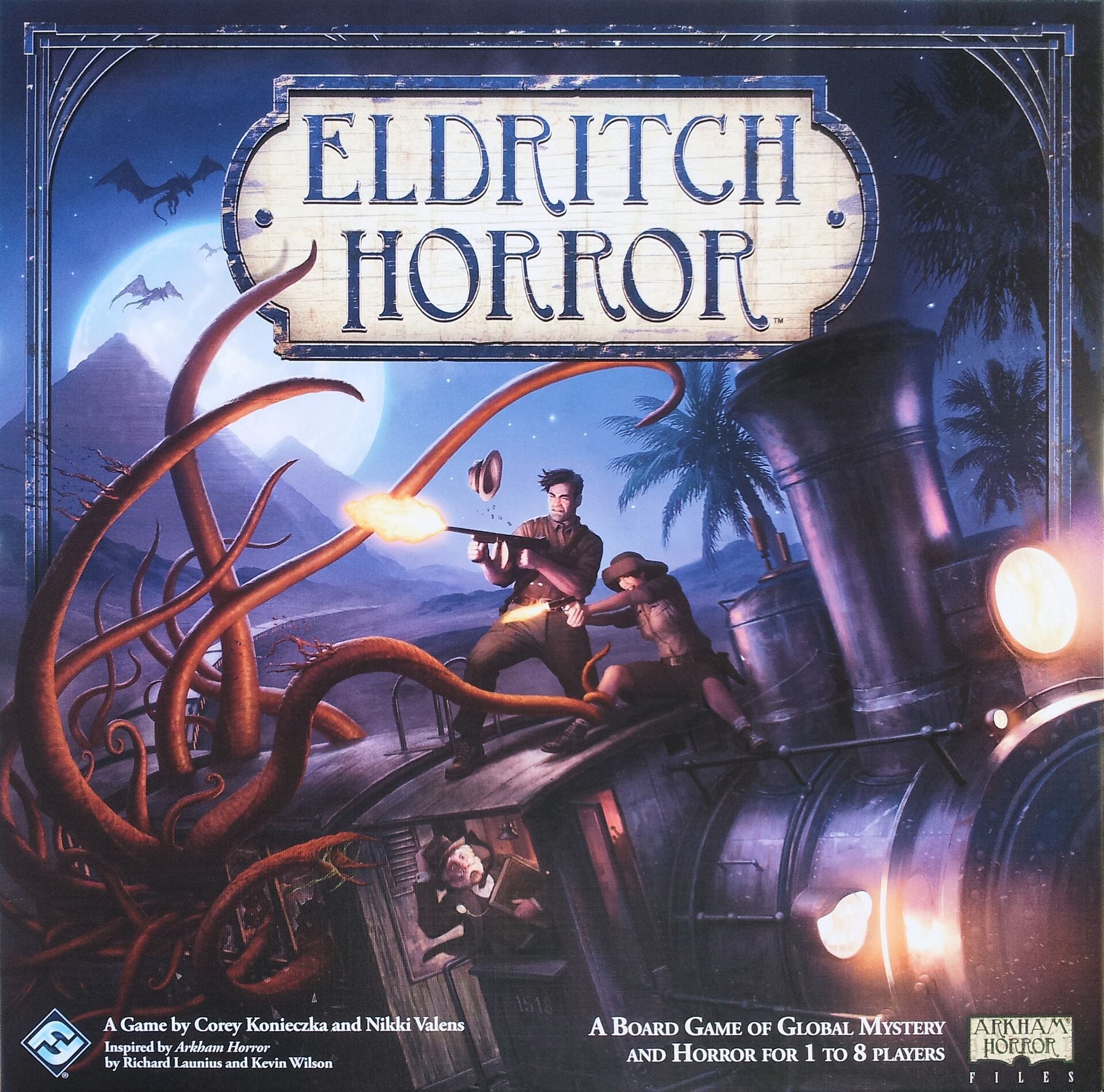
/pic3539898.jpg)
Qual é a sua dúvida sobre Eldritch Horror: As Terras Oníricas?
Pergunte antes de baixar o manual: o assistente foi treinado neste arquivo e responde na hora, citando a página exata.
Tire dúvidas sobre o jogo
Pergunte qualquer coisa sobre Eldritch Horror: As Terras Oníricas: regras, preparação, componentes, complexidade, preço ou se combina com seu grupo.
Escreva sua pergunta primeiro. Você criará sua conta grátis para ver a resposta — leva 20 segundos.
Manual completo
Navegue pelo manual ou baixe o PDF originalTexto completo do manual disponível para leitura Abrir texto
Old Friends
Stepping off the lightly rocking ship, Luke Robinson took a deep breath of the salt-filled air, relishing in the gentle breeze rolling off the Cerenarian Sea over the port city of Celephaïs. The shining city sprawled eastward, climbing the gingko-covered slopes of Mount Aran. The mountain, whose snow-capped peak loomed silently in the distance, conferred upon Luke a sense of safety, though he knew it to be false. Waiting for him at the end of the dock, a lavishly dressed man reached out to him with open arms.
“Luke! My friend, it has been too long. Come, let us drink and be reacquainted with one another!” A full-faced smile bloomed across his features, and his gold and turquoise jewelry jingled and glinted from the sunlight.
Luke shook his head. “Soon, Kuranes. You know I would love nothing more.” He grimaced. “But it is not for want of friendship that I come to Celephaïs today. Something terrible stirs in the north. I can feel it.” He nervously fiddled with the ornate gilded box he kept in one of his pockets, a gift given to him long ago by his uncle.
Kuranes’ features darkened. “In this you are not alone, my friend. I have felt it as well.” Kuranes turned, gazing into the distance. “The Lord of Kadath wakes.” Luke shook his head. “We do not know for certain—” Kuranes raised a hand to silence him. “No. You know it is true. He is planning something. All the realms of humanity stand upon a precipice.”
Luke shivered, despite the pleasant warmth of the noon sun, drawing his coat around him. “And the Dreamlands are no exception.” Luke nodded, turning his head northward. “That’s why I am here, old friend. I mean to stop him.” Turning back toward Kuranes, Luke put his hand on his friend’s shoulder. “Come,” he said. “There is much to discuss.”
Expansion Overview
In The Dreamlands expansion, investigators must investigate the strange visions bestowed upon them in their nightmares and work against the forces which seek to merge the land of dream with reality. This expansion includes two new Ancient Ones and new investigators, Monsters, and encounters to be used with Eldritch Horror. It also introduces entirely new mechanics including Unique Assets and Focus tokens.
Using This Expansion
When playing with The Dreamlands expansion, add all expansion components to their respective decks or pools of Eldritch Horror components except for the components described below.
Before setup, players draw one random Prelude card. These cards alter game setup and make each game feel unique.
The Dreamlands side board, Dreamlands Encounter cards, Dream-Quest Encounter cards, Dream Portal tokens, the Dream-Quest token, and the seven Clues and three Gates that correspond to spaces on the Dreamlands side board are used by the Hypnos Ancient One and the Otherworldly Dreams Prelude card included in this expansion. Otherwise, these components are returned to the game box. See pages 4 and 5 for rules regarding these components.
The Adventure cards included in this expansion are used by the Otherworldly Dreams Prelude card. Otherwise, they are returned to the game box. See page 4 for rules regarding Adventures.
Add all Focus tokens and the Adventure token to the general token pool. See pages 4 and 6 for rules regarding these components.
Shuffle all Unique Assets to create the Unique Asset deck. Place this deck faceup near the Asset deck.
Some components in this expansion require other newly introduced components. For this reason, all expansion content should be included when playing with this expansion.
Cards in this expansion are marked with the Dreamlands expansion icon to distinguish these cards from the cards in other Eldritch Horror products.
---
3
Components
24 Mythos Cards
6 Prelude Cards
4 Round Overview Cards
12 Mystery Cards (2 unique backs)
8 Adventure Cards
2 Ancient One Sheets
1 Dreamlands Side Board
8 Investigator Sheets with Matching Tokens and Plastic Stands
4 Artifact Cards
19 Condition Cards
12 Spell Cards
25 Unique Asset Cards
16 Asset Cards
6 Monster Tokens and 5 Epic Monster Tokens
7 Clue Tokens
12 Focus Tokens
4 Health and Sanity Tokens
3 Gate Tokens
1 Adventure Token
1 Dream-Quest Token
3 Dream Portal Tokens
Actions
Each action can be performed once per round.
Travel: Move 1 space and spend travel tickets to move additional spaces.
Prepare for Travel: Gain 1 travel ticket.
Acquire Assets: Test [skill] and gain Assets of equal or lesser value from reserve.
Rest: Recover 1 Health and 1 Sanity.
Focus: Gain 1 Focus.
Trade: Trade possessions with another investigator on your space.
Component Actions: Perform the action or local action of a component. Each component action counts separately.
Encounters
Resolve a Combat Encounter against each Monster on the space. Then, if there are no Monsters on the space, choose one:
Location Encounter: Resolve an encounter based on the space’s type or art.
Token Encounter: Resolve an encounter that corresponds to a token on the space.
12
2 1
042
3
1
1
—
1}
—
9
Cultists
Set up
Mythos Deck
Stage I:
Stage II:
Stage III:
Set aside the Leng Spider Monster. The Lead Investigator gains 1 Spell.
When this Monster is spawned, move it to the nearest space that does not contain a Gate or a Monster.
Atlach-Nacha
The Dreamweaver
• @: Spawn 1 Gate unless investigators as a group discard a total number of Clues and/or Spells equal to half ~.
• When 3 Mysteries have been solved, investigators win the game.
• When Atlach-Nacha awakens, flip this sheet and resolve the “Atlach Nacha Awakens!” effect on the back.
Ever weaving, ever watching, should Atlach-Nacha ever complete her empyrean masterpiece, it would merge the firmaments of the Dreamlands and reality into a single cosmic ingress, opening the way for the horrors of the Underworld to wage war upon the cities of humanity.
4 Europe
16 Dreamlands
4 General
4 Americas
24 Special (3 unique backs)
48 Research (2 unique backs)
20 Dream-Quest (4 unique backs)
4 Asia/Australia
6 Other World
Encounter Cards
Condition
Talent
You may reroll 1 die when resolving a [skill] test.
Once per round, when you would lose 2 or more Sanity, prevent 1 of that Sanity loss. Then flip this card.
Moxie
Unique Asset
Item
Action: Move 1 Monster on your space to an adjacent space.
If a Gate would spawn on your space, discard that Gate instead.
Flux Stabilizer
Spell
Glamour
Play with the top Gate of the Gate stack revealed.
@: Test [skill] and flip this card.
Find Gate
3 24 2 2
7
5
Lore Observation Influence Strength Will
• Action: If you are on a space containing a Gate, discard 1 Monster on your space with toughness less than your [skill].
• If a Gate would spawn on your space, discard that Gate and gain 1 Clue instead.
“Professor Young taught me that everything is simpler than it seems. The connection is there if you look for it.”
The Scientist
Kate Winthrop Carrier nightgaunt atlach-nacha
---
4
Prelude Cards
When playing with this expansion, players draw one random
Prelude card before setting up the game. These cards alter game
setup and make each game feel unique.
The card’s effect is resolved immediately after drawing the card
unless it specifies different timing, such as “after resolving setup.”
The Otherworldly Dreams Prelude card instructs players to
setup the Dreamlands side board. The rules for setting up and
using this side board are described on the right.
Adventures
Adventure cards represent various stories that investigators can take part in for additional rewards, such as gaining
Talent Conditions or advancing the active Mystery.
The Otherworldly Dreams Adventures are used only if the
Otherworldly
Dreams Prelude card is drawn at the beginning of
the game. Set aside all Adventure cards to be used as instructed by the Prelude. The Otherworldly Dreams Adventures are
split into four stages, shown as a trait (I, II, III, IV) on the cards’ fronts which will be called out during the game.
After resolving setup, the Otherworldly Dreams Prelude
instructs investigators to draw the Adventure for the first
stage of the story, A Chance Encounter. When an Adventure
is drawn, the active investigator places it faceup in play and
resolves that card’s “when this card enters play” effect.
Each Adventure has an effect that allows investigators to
complete the Adventure. When an Adventure is completed, the
active investigator resolves that card’s “when this Adventure is
completed” effect, which includes drawing another Adventure
representing the next chapter of the story. Then the active
investigator discards the Adventure, any tokens on it, and
any tokens placed by its effects. Each Adventure will instruct
investigators to draw an Adventure for the next stage of the
story until reaching the fourth and final stage.
Dreamlands Side Board
The Dreamlands side board featured in this expansion creates bridges between the waking world and the land of dreams and allows the investigators to visit fantastical cities and other mysterious locations.
This side board is used only if Hypnos is the Ancient One or
when using the Otherworldly Dreams Prelude card.
While the side board is in play, “game board” refers to both
the main board included in Eldritch Horror and the side board.
“Side board” refers to the side board but not the main board.
Side Board Setup
Follow the steps below to set up the Dreamlands side board.
1. Place Side Board
Unfold the side board and place it near the main board within reach of all players.
2. Add Clues and Gates
Add the seven Clues and three Gates that correspond to spaces on the side board to the Clue pool and Gate stack, respectively, and randomize the Clue pool and Gate stack.
3. Set Aside Monsters
Set aside the following Monsters from the Monster cup: 1 Ghoul Monster, 1 Moon-beast Monster, 1 Nightgaunt Monster, and 1 Zoog Monster.
If one of these components would be returned to the Monster
cup, it is set aside instead.
4. Separate and Place Decks
Separate all Dreamlands Encounters and Dream-Quest Encounters into decks and shuffle both decks. Place these decks near the side board. Then place the Dream-Quest token on the space that corresponds to the top card of the Dream- Quest Encounter deck.
5. Spawn Dream Portals
Reveal Gates from the top of the Gate stack until three Gates are revealed that each correspond to a space that is not on the Dreamlands side board. Place the three Dream Portal tokens on those spaces. Leave each revealed Gate in the Gate stack and do not randomize the Gate stack after spawning a Dream Portal.
---
Side Board Rules
The following rules relate to the Dreamlands side board.
Moving to the Side Board
When an investigator that is not on the Dreamlands side board performs the Rest action, he may spend 1 Clue or test {–1. If he passes or spends the Clue, he moves to The Enchanted Wood.
In addition, Dream Portals allow investigators to travel between the Dreamlands side board and the main board. See “Dream Portals” below.
Dream Portals
Dream Portals represent locations where the Dreamlands bleed into the waking world. Each space containing a Dream Portal is connected by a Local path to the space that corresponds to that token. See “Local Paths” on the right.
Some effects cause Dream Portals to spawn. To spawn a Dream Portal, reveal Gates from the top of the Gate stack until a Gate is revealed that corresponds to a space that is not on the Dreamlands side board and does not contain a Dream Portal.
Place the Dream Portal on that space. A revealed Gate remains revealed in the Gate stack; do not randomize the Gate stack after spawning a Dream Portal.
If a Gate would spawn on a space containing a Dream Portal, spawn that Gate on the space that corresponds to that Dream Portal instead.
Dream-Quest Spaces
The Enchanted Wood, The Moon, The Underworld, and Unknown Kadath are Dream-Quest spaces and can be identified by their circular art inside a rectangular frame. As an encounter, an investigator on a Dream-Quest space can resolve a Dream-Quest Encounter as described on the right.
Location Encounters
Investigators on the Dreamlands side board have access to thematic encounters related to those locations. Each City space on the side board has a brief description below its name that explains the most common effect that appears on encounter cards for that space.
During the Encounter Phase, an investigator on Celephaïs, Dylath-Leen, or Ulthar may encounter that space by drawing a Dreamlands Encounter and resolving the effect that corresponds to his space.
Research Encounters
When an investigator encounters a Clue on the Dreamlands side board, he draws a Research Encounter for the chosen Ancient One and resolves the effect that corresponds to his space’s type as normal.
Dream-Quest Encounters
The Dream-Quest Encounter cards in this expansion allow investigators to embark on a journey through exotic locations in the Dreamlands and reap a myriad of rewards to aid them during their quest.
Dream-Quest Encounters are complex encounters that may require an investigator to resolve multiple tests.
Each Dream-Quest Encounter’s back indicates the space it corresponds to.
The Dream-Quest token is placed on the space corresponding to the top card of the Dream-Quest Encounter deck. This space is referred to as the “active Dream-Quest space.” If the top card of the Dream-Quest Encounter deck changes for any reason, move the Dream-Quest token to the appropriate space.
During the Encounter Phase, an investigator on the space containing the Dream-Quest token may encounter it by drawing and resolving the top card of the Dream-Quest Encounter deck.
Local Paths
Each space containing a Dream Portal is connected by a Local path to the space that corresponds to that token. Spaces connected by Local paths are so close to each other that moving between them does not require an action.
During the Action Phase, an investigator may move along any number of interconnected Local paths.
• Each investigator may perform this movement only once per round.
• This movement does not require an action but cannot be performed by a Delayed investigator.
---
Additional Rules
This section lists additional rules regarding Combat Encounters and Mysteries.
Combat Encounters
During the Encounter Phase, an investigator must encounter each non-Epic Monster on his space before encountering each Epic Monster on his space.
Focus Action
This expansion includes the Focus action, a new action first introduced in the Mountains of Madness expansion, that can be performed by any investigator. As an action, an investigator on any space gains one Focus token.
An investigator may spend one Focus token to reroll one die when resolving a test. There is no limit to the number of Focus tokens he can spend to reroll dice.
An investigator cannot have more than two Focus tokens.
Gates
Some effects in this expansion cause Gates in the Gate stack to be revealed. Revealed Gates remain where they are in the Gate stack unless the effect that causes the Gates to be revealed states otherwise.
If an effect would cause a number of Gates to be revealed that exceeds the number of Gates in the Gate stack, the active investigator randomizes the Gates in the discard pile and places them at the bottom of the Gate stack before resolving that effect.
After a Gate in the Gate stack has been revealed, it remains revealed until it is removed from the Gate stack or the Gate stack is randomized.
Mysteries
This expansion includes a new mechanic first introduced in the Mountains of Madness expansion: “advance the active Mystery.” Due to the complexity of Mysteries, this can result in a number of different effects. When investigators are instructed to advance the active Mystery, the active investigator resolves one of the following effects that applies:
If the active Mystery requires one or more tokens to be placed on the card, place one token of that type on the card.
• Clues, Gates, and Monsters placed on the active Mystery in this way are drawn from the Clue pool, Gate stack, and Monster cup, respectively.
If the active Mystery requires an Epic Monster to be defeated, place two Health on the card. The Epic Monster’s toughness is reduced by one for each Health on the active Mystery.
If the active Mystery requires an investigator to spend one or more Clues, place one Clue from the Clue pool on the card. Any investigator may spend Clues placed on the active Mystery when resolving an effect of that card.
Skill Values
Some effects in this expansion reference an investigator’s skills as a value. A skill’s value is equal to its printed value as modified by Improvement tokens and Impairment tokens.
A skill’s value is not affected by bonuses from possessions or other effects, since those effects are applied only when resolving a test.
For example, Kate Winthrop has a printed | of 4 and a single “+1 |” Improvement token. As such, her | value is 5 (4 from its printed value plus 1 from her Improvement token). The bonus to | that Kate would gain from the Private Investigator Asset does not affect the skill’s value.
Unique Assets
Some encounters in this expansion reward investigators with various Unique Assets. Like Spells or Conditions, Unique Assets are double-sided cards. An investigator cannot look at the back of a Unique Asset unless an effect allows him to.
Unique Assets are possessions and may be traded using the Trade action. There is no limit to the number of Unique Assets an investigator can have.
“Asset” refers to both Assets and Unique Assets. “Non-Unique Asset” refers to Assets but not Unique Assets.
When a Unique Asset is discarded, also discard all tokens on it.
---
7
Q. Can Amanda Sharpe’s action ability improve the same skill
multiple times?
A. Yes. If Amanda’s action ability is used to discard multiple
Talent Conditions, she may improve the same skill more than
once. However, she cannot improve a skill to more than two
above its printed value.
Q. What happens if Kate Winthrop is on a space containing a
Dream Portal and a Gate would spawn on that space?
A. Both the Dream Portal effect and Kate Winthrop’s
passive ability will attempt to replace the Gate spawn.
The active investigator decides which effect takes priority.
As such, he could have Kate’s passive ability cause the
Gate to be discarded instead of spawning.
Q. What counts as “encountering a Gate” when using Luke
Robinson’s passive ability?
A. Luke can resolve his passive ability to ignore Monsters
on his space when choosing an encounter. However, he must
choose to encounter a Gate.
The most common way to encounter a Gate is to draw and
resolve an Other World Encounter card. However, resolving
any encounter that requires Luke to occupy a space containing
a Gate is encountering a Gate. For example, the Caught in the
Web Mystery grants a different option for encountering a Gate.
Q. What is Luke Robinson’s starting space if there are multiple
Gates on the game board or if there are no Gates on the game board?
A. Luke’s Investigator token is not placed during step 3 of
setup as usual. After resolving setup, Luke chooses a space
that contains a Gate and places his Investigator token on that
space. If there are no Gates on the game board, he places his
Investigator token on a space of his choice instead.
Q. What happens to Gates in the Gate stack after they are revealed?
A. Revealed Gates remain where they are in the Gate stack
unless the effect that causes the Gates to be revealed states
otherwise. The Gate stack is not randomized nor are the Gates
discarded or otherwise moved in the Gate stack.
After a Gate in the Gate stack has been revealed, it remains
revealed until it is removed from the Gate stack or the Gate
stack is randomized.
Optional Rules
Some players may wish to adjust the game’s difficulty. This section lists optional rules for adjusting the game’s difficulty and setup instructions of Prelude cards.
Adjusting Game Difficulty
If all players agree at the start of the game, they can use the optional rules listed below to alter the difficulty of the game.
Staged Difficulty
Players can make the game’s difficulty increase in stages by building stage I of the Mythos deck using only easy Mythos cards, building stage II of the Mythos deck using only normal Mythos cards, and building stage III of the Mythos deck using only hard Mythos cards.
To increase the difficulty of this optional rule, players can use
normal blue Mythos cards when building stage I of the Mythos
deck and hard blue Mythos cards when building stage II of the
Mythos deck. Players may also start with an easy blue Mythos
card in play following the “Starting Rumor” rule in the Eldritch
Horror Reference Guide.
Insane Difficulty
If players wish to have a more challenging game experience than Hard game difficulty from the base game, they can make the game significantly more difficult by building the Mythos deck using only hard Mythos cards.
Note—This optional rule may require additional expansions
depending on the chosen Ancient One.
Control Your Fate
Instead of drawing a random Prelude card before setup, players as a group may choose one Prelude card, following the card’s effects as normal.
Alternatively, players may choose to not use a Prelude card.
Frequently Asked Questions
---
8
Credits
Expansion Design: Nikki Valens
Eldritch Horror Design: Corey Konieczka and Nikki Valens
Additional Development: Dane Beltrami
Additional Writing: Tim Uren
Proofreading: Christopher Meyer
Graphic Design: Monica Helland
Managing Graphic Designer: Brian Schomburg
Cover Art: Jacob Murray
Interior Art: Frej Agelii, Cristian Balanescu, Tony Foti,
David Griffith, Adam Lane, Mark Molnar, Reiko Murakami,
Jacob Murray, Christopher A. Peuler, Stephen Somers,
and the artists of Call of Cthulhu LCG and
Arkham Horror Files products
Art Direction: Zoë Robinson
Managing Art Director: Andy Christensen
Creative Director: Andrew Navaro
Production Management: Megan Duehn and
Jason Beaudoin
Quality Assurance Coordinator: Zach Tewalthomas
Executive Producer: Michael Hurley
Publisher: Christian T. Petersen
Playtesting: Carolina Blanken, Marieke Franssen,
Anita Hilberdink, Matthew Landis, Mark Larson,
Emile de Maat, Alex Ortloff, Emiel Speets, Léon Tichelaar,
Marjan Tichelaar-Haug
Special thanks to all of our beta testers!
Black Galley to the Moon
In all the years Luke had traveled through the idyllic landscapes of
dreams, he had never before dared to board one of the black galleys.
Now he hid, quiet and patient among the rubies that the Men from
Leng used these great ships to transport. “The sea seems calm,” he
whispered to his companion, a large orange cat.
“When you walk the Land of Dreams, keep an eye on all that
seems,” purred the cat. Long ago Luke had learned the language of
cats and it served him well ever since. “Take our hosts for example.”
“The Men from Leng?” Luke responded. “Perhaps they are not from
Leng?” Perhaps they are not men, he thought. It was impossible
to determine their true shape under their dark robes. Luke looked
closely at the rubies that surrounded them. The stones were red
like a mortal wound, and touching one conveyed a sense of
aching desolation.
“Come on,” he gestured for the cat to follow him, “let’s sneak up and
see where we are.”
As the two quietly pushed through the door to the deck, Luke was
stunned by what he discovered. The ship no longer traveled in the
sea, but rather sailed through the night sky. Ahead of them lay their
destination, the Moon. It was larger than Luke could have ever
imagined seeing it. Lakes and forests were visible on the surface
below as the ship began to turn and make way for the side of the
moon that lingers in perpetual darkness.
Luke was so amazed, he failed to notice the cat slip quietly away.
“So,” came a booming voice from behind him. “It seems we
have a stowaway.”
© 2016 Fantasy Flight Games. Fantasy Flight Supply is a trademark of
Fantasy Flight Games. Fantasy Flight Games, Arkham Horror, Eldritch Horror and
the FFG logo are registered trademarks of Fantasy Flight Publishing, Inc. Fantasy Flight
Games is located at 1995 West County Road B2, Roseville, Minnesota, 55113, USA,
651-639-1905. Actual components may vary from those shown. Made in China.
THIS PRODUCT IS NOT A TOY. NOT INTENDED FOR USE BY PERSONS
13 YEARS OF AGE OR YOUNGER.
www.FantasyFlightGames.com
---
Por que perguntar ao BoardGamesBot
Em vez de folhear o manual inteiro- Respostas precisas Baseadas exatamente neste manual, com a página de origem.
- Economize tempo Ache a regra em segundos, sem folhear 8 páginas.
- A qualquer hora Tire dúvidas no meio da partida, direto do celular.
- 100% grátis Crie sua conta grátis e comece a usar agora.
Como funciona
Três passos até a resposta- 1 Faça sua pergunta Digite sua dúvida sobre as regras deste jogo.
- 2 Crie sua conta grátis Leva 20 segundos — é só para guardar seu histórico.
- 3 Receba a resposta A IA encontra a regra exata e cita a página do manual.
Expansão de
Conteúdo adicional publicado
Manual publicado pela editora · uso para consulta de regras. Mais sobre o jogo em BoardGameGeek e Ludopedia .
