
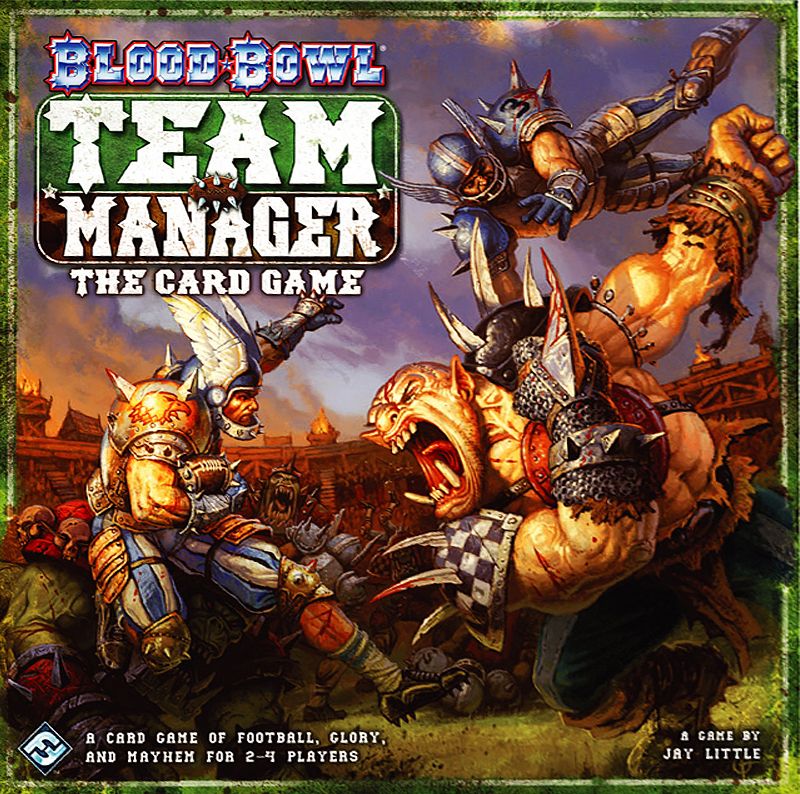
How to Play Blood Bowl: Team Manager – The Card Game
Fantasy Flight Games, Edge Entertainment, Galakta · Board game · 2011What do you want to do now
Ask anything about Blood Bowl: Team Manager – The Card Game: rules, setup, components, complexity, price, or whether it fits your group.
Video: How to Play
Start here, then follow the written guide
Step by step
Objective of the Game
Welcome, aspiring Blood Bowl Team Managers! Forget about just winning a single game; in Blood Bowl: Team Manager - The Card Game, you're in it for the long haul – a whole glorious season of brutal, bone-crunching, and financially savvy management! Your ultimate goal? To be crowned the Blood Bowl: Team Manager Season Champion by navigating your team through a series of Regular Season Games, challenging Tournament Games, and ultimately, the grand Blood Bowl Tournament Games. You'll draft players, purchase valuable Team Improvements, manage injuries, and even level up your players to create custom Star Players. It's not just about who scores the most touchdowns, but who builds the most formidable and well-managed team over an entire season!
Preparation (Setup)
Alright, coaches, let's get your league started! Here's how to set up for a season of Blood Bowl: Team Manager:
- Assign a League Commissioner: First things first, one manager needs to step up as the League Commissioner. This person will decide which and how many Tournament Games will be held throughout the season, and how often they'll be played.
- Initial Treasury: Each manager starts with a cool $1,000 in their treasury. Spend it wisely!
- Team Draft: This is where the magic begins!
- Managers will choose a team (e.g., Wood Elves, Dwarves, Humans, Orcs, Skaven, Chaos, Vampires, Dark Elves, Undead, Nurgle, Goblins, Chaos Dwarves).
- You must start with exactly 12 players in your starting deck. You can buy players from the Team Rosters section, respecting the quantity limits for each character type.
- Your total roster (including your starting deck and any benched players) can have no more than 16 players.
- Important: You must buy at least 12 players before buying any Team Improvements.
- Suggestion: For easier setup, consider using the starting deck of each team as managers' starting decks instead of buying individual players. The "Initial Total" in the Team Rosters section gives the cost for this.
- Purchase Team Improvements: After drafting your 12 players, you can use your remaining cash to buy Team Improvements. These are permanent for the season!
- Team Wizard ($30): Max 1 per team.
- Team Dok ($50): Max 2 per team.
- Team Reroll ($110): Max 4 per team.
- Note: All Team Improvements should be proxied from the start of the season.
- Team Roster Sheet: Each manager receives a Team Roster Sheet to keep track of their individual team's progress, including player levels, skills, and current treasury.
- Proxy Cards: You'll likely need to proxy cards for creating players, modifying team decks, Team Improvements, some Inducements, or if your roster exceeds 12 players. Card sleeves are recommended!
The Game Turn
A season of Blood Bowl: Team Manager is a series of games, each with its own rhythm. Here's a breakdown of how games unfold within the season:
Pre-Match Sequence
Before any game (Regular Season Games, Tournament Games, or Blood Bowl Tournament Games), prepare for battle!
- Calculate Team Value: This is crucial! Add up:
- All players' values (from Team Rosters) + $30 per level per player.
- Cost of any purchased Team Improvements.
- Cost of any Star Players.
- Total cash on hand.
- $60 per Team Upgrade and $30 per Staff Upgrade carried over.
- Inducements: The team with the lower Team Value (or managers with a lower value compared to the highest in a 3+ player game) gains temporary cash equal to the difference. This cash can be spent on one-game-only Inducements like a Wizard ($10) or a Dok ($20), or on items that can potentially be carried over in the Post Match Sequence, such as Staff Upgrades ($30), Star Players ($70), or Team Upgrades ($90).
- Kickoff Roll: Roll 2 dice to determine a special Kickoff Result for the game. This can grant extra rerolls, cards, or even cause immediate injuries!
Game Play (Standard Blood Bowl: Team Manager Rules Apply)
The core gameplay follows the standard Blood Bowl: Team Manager rules, but with some seasonal twists:
- Game Types:
- Regular Season Games: 1 vs. 1 games, 5 rounds. Rounds 1, 3, and 5 use 5 highlights (keeping the first 3 committed). Rounds 2 and 4 use 4 highlights (keeping the first 2) and one Headline Card. Exclude all Tournament cards.
- Tournament Games: Include all managers in the league (split into divisions if more than 6 players). 5 rounds. Rounds 1 and 3 use one additional highlight. Rounds 2 and 4 use the normal amount of highlights and one Headline Card. Only one Tournament card is included per game, played in the last round.
- The Blood Bowl Tournament Games: The grand finale! This is a bracket tournament. Seeding is determined by win/loss records from Regular Season Games (Tournament Games don't count).
- Player Injuries & Substitutions:
- If a player is injured or dies, you can immediately replace them with a benched player from your roster by placing the benched player into your discard pile.
- If your roster drops below 12 players, you can still play as long as you have at least 10 players in your deck at the start of the game.
- If your deck drops below 6 players during a game, you are forced to forfeit.
- Forfeiting: You can forfeit at any time if things are going badly. The payout depends on when you forfeit (see Fim de Jogo e Pontuação).
Post Match Sequence
After the final whistle, it's time to tally up and improve your team!
- Collect Earnings (A.K.A. Get Paid!):
- Multiply your fan total by 2 to calculate your earnings for the game. Add this cash to your treasury.
- Forfeiting Payouts:
- If you forfeit before the game starts or end of Round 1: You get $50, opponent gets $150.
- If you forfeit after Round 1 but before game end: You get $50 + (fan total x 2). Opponent gets $100 + (fan total x 2). The winning manager continues to Roster Improvements and Player Improvements, the forfeiting manager does not.
- In Tournament Games, a forfeiting manager gets $50. Other managers play with fewer highlights.
- Roster Improvements: This is where you decide what to keep for future games.
- Managers gather all Team Upgrades, Star Players, and Staff Upgrades acquired during the game into individual pools.
- You can keep up to 1 Team Upgrade, 1 Star Player (of your team's race), and 1 Staff Upgrade to carry over.
- To keep a Star Player, you must pay its cost from your treasury. Only Star Players acquired during gameplay can be bought here.
- You can carry over a maximum of 2 Team Upgrades and 6 Staff Upgrades total across matches. There's no limit on Star Players kept.
- If buying a Star Player puts you over the 16-player roster limit, you must immediately cut a player.
- Player Improvements: Time to level up your team!
- Any remaining Team Upgrades, Star Players, and Staff Upgrades from the pools are converted into MVP points:
- Each Team Upgrade = 3 points
- Each Star Player = 2 points
- Each Staff Upgrade = 1 point
- Add up your total points and divide by 3, rounded down, to get your number of MVPs.
- Assign MVPs to your players to level them up:
- Level 1 = 1 MVP
- Level 2 = 2 Additional MVPs
- Level 3 = 3 Additional MVPs (and so on, up to Level 6 = 6 Additional MVPs)
- Note: Star Players are not eligible for MVPs (they are already Level 6).
- Unused MVPs carry over to the next game.
- Important: All players on your roster must be within 2 levels of each other. If a new player is added and this rule is violated, that new player must receive all gained MVPs until they are within the 2-level spread.
- When a player levels up, they gain a skill, icon, or +1 Star. Roll 2 dice to determine the options. You'll track these on your Team Roster Sheet and use proxy cards for leveled-up players.
- Any remaining Team Upgrades, Star Players, and Staff Upgrades from the pools are converted into MVP points:
End of Game and Scoring
A game concludes after the specified number of rounds (usually 5). The winner of a Tournament Game is decided by the most fans at the end of the game, granting special bonuses.
The season itself culminates in the Blood Bowl Tournament Games, a bracket tournament where the manager who wins the final match is crowned the Blood Bowl: Team Manager Season Champion!
Tips for Winning
- Financial Management is Key: Don't just focus on winning games; effectively manage your treasury! The Collect Earnings phase is vital for purchasing Star Players and Team Improvements. Remember, Team Value impacts Inducements, so keeping an eye on your team's overall worth can give you an edge.
- Strategic Player Development: The Player Improvements phase is where you build your long-term strength. Carefully consider which players to level up and what skills/icons to give them. Don't forget the 2-level spread rule for player levels – it encourages a balanced team rather than just one or two superstar players. Also, keep an eye on the "Normal" and "Other" skill categories for your chosen race to maximize their potential.
- Adapt to the Kickoff Roll and Inducements: Each game starts with a unique Kickoff Roll and potential Inducements. These can significantly alter your strategy for that specific match. Be flexible! If you get a "Perfect Defense," use it to disrupt your opponent's hand. If "Weather" strikes, adjust your use of Sprint, Pass, or Tackle icons accordingly. Leveraging these pre-game advantages can set you up for success.
More videos
More rules explanations from the community
In English
-
 Critical Plays - Blood Bowl Team Manager
-
 Setup, How To Play, Sample Round of Blood Bowl: Team Manager
-
 ARWH Episode 2 Blood Bowl TM with Twisted Pretzel
-
 Blood Bowl Team Manager: How to Win at Losing
-
 Blood Bowl: Team Manager Tutorial 1/6
-
 Blood Bowl: Team Manager Tutorial 2/6
-
 Blood Bowl: Team Manager Tutorial 5/6
-
 Blood Bowl: Team Manager Tutorial 3/6
-
 Blood Bowl: Team Manager Tutorial 6/6
-
 Blood Bowl: Team Manager Tutorial 4/6
Rules manual
Official PDF file
Frequently Asked Questions
Quick answers about the rules
