
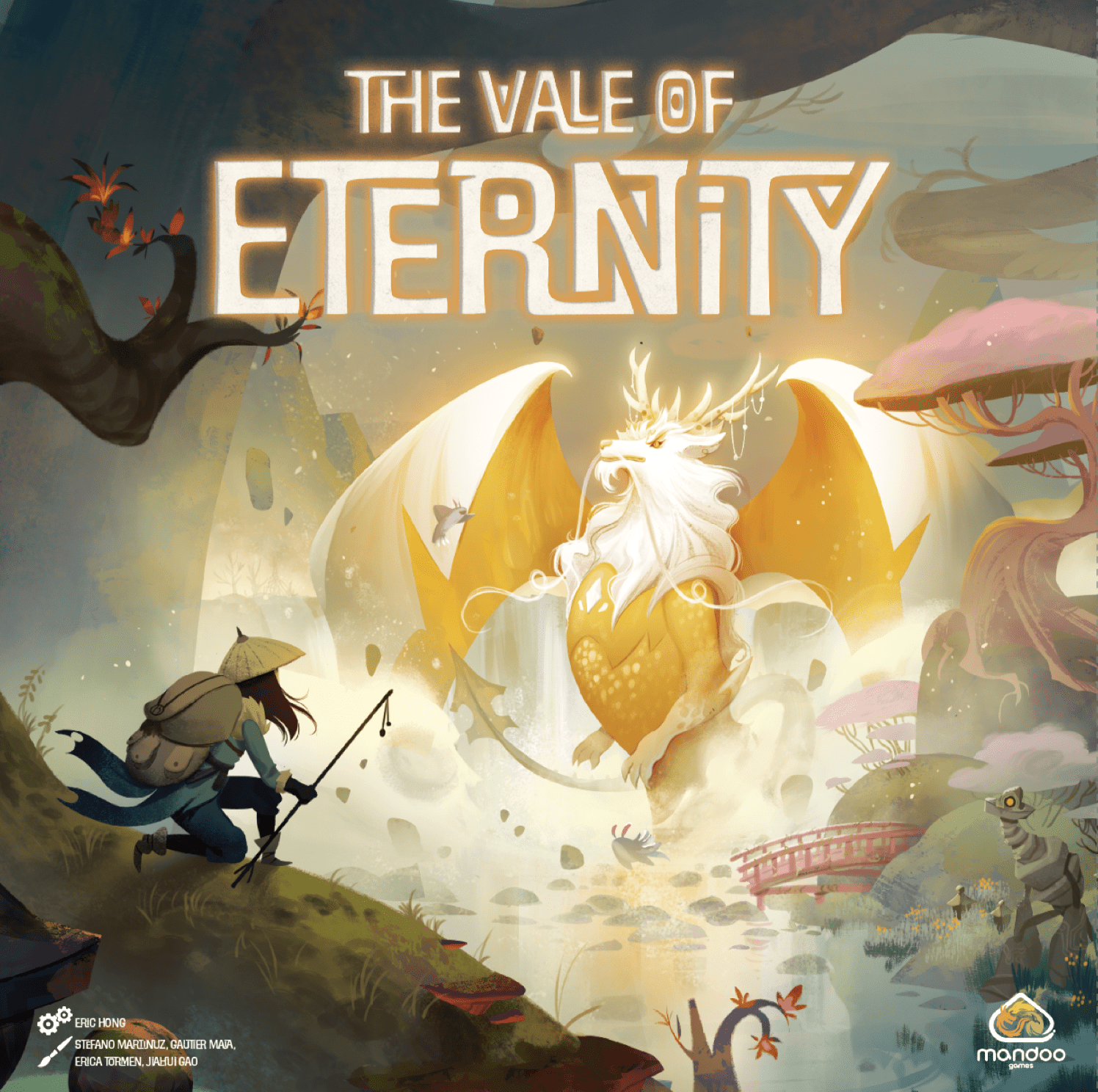
The Vale of Eternity — How to Play
Mandoo Games, Across the Board, Blackrock Games · Board game · 2023What do you want to do now
Ask anything about The Vale of Eternity: rules, setup, components, complexity, price, or whether it fits your group.
Video: How to Play
Start here, then follow the written guide
Step by step
Objective of the Game
Welcome, fellow creature tamers, to The Vale of Eternity! Prepare to dive into a fantastical world brimming with monsters, spirits, and even gods. Your ultimate quest? To hunt, tame, and master a diverse menagerie of creatures, with a special focus on capturing those noble and powerful dragons. Each game is a unique journey thanks to 70 different creatures drawn from global myths. The tamer who assembles the most outstanding collection of creatures will emerge victorious!
Preparation (Setup)
Getting ready to embark on your taming adventure is quick and easy:
- Choose Your Color: Each player picks a color and takes 2 player markers and 1 player tile of that color.
- First Player: The player who has most recently seen a reptile becomes the first player and receives the first player marker.
- Board Placement: Place the game board and the score board in the middle of the table. Feel free to use the beautiful Eternity standee on the game board for extra flair!
- Card Pile: Shuffle all 70 cards to form a draw pile. Leave some space next to it for the discard pile.
- Round Tracker: Put the round marker on the first space of the round track.
- Initial Scoring: Starting with the first player and going clockwise, each player gets points equal to their rank in turn order (e.g., first player gets 1 point, second gets 2, etc.). Place each player's score marker on the scoring track to record these initial points.
- Magic Stone Supply: Place all the magic stones (16 Red, 14 Blue, 12 Purple) next to the score board to form the general supply. Remember, Red Stones are worth 1, Blue Stones are worth 3, and Purple Stones are worth 6.
The Turn of Play
A game of The Vale of Eternity unfolds over several rounds, typically 8 to 10. Each round is divided into three exciting phases:
1. Hunting Phase
This is where you'll draft new creatures for your collection!
- Reveal Cards: Reveal a number of cards equal to twice the number of players from the draw pile. Sort these cards by their families (Fire, Water, Earth, Wind, Dragon) and place them in the matching zones around the game board. (If the draw pile runs out, shuffle the discarded cards to create a new one.)
- First Pick: Starting with the first player and going clockwise, each player chooses one revealed card and places one of their player markers on it. Once a card has a marker, it can't be chosen again.
- Second Pick: Then, starting with the last player and going counterclockwise, each player chooses a second card and places their remaining player marker on it. This means the last player gets to choose two cards consecutively! The Hunting Phase ends once the first player has placed their marker on the very last card.
2. Action Phase
Now it's time to put your drafted creatures to work!
Starting with the first player and going clockwise, players take turns. On your turn, you can perform as many actions as you desire, and you can even perform the same action multiple times or in any order you choose. There are four actions available:
- Sell a Card:
- Retrieve one of your player markers from a card you placed it on during the Hunting Phase.
- Discard the matching card.
- Receive magic stones based on the card's family (the game board shows how many stones you get for each family).
- Important: You cannot have more than 4 magic stones at any time. If selling a card would put you over this limit, you must keep 4 and discard the rest before taking any other actions.
- Tame a Card:
- Retrieve one of your player markers from a card you placed it on during the Hunting Phase.
- Take the matching card into your hand. Your hand is secret from opponents, and there's no hand limit!
- Summon a Card:
- First, check your areas. The number of areas you have is equal to the current round number. You cannot have more summoned cards in your area than your current number of areas. If your areas are full, you cannot summon a card.
- Pay the summoning cost of the card using your magic stones. You don't get change if you pay more than the required cost.
- Place the card face-up in front of you in your area.
- Resolve any Instant effects the summoned card might have. (A card cannot be summoned if any part of its Instant effect cannot be resolved.)
- Remove a Card:
- Discard one of your own already summoned cards from your area.
- The cost to remove a card is equal to the current round number. Pay this cost in magic stones.
Once you have no more actions you wish to take, you finish your turn. The next player (clockwise) then takes their turn. The Action Phase ends once all players have finished their turns. (Note: You can't end a turn while your player marker is still on a card; it must be retrieved by selling or taming that card.)
3. Resolution Phase
This is where your summoned creatures show their true power!
Starting with the first player and going clockwise, players take turns. On your turn, you must use every available Active effect of the cards in your areas once. If you have multiple Active effects, you can choose the order in which you use them. If you have no Active effects remaining, or if you've already activated all of them, you finish your turn. The Resolution Phase ends once all players have finished their turns.
End of the Round
After the Resolution Phase, the round ends. Check the end game condition (explained below). If the game hasn't ended, move the round marker to the next space on the round track. The player to the left of the current first player becomes the new first player and receives the first player marker.
End of Game and Scoring
The game ends immediately at the end of a round if one of two conditions is met:
- Any player has a score of 60 or more points. (If your score marker exceeds 60, flip your player tile to indicate this.)
- The 10th round ends.
Once the game ends, the player with the most points wins!
- Tie-breaker: In case of a tie, the player among them with the most summoned cards wins.
- Further Tie: If there's still a tie, those players share the victory.
Tips for Victory
To help you on your path to becoming the ultimate tamer, here are a few pointers:
- Manage Your Areas Wisely: Remember that the number of cards you can have in your area is limited by the current round number. Don't be afraid to Remove a Card if it's no longer serving you, especially if it frees up space for a more powerful creature!
- Strategic Drafting: In the Hunting Phase, think not just about the cards you want, but also about the cards your opponents might need. Denying a key card can be just as powerful as gaining one yourself, especially with the unique last-player-chooses-two mechanic.
- Magic Stone Economy: Keep a close eye on your magic stones. You can't have more than 4, so plan your Selling and Summoning actions to maximize your income and spending without wasting valuable resources. Sometimes, selling a card for a quick infusion of stones is better than holding onto it.
More videos
More rules explanations from the community
In English
-
 Trailer - Vale of Eternity - EN
-
 All the Games with Steph: The Vale of Eternity
-
 How to Play The Vale of Eternity
-
 The Vale of Eternity Teach & Play
-
 How to play The Vale of Eternity
-
 The Vale of Eternity - A strategize tableau building, so many things to love
-
 How to Play The Vale of Eternity and Strategy Tips!
-
 Unofficial solo variant for The Vale of Eternity | One Stop Co-Op Shop
Rules manual
Official PDF file
