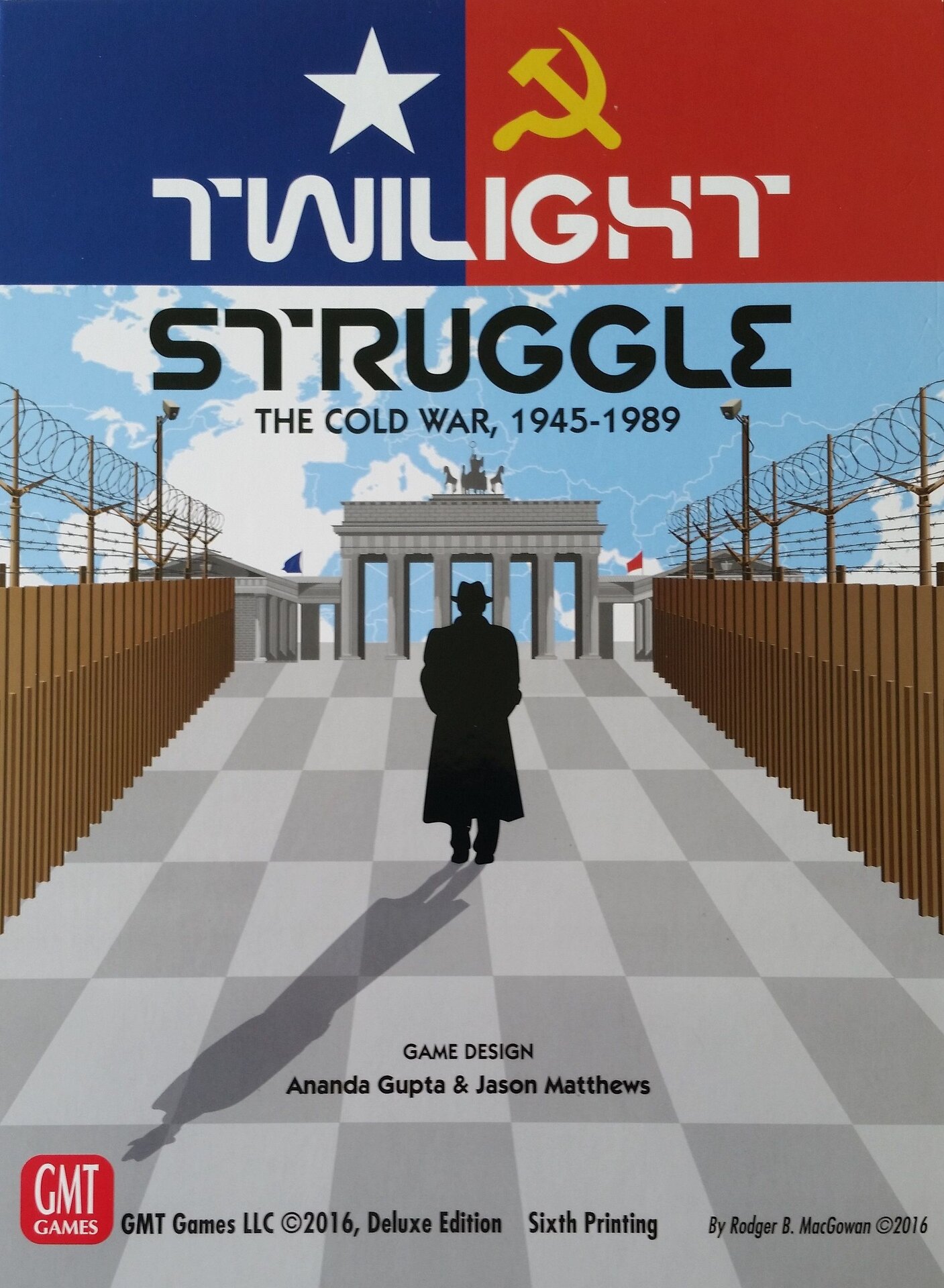
How to Play Twilight Struggle
GMT Games, Asterion Press, Bard Centrum Gier · Board game · 2005What do you want to do now
Ask anything about Twilight Struggle: rules, setup, components, complexity, price, or whether it fits your group.
Video: How to Play
Start here, then follow the written guide
Step by step
How to Play Twilight Struggle: The Ultimate Guide
Welcome, Comrade, to the most intense geopolitical showdown of the 20th century! Twilight Struggle isn't just a board game; it's a head-to-head battle for the soul of the world, played out on a global stage from 1945 to 1989. One player commands the mighty Soviet Union, spreading the red star across the map. The other leads the United States, championing the free world. Your weapons? Influence, intrigue, and a deck of historical events that can change the course of history in a single card play. Ready to rewrite the Cold War? Let's dive in.
1. The Goal of the Game: Win the Cold War
The ultimate objective is simple: score more Victory Points (VPs) than your opponent by the end of Turn 10. You earn these points by controlling countries and regions, achieving dominance in key areas like Europe or Asia, and through specific Events that swing the global balance of power. The game can end instantly with an Automatic Victory if you reach 20 VPs, control Europe when its scoring card is played, or if your opponent triggers nuclear war by pushing DEFCON to 1. It's a delicate dance of prestige and peril—every move counts!
2. Setup: Preparing the Battlefield
Gather 'round the massive, beautiful map—it's time to set the stage for forty-five years of tension. Here’s how to get started:
- The Map: Lay out the board, which divides the world into six Regions: Europe, Asia, Central America, South America, Africa, and the Middle East. Europe and Asia have sub-regions (Eastern/Western Europe, Southeast Asia). Each country has a Stability Number—this is key for control and coups.
- Influence Markers: Each player gets a supply of their colored influence markers (red for USSR, white for US). These represent your political and economic sway in a country.
- The China Card: Place this special card face up in front of the Soviet player. It’s a powerful, reusable asset.
- Initial Influence Placement: Follow this exact order:
- USSR First: Place 15 influence markers: 1 in Syria, 1 in Iraq, 3 in North Korea, 3 in East Germany, 1 in Finland, and 6 anywhere in Eastern Europe.
- US Second: Place 20 influence markers: 1 in Iran, 1 in Israel, 1 in Japan, 1 in Australia, 1 in the Philippines, 1 in South Korea, 1 in Panama, 1 in South Africa, 5 in the United Kingdom, and 7 anywhere in Western Europe.
- Other Components: Place the DEFCON marker on 5, both Space Race markers on the starting space, and both Military Operations markers on zero. Put the VP marker in the center of the track.
3. The Game Turn: How a Round Works
A turn represents 3-5 years of Cold War maneuvering and consists of several phases. Here’s the flow:
A. Improve DEFCON Status
If DEFCON is below 5, move it up one step (towards peace). This happens automatically at the start of every turn.
B. Deal Cards
Each player draws cards to fill their hand:
- Turns 1-3: 8 cards each.
- Turns 4-10: 9 cards each.
- The China Card is never in your hand limit.
C. Headline Phase
Both players secretly pick one card from their hand. They reveal them simultaneously. The card with the higher Operations (Ops) value goes first. Scoring cards have a Headline value of 0 and always go second. If tied, the US event happens first. The event on the card occurs immediately (and if it has an asterisk, it's removed from the game). Note: You don't get Ops points from Headline cards.
D. Action Rounds
This is the heart of the turn. Players alternate playing one card per round.
- Number of Rounds: 6 rounds in Turns 1-3, 7 rounds in Turns 4-10.
- USSR goes first in each round.
- You will almost always have one card left over ("held") after all rounds. Scoring cards may never be held!
- If you run out of cards, you sit out the remaining rounds.
E. Check Military Operations
At the end of the turn, each player checks if they performed enough Military Operations (coups or war events). The requirement equals the current DEFCON number. For every point short, your opponent gains 1 VP. Then, reset your Military Ops marker to zero.
F. Reveal Held Cards (Tournament Rule)
In competitive play, show any held cards to prove you didn't cheat by holding a scoring card.
G. Flip China Card
If you passed The China Card face down this turn, flip it face up now. It's ready for your opponent to play next turn.
H. Advance Turn Marker
Move to the next turn. At the end of Turn 3, shuffle the Mid War cards into the deck. At the end of Turn 7, shuffle in the Late War cards.
4. Card Play: Events vs. Operations
Each card has two uses: trigger its Event or spend its Operations (Ops) points. You must choose one when you play it.
Playing Your Own Event
If the event symbol (red star, white star, or split) matches your superpower, you can play it for the event. Follow the text exactly.
Playing a Card for Operations
This is the most common play. You spend the Ops points to:
- Place Influence: Add your markers to countries. Costs 1 Ops in friendly/uncontrolled countries, 2 Ops in enemy-controlled ones. All new markers must be placed adjacent to existing friendly markers (unless the event says otherwise).
- Realignment Roll: Roll a die to try to remove enemy influence. Modifiers: +1 per adjacent controlled country, +1 if you have more influence in the target, +1 if your superpower is adjacent. High roller removes the difference.
- Coup Attempt: Roll a die, add Ops value. If total > (Stability Number x 2), you remove enemy influence and add your own. Coups in Battleground countries always drop DEFCON by 1!
- Space Race: Spend Ops to roll a die and try to advance on the track. Success grants VP, special abilities, or both. You may only attempt one Space Race play per turn (unless a special ability says otherwise).
Playing Your Opponent's Event
If you play a card for Ops and it has your opponent's symbol, their event still happens
The game ends in one of three ways: If no automatic win occurs, play the final scoring. Score every region as if its scoring card had just been played (Southeast Asia is included in Asia scoring). Then, see who has more VPs:
5. End of Game & Scoring
A. Automatic Victory
B. End of Turn 10
How Regional Scoring Works
When a scoring card is played, compare control:
- Presence: Control at least one country.
- Domination: Control more countries and more Battleground countries than your opponent, plus at least one non-Battleground and one Battleground country.
- Control: Control more countries and all Battleground countries.
Then, score extra points:
- 1 VP for each country you control that is adjacent to your opponent's superpower.
- 1 VP for each Battleground country you control.
6. Tips for New Players: Don't Get Overwhelmed!
Twilight Struggle has a learning curve. Here are three key tips to keep you in the game:
1. Protect Your Head: The Space Race is Your Safety Valve
Early on, you'll often hold terrible cards—cards with your opponent's powerful events. Don't panic! Use them for the Space Race. If the card has enough Ops (usually 2+), you can dump it there. You might fail the roll, but you deny your opponent the event and inch closer to valuable special abilities (like playing two cards per round or seeing their Headline first). It’s a strategic retreat that keeps you in the game.
2. Control the Narrative: Play Scoring Cards at the Right Moment
Never play a scoring card when you're losing in that region! Always try to maximize your influence just before the scoring hits. If you see your opponent is about to score, use your Ops to shore up control or perform a coup to disrupt their position. Timing is everything—a well-timed scoring card can swing the VP track dramatically.
3. Mind the DEFCON: Coups Can Lose You the Game
Every coup in a Battleground country drops DEFCON by one. If you're at DEFCON 2 and coup in a battleground, you trigger nuclear war and lose instantly! Always check the DEFCON track before attempting a coup. Sometimes, it's better to use Realignment or place influence peacefully, especially in tense moments. The threat of nuclear annihilation is real and should guide your aggression.
And that's the essence of Twilight Struggle! It's a game of careful calculation, bold gambits, and historical irony. You'll laugh when a single card like "De-Stalinization" reshapes the globe, and you'll groan when "Duck and Cover" sends you spiraling towards defeat. Now, go forth, spread your ideology, and may the best superpower win!
More videos
More rules explanations from the community
In English
-
 TWILIGHT STRUGGLE How To Play / Digital Tutorial WALKTHROUGH
-
 TWILIGHT STRUGGLE / SPACE RACE Strategy / HOW To Use The SPACE RACE In TWILIGHT STRUGGLE Board Game
-
 TWILIGHT STRUGGLE / RESHUFFLE Strategy /HOW To Manage The RESHUFFLES In TWILIGHT STRUGGLE Board Game
-
 Cold War in a Box: How To Play Twilight Struggle
-
 Twilight Struggle - 2p - The Rules by Heavy Cardboard
-
 Twilight Struggle STRATEGY Guide / HOW to play the Red Scare Purge / HOW TO WIN at Twilight Struggle
-
 HOW to play the SOUTHEAST ASIA scoring card
-
 How to Play Twilight Struggle with Jorge - Part 1, Rules (Greek Subbed)
-
 TWILIGHT STRUGGLE Strategy / HOW Do You Play The BRUSH WAR Card? / STRATEGY Tips
-
 Twilight Struggle STRATEGY / HOW To PLAY Cuban Missile Crisis Card
-
 Twilight Struggle STRATEGY Guide / HOW to play the Decolonization card / Strategy Walkthrough
Rules manual
Official PDF file
Frequently Asked Questions
Quick answers about the rules
How do you set up Twilight Struggle?
How does Twilight Struggle end, and how do you score?
What are some tips for winning Twilight Struggle?
Expansions
Published additional content

Other Games You'll Like
Based on mechanics and theme
 1989: Dawn of Freedom
 Twilight Struggle: 20th Anniversary Hall of Fame Edition
 Twilight Struggle: Red Sea – Conflict in the Horn of Africa
 Andean Abyss
 Labyrinth: The War on Terror, 2001 – ?
 The British Way: Counterinsurgency at the End of Empire
 1960: The Making of the President
 People Power: Insurgency in the Philippines, 1981-1986