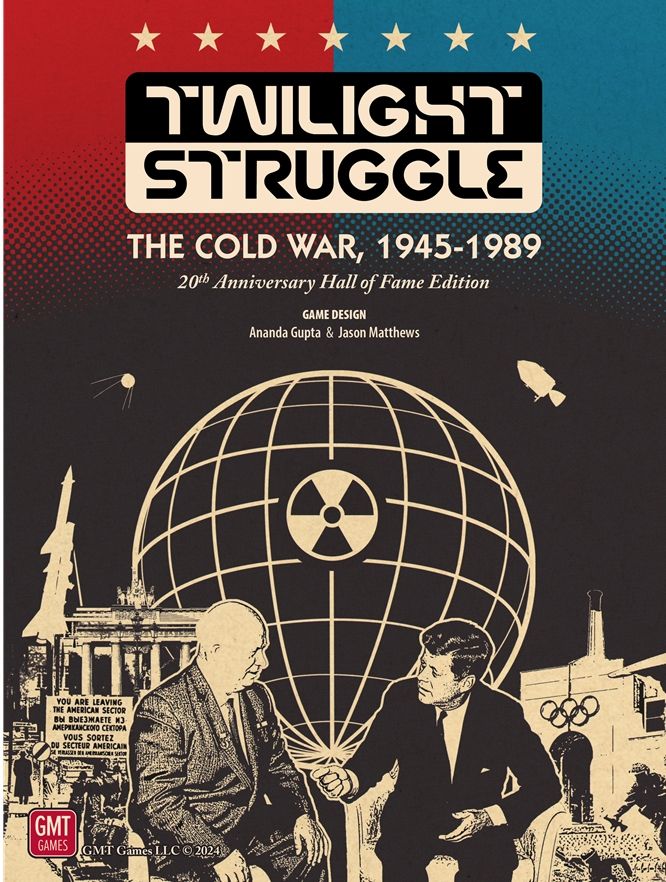
Qual é a sua dúvida sobre Twilight Struggle: 20th Anniversary Hall of Fame Edition?
Pergunte antes de baixar o manual: o assistente foi treinado neste arquivo e responde na hora, citando a página exata.
Tire dúvidas sobre o jogo
Pergunte qualquer coisa sobre Twilight Struggle: 20th Anniversary Hall of Fame Edition: regras, preparação, componentes, complexidade, preço ou se combina com seu grupo.
Escreva sua pergunta primeiro. Você criará sua conta grátis para ver a resposta — leva 20 segundos.
Manual completo
Navegue pelo manual ou baixe o PDF originalTexto completo do manual disponível para leitura Abrir texto
RULEBOOK
TABLE OF CONTENTS
1.0 Introduction 2
2.0 Components 2
3.0 Game Setup 6
4.0 Game Sequence 8
5.0 Card Play 9
6.0 Operations 10
7.0 Events 13
8.0 DEFCON Status and Military Operations 14
9.0 China 15
10.0 Scoring and Victory 16
11.0 The Chinese Civil War Variant 17
12.0 Turn Zero Expansion 18
13.0 Optional Rules 19
A Late War Scenario/Red Sun Rising Scenario 20
Credits 23
GMT Games LLC © 2026
---
© 2026 GMT Games, LLC 2
1.0 INTRODUCTION
“Now the trumpet summons us again—not as a call to bear arms,
though arms we need, not as a call to battle, though embattled we
are—but a call to bear the burden of a long twilight struggle...”
—John F. Kennedy
(Inaugural Speech, January 1961)
In 1945, unlikely allies slew the Nazi beast, while humanity’s
most devastating weapons forced the proud Japanese Empire
to its knees in a storm of fire. Where once there stood many
great powers, now stood only two. The world had scant time to
breathe a sigh of relief before a new conflict threatened. Unlike
the titanic conflicts of the preceding decades, this conflict would
be waged primarily not by soldiers and tanks, but by spies and
politicians, scientists and intellectuals, artists and traitors.
Twilight Struggle is a two-player game simulating the 45-year
dance of intrigue, prestige, and occasional flares of warfare
between the Soviet Union (USSR) and the United States. The
entire world is the stage on which these two titans fight to make
the world safe for their own ideologies and ways of life. The game
begins amidst the ruins of Europe as the two new “superpowers”
struggle over the wreckage of the Second World War, and ends
in 1989, when only the United States remained standing.
This 20th Anniversary Hall of Fame Edition combines the classic,
award-winning gameplay of Twilight Struggle with a new modern graphic design, and collects the Turn Zero expansion, the
alternate Space Race track, all published promotional cards, and
optional rules, into a single deluxe set. Additionally, it includes
an all-new alternate-history scenario, Red Sun Rising. This is
the definitive edition of Twilight Struggle!
Twilight Struggle inherits its fundamental systems from the
card-driven classics We the People and Hannibal: Rome vs.
Carthage. It is a quick-playing, low-complexity game in that
tradition. Event cards cover a vast array of historical happenings,
from the Arab-Israeli conflicts of 1948 and 1967, to Vietnam and
the US peace movement, to the Cuban Missile Crisis and other
such incidents that brought the world to the brink of nuclear
annihilation. Subsystems capture the prestige-laden Space Race
as well as nuclear tensions, with the possibility of nuclear war
ending the game.
These rules are organized into numbered sections and subsections (for example, 2.1 and 2.2). In a number of places, you will
see references made to rule sections and subsections that are
related to the one you are reading.
Additionally, terms such as “Influence” or “Battleground” are
capitalized to allude to their specialized meaning within the rules.
2.0 COMPONENTS
Twilight Struggle 20th Anniversary Hall of Fame Edition
includes the following components used to play the base Twilight Struggle game:
• One double-sided 22” by 34” map board
• Two punchboards
• Two Player Aid cards
• 110 Event cards (numbered 1 through 110)
• Two 6-sided dice
• A Background Booklet
• This Rules Booklet
The Turn Zero Expansion:
• 10 Turn Zero Statecraft cards (TZ1-TZ10)
• 6 Turn Zero Oversize Crisis cards
• 2 Turn Zero Event cards (TZ11-TZ12)
• Several cardboard tokens (on a shared punchboard)
The Red Sun Rising scenario:
• One 11” by 17” map overlay
• 18 Event cards (RS1-RS18)
• Several cardboard tokens (on a shared punchboard)
Promotional and Optional materials:
• 18 Promotional cards
• One alternate Space Race track (on a shared punchboard)
• One cardboard country token (on a shared punchboard)
(See graphic on next page—components not to scale)
---
© 2026 GMT Games, LLC 3 BASE GAME TURN ZERO EXPANSION RED SUN RISING SCENARIO PROMOTIONAL/OPTIONAL
2-sided Game Board
Dice
Player Aids
Statecraft Cards
Event Cards (#1-110)
Event Cards (#RS1-RS18)
Event Cards (#P1-P18)
Board Overlay
Shared Punch Board
Event Cards (#TZ11-TZ12)
Crisis Cards
Punch Boards
---
© 2026 GMT Games, LLC 4
2.1 THE GAME MAP
“From Stettin in the Baltic to Trieste in the Adriatic, an iron curtain has descended across the continent.” —Winston Churchill
The game board is double-sided, featuring the classic Twilight Struggle map on one side and the new 20th Anniversary map on the other. Players may choose the map they prefer; they function identically. All graphics in this rulebook use the 20th Anniversary map.
2.1.1 The map is divided into six Regions: Europe, Asia, Central America, South America, Africa, and the Middle East. A Region is a group of geopolitically connected nations, normally in close geographic proximity. Europe is divided into two sub-Regions: Eastern Europe and Western Europe. Two historically neutral countries (Austria and Finland) count as being in both Eastern and Western Europe. Asia also contains a sub-Region: Southeast Asia. The countries within a Region share a map color. Sub-regions are shades of those colors.
DESIGN NOTE:
Although not exactly geographically correct, the Middle East includes Libya and Egypt for political purposes, while Canada and Turkey are included in Europe.
2.1.2 Any Event, rule, or card that refers to “Europe” or “Asia” includes their sub-Regions.
2.1.3 Each map space represents a country or bloc of countries (hereafter simply called a country). Each country has a Stability Number representing the country’s overall stability, independence and power.
2.1.4 Battleground Countries: While most country names are written on white, Battleground country names are written on purple. They work the same way as normal countries, but have special rules for Scoring (see 10.1) and Coup attempts (see 6.3).
2.1.5 There are two spaces on the map representing the geographic locations of the United States and the Soviet Union. They are out of play for Influence markers, but count as “adjacent Controlled countries” for Events and Realignment rolls (6.2.2).
2.1.6 Countries are connected via the brown, red and black lines on the map. Brown lines connect countries within a Region. Red dashed lines connect countries in different Regions. Black lines connect countries and superpowers. A country is considered adjacent to all other countries to which it is connected.
DESIGN NOTE:
Adjacency is not entirely a reflection of geography. Several countries that share physical boundaries are not connected in the game. This is not a map error but is part of the mechanics of the game and the political situation of the times.
---
© 2026 GMT Games, LLC 5
2.1.7 Controlling Countries: Each country on the map is either considered Controlled by one of the players, or uncontrolled. A country is considered Controlled by a player if:
• The player’s Influence in the country is greater than or equal to the country’s Stability Number, and
• The player’s Influence in the country exceeds their opponent’s Influence in that country by at least the country’s Stability Number.
EXAMPLE:
To Control Israel (Stability Number 4), a player must have at least 4 Influence in Israel, and at least 4 more Influence in Israel than their opponent.
2.1.8 Some countries have small blue or red numbers in their lower corners. These numbers indicate Influence placed in that country at setup. Influence assigned to a Region but not a specific country is noted below the Region labels on the map. See 3.2 and 3.3 for a full list of starting Influence.
2.2 CARDS
2.2.1 The game uses 110 cards. Except for Scoring cards, all cards have an Operations value, an Event title and an Event description. Scoring cards have “Scoring” in their title.
PLAY NOTE:
Players familiar with older versions of Twilight Struggle may note that the “optional” cards numbered 104-110 are now included by default. Years of competitive play has shown that the full 110 card deck is the most balanced and interesting way to play Twilight Struggle. If you would like to try the game without the “optional” cards, simply remove cards 104-110 from the deck before setting up.
2.2.2 Each card shows which superpower is associated with its Event:
• Cards with a red star are associated with the USSR;
• Cards with a blue star are associated with the US;
• Cards with a gray star are associated with both sides.
(See 5.2 for the effect of playing cards whose Events are associated with your opponent’s superpower.)
2.2.3 Cards may be played as either Events or Operations.
2.2.4 Many cards have an asterisk following their Event title. When these cards are played as Events, they are removed permanently from the game.
2.2.5 Cards that have their Event title underlined are displayed face-up beside the game board, as a reminder they have a lasting effect, until they are canceled (or the game ends).
PLAY NOTE:
Players may also use the numbered card reminder markers to show that underlined Events have been played.
2.2.6 Cards that are discarded (not permanently removed from the game) are placed face-up beside the draw pile.
2.3 MARKERS
The game includes various markers to assist play:
---
© 2026 GMT Games, LLC 6
3.0 GAME SETUP
3.1 Shuffle the Early War cards to form the draw deck, and deal each player 8 cards beginning with the Soviet player. Place The China Card face-up in front of the USSR player. The players may examine their cards before placing their initial Influence markers.
3.2 The USSR player sets up first, placing 15 Influence markers in the following locations: 1 in Syria, 1 in Iraq, 3 in North Korea, 3 in East Germany, 1 in Finland, and 6 anywhere in Eastern Europe.
3.3 The US player sets up second, placing 25 Influence markers in the following locations: 2 in Canada, 1 in Iran, 1 in Israel, 1 in Japan, 4 in Australia, 1 in the Philippines, 1 in South Korea, 1 in Panama, 1 in South Africa, 5 in the United Kingdom, and 7 anywhere in Western Europe.
3.4 Place the US and USSR Space Race markers in the Space Race track’s Start box. Place the Military Operations markers on the zero space of the Military Operations track. Place the Turn marker on the first space of the Turn Record track, and the Action Round marker near the Action Round track. Place the DEFCON marker on Level 5 of the DEFCON track. Finally, place the VP marker on the zero space of the Victory Point track.
PLAY NOTE:
Experienced players, or players in a competitive setting, may wish to use the bidding rules to select sides (see 13.4).
---
TWILIGHT STRUGGLE 20th Anniversary Hall of Fame Edition 7
TURN RECORD TRACK
EARLY WAR Hand Size: 8 • 6 Action Rounds
MID WAR Add Mid War cards • Hand Size: 9 • Start 7 Action Rounds
LATE WAR Add Late War cards • Hand Size: 9 • Final Scoring at end of Turn 10
ACTION ROUND TRACK
1 2 3 4 5 6 7 8
ASIA
Presence 3
Domination 7
Control 9
MIDDLE EAST
Presence 3
Domination 5
Control 7
AFRICA
Presence 1
Domination 4
Control 6
SPACE RACE TRACK
SPACE RACE VP SCORING: 1st VP: 2 VP for 1st player to box. 1 VP for 2nd player to box.
VICTORY POINT TRACK
7 6 5 4 3 2 1 1 2 3 4 5 6 7 8 9 10 11 12 13 14 15 16 17 18 19
THE CHINA CARD
Begins the game with the USSR player.
+1 Operations when all points are used on Asia. Flips to opponent after use.
+1 VP for the player holding This card at the end of Turn 10.
Cannot affect if Formosa Resolution is the card 1, played by the US player.
© 2026 GMT Games, LLC
---
© 2026 GMT Games, LLC 8
C. Headline Phase:
Each player secretly selects a card from their hand. Once both players have made their choice, they reveal their cards to each other simultaneously. These are called Headline cards and their Events occur in this phase (if the Event title has an asterisk, remove it from the game after it is played). The card with the higher Operations value occurs first. In the event of a tie, the US player’s Event occurs first.
• Scoring cards may be played during the Headline Phase. However, they are considered to have an Operations value of 0. If both players select a Scoring card as their Headline card, the US player’s Scoring card occurs first.
• Players must play a Headline Event, regardless of whether the Event helps them or their opponent.
NOTE:
If you play your opponent’s Event during the Headline Phase, your opponent implements the Event as if they had played the card themselves. However, the player of the Headline card is considered the Phasing Player for DEFCON status purposes (see 8.1.3).
• The China Card may not be played during the Headline Phase.
• Unless the Headline Event specifically mentions Operations points, neither player receives Operations points from cards played during the Headline Phase.
D. Action Rounds:
There are 6 Action Rounds in Turns 1–3 and 7 Action Rounds in Turns 4–10. Players take turns playing cards, one per Action Round. The USSR player always plays first. Actions required by a card must be resolved before the next player starts their Action Round by playing a card. The player whose Action Round is underway is called the Phasing Player.
• Ordinarily, a player will have a card left over after all Action Rounds are completed. This card is considered “held” and may be played in subsequent rounds. Be careful: holding a Scoring card will cause you to lose the game (see 10.3.1)!
• If a player has insufficient cards to complete the remaining Action Rounds, they must sit out of the remaining Action Rounds while their opponent completes the turn.
E. Check Military Operations Status:
Each player determines if they are penalized Victory Points for failing to perform enough Military Operations during the turn (see 8.2). Each player then resets their Military Operations markers back to 0.
4.0 GAME SEQUENCE
4.1 Twilight Struggle has 10 turns. Each turn represents between three and five years, in which each player will make six or seven normal card plays. At the beginning of the game, each player receives 8 cards from the Early War deck. At the beginning of Turn 4, the Mid War deck is shuffled into the draw pile and players are dealt 9 cards. At the beginning of Turn 8, the Late War deck is shuffled into the draw pile.
4.2 The Phasing Player is the player whose Action Round is underway.
4.3 When no cards remain in the draw deck, reshuffle the discard pile to form a new draw deck. Deal all cards remaining in the draw deck before reshuffling. Event cards with an asterisk (*) are permanently removed from the game when they are played, and are not shuffled into the new draw deck.
4.4 When moving from Early War to Mid War, or from Mid War to Late War, do not add the discard pile to the deck. Instead, add the Mid War or Late War cards (as appropriate) to the existing deck and reshuffle. The discard pile is ignored for now, but will be reshuffled into the deck when the draw deck runs out.
4.5 A turn in Twilight Struggle has the following structure:
A. Improve DEFCON Status
B. Deal Cards
C. Headline Phase
D. Action Rounds
E. Check Military Operations Status
F. Check for Held Scoring Card
G. Flip The China Card
H. Advance Turn Marker
I. Final Scoring (after Turn 10 only)
A. Improve DEFCON Status:
If the DEFCON level is lower than 5, add 1 to the DEFCON status (towards Peace).
B. Deal Cards:
Each player is dealt enough cards to bring their hand size to 8 on Turns 1–3. On Turns 4–10, players should be dealt enough cards to bring their hand size to 9. The China Card is never included in this total.
PLAY NOTE:
In competitive games, deal the first card of each deal to the USSR player, then alternate between players until both players have reached their hand size. A player may receive consecutive cards in a deal if they require more cards than their opponent.
---
EXAMPLE 1: The USSR player plays the NATO card before the Marshall Plan or Warsaw Pact Formed cards have been played. The USSR player receives 4 Operations points, but NATO does not occur. Despite being asterisked, the NATO card is placed in the discard pile and not permanently removed from play.
EXAMPLE 2: The US player plays Arab-Israeli War for 2 Operations. However, during their previous Action Round, they played Camp David Accords, which prohibits play of Arab-Israeli War as an Event. The US player would still receive 2 Operations points, but the Event does not occur.
© 2026 GMT Games, LLC
9
F. Check for Held Scoring Card:
If either player is holding a Scoring card, they immediately lose the game.
G. Flip The China Card:
If The China Card was passed face-down during the turn, flip it face-up now.
H. Advance Turn Marker:
Move the Turn marker to the next turn. If it is the end of Turn 3, shuffle the Mid War cards into the draw deck. If it is the end of Turn 7, shuffle the Late War cards into the draw deck.
I. Final Scoring:
At the end of Turn 10, perform Final Scoring (see 10.3.2).
5.0 CARD PLAY
5.1 Cards may be played as either Events or Operations. Ordinarily, players will hold one card in their hand at the end of the turn. Players may not forgo their turn by declining to play a card or discarding a card from their hand. Players may play cards associated with their own superpower, or with both superpowers, for either Operations (see 6.0) or the Event (see 7.0). Cards associated only with their opponent’s superpower may only be played for Operations, but the event will occur automatically (see 5.2).
5.2 Events Associated With Your Opponent:
If you play a card for Operations, and its Event is associated only with your opponent, the Event still occurs (and the card, if it has an asterisk after the Event title, is removed). The Phasing Player always decides whether the Event occurs before or after the Operations are conducted.
NOTE:
When playing a card for Operations and it triggers your opponent’s Event, your opponent implements the Event text as if they had played the card themselves.
• If an opponent’s Event has a prerequisite card play or condition that has not been met, the Event does not occur.
• If play of an opponent’s Event has been prohibited or canceled by another Event card, then the Event does not occur (this Event will only be playable for Operations for the remainder of the game).
• Opponent’s Events that are removed after being resolved (those marked with an asterisk) are only removed if the Event actually occurs. If an Event is played and does not occur, it is returned to the discard pile and not removed from the game as usual.
• If the Event results in no effect, the Event is still considered to have occurred, and would still be removed if it has an asterisk.
---
EXAMPLE 3: The USSR player plays Alliance for Progress. However, the US player does not Control a Battleground country in either South or Central America. Nevertheless, the Event is considered played, and the card is permanently removed from play.
EXAMPLE: The US player has 2 Influence markers in Turkey and the USSR player has none. Therefore, the US Controls Turkey. The USSR player uses a 4 Operations point card to place Influence markers. When placing markers in Turkey, the first marker costs 2 Operations points. However, after the first USSR Influence marker is placed, the US no longer exceeds USSR Influence in Turkey by the Stability Number of 2. Thus, additional Soviet Influence markers would only cost 1 Operations point each. If the US player started with only 1 Influence marker in Turkey, the US player would not Control Turkey. Therefore, Soviet Influence markers would only cost 1 Operations point each.
EXAMPLE: The US player controls Turkey and Greece and the USSR player controls Syria and Lebanon. Neither player controls Romania or Bulgaria.
EXAMPLE 4: The USSR plays Star Wars for Operations, which would normally trigger the Event, but the US player is behind on the Space Race track. Nothing happens and the Star Wars card is simply discarded.
EXAMPLE: The Quagmire card requires the US player to discard a 2 or more Operations card. If the US discards a 3 Operations card, the requirement is still met.
6.0 OPERATIONS
Operations can be used to place Influence markers, make Realignment rolls, attempt Coups, or advance in the Space Race. When a card is played for Operations points, the player must use all of the Operations points on one of these options.
6.1 PLACING INFLUENCE MARKERS
“Everyone imposes his own system as far as his army can reach.”
—Joseph Stalin
6.1.1 Influence markers are placed one at a time. However, they must be added to countries containing, or countries that are adjacent to countries containing, friendly Influence that was in place at the start of the Phasing Player’s Action Round. Exception: markers placed when required by an Event are not subject to this restriction, unless specifically stated otherwise on the card. If the Influence is sufficient to gain Control of the country, place the marker on its darker Controlled side.
6.1.2 It costs one 1 Operations point to place an Influence marker in a country that you Control or that is uncontrolled. It costs 2 Operations points to place an Influence marker in an enemy-Controlled country. If a country’s Control status changes while placing Influence markers, additional markers placed during that Action Round are placed at the lower cost.
5.3 When an Event requires a card of a specific value to be played or discarded, a higher valued card will always satisfy the requirement.
5.4 When an Event forces a player to discard a card, the Event on the discarded card does not occur. This also applies to Scoring cards.
5.5 Except as noted in Rule 10.1.5, card text overrides the written rules.
© 2026 GMT Games, LLC
10
---
© 2026 GMT Games, LLC 11
6.1.3 Influence markers may be placed in multiple Regions and multiple countries up to the number of Operations points on the card played.
6.1.4 Influence markers may always be placed in countries adjacent to the Phasing Player’s superpower space.
6.1.5 Influence markers are treated like cash. Players may break a large denomination into smaller denominations at any time. Additionally, the number of Influence markers included in the game is not an absolute limit. Small poker chips, coins or wooden blocks can be used in the event of a marker shortage.
6.1.6 If a player has 2 or more markers in a country, place the larger denomination on top. Influence markers are open to inspection at all times.
6.2 REALIGNMENT ROLLS
6.2.1 Realignment rolls are used to reduce enemy Influence in a country. To attempt a Realignment roll, you need not have any Influence in the target country or in an adjacent country, although this improves the chance of success greatly. However, your opponent must have Influence markers in the target country. When using a card for Realignment rolls, the player may complete each roll before declaring the next target. Countries may be targeted for Realignment more than once per Action Round.
6.2.2 It costs one Operations point to make a Realignment roll. Each player rolls a die and the high roller may remove the difference between the rolls from their opponent’s Influence in the target country. Ties are considered a draw, and no markers are removed. Each player modifies his die roll:
• +1 for each adjacent Controlled country,
• +1 if they have more Influence in the target country than their opponent,
• +1 if their superpower is adjacent to the target country.
EXAMPLE:
The US player targets North Korea for Realignment. The USSR has 3 Influence points in North Korea, while the US player has none. The US player has no modifiers—they do not Control any adjacent countries and have less Influence in North Korea than the Soviets. The USSR player has +1 because North Korea is adjacent to the USSR and +1 for having more Influence in North Korea than the US. The US player gets lucky and rolls a 5, while the USSR player rolls a 2 (modified to 4). The USSR player must remove one Influence point from North Korea.
6.2.3 No Influence is ever added to a country as a result of a Realignment roll.
EXAMPLE: The US player has markers in Panama and South Korea. The US player uses a 3 Operations card to place more Influence. The US player may place Influence markers in both Costa Rica and Colombia. However, they cannot place Influence markers in Costa Rica and then Nicaragua. They could also use any remaining Operations points to strengthen South Korea or its neighboring countries.
---
© 2026 GMT Games, LLC 12
6.3 COUP ATTEMPTS
6.3.1 A Coup represents operations short of full-scale war to change the composition of a target country’s government. To attempt a Coup, you need not have any Influence in the target country or in an adjacent country. However, your opponent must have Influence markers in the target country.
6.3.2 To resolve a Coup attempt, multiply the Stability Number of the target country by 2. Then roll a die and add the Operations points on the card to it. If this modified die roll is greater than the doubled Stability Number, the Coup is successful, otherwise it fails. If the Coup is successful remove opposing Influence markers equal to the difference between the modified die roll and the doubled Stability Number from the target country. If there are insufficient opposing Influence markers to remove, add your own Influence markers to make up the difference.
6.3.3 Move your Military Operations track marker the number of spaces equal to the Operations value of the card played.
EXAMPLE: The US player plays a 3 Operations card to conduct a Coup attempt in Mexico. The US player has no Influence in Mexico; the USSR player has 2 Influence. First, the US player adjusts their marker on the Military Operations track to show that they spent 3 points on Military Operations this turn (see 8.2). Then they roll a 4 and add their Operations number (3) for a total of 7. They now subtract twice the value of Mexico’s Stability Number (2x2=4) from this result to get a final total of 3. This is the number of Influence markers they may remove from/add to Mexico. The US removes the 2 Soviet Influence markers, then places 1 US Influence marker.
6.3.4 Any Coup attempt in a Battleground country degrades the DEFCON status one level (towards Nuclear War).
6.3.5 Cards that give a player a free Coup attempt in a particular Region may ignore the geographic restrictions of the current DEFCON level (see 8.1.5). However, a free Coup attempt used in a Battleground country still degrades the DEFCON level (see 6.3.4). Free Coup attempts do not count as Military Operations (see 8.2.2).
6.4 THE SPACE RACE
“We go into space because whatever mankind must undertake, free men must fully share... I believe that this nation should commit itself to achieving the goal, before the decade is out, of landing a man on the moon and returning him safely to the earth.”
—John F. Kennedy
6.4.1 The Space Race track has a marker for each superpower. Operations points may be used to move to the next box on the track. To do so, play a card with an Operations value equal to or greater than the number shown on the box into which you are attempting to advance. Roll the die. If the number falls within the range listed above the target box, move your marker to the new box.
6.4.2 A player may only play 1 card per turn in an attempt to advance in the Space Race. Exception: Space Race track special abilities and certain Events may let players discard multiple cards or advance their marker on the Space Race track.
---
© 2026 GMT Games, LLC 13
6.4.3 Advancing on the Space Race track results in Victory Points, a special ability, or both. Five boxes on the Space Race track are marked with two numbers divided by a slash (for example, 3/1). The left-hand number is how many Victory Points are awarded to the first player to reach that box; the right-hand number is how many Victory Points are awarded to the second player to reach that box. Victory Points are awarded immediately and are cumulative.
6.4.4 Special abilities are granted only to the first player to reach the space. The special ability is immediately canceled when the second player reaches that box.
• Upon reaching Box 2 (Animal in Space), you may play two Space Race cards per turn.
• Upon reaching Box 4 (Man in Earth Orbit), you select and reveal your Headline card after your opponent.
• Upon reaching Box 6 (Eagle/Bear has Landed), you may discard one held card at the end of the turn.
• Upon reaching Box 8 (Space Station), you may play 8 Action Rounds per turn.
EXAMPLE:
The USSR player reaches Box 2. They may play a second Space Race Card during their next Action Round. If the USSR player reaches Box 4 before the US player reaches Box 2, the USSR player may play 2 Space Race cards per turn and make the US player show their Headline card before selecting their own.
6.4.5 When a card is played for the Space Race, the Event does not occur and the card is placed in the discard pile.
DESIGN NOTE:
The Space Race is your safety valve. If you want to at least temporarily get rid of an Event that is good for your opponent, dump it on the Space Race (provided it has a sufficient Operations value to qualify for an attempt to move forward).
6.4.6 If a player reaches the final box in the Space Race, they cannot play any more cards in the Space Race for the remainder of the game.
7.0 EVENTS
“Do you, Ambassador Zorin, deny that the USSR has placed and is placing medium—and intermediate—range missiles and sites in Cuba? Yes or no? Don’t wait for the translation! Yes or no?”
—Adlai Stevenson, US Ambassador to the United Nations
7.1 A player may play a card associated with the player’s own superpower, or with both superpowers, as an Event instead of Operations. It occurs as directed by the card’s text.
7.2 The Southeast Asia Scoring card has an asterisk and is the only Scoring card permanently removed from the game after play.
7.3 Lasting Events:
Some Event titles are underlined, e.g. Flower Power. This indicates that the effects of these Events last for the duration of the game, or until canceled. When these cards are played as Events, place them beside the map, or their markers on the Turn track or elsewhere on the board, as a reminder of their ongoing effects.
7.4 Some Event cards modify the Operations value of cards that follow. These modifiers are cumulative and can modify The China Card.
EXAMPLE: The US player plays the Red Scare/Purge card as an Event during the Headline Phase. Ordinarily, 1 Operations point would be subtracted from all USSR cards for the rest of the turn. However, the USSR played Vietnam Revolts for their Headline card, which adds 1 to all Soviet Operations in SE Asia. For their first Action Round, the USSR chooses The China Card. They use all points in SE Asia for 5 Influence. The Vietnam Revolts card adds 1 point, but the Red Scare/Purge card removes 1 point. They cancel each other out and the USSR plays 5 Operations points.
7.4.1 Events modifying the Operations value of a card only apply to one player. The modifier is not transferable to their opponent by virtue of a card taken from their opponent’s hand.
EXAMPLE:
The USSR player has played Brezhnev Doctrine as an Event and therefore receives a +1 Operations value modifier for all of their cards. If the US player steals a card, for example by playing Grain Sales To Soviets, the US player does not benefit from a +1 Operations value modifier on that card.
---
© 2026 GMT Games, LLC 14
7.4.2 Events modifying the Operations value of subsequently played cards do so for all purposes.
EXAMPLE 1: If the Soviet player uses Red Scare/Purge and the US player used a 2 Operations card for a Coup, the US player only adds 1 to his Coup roll and receives 1 Required Military Operations point.
EXAMPLE 2: If the Soviet player uses Brezhnev Doctrine, they could then play a 1 Operations card to make a required roll under Bear Trap.
EXAMPLE 3: If the US player uses Containment, they could then play CIA Created and use 2 Operations.
7.4.3 If an Event specifies that a player may “conduct Operations, place Influence or attempt Realignments as if” they played a card of a certain Operations value, those additional Operations are treated as if a card had been played for its Operations points. Therefore, those Operations are subject to Rule 6.0 and other Events limiting their placement or value.
7.5 If an Event is canceled or restricted by another Event, the unplayable Event card may still be used for Operations.
7.6 War Events:
The deck contains 5 War Events: Korean War, Arab-Israeli War, Indo-Pakistani War, Brush War, and Iran-Iraq War. A player does not need Influence markers in either the attacking or defending countries to play these Events. If no Influence is at risk, the player still receives Required Military Operations and, if successful, Victory Points (see 8.2.4).
8.0 DEFCON STATUS AND MILITARY OPERATIONS
“Strange game. The only winning move is not to play.” —Joshua, the NORAD computer from WarGames
8.1 The DEFCON Track
8.1.1 DEFCON measures nuclear tension in the game. The DEFCON level begins the game at its maximum ‘peace’ level of 5 and will decrease and increase due to Events and player actions.
8.1.2 Maximum DEFCON is 5. Any Event that would improve DEFCON above 5 has no effect on DEFCON.
8.1.3 If DEFCON reaches 1, nuclear war breaks out and the game ends immediately. The Phasing Player is responsible and loses the game.
PLAY NOTE: It is not uncommon for a game of Twilight Struggle to end with a player having no option but to play a card that would degrade DEFCON to 1 (or allow their opponent to do so), ending the game in Nuclear War. There are 14 cards in Twilight Struggle that can cause you to lose the game if played at the wrong moment, and these are marked with in the lower right corner as a reminder.
EXAMPLE: The US player plays Olympic Games with the DEFCON status at 2. The USSR player boycotts the Games. DEFCON decreases to 1, and nuclear war is triggered. The US player, as the Phasing Player, loses.
8.1.4 Any Coup attempt in a Battleground country decreases DEFCON by 1.
8.1.5 DEFCON status consequences are as follows:
• DEFCON 5: No effect
• DEFCON 4: No Coup or Realignment rolls are permitted in Europe.
• DEFCON 3: No Coup or Realignment rolls are permitted in Europe or Asia.
• DEFCON 2: No Coup or Realignment rolls are permitted in Europe, Asia, or the Middle East.
• DEFCON 1: Game over. The Phasing Player loses the game.
PLAY NOTE: Players may place a DEFCON Restriction marker in a specific Region as a reminder that no Realignment rolls or Coups are permitted there.
---
© 2026 GMT Games, LLC 15
8.1.6 During the Increase DEFCON Status Phase, if DEFCON is below 5 at the beginning of a turn, increase it by 1.
8.1.7 Improve & Degrade. When rules or cards say to “improve” the DEFCON status, move the DEFCON marker to a higher number. When they say “degrade”, move the DEFCON marker to a lower number.
8.2 Required Military Operations
“Restraint? Why are you so concerned with saving their lives? The whole idea is to kill the bastards. At the end of the war, if there are two Americans and one Russian left alive, we win.”
—Gen. Thomas Power, US Strategic Air Command
8.2.1 Players must carry out a certain number of Military Operations each turn or be penalized Victory Points. The number of Required Military Operations is equal to the current DEFCON status. If you carry out insufficient Military Operations, your opponent gains 1 VP per unplayed Military Operations point. If both players are penalized Victory Points, the net total should be implemented on the Victory Points track.
EXAMPLE:
The US player carries out two points in Military Operations in a turn. DEFCON is at 4. The USSR player gains 2 Victory Points.
8.2.2 Coup attempts and War Events count as Military Operations. Realignment rolls and free Coup rolls through Events do not.
8.2.3 When Operations points are used in a Coup attempt, the Phasing Player moves their Military Operations marker by the number of spaces equal to the Operations value of the card. When a War Event card is played (e.g., Arab-Israeli War, Korean War, etc.) the Phasing Player moves their marker the number of spaces instructed on the card. A player may never have more than 5 Military Operations.
8.2.4 If a player uses a card for Operations and triggers a War Event associated with their opponent, their opponent moves their Military Operations marker as instructed on the card.
EXAMPLE:
The US player uses the Arab-Israeli War card for Operations points, triggering the Soviet War Event. The Event occurs, and the USSR player moves their Military Operations marker 2 spaces on the Military Operations track.
9.0 CHINA
9.1 China’s role in the Cold War is abstracted through The China Card. Either player may use The China Card as part of their regular hand. The China Card does not count towards the hand limit.
9.2 Playing The China Card counts as an Action Round. As a result, players may have more held cards than usual, if The China Card is played.
9.3 When you play The China Card, immediately hand it to your opponent face-down. Your opponent cannot play it this turn as long as it is face-down. Next turn, your opponent may flip it face-up and ready for play.
9.4 If The China Card changes hands through an Event, give it to your opponent as instructed by the Event.
9.5 The China Card may not be played:
• during the Headline Phase;
• as a discard required by an Event.
9.6 To receive the bonus +1 Operations point indicated on The China Card, all of the Operations points must be spent in Asia (including Southeast Asia).
9.7 The Operations value of The China Card may be modified by Events.
9.8 Play of The China Card can never be forced by Events or a card shortage.
---
© 2026 GMT Games, LLC 16
10.0 SCORING AND VICTORY
The object of the game is to score Victory Points (VPs). You can earn Victory Points by Controlling countries or playing certain Events. Each Region has its own Scoring card, which earns players Victory Points depending on how much Influence they have in the Region when it is played.
PLAY NOTE:
Playing Scoring cards when you have peak Influence in a Region is often key to winning the game.
10.1 SCORING
10.1.1 The following terms are used during Regional Scoring:
Presence: A superpower has Presence in a Region if it Controls at least 1 country in that Region.
Domination: A superpower achieves Domination of a Region if it Controls more countries (total) and more Battleground countries in a Region than the opponent (and at least 1 non-Battleground country).
Control: A superpower has Control of a Region if it Controls more countries in a Region than its opponent, and Controls all of the Battleground countries in the Region.
10.1.2 Players can earn additional points during Regional Scoring, as follows:
• +1 VP per Controlled country adjacent to the enemy superpower.
• +1 VP per Controlled Battleground country in the Region.
• Adjust the Victory Point track by the difference between the players’ scores.
EXAMPLE: The USSR plays the Central America Scoring card. The USSR Controls Cuba, Haiti and the Dominican Republic. The US controls Guatemala, and has 1 point of Influence in Panama. The USSR therefore has Domination (3 VPs), Controls 1 Battleground country (1 VP), and Controls a country adjacent to the enemy superpower (1 VP), for a total of 5 VP. The US has Presence (1 VP), but that is all because they do not Control any Battleground countries (1 Influence is insufficient to Control Panama). The difference between the two scores (5 VP and 1 VP) is 4. Move the Victory Point marker 4 spaces toward USSR Victory.
10.1.3 Certain Events may award Victory Points.
10.1.4 You may earn Victory Points if your opponent fails to perform the number of Required Military Operations in a turn (see 8.2).
10.1.5 Events cannot force players to hold Scoring cards.
10.2 The Victory Point Track
10.2.1 The Victory Point track goes from US-20 (automatic US Victory) to USSR-20 (automatic USSR Victory). The VP marker starts in the Start (zero) box, or total equilibrium between the two sides. Count this box as a space when adjusting players’ scores.
---
© 2026 GMT Games, LLC 17
10.2.2 If a card states that a player “gains” a Victory Point, move the VP marker one space in that player’s favor.
EXAMPLE:
If the VP marker is on the US-10 box and the USSR player gains 2 VP, move the marker to the US-8 box. If the VP marker is on the USSR-1 box, and the US player scores 2 VPs, move the marker 2 spaces to the US-1 box.
10.2.3 If a card awards both players Victory Points, move the VP marker the difference between the scores.
10.3 VICTORY
10.3.1 Automatic Victory. Automatic victory is achieved when:
• A player reaches 20 VP. The game ends immediately and that player wins. If a player reaches 20 VP during the Check Military Operations Status phase, they must reveal any held cards before they are declared the winner; if they are holding a Scoring card they instead immediately lose the game. NOTE: Score both players’ VP awards for an Event or Scoring card before determining Automatic Victory.
• Europe is Scored and a player Controls Europe. That player wins.
• Any player holding a Scoring card during the Check for Held Scoring Card phase has started an accidental nuclear war and loses immediately.
• Nuclear War: A player may also declare Automatic Victory if DEFCON reaches 1 while their opponent is the Phasing Player.
10.3.2 End Game Victory. At the end of Turn 10, every Region is scored and these VPs are added to the current score. Southeast Asia is included in Asia Scoring. Begin with Europe, since Control of Europe results in Automatic Victory. Score every Region before determining who has the most points and is victorious. If the VP marker is on 0, the game ends in a draw.
11.0 THE CHINESE CIVIL WAR VARIANT
From C3i #21, copyright RBM Studio
The Chinese Civil War Variant should be played under existing The China Card rules (see 9.0). However, where these rules conflict with existing rules or Event card text, this section of the rules takes precedence.
11.1 The Chinese Civil War space
The Chinese Civil War space is considered adjacent to the Soviet Union only. The space is in Asia, but not Southeast Asia. It does not affect any Scoring cards. The only action for the Chinese Civil War space is the Soviet player placing Influence points therein. The US player may not apply any Operations or Events to the Chinese Civil War space. Once the Soviet player has placed 3 Influence points on the Chinese Civil War space, it has no further effect. The markers may be returned and the Chinese Civil War space is ignored for the remainder of the game.
11.2 Control
The Soviet Union must place 3 Influence on the Chinese Civil War space for Control, under the normal restrictions of Rule 6.1. If The China Card remains unclaimed throughout the game (see 11.3), neither player receives a Victory Point for possession of The China Card during End Game Scoring.
11.3 Impact of Control
Until the Soviet player has placed 3 Influence points on the Chinese Civil War space, The China Card is in no player’s possession. Once the Soviet player has placed 3 Influence points on the space, they immediately receive The China Card faceup and ready for play, and the restrictions on Event play (see 11.4) are lifted.
11.4 Event Restrictions
Until the Soviet player has placed 3 Influence points on the Chinese Civil War space, the Soviet player may not play Red Scare/Purge nor Cultural Revolution as Events. Additionally, the US player may not play Formosan Resolution as an Event.
11.4.1 Special US Condition: When playing Ussuri River Skirmish or Nixon Plays the China Card as Events, the US is deemed to be in possession of The China Card if the Soviet player has not yet placed 3 Influence points on the Chinese Civil War space.
11.4.2 Until the Soviet player has placed 3 Influence points on the Chinese Civil War space, the Soviet player subtracts an additional 1 when rolling to resolve the Korean War Event.
11.4.3 Events made unplayable by these restrictions can still be used for Operations points (see Rule 7.5).
---
© 2026 GMT Games, LLC 18
12. TURN ZERO EXPANSION
The Turn Zero expansion is a way to freshen up your Twilight Struggle experience. It represents a series of variants on the end of World War II and its aftermath that could have resulted in a substantially different Cold War.
PLAY NOTE:
Due to the large number of new possibilities in the starting setup, game balance is not guaranteed with Turn Zero!
Turn Zero cannot be used when playing the Late War or Red Sun Rising scenarios. It can be used with the Chinese Civil War variant by using the modifications indicated in the setup steps (see 12.2).
12.1 Turn Zero Components
Turn Zero consists of six oversized Crisis cards, ten Statecraft cards, two modified Event cards (The Allied Berlin version of Europe Scoring and Nationalist China), five counters to help track Crisis results, and one Taiwan overlay tile.
12.2 Setting Up Turn Zero
1. Determine sides randomly, or bid for sides [13.4].
2. Give each player the five Statecraft cards marked with their side.
3. If using the Chinese Civil War variant, each player discards one of their non-Dummy Card Statecraft cards face-down, at random. This discard is face-down, so the players do not know which Statecraft card their opponent discarded. This card will not be used and can be returned to the box.
4. Separate the six Crisis cards into two piles of three each: The first pile should contain VE Day, Yalta and Potsdam, and 1945 UK Election. The second should contain Israel, VJ Day, and Chinese Civil War. Shuffle the piles. (If using the Chinese Civil War variant, return the Chinese Civil War Crisis card to the box; the second pile will only contain two Crisis cards.)
12.3 Playing Turn Zero
Turn Zero consists of resolving a series of Crisis cards, one at a time. To resolve a Crisis card:
1. Turn over the top Crisis card in the first Crisis card pile.
2. Each player selects one of their Statecraft cards and places it face-down.
3. Reveal both selected Statecraft cards.
4. Roll a die, applying any modifiers from the Statecraft cards. Cross-reference the result on the face-up Crisis card, and implement the indicated effects (if any). We recommend placing bonus Influence in or near the areas on the map where it will go. Counters are available to track other Crisis effects.
5. Discard the played Statecraft cards (unless a player played their Dummy Card, which is returned to their hand). Note this means that each non-Dummy Statecraft card will only give its modifiers to a single Crisis.
Repeat these steps for the rest of the cards in the first pile; then again for the cards in the second pile. Once all of the Crisis cards have been resolved, return the Crisis cards, Statecraft cards, and any unused reminder markers or country tiles to the box. They will not be used for the remainder of this game.
If the ‘6’ result of Chinese Civil War was implemented, place the Taiwan country tile over the existing Taiwan map space. This tile is marked with the 3 starting Influence granted by the Crisis result. If either of the Yalta and Potsdam results that grant a card for the starting hand was rolled, the applicable player now may take that card into their hand.
Finally, conduct setup normally [3.0]. When dealing starting hands [3.1], count any card added by a Crisis card as a dealt card—that is, count it against the starting hand size as if it had been dealt normally. All extra Influence granted from Crises is in addition to that normally received in setup; all Influence reduction is taken from that normally received in setup.
12.4 Where a Crisis result indicates that a card’s Event has no effect, it remains in the deck and is removed normally should its Event be triggered. The Event simply does nothing when triggered.
---
© 2026 GMT Games, LLC 19
13.0 OPTIONAL RULES
To celebrate Twilight Struggle’s 20th Anniversary and induction into the GAMA Hall of Fame, we have collected all of the promotional cards and optional rules officially published for Twilight Struggle by GMT Games and our international partners. The rules in this section will guide you through incorporating them into your games of Twilight Struggle. Note that none of these optional rules should be considered competitively balanced and are included for fun.
13.1 Alternate Space Race Track
The punchboard alternate Space Race track can be used instead of the Space Race track printed on the board, but it is not recommended for use with the Late War and Red Sun Rising scenarios. The alternate Space Race track follows all the normal rules for the Space Race [6.4] but confers different abilities:
• Upon reaching space 2 (Earth Satellite), during each Check Military Operations Status phase, you add two Military Operations to your total before VPs are deducted for shortfall.
• Upon reaching space 4 (Eagle/Bear has Landed), once per Action Round, you may pay only one Operations point to place one Influence point in a country Controlled by your opponent (instead of the usual two Operations points that this normally costs). When this capability is used, place an Influence marker near the track to indicate that this ability cannot be used again until the next Action Round. Remove this marker at the end of the Action Round.
• Upon reaching space 6 (ABMs), once per turn, you may re-roll one Coup attempt; the player must accept the re-rolled result. When this capability is used, place an Influence marker near the track to indicate that this ability cannot be used again until the next turn. Remove this marker at the end of the turn.
• Upon reaching space 7 (Neutron Bomb), your opponent suffers a –1 modifier to all Coup die rolls.
HISTORICAL NOTE:
The abbreviations used on this track all refer to various military technology: H-Bomb (Hydrogen Bomb), ICBMs (Intercontinental Ballistic Missiles), MIRVs (Multiple Independently Targetable Re-entry Vehicles), ABMs (Anti-Ballistic Missiles) and SDI (Strategic Defense Initiative).
13.2 Promotional Cards
Cards with numbers that begin with ‘P’ are promotional cards. Cards P1-P8 are GMT promotional cards, while cards P9 through P17 are promotional cards included in localized versions of Twilight Struggle, and are included with the gracious permission of our international publishing partners. A country overlay tile for Zaire is provided for use with card P2.
Card P18 is the winner of the International Twilight Struggle League’s card design competition and was designed by Anton Skott. These cards can be used in any combination, but we recommend only adding 1 or 2 promotional cards to each of the Early, Mid, and Late War decks. Note that these cards are not competitively balanced, and adding these cards can change when shuffles occur, which may have a dramatic impact on the game. Players wishing to reduce the impact of these cards on shuffle timing can remove cards 104-110 when adding promotional cards.
PLAY NOTE:
You may have to experiment with which cards you add and remove from the deck to find a combination of promotional cards added, and regular cards removed, that suits your style. That’s the fun of the promotional cards, but don’t expect competitive balance!
13.3 Designers’ Optional Rules
These rules were also playtested by the designers during the development of Twilight Struggle, but for various reasons fell by the wayside on the road to publication. Players seeking some variety in the play of the game may find these rules interesting and worthwhile.
Realignment Rolls
We tried many variations on Realignments. One of the great design challenges in TS was figuring out a simple system to handle superpower-directed political change that wasn’t violent enough to count as a Coup attempt. We are happy with the rules we arrived at, but if players wish to see some of the other paths we tried, here they are. They can be played separately or all together.
• Realignment rolls are not subject to geographic DEFCON restrictions. That is, countries in any Region may be targeted for Realignment rolls regardless of the current DEFCON level.
• The Phasing Player may not lose Influence in a country targeted for Realignment.
• Operations points may be used to purchase both Influence markers and Realignment rolls, at normal costs, but Influence markers may not be placed in a country targeted by a Realignment roll during the current Action Round. Similarly, Realignment rolls may not target countries that have had Influence markers placed in them during the current Action Round.
---
© 2026 GMT Games, LLC 20
The Space Race
A player who “dumps” a card on the Space Race may choose not to roll the die (thus forgoing any chance of advancing on the track).
13.4 Bidding for Sides
Experienced players may wish to use bids to select a side and set an Influence handicap. Players wishing to bid should follow these steps:
1. Each player should secretly write the name of a side and a number on a piece of paper.
2. The two bids are then revealed:
a. If the bids show different sides, each player takes the side he wrote down, and play begins.
b. If the bids show the same side, the player who wrote the higher number takes that side. Their opponent then receives Influence equal to the higher number, to be allocated during setup after all other Influence is placed (see below). If the numbers are equal, sides are determined randomly (roll dice); the player taking the side that did not appear on either bid then receives the additional Influence.
Additional Influence received in this way can only be placed in countries where the player has existing Influence at setup (as of the end of the regular setup phase) and may not exceed 2 more than what is needed for Control of the country.
EXAMPLE:
Setup is complete and the US player is placing additional Influence from bidding. The US has 3 Influence in a Stability Number 3 country, and the USSR has 1. Since 4 Influence are needed for Control, the US cannot have more than 6 (4+2) Influence in that country when play begins.
A LATE WAR SCENARIO
for Twilight Struggle
By Volko Ruhnke
from C3i Magazine #19, copyright RBM Studio
If you’ve played with your TS set as much as I have, you may find the Early and Mid War Event cards looking a little worn compared to the less-often-used Late War Events. For those of you who would like to dive right into the post-Quagmire era and try out the cool possibilities of a Landed Eagle, Star Wars, and Chernobyl, or Aldrich Ames, the Hostage Crisis, and Terrorism, here’s a scenario that cuts to the chase.
My sense of the game-turn structure is that the turns roughly represent the following years:
◊ Turn 1 = 1945–1948
◊ Turn 2 = 1949–1952
◊ Turn 3 = 1953–1956
◊ Turn 4 = 1957–1960
◊ Turn 5 = 1961–1964
◊ Turn 6 = 1965–1969
◊ Turn 7 = 1970–1974
◊ Turn 8 = 1975–1979
◊ Turn 9 = 1980–1984
◊ Turn 10 = 1985–1989
Thus, the Late War period would begin in 1975, say, with the Fall of Saigon. So I have used that date (and a dose of interpretation of history into the TS fabric) to set the Influence and Events for the opening of the Late War Scenario.
To my surprise, the US appears to begin the post-Vietnam era in a decidedly strong position in game terms. Whether or not the dominoes have fallen, the US still dominates Asia, for example. Play of the scenario showed that a US Automatic Victory is well within reach, so the Soviet player in this scenario wins just for engineering a more graceful decline of the Socialist experiment.
Have fun, and please try to avoid The Day After…
---
© 2026 GMT Games, LLC 21
• US Dominates South America and Asia
Mark Influence as minimum needed for Control, except where shown as (US#/Sov#).
US CONTROL
UK
Italy
Benelux
Denmark
Norway
W. Germany (5/1)
Israel
Iran
Pakistan
Turkey
Zaire
Somalia
Kenya
Nigeria
Japan
South Korea
Taiwan
Philippines (3/1)
Thailand
Indonesia
Australia
Malaysia (3/1)
Nicaragua
Panama
Haiti
Honduras
Venezuela
Chile
Argentina
Colombia (2/1)
Dominican Republic
USSR CONTROL
E. Germany
Poland
Hungary
Czechoslovakia
Bulgaria
Iraq
Syria (0/3)
India
Afghanistan
Cuba
Libya
Algeria
Ethiopia
Zimbabwe
North Korea
Angola (1/3)
Laos (0/2)
Vietnam (0/5)
SE African States (0/2)
NEUTRAL
Spain (1/0)
France (3/1)
Romania (1/3)
Jordan (2/2)
Egypt (1/0)
South Africa (2/1)
Finland (1/2)
Burma (0/1)
Peru (2/1)
Yugoslavia (1/2)
Saudi Arabia (2/0)
A LATE WAR SCENARIO SETUP
Cards
Remove all Early and Mid War Events with asterisks EXCEPT Bear Trap, Camp David Accords, John Paul II Elected Pope, and Panama Canal Returned. Give The China Card to the Soviet player. Shuffle the remaining Early, Mid War, and Late War cards together and deal to begin Turn 8.
Markers
Place the US Space Race marker on the Eagle has Landed space of the Space Race track. Place the USSR Space Race marker on the Man in Earth Orbit space of the Space Race track. Place the Military Operations markers on the 0 space of the Military Operations track. Place the Turn marker on space 8 of the Turn Record track, and the Action Round marker near the Action Round track. Place the DEFCON marker on Level 4 of the DEFCON track. Finally, place the VP marker on the 4 space (US side) of the Victory Point track. See scenario Control and Influence setup box.
Events in Play Counters:
Victory
The US may not win through a US play of Wargames. At the end of Final Scoring, the US must have 20+ VP to win, otherwise the USSR wins. All other Automatic Victory is as per the normal rules (10.3.1).
A LATE WAR SCENARIO
Control and Influence
---
© 2026 GMT Games, LLC 22
RED SUN RISING SCENARIO
By Jason Matthews
This “what if” scenario, while not competitively balanced, should inject some variety into your games of Twilight Struggle. This scenario uses the map overlay and 18 new cards to bring you into a different 1945: one where Stalin invaded Japan in the waning days of World War II, and where Japan was divided between the United States and the Soviet Union. As the Cold War dawns in this very different world, the United States is forced to tolerate the continued colonial presence of its European allies for much longer than in our timeline; a divided Japan gives the Soviet Union the leverage necessary to unite Korea, and the United States backs Chiang Kai-Shek’s Republic in a desperate attempt to counter the spread of Communism.
Red Sun Rising Components
Red Sun Rising consists of 18 Event cards (numbered RS1 through RS18), an 11” by 17” map overlay, new Event reminder tokens, and three Imperial Colony tiles.
RED SUN RISING SCENARIO SETUP
Place the map overlay over the board. Place the D. East Indies, Malaya, and Fr. Indochina Imperial Colony tiles so they cover those countries on the overlay.
Cards
Remove the following 19 cards from the Twilight Struggle deck:
Early War:
◊ The China Card
◊ Vietnam Revolts
◊ Korean War
◊ US/Japan Mutual Defense Pact
◊ Decolonization
◊ Formosan Resolution
◊ The Cambridge Five
◊ Special Relationship
◊ NORAD
Mid War:
◊ Southeast Asia Scoring
◊ Quagmire
◊ Cultural Revolution
◊ Nixon Plays the China Card
◊ Ussuri River Skirmish
◊ Che
◊ Our Man in Tehran
Late War:
◊ Soviets Shoot Down KAL-007
◊ Yuri and Samantha
◊ AWACS Sale to Saudis
Take the 18 Red Sun Rising cards (marked with “RS” in front of their card number) and place the Security Council Resolutions card face-up in front of the US player. Add the remaining cards to their respective decks. Then shuffle the Early War cards and deal each player 8 cards.
Markers
Place the US and USSR Space Race markers in the Space Race track’s Start box. Place the Military Operations markers on the 0 space of the Military Operations track. Place the Turn marker on the first space of the Turn Record track, and the Action Round marker near the Action Round track. Place the DEFCON marker on Level 5 of the DEFCON track. Finally, place the VP marker on the 0 space of the Victory Point track.
Influence Markers
The USSR player sets up first, placing 18 Influence markers in the following locations:
◊ 1 in Syria
◊ 1 in Iraq
◊ 2 in PRC
◊ 3 in Korea
◊ 1 in Ainu DPR
◊ 3 in East Germany
◊ 1 in Finland
◊ 6 anywhere in Eastern Europe
The US player sets up second, placing 28 Influence markers in the following locations:
◊ 2 in Canada
◊ 1 in Iran
◊ 1 in Israel
◊ 1 in Japan
◊ 2 in ROC
◊ 1 in French Indochina
◊ 4 in Australia
◊ 1 in the Philippines
◊ 1 in New Zealand
◊ 1 in Panama
◊ 1 in South Africa
◊ 5 in the United Kingdom
◊ 7 anywhere in Western Europe
---
© 2026 GMT Games, LLC 23
Special Rules
All Twilight Struggle rules apply to this scenario, but in addition:
• Malaya, French Indochina, and Dutch East Indies have Imperial Colony tiles. When these countries have Imperial Colony tiles on them, they are treated as if they are US Controlled for all USSR Influence placement.
In other words, it always costs the USSR 2 Operations points for 1 Influence placed in countries with these tiles. The Imperial Colony tile is removed from a country whenever a USSR Coup roll removes US Influence from that country.
• The Philippines, not Japan, is adjacent to the United States in this scenario.
• The Security Council Resolutions card is worth 1 Victory Point during Final Scoring for whichever player possesses it.
CREDITS
Game Design
Jason Matthews & Ananda Gupta
Game Development
Jason Matthews
Additional Development
George Young and William F. Ramsay, Jr.
Deluxe Edition Map
Mark Simonitch and Guillaume Ries
Playtesting
Greg Schloesser, Bill Edwards, Marvin Birnbaum, Brad and Brian Stock, Peter Reese, Joe Rossi Jr., Greg Kniaz, PJ Glowacki, Steve Viltoft, Doug Austin, Shawn Metcalf, Steve Kosakowski, Ken Gutermuth, and Ben & Marcia Baldanza
Deluxe Edition Playtesters
Ted Torgerson, Charles Robinson, Dave Gerson, Sakari Lahti, Randy Pippus, Riku Riekkinen, Doug Steinley, Rich Jenulis, Paul Sampson
Additional Rules Editing
Paige Wergeland
Special thanks to Bruce Wigdor, Chris Withers, Stefan Mecay, Randy Pippus, and David Wilson.
20TH ANNIVERSARY HALL OF FAME EDITION CREDITS
Development
Jason Carr
Graphics
Terry Leeds
Card Illustrations
Martin Gronau
Production Coordinator
Kai Jensen
Proofreaders
Fabian Amstad, Russ Brown, Joe Dewhurst, William Doniel, Kevin Duke, Niko Hornbruch, Allan Hurworth, Alexander Kasanof, David Kurtz, Miquel Miralbes, Marco Poutré, Joël Simoneau, Tom Wilde
Playtesters
Marek Adrian, Christophe Correia, Paul Daniels, Peter Evans, Calvin Kirkpatrick, David Kurtz, Marco Poutré
Competitive Play Consultant:
Michael Lahl
---
YOU ARE LEAVING
THE AMERICAN SECTOR
ВЫ ВЫЕЗЖАЕТЕ ИЗ
АМЕРИКАНСКОГО СЕКТОРА
VOUS SORTEZ
DU SECTEUR AMERICAIN
SIE VERLASSEN DEN AMERIKANISCHEN SEKTOR
---
Por que perguntar ao BoardGamesBot
Em vez de folhear o manual inteiro- Respostas precisas Baseadas exatamente neste manual, com a página de origem.
- Economize tempo Ache a regra em segundos, sem folhear 24 páginas.
- A qualquer hora Tire dúvidas no meio da partida, direto do celular.
- 100% grátis Crie sua conta grátis e comece a usar agora.
Como funciona
Três passos até a resposta- 1 Faça sua pergunta Digite sua dúvida sobre as regras deste jogo.
- 2 Crie sua conta grátis Leva 20 segundos — é só para guardar seu histórico.
- 3 Receba a resposta A IA encontra a regra exata e cita a página do manual.
Outros Jogos que Você Vai Gostar
Baseado em mecânicas e tema
Manual publicado pela editora · uso para consulta de regras. Mais sobre o jogo em BoardGameGeek e Ludopedia .