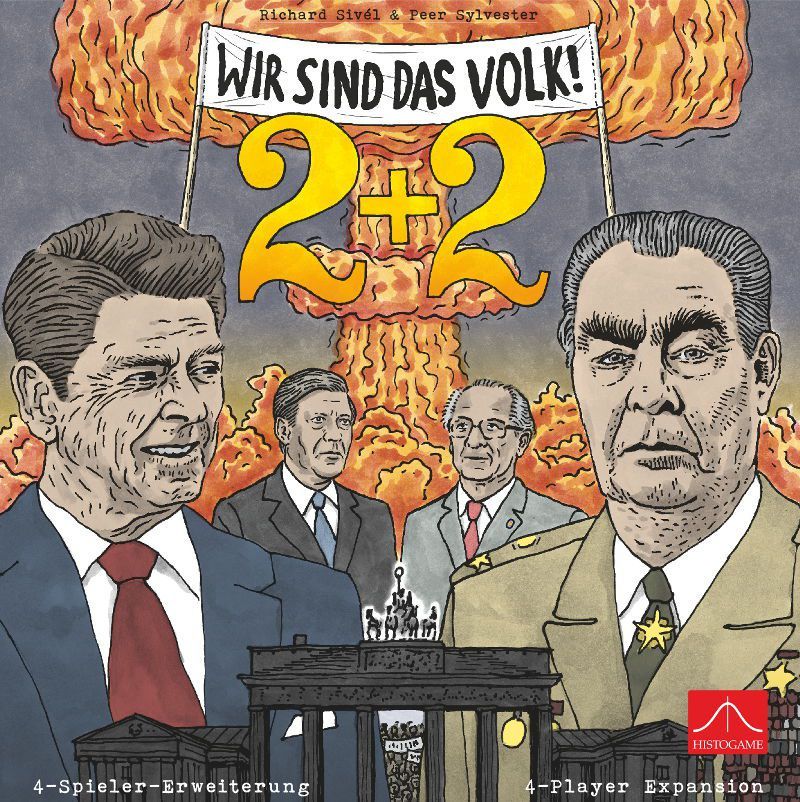
Qual é a sua dúvida sobre Wir sind das Volk!: 2+2?
Pergunte antes de baixar o manual: o assistente foi treinado neste arquivo e responde na hora, citando a página exata.
Tire dúvidas sobre o jogo
Pergunte qualquer coisa sobre Wir sind das Volk!: 2+2: regras, preparação, componentes, complexidade, preço ou se combina com seu grupo.
Escreva sua pergunta primeiro. Você criará sua conta grátis para ver a resposta — leva 20 segundos.
Manual completo
Navegue pelo manual ou baixe o PDF originalTexto completo do manual disponível para leitura Abrir texto
1 INTRODUCTION
is the four-player expansion for Wir sind das Volk! It is not a
stand-alone game. To play it, you need a copy of Wir sind das
Volk!
Basic idea: Players form partnerships (USA & West Germany vs
Soviet Union & East Germany). However, there will be only one
individual winner in the end.
Players build up their part of Germany and raise its living stand-
ards. Furthermore, the two superpowers USA and Soviet Union
fight the Cold War on three fronts (global dominance, arms race,
space race) – a contest which might end in a nuclear apocalypse.
A superpower wins, if it triumphs over the other one and if its
German ally fulfils its base game victory conditions. If no su-
perpower wins, the winner is the German state fulfilling its base
game victory conditions.
The expansion includes: 1 game board, 40 action cards, 10
arms race cards, 10 conflict cards, this rules booklet, and the
die-cut markers as depicted to the right.
Reminders for 2 events 1 extra factory
for the base game
Strict prestige arrows
for special cards
6 peace
doves
4 player markers
(1 for each player)
1 each for arms race, space race,
dominance, US treasury, Soviet treasury
(from left to right)
1 treasury + 10
(front and reverse)
1 red button
(front and reverse)
---
3+3 cards & 1 special card
Card display
Arms Race and conflict cards
Dominance
Space Race
Arms Race
Treasury
End of decade
Turn order
World peace (base game cards only)
DRAW DECK
sub-decades
B and C -cards for
— SOME BASIC DEFINITIONS —
Superpowers: USA and Soviet Union.
German states: West Germany and East Germany, hereafter referred to as West and East.
Yellow players: USA and West. They are allied.
Red players: Soviet Union and East. They are allied.
Active player: The player currently performing an action.
Active side: The active player and his ally.
Dominance advantage: When the dominance marker is in a yellow space, it is held by the USA. When the marker is in a red space, it is held by the Soviet Union.
2 GAME COMPONENTS
The game board
The game board shows 4 tracks (one each for treasury, arms race, space race and [global] dominance), a world peace pool and spaces for the end of decade, turn order and sub-decades.
The tracks are similar to the ones in the base game. One detail, however, is new: Most spaces have a victory point value. (The space depicted to the left is worth 1 victory point.) Victory points are earned by the superpowers at the end of the game.
The world peace pool
The game starts with 6 peace doves and 1 red button in the world peace pool. Be careful! When all peace doves are gone, nuclear war is only a press of the red button away.
Arms race cards & conflict cards
These cards form 2 separate draw decks. When engaging in the arms race or when affected by a conflict icon, a superpower has to draw 1 card from the corresponding deck.
The action cards
For each decade, there is one set of 10 action cards (hereafter referred to as -cards). Beside the well known card types, there are Blue, Green and Black Cards (with graphic art and title in the corresponding colour).
A Blue, Green and Black card.
Some cards have a ban on arms race icon in their top right corner. Such a card cannot be used for engaging in the arms race (see section 6.5).
Some cards have icons close to their card value. These icons are a penalty or a bonus for not triggering the card event. (For more details see section 7).
Important rules changes for WIR SIND DAS VOLK!
For better game balance, the rules were changed for Wir sind das Volk! in late 2015. Maybe you were not aware of these changes yet. The changes are:
1. East starts the game with only 1 socialist in the socialist holding box.
2. West starts the game with only 2 unrest cubes in the 3 supplier provinces (Baden-Württemberg, Nordrhein-Westfalen, Rheinland-Pfalz).
3. When East plays the special card, it has to either discard 1 hand card, or let West draw an additional hand card from the draw deck.
4. At the start of a new decade, a player holding 3 hand cards must discard at least one of them.
Note that these changes are valid for as well. You can download the current version of the WSDV rules at www.histogame.de.
2
---
3 SET UP
The 4 players choose their role. Then, set up the base game according to the above mentioned current rules version. Lay the game board alongside the top edge of the base game board.
Put the markers arms race, space race and dominance onto their tracks (each goes into the space depicting its symbol).
Put the markers US treasury and Soviet treasury face-up onto the space “$6” of the treasury track.
The world peace pool is filled with all 6 peace doves and the red button. (All markers are placed face-up.)
Relocate the base game marker End of Decade onto the end of decade space arms race (to be found on the board).
Put the 4 player markers onto the turn order track. The initial turn order is: 1. USA, 2. Soviet Union, 3. West, 4. East. Use the black-numbered spaces.
Shuffle both the arms race and conflict cards and stack them close to the board. — Now the game is ready to start. Starting player will be the USA.
4 SEQUENCE OF PLAY
Basically, the sequence of play is identical to the base game. Exceptions are: Every decade consists of 3 sub-decades (called A, B, C) and there are more end of decade phases.
Every sub-decade A is played as follows:
1. Determine the turn order according to section 5. (Skip this step in decade I.)
2. Put the special card of the current decade into the card display. Shuffle the base game cards of the current decade to form the draw deck and deal cards until every player has 2 hand cards. (As in the base game, players may discard hand cards from an earlier decade before receiving new hand cards.)
In , prestige arrows on special cards have a slightly different meaning. As a reminder, put the appropriate marker strict prestige arrow on such an arrow (see section 6.4).
3. From the draw deck, put 3 cards into the card display. Shuffle the cards of the current decade and put 3 into the card display.
4. With the remaining cards prepare 2 stacks for the upcoming sub-decades: Put 3 cards alongside each space sub-decade B and sub-decade C (see picture on pg. 2). Discard the remaining card unseen.
Note: The 2 sub-decade stacks are an automatic sub-decade tracker.
5. Actions. The starting player chooses 1 card from the card display or 1 hand card and performs 1 action. Only a red player may choose the special card. Then player 2 performs one action, followed by player 3, player 4, player 1 again, etc.
Tip: When you finish your action, move your player marker to the right. When player 4 is done, return all markers to their space of origin. That way you always know whose turn it is.
6. The sub-decade ends as soon as there is only 1 normal card left in the card display. (As in the base game, hand cards or the special card don’t matter.)
7. The event of this last card is then triggered automatically (see section 9).
As in the base game, line up played cards at the bottom edge of the board, unless a player has to collect a card.
Sub-decades B and C are played in almost the same way. Differences are:
• Ignore steps 1, 2, 4 above.
• In step 3, put into the card display
◦ for sub-decade B: The 3 prepared cards and 3 cards from the draw deck.
◦ for sub-decade C: The 3 prepared cards and 4 cards from the draw deck (that is, 1 card more).
• If still in the display, the special card stays there.
• Starting player is the one who would have had the next action in the sub-decade that just ended.
Sub-decades B and C end the same way as sub-decade A. When sub-decade C is finished, play the end of decade (section 12). If there is no winner, discard the special card (if still in the card display), set aside the draw deck unseen, and start the next decade.
In the rare case that the draw deck runs empty in decade III, bring into play 1 unplayed decade II card.
5 TURN ORDER
For determining turn order, consult the prestige and dominance tracks. Count the steps each marker is off its start position. Both results are positive for the players holding prestige/dominance advantage, and negative for the players in disadvantage.
The starting player is the one with the highest (positive) result, followed by the player with the second highest result, and so on. According to the result, put the player markers onto the turn order spaces 1–4.
Tiebreakers
When tied with a German state, a superpower is ranked higher.
If the prestige marker is in its start space, West is ranked higher than East.
3
---
If the dominance marker is in its start space, use the space race track to resolve the tie. If still tied, use the arms race track. If all 3 markers are in their start space, the USA is ranked higher than the Soviet Union.
+2 steps for East
(−2 for West)
0 steps from start space for USA & Soviet Union
Tiebreaker: +2 for USA
Example: The prestige marker was moved 2 steps in East’s favour (which means –2 steps for West). The dominance marker is on its start space (0 steps both for USA and Soviet Union). Because the USA are leading in the Space Race, the turn order is: East (+2), USA (0), Soviet Union (0), West (–2).
6 THE ACTIONS
As in the base game, players perform actions by playing a card. Every player can play a normal card in 1 of 4 ways. He may:
• remove 1 unrest counter, or
• build up the economy of his side, or
• increase living standard of his side, or
• trigger the card event.
A superpower has 2 more options. It can:
• engage in the arms race, or
• take a credit.
In case of a special card, you may only trigger the event (and only a red player may do so).
6.1 Remove 1 unrest counter
The base game rules are not changed. The USA may remove 1 West unrest counter, the Soviet Union may remove 1 East unrest counter (as if they were West or East).
For a yellow (red) player, the removal is free when using a Yellow (Red) Card. In all other cases, players have to pay by dismantling 1 build point in “their” Germany.
6.2 Build up economy
The base game rules are not changed. The USA may build up West’s economy, the Soviet Union may build up East’s economy (as if they were West or East).
6.3 Increase living standard
The base game rules are not changed. The USA may increase West’s living standard and the Soviet Union may increase East’s living standard (as if they were West or East, including the decision about where Hamburg or an external factory belongs to).
6.4 Trigger the card event
The base game rules are not changed. A Red Card event may be triggered only by a red player. A Yellow Card event may be triggered only by a yellow player. All other cards’ events can be triggered by any player.
Dual Cards: A player may ignore 1 arrow or 1 icon without arrows when triggering a Dual Card event (as in the base game).
Blue Cards: Blue Card events are symmetrical. (Every icon and every arrow exists in red and yellow.) When triggering the event, a red player ignores all yellow arrows/icons; a yellow player ignores all red arrows/icons.
Black Cards: When triggering the event, a player executes all icons and arrows.
Green Cards: When triggering the event, a player executes all icons and arrows.
Icons blended with a coat of arms are executed by West or East (as in the base game).
Left-right arrows: Some Cards depict icons with arrows pointing in both directions. When these arrows have to be executed, move the marker by the net-sum. (1 left & 1 right is a net-shift of 0.) In case of left-right arms race arrows, both superpowers still have to pick 1 arms race card each.
Superpowers and prestige arrows: When an active superpower executes a prestige arrow, it may opt to move the dominance marker in stead. A double arrow (which allows the movement of 2 steps) may be split to both tracks. The strict prestige arrow, however, has to be executed on the prestige track. The same is true for a prestige arrow on a special card (e.g. Russian tanks).
Tip: Use the appropriate marker strict prestige arrow to convert a special card prestige arrow to a strict prestige arrow.
Non executable dominance arrows: For each red dominance arrow which cannot be executed (because it would shift the marker off the track) the Soviet Union may choose to add +$1 to its treasury or to remove 1 East unrest counter. The USA benefits from non-executable yellow arrows accordingly (+$1 or remove 1 West unrest counter).
New icons: The new icons are explained on the next page.
Example 1: The Soviet Union triggers this event. It ignores all yellow icons and all yellow arrows. This results in the shift of both the space race and dominance markers by 1 to the right. Finally, the Soviet Union has to pay $3 from its treasury.
Example 2: East triggers this event. As a result, 2 peace doves are flipped back to their face-up sides. Furthermore, East opts to shift the prestige marker by 1 in its favour and puts the card in front of itself. (This reflects East’s engagement for world peace.)
Variant: As above, but East opts to shift the dominance marker by 1 in US-favour to sabotage Soviet plans.
4
---
Icons with arrows
According to the arrows, move the dominance marker by 1 or 2 to the left or right.
As in the base game. However, an active superpower may choose to move the dominance marker instead. (A double arrow can be split to both tracks.)
Strict prestige icon. The same as a prestige icon, but a superpower cannot choose to move the dominance marker instead.
The active player chooses whether to move the dominance or the prestige marker by either 1 space to the left or to the right. Ignore this icon in the case of an automatic event. (Note: East, trying to win the game, could move the dominance marker by 1 in US-favour; this is perfectly legal.)
According to the arrows, move the space race marker to the left or right.
According to the arrows, move the arms race marker to the left or right. Furthermore, the benefiting superpower has to draw and execute the top arms race card.
Icons without arrows
Flip 1 peace dove to its blank side. If all are already flipped, the active player has to press the red button and put it in front of himself (with the mushroom cloud side face-up). By doing that he triggers a nuclear war and the game ends immediately. (If an automatic event triggers the war, the player who was last active has to press the button.)
Reflip 1 flipped peace dove (if possible).
Peacemaker. Upon finishing his action, the active player collects the card in front of himself. (In case of a nuclear war, the player with the most collected peacemaker cards will win.) Ignore this icon in the case of an automatic event.
The affected superpower pays the stated amount from its treasury. Move its treasury marker accordingly. (Here, the Soviet Union pays $1.)
The affected superpower adds the stated income to its treasury. Move its treasury marker accordingly. (Here, +$3 for the USA.)
The affected superpower (here, the Soviet Union) draws the top conflict card and executes its effects.
The superpower of the active side draws the top conflict card and executes its effects.
From now on, the cost for each arms race step is increased by +$1. Put the appropriate reminder on the arms race draw deck.
From now on, when the Soviet Union chooses the actions Build up economy or Increase LS the card value is reduced by 1 (but not below 0). Put the appropriate reminder into East’s territory. (Notes: a) Even with a 0-value the Soviet Union can still place up to 3 LS. b) East is not affected by this icon.)
Clarification for base game icons
Follow precisely the base game rules. (So even if the Soviet Union triggers the event, East will benefit from the icon; East may examine only the West hand of cards or the draw deck; superpower hand cards or-cards are a no-no.)
6.5 Engage in the arms race
Only a superpower may choose this action. It can use every normal card not depicting a ban on arms race icon. On choosing that action, the superpower moves the arms race marker by 1 step in its favour, draws the top arms race card and executes its effects.
Example: In decade 2, the Soviet Union engages in the arms race. It moves the arms race marker by 1 in its favour and draws the arms race card. The effect is the highlighted icon (red column, decade 2): The Soviets deduct $1 from their treasury.
— THE TREASURIES —
Superpowers track their $-income and payments by shifting their treasury marker accordingly.
When a marker has to be moved off the track, then flip the marker and treat the space –$1 as –$6 (in case of a deficit), or use the treasury+10 marker instead and treat the space $1 as $11 (in case of a surplus).
6.6 Take a credit
Only a superpower can take a credit. It can use every normal card. With this action, the superpower receives income equal to the card value.
A superpower is in the red, when its treasury becomes negative. It is then severely restricted in its choice of actions. It can only:
• Take a credit, or
• Trigger events which add income to its treasury.
Tip: If a superpower is in the red, flip its player marker.
5
---
7 VALUES WITH ICONS
Some cards have one or more icons close to
their value. If such icons are to be executed,
they are executed after the player action.
Play the card value: Every action except
trigger the card event is referred to as play
the card value.
An icon right of a value can only
be a red or yellow conflict icon. A
red conflict icon is executed if a
red player plays the card value. A
yellow conflict icon is executed if a yellow
player plays the card value.
Icons below a value are executed if
any player plays the card value.
Example: East builds up its economy with the value
depicted above. Because it does not trigger the card
event, the icons are executed after East’s action. For
the black conflict icon, the superpower of the active
side has to draw 1 conflict card. This is the Soviet
Union. For the crossed-out peace dove, 1 peace dove
is flipped in the world peace pool.
8 ARMS RACE & CONFLICTS
The arms race and conflict cards form 2 sep-
arate draw decks. The following rules apply:
Arms Race cards. When-
ever a superpower moves
the arms race marker one
step in its favour, it has to
draw the top arms race card and execute its
effects (even if the arms race step is the result of
an event or of a conflict card).
The effects are found by cross-indexing
the current decade with the superpower’s
column. Icons are executed from left to right.
The superpower decides where to apply the
effect. (Unless the icon is blended with a coat of
arms; here the decision is up to East or West as
usual.)
Conflict cards. Whenever a
superpower is affected by a
conflict icon, it has to draw
the top conflict card and ex-
ecute its effects. (In the case that both su-
perpowers are affected simultaneously, it is – as
usual – up to the active player to decide who
draws the card first.)
Example: The Soviet Union draws the above conflict
card. The red column is in effect. Therefore, the dom-
inance marker is shifted by 2 to the left.
For both decks:
• The yellow column applies to the USA,
the red column to the Soviet Union.
• Discard an executed card.
• You may count the cards still in the
draw deck. You may not inspect
formerly executed cards, except the last
one.
Reshuffle. In both decks there are 2
cards with this icon. It means: Re-
shuffle all 10 cards of this deck (incl.
discards) and form a new draw deck.
9 AUTOMATIC EVENT
Important: The rules of this section apply only to
the automatic event itself, but not to resulting secon-
dary effects (like a bonus for a non-executable pres-
tige arrow). Secondary effects are executed per the
standard rules.
At the end of a sub-decade, the event of
the last normal card in the open display is
automatically triggered and executed in the
standard way. However:
• For a Dual Card, do not ignore any
icon/arrow.
• For a Blue Card, execute all icons and
arrows (even if their net-effect is 0).
• For a Green Card ignore icons/arrows
on a shaded background.
Which sequence? All icons/arrows are ex-
ecuted from left to right and from top to bot-
tom.
Where? Icons blended with a coat of arms
are executed as usual by East or West. For
any other red icon, East decides where to ap-
ply its effect; for any other yellow icon, West
decides where to apply its effect. (All other
icons and arrows don’t offer any choice. Note that
a prestige arrow cannot be converted to a domin-
ance arrow, since there is no active superpower.)
Arms race advantage. A superpower may ig-
nore some of the above rules if it has an arms
race advantage. To find out the specific ad-
vantage, check the position of the arms race
marker before executing the automatic event.
Note: The determined arms race advantage is valid for
the complete automatic event, even if the arms race
marker is moved during the auto-event.
The meanings of the icons shown below are:
The USA decides where the effect of
an icon is applied, unless it is an icon
blended with a coat of arms.
As above. In addition, the USA de-
cides where to apply the effect of an
icon blended with East’s coat of arms.
As above. In addition, the USA may
ignore 1 icon or 1 arrow (as if the card
were a dual card).
Victory space. All above advantages
are in effect. In addition, US victory
can be triggered in the end of decade
(see section 12).
For the Soviet Union, the red icons have the
equivalent/mirrored meanings.
10 SPECIFICS FOR EAST
The special card: Both East and the Soviet
Union may play the special card. Whoever
plays it must discard 1 hand card or let the
yellow side draw an additional hand card
from the draw deck. The card will be drawn
by the yellow player with fewer hand cards;
if both have the same number, it will be
drawn by the player whose turn is next.
Police power cards: The Soviet Union may
use East’s police power cards to remove un-
rest counters (as if it were East).
Stasi-disbandment: In the rare case that
7 unrest counters are to be returned, East
chooses one province to receive 2.
6
have the equivalent mirrored meanings 10 SPECIFICS FOR EAST The special card Both East and the Soviet Union may play the special card Whoever plays it must discard 1 hand card or let the yellow side draw an additional hand card from the draw deck The card will be drawn by the yellow player with fewer hand cards if both have the same number it will be drawn by the player whose turn is next Police power cards The Soviet Union may use East s police power cards to remove un rest counters as if it were East Stasi disbandment In the rare case that 7 unrest counters are to be returned East chooses one province to receive 2 6
---
11 NUCLEAR WAR
During the Cold War, the world was more than once at the edge of a nuclear war. The destruction of mankind would have known no winner, and normally a game should have no winner as well. However, game dynamics become quite problematic when all players can lose. Therefore, there will be a winner even if nuclear war breaks out.
The game ends immediately with a nuclear war when a player has to press the red button (because there is no peace dove left in the pool). This triggering player loses.
Victory in case of a nuclear war. The winner is the non-triggering player who collected the most cards with a peacemaker icon. In case of a tie, the ally of the triggering player loses the tie.
Peacemaker icons exist only on Green and Black cards. You collect such a card, when you: a) trigger the event of a Green Card, or b) use a Black Card for any action, except triggering the event.
12 END OF DECADE
The end of decade is amended by the addition of arms race, space race and dominance phases. After these, you play the 10 phases of the base game.
12.1 Arms race
Check the arms race track.
Arms race victory. A superpower wins immediately when the marker is in one of its victory spaces. Skip the remaining phases.
Note: All other icons of the arms race track are ignored during the end of decade.
12.2 Space race
The position of the marker on the space race track tells you what icon(s) to execute.
This icon means: The benefiting superpower (here, the Soviet Union) immediately receives 1 hand card from the draw deck of the next decade. At the start of the next decade, it may discard hand cards from a (then) earlier decade (but not the just received hand card). After that it refills its hand to 3 cards before then discarding 1 of its choice.
Space race victory. A superpower wins immediately when the marker is in its victory space. Skip the remaining phases.
12.3 Dominance
The player holding the current dominance advantage executes the icon(s) below the dominance marker or of a lower value box.
Both superpowers receive regular income from the dominance track. Note that they will receive it even if there is no future decade to come. This is important, since ending the game in the red will result in negative victory points (see below).
12.4 Base game end of decade
Now the base game end of decade is played, phase by phase, starting with Flight/wall, prestige, etc.
If one of the base game victory conditions is fulfilled, the game ends immediately. The winner is then determined in 2 steps.
1. Determine the winning side:
• The yellow side wins, if East loses (for instance by collapsing due to 4 mass protests or by suffering national insolvency),
• The red side wins, if West loses.
2. Determine the the winning player. For that, both superpowers add up their victory points on the tracks. Note: A superpower ending the game in the red receives –1 victory point for each $2 deficit.
The winner is the winning side’s superpower, if it has more victory points than the opposing superpower; otherwise the winner is the winning side’s German state.
Soviet Union: 4 − 1 = 3 VPs 2 + 1 = 3 VPs
USA:
Example: East collapses due to 4 mass protests, this makes yellow the winning side. Since both superpowers have 3 victory points, the USA is not better than the Soviet Union: Therefore West wins.
13 RANKING
In case of a nuclear war, there are 1 or 2 winners and 1 loser. All others are second-last.
For all other victories, there is only 1 winner; all other players lose. Exception: When the game ended in decade IV, the winner’s ally is second ranked.
Players earn tournament points as follows:
NUCLEAR WAR WIN
Winner 2nd-last Loser
4 P 1 P –2 P
ALL OTHER WINS
Winner 2nd Loser
4 P 2 P 0 P
14 TABLE TALK
Before starting the game, players should agree on how much game specific discussions they want to allow. It is recommended to play without any hints or advice increases the tension. However, non-experienced players might find some coordination helpful.
But it should be strictly forbidden to provide any kind of information about hand cards.
7
---
Design notes
I.C.B.M’s, S.S.20’s, they lie so dormant,
they got so many.
Midnight Oil, 1984
It was clear right from the start that there should be
a four-player version of Wir sind das Volk (WSDV).
For pragmatic reasons, however, its design had to
wait. We supposed that once the 2-player game
was finished, it would be very easy to introduce
rules for the superpowers. How wrong we were!
Peer’s initial idea was somewhat abstract, but the
first play test worked quite well. Unfortunately,
the Cold War feel was completely lacking. Most
crucially, neither playing the USA nor the Soviet
Union felt like being the USA or the Soviet Union.
We went back to the drawing board and intro-
duced tracks for the key elements of the Cold War:
The arms race, the space race and global dominance. These tracks, along with the new action types
(arms racing & take a credit) and the Blue, Green
and Black Cards transformed— it was now a
true Cold War game. Eventually the process of pol-
ishing and balancing could start.
Sub-decades and automatic events. With 10 ad-
ditional cards per decade, two half decades were
not enough. We tried quarter decades, but they
didn’t work well. Then we switched to 3 sub-
decades including an auto-event. This fixed four
design problems in one stroke! (And it is always
good when one new rule solves more than one
problem.) 1.) Three sub-decades tightened the
storytelling arc considerably. 2.) Since there are
more Red Cards than Yellow, the red side will be-
nefit more often from the auto-event, thus mitigat-
ing the problem of balance. 3.) The arms race ad-
vantage could be modeled simply and effectively.
(Up to then it was a time consuming procedure
with almost no effect.) 4.) Since automatic event
plays are faster than player actions, playing time
was reduced to ca. 180 minutes, as desired. (N.B.:
The last sub-decade includes one extra card to en-
able all the players to take the same number of ac-
tions, assuming all the hand cards are played.)
The Hungarian Uprising. This is a new sort of Red
Card, since the event is bad for the red side. This
is reflected by the card values, too. (The value is
higher for yellow than for red.) Our thinking was:
If the event is triggered, the Hungarian Uprising
takes place as it did historically. If yellow plays the
value, the Uprising does not take place; if red plays
the value, the Uprising takes place, but without So-
viet intervention. The same concept is used for the
Vietnam and Afghanistan events as well.
Conflicts and the arms race. In the real world, the
outcome of conflict is unpredictable. That’s why
we introduced variable costs determined by draw-
ing a card. The same is true for the arms race:
Every step in the arms race is a danger to world
peace and also the political and monetary costs
are uncertain. Engaging in the arms race is play-
ing with fire. Nevertheless, your decisions may be
conditioned by the perverse logic of the arms race
if your opponent is getting too far ahead. It should
be mentioned that the conflict icons also serve an-
other important purpose: Triggering them, a German
state can sabotage the plans of its allied super-
power to promote its own victory.
Blue, Green, Black Cards. You can only advance
along the space track using Blue Cards. It is a race:
Who will launch the first satellite? Who will be the
first to reach the moon? What happens in the game
does not necessarily reflect what happened histor-
ically. That’s why the Blue Card events are sym-
metrical. Black Cards address major crisis. Their
events, which always remove peace doves, is not
very useful for anyone. But, for a superpower
playing the value is not a real option either. So
maybe the best is to simply leave them on the dis-
play — but will the world peace survive a Black
auto-event? Black Cards present an exquisite di-
lemma. Green Cards restore peace doves. And so,
by paradoxical Cold War logic, superpowers need
green events to progress in the arms race.
Individual victory. Although allied, players pur-
sue their own objectives. There is a real multi-
player dynamic. Play is much less predictable than
in WSDV, the situation on the tracks can change
rapidly. Winning the game is a tightrope walk. If
you hinder your partner too much, he will need
precious actions to get back on track, actions which
may be desperately needed for the common cause.
On the other hand, if you don’t slow him down
enough, you won’t win either. The victory condi-
tions are to be read as: A German state wins by
triumphing over the other Germany and reaching
full sovereignty.
Nuclear war. Even if the idea of global destruction
is utterly repellent, what would a game about the
Cold war be without the threat of nuclear war? Al-
most immediately we rejected the obvious thought
of everyone losing if nuclear war broke out. A
game needs a clear winner, which is not possible if
everyone loses. Players who thought they had no
chance of winning would be tempted to play de-
structively to drag all the others down with them
into nuclear apocalypse. Thus, we came up with
the idea of making the biggest peacemaker the
winner if there was a nuclear war.
GAME DESIGN : Richard Sivél & Peer Sylvester
COVER ILLUSTRATION : Friedemann Bochow
OTHER GRAPHICS : Richard Shako
LAYOUT, TEXTS, TRANSLATION: Richard Shako
PROOFREADING: Stefanie Tinder. Many thanks
ENGLISH PROOFREADING : John McCullough, Guy
Atkinson, Robin Gower. Many, many thanks
PLAYTESTING: Johannes Strobel, Anton Telle, Srđan
Grbić, Christophe Denoize, Björn Steinborn, Holger
Schulz, Mario Ruhmann, Thorsten Groß, Hendrik
Möller, Markus Stoy, Christoph Rauh, Gerd Kunz-
mann, Thilo Kramer, Bernd Eisenstein, Spielwiese
game designers meeting, et al. – Many, many thanks!
Extra-special thanks to Christophe Denoize for
programming the 2+2 playtest online-version on
play.boardgamecore.net. Special thanks to Mikhail
Evstafiev for allowing to use his Afghanistan photo.
Many cards’ graphic art is licensed under Creative
Commons, details to be found in the ”Bildnachweis”.
©2017 Histogame, Knaackstr. 70, 10435 Berlin,
www.histogame.de. All rights by Histogame and the
designers.
Talking of nuclear war, we want to commemor-
ate the man who saved humanity in 1983: Three
weeks after the KAL007 was shot down, he was
duty officer in a Soviet early-warning command
centre and judged a computer alert of an incom-
ing US nuclear missile to be a false alarm, and thus
averted an immediate retaliation strike. Stanislaw
Jewgrafowitsch Petrow. To him we wish to grate-
fully dedicate. May many equal his example of
moral courage and considerateness — especially in
these times with all their Kims and Trumps.
Richard Sivél
Berlin, September 2017
Creative Commons details to be found in the Bildnachweis 2017 Histogame Knaackstr 70 10435 Berlin www histogame de All rights by Histogame and the designers Talking of nuclear war we want to commemor ate the man who saved humanity in 1983 Three weeks after the KAL007 was shot down he was duty officer in a Soviet early warning command centre and judged a computer alert of an incom ing US nuclear missile to be a false alarm and thus averted an immediate retaliation strike Stanislaw Jewgrafowitsch Petrow To him we wish to grate fully dedicate May many equal his example of moral courage and considerateness especially in these times with all their Kims and Trumps Richard Sivél Berlin September 2017
---
BILDNACHWEIS
Die Bildrechte der Fotos, aus dem die Grafik der folgenden Spiel-
karten als grafische Bearbeitungen entstanden, liegen bei:
Nr.3: Bundesarchiv, B 145 Bild-107546 / CC BY-SA, Lizenz: CC-
BY-SA 3.0
Nr.5: Bundesarchiv, Plak 005-002-008/CC BY-SA, Lizenz: CC-BY-
SA 3.0
Nr.7: Bundesarchiv, Bild 183-B0118-0010-027/CC BY-SA, Lizenz:
CC-BY-SA 3.0
Nr.8: FOTO:FORTEPAN/Pesti Srác, via Wikimedia Commons/
Lizenz: CC-BY-SA 3.0
Nr.9: Deutsche Fotothek/Lizenz: CC-BY-SA 3.0 de
Nr.13: By Austin Mills (austinmills), via Wikimedia Commons,
Lizenz: CC-BY-SA 2.0
Nr.19: RIA Novosti archive, image #36535 / Yuriy Ivanov / via
Wikimedia Commons/Lizenz: CC-BY-SA 3.0
Nr.21: Bundesarchiv, Bild 183-T0709-148 / Peter Koard / CC BY-
SA, Lizenz: CC-BY-SA 3.0
Nr.24: Bundesarchiv, Bild 183-76052-0335/Kohls, Ulrich/CC BY-
SA, Lizenz: CC-BY-SA 3.0
Nr.25: Bundesarchiv, Bild 183-P0801-026/CC BY-SA, Lizenz: CC-
BY-SA 3.0
Nr.26:(Solschenizyn)By Verhoeff, Bert / Anefo / via Wikimedia
Commons / Lizenz: CC-BY-SA 3.0 /(Sacharow)By Rob C. Cro-
es (ANEFO) GaHetNa (Nationaal Archief NL) / via Wikimedia
Commons/Lizenz: CC-BY-SA 3.0
Nr.29: Bundesarchiv, B 145 Bild-F088809-0038/Thurn, Joachim F.
/CC BY-SA, Lizenz: CC-BY-SA 3.0
Nr.30: © Mikhail Evstafiev (www.evstafiev.com)
Nr.34: By Eric Salard (HL7492), via Wikimedia Commmons, Li-
zenz: CC BY-SA 2.0
Nr.37: RIA Novosti archive, image #30624/E. Kotliakov/Lizenz:
CC-BY-SA 3.0
Nr.38: RIA Novosti archive, image #770913/Yuryi Abramochkin
/Lizenz: CC-BY-SA 3.0)
Nr.40: By Vladislav Falshivomonetchuk (Own work) / via Wiki-
media Commons/Lizenz: CC-BY-SA 3.0
Ferner wurde Bildmaterial inbearbeiteter Form verwendet für:
Guillaume-Affäre-Symbol:Foto, Pelz, Wikimedia Commons, Li-
zenz: CC-BY-SA 3.0. Sozialistensymbol:Foto, Bundesarchiv, Bild
102-12940 / Lizenz: CC-BY-SA 3.0 DE. Betonhintergrund:Lear-
ning Object Online Platform, Fachhochschule Lübeck, http:/
/loop.oncampus.de, Lizenz: CC-BY-SA 3.0
Eine Grafik, deren Vorlage lt. obiger Liste unter einer CC-BY-SA-
Lizenz steht, steht unter derselben Lizenz wie seine Vorlage. Bei
Verwendung ist als Namensnennung anzugeben: Richard Shako,
Histogame, www.histogame.de, K/G x des Brettspiels 2+2. Für K/G
ist Karte bzw. Grafik und für x Kartennr. bzw. Name der Grafik
einzusetzen.
Die Links zu den Lizenzen sind:
CC BY-SA 3.0 de: [...]/by-sa/3.0/de/legalcode
CC BY-SA 3.0: [...]/by-sa/3.0/legalcode
CC BY-SA 2.0: [...]/by-sa/2.0/legalcode
Hierbei steht [...] für https://creativecommons.org/licenses
Alle anderen Grafiken sind freie Zeichnungen, Collagen, Freie
Benutzungen, Bearbeitungen gemeinfreier Vorlagen, etc.
---
Por que perguntar ao BoardGamesBot
Em vez de folhear o manual inteiro- Respostas precisas Baseadas exatamente neste manual, com a página de origem.
- Economize tempo Ache a regra em segundos, sem folhear 9 páginas.
- A qualquer hora Tire dúvidas no meio da partida, direto do celular.
- 100% grátis Crie sua conta grátis e comece a usar agora.
Como funciona
Três passos até a resposta- 1 Faça sua pergunta Digite sua dúvida sobre as regras deste jogo.
- 2 Crie sua conta grátis Leva 20 segundos — é só para guardar seu histórico.
- 3 Receba a resposta A IA encontra a regra exata e cita a página do manual.
Manual publicado pela editora · uso para consulta de regras. Mais sobre o jogo em BoardGameGeek e Ludopedia .