
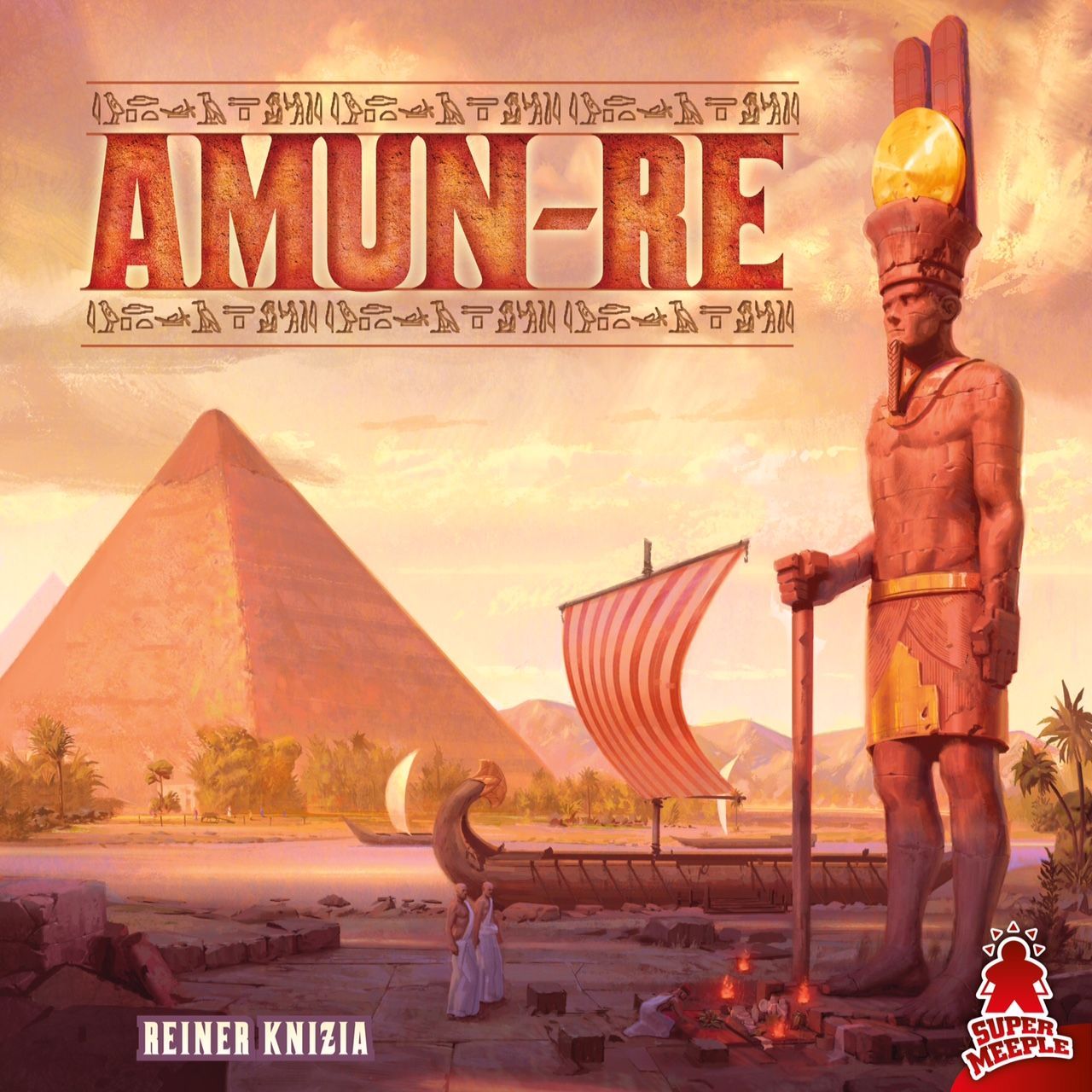
Amun-Re
Hans im Glück, Super Meeple, 999 Games · Board game · 2003Objective of the Game
Welcome, aspiring Pharaohs, to the sun-drenched lands of ancient Egypt! In Amun-Re, you'll lead your royal family through the Old and New Kingdoms, vying with rivals to acquire fertile provinces, erect magnificent temples and pyramids, and cultivate your fields along the unpredictable Nile. Your ultimate goal? To be remembered by history as the greatest pharaoh of all time! This means outscoring your opponents in Victory Points (VP) across two ages of intense auctioning and development. May Amun-Re favor your reign!
Preparation (Setup)
Let's get this ancient empire ready for action! Here’s how to set up your game of Amun-Re:
- Lay the beautiful game board face-up in the center of your table.
- Create a supply of Stones, Pyramids, and Double Pyramids in the designated Quarry area on the board.
- Form a separate supply of Farmer tokens.
- Sort the Gold cards by value to create the Gold Reserve, placing the stacks face-up next to the board. Remember, you can always make change with these!
- Place the Offering tiles face-up beside the game board.
- Deal 1 Architect Favor card to each player. Shuffle the remaining Favor cards (with statue backs) to form the Favor deck and place it beside the board.
- Construct the Province deck (with pyramid backs). It should contain 3 Province cards per player. For example, a 4-player game uses 12 cards. Return any unused Province cards to the box.
- Each player chooses a color and collects their 3 matching Scribe pawns. Return unused components to the box.
- Place a Victory Point marker of each player's color next to the score track on the game board.
- Deal each player a combined value of 20 Gold using various Gold cards.
- Deal 1 Theft card to each player. Return any unused Theft cards to the box.
- Randomly determine the Start Player and give them the Start Player token.
The Turn of Play
A game of Amun-Re unfolds over two ages (the Old Kingdom and the New Kingdom), each consisting of three identical rounds. Each round is divided into four exciting phases:
1. The Auction Phase
Time to claim your territory! In this phase, players bid to acquire valuable Provinces.
- At the start, draw 1 Province card for each player and place them face-up on their matching Provinces on the board.
- For each Province card placed, add any Stones, face-down Favor cards, and Gold cards indicated in its brown "Immediate Bonuses" box.
- Starting with the Start Player and proceeding clockwise, each player must either:
- Place a bid on an unoccupied bidding space of a Province using one of their Scribe pawns. If bidding on an already-bid-on Province, your bid must be higher than the current one.
- Pass, if you already have the highest bid on a Province.
- If you are outbid, you must move your Scribe pawn to bid on a different Province on your next turn. You cannot bid on the same Province again immediately.
- You cannot bid more Gold than you currently possess.
- The auction ends when exactly 1 Scribe pawn is on each Province.
- Players then pay their bid in Gold to the Reserve and leave their Scribe pawns on the board to show control.
- Finally, players collect any Immediate Bonuses (Stones, Favor cards, Gold) indicated on their newly acquired Provinces. The Province cards are then moved to a discard pile.
Favor Cards in Auction:
- Bribery: If outbid, play this to make a new, higher bid on the same Province.
- Protection: When bidding, play this to block the next-highest bidding space, forcing opponents to bid at least 2 spaces higher.
2. The Market Phase
Now that you have your Provinces, it's time to develop them! Starting with the Start Player, you can purchase items from the supply in a specific order:
- Favor cards: You can buy 0-4 Favor cards, limited by the highest number of Favor symbols on any single Province you control. No Favor symbols means no Favor cards!
- Farmer tokens: Purchase Farmer tokens and immediately place them in open Field spaces in your controlled Provinces. You can't buy Farmers you can't place.
- Stones: Acquire Stones and immediately place them in your controlled Provinces.
You pay Gold to the Reserve based on the cost scale on the board for each type of item. Each purchase is separate. Once you've purchased an item type or passed on it, you can't buy it again this turn.
Construction: As soon as a third Stone is placed in a single Province, immediately replace those 3 Stones with a single Pyramid. If a Pyramid was already there, replace it with a Double Pyramid instead!
Favor Cards in Market:
- Architect: Play this to build 1 Pyramid using only 2 Stones instead of 3.
- Free Farmer: Play this to acquire 1 Farmer token for free and place it in any Province you control, even if it has no Field spaces. This is separate from your normal Farmer purchases.
3. The Offering Phase
The Nile's flood is crucial, and Amun-Re needs convincing! Players secretly choose and simultaneously reveal Gold cards or a Theft card as their offering.
- Gold Offering: Your offering value is the sum of all Gold cards you contribute.
- Theft Card: If you play a Theft card, you steal 3 Gold from the Reserve.
- You can include a blue Offering Adjustment Favor card with your offering.
- Calculate the Collective Offering: Sum all individual Gold offerings, then subtract 3 for each Theft card played.
- Offering Adjustment: Starting with the Start Player, players who played an Offering Adjustment Favor card declare whether to increase or decrease the collective offering by 3.
- Place the corresponding Offering tile on the Nile Delta space based on the final collective offering value.
- If you played a Theft card, return it to your hand and collect your 3 Gold from the supply.
- Rewards:
- The player who contributed the most Gold to the offering collects 3 Rewards (any combination of Favor cards, Stones, and/or Farmer tokens).
- The player with the second-highest offering collects 2 Rewards.
- All other players collect 1 Reward.
- Players who played a Theft card receive no Rewards.
- In case of a tie for highest/second-highest offering, the player earliest in turn order wins the tie.
- Remember to place Farmer tokens in open Field spaces and Stones immediately in your Provinces. Three Stones in a Province become a Pyramid!
- New Start Player: The player who offered the most Gold becomes the new Start Player for the next round. Ties are broken by current turn order.
4. The Harvest Phase
The Nile has flooded! Beginning with the Start Player, players collect income from their controlled Provinces.
- Gold Mines: Gain Gold equal to the indicated number on the Province.
- Caravans: Gain Gold equal to the number indicated above the camel, but only if the current Offering tile depicts a camel.
- Farmer Tokens: For each Farmer token in your Provinces, gain Gold equal to the amount shown on the current Offering tile.
Favor Cards in Harvest:
- Big Harvest: Play this before calculating income. Choose one Province; each Farmer token in that Province provides 1 additional Gold this turn.
- Treasury: Play this before calculating income. Choose one Province; that Province provides no income this turn, but you instead collect 8 Gold from the Reserve.
End of Game and Scoring
After the Harvest Phase, the round ends. A new round begins unless it's the third round of an age.
Intermediate Scoring
This occurs at the end of each age (after the 3rd round). Award Victory Points (VP) for:
- Temples: +1, +2, +3, or +4 VP for each Temple you control, based on the Gold value on the current Offering tile.
- Pyramids: +1 VP for each Pyramid you control (Double Pyramids count as 2 Pyramids).
- Fewest Pyramids: +3 VP for each Pyramid in your single Province with the fewest Pyramids. (If you control a Province with no Pyramids, you don't score for this item).
- Most Pyramids per Nile Side: +5 VP for the player with the most Pyramids on each side of the Nile (Upper and Lower Egypt score separately). Ties are broken by Stones, then shared.
- Yellow Favor Cards: +3 VP for each yellow Favor card whose conditions are satisfied (e.g., Master of Scribes, Master of Farmers, West Side/East Side, Nile/Frontier, Upper/Lower Egypt). Discard these after scoring.
If this is the end of the Old Kingdom: Remove all Scribe pawns and Farmer tokens from the board, returning Farmers to the supply. Collect all Province cards and shuffle them back into the Province deck. Pyramids and Stones remain on the board but are no longer controlled.
If this is the end of the New Kingdom: Proceed directly to Final Scoring!
Final Scoring
After the New Kingdom's Intermediate Scoring, it's time for the grand finale!
- Players reveal their Gold cards.
- +6 VP to the player with the highest combined value of Gold cards.
- +4 VP to the player with the second-highest value.
- +2 VP to the player with the third-highest value.
- In case of a tie for any of these rewards, all tied players score the appropriate VP, but subsequent players are moved down (e.g., if two players tie for highest, they both get +6 VP, and the next player scores +2 VP).
The player with the most Victory Points wins! In case of a tie, the tied player with the most Pyramids wins. If still tied, the player with the most Stones wins. If still tied, victory is shared!
Tips for Winning
- Master the Auction: Don't just bid high; bid smart! Sometimes a low bid on a less contested Province can secure you valuable Immediate Bonuses or crucial Permanent Bonuses like Favor symbols or Gold Mines. Watch what others need and try to predict their moves.
- Pyramid Power: Pyramids are a consistent source of Victory Points and are key to breaking ties at the end of the game. Prioritize building them, especially in your "fewest Pyramids" Province for that sweet +3 VP bonus during Intermediate Scoring. The Architect Favor card is a fantastic way to accelerate this!
- Adapt to the Offering Tile: The current Offering tile dictates the income from Farmers and Caravans, and the VP for Temples. Pay close attention to its values and the presence of the camel. If a big Farmer income is coming, investing in Farmer tokens during the Market Phase can pay off handsomely. Likewise, if Temples are worth a lot, acquiring Provinces with them becomes more valuable.

