
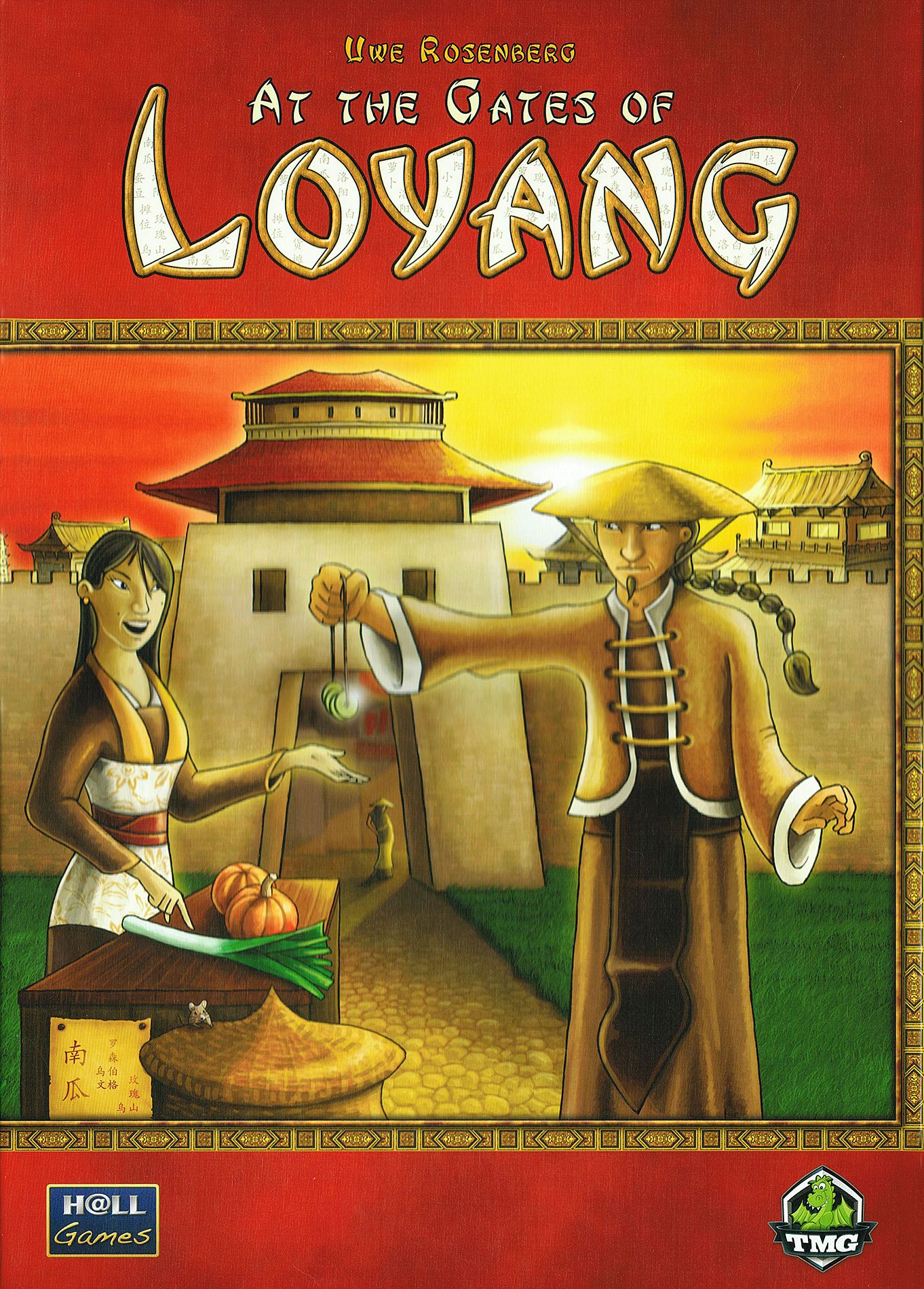
At the Gates of Loyang
Hall Games, Tasty Minstrel Games, 999 Games · Board game · 2009
1–4 · best 2
Solo
60–120 min
Weight 3.1/5
7.8
rating
Ludopedia
7.3
rating
BGG
Game Objective
Welcome, farmers! In "At the Gates of Loyang," you are talented farmers in ancient China, on the outskirts of the prosperous capital of Loyang. Your objective is simple yet challenging: become the most successful farmer by advancing as far as possible on the **path of prosperity**. Each step requires more money, so finding the perfect balance between investing and profiting is key to victory. The game lasts 9 rounds, and whoever is furthest along the path of prosperity at the end will be the grand winner!Preparation (Setup)
Let's set up the table and prepare your fields for harvest!- Separate all **game components**: the **coins**, the **vegetables** (wheat, pumpkins, turnips, cabbages, beans, leeks), the **satisfaction markers**, and the **loan cards**. Create a **common supply** with them on the table.
- Shuffle the 4 **regular customer cards** marked with a blue dot and deal one face down to each player. You can look at and keep these cards in your hand until you decide to play them. In games with 2 or 3 players, the remaining cards are returned to the **Action card** deck.
- Shuffle all **Action cards** (the brown ones) and place them in a face-down pile, forming the **purchase pile**.
- Each player receives the following items:
- 1 **T-shaped game board** (with the path of prosperity and the market).
- $10 in **coins**.
- 1 **Starting field** (the green 9-space card).
- 1 **scoring marker** (place it at the beginning of the path of prosperity).
- 1 **"storage / Cart" card** (with the storage side face up).
- 1 **"Turn Summary" card**.
- **Vegetables to stock the shop**: 3 wheat, 2 pumpkins, 2 turnips, 2 cabbages, 1 bean, and 1 leek. (The two pale spaces in the shop remain empty).
- 8 **private fields** (green cards): 2 sets of 4 cards (3, 4, 5, and 6 spaces). Shuffle each set and place one on top of the other, face down, to the left of your starting field. This is your **field pile**.
- Choose a **starting player** (whoever picked up the larger token). The smaller token is not used at the start.
- Starting with the starting player and proceeding clockwise, each player buys a vegetable from their own shop and **plants** it in their **starting field**.
- You can only plant wheat, pumpkin, or turnip.
- No more than 2 players can plant the same type of vegetable at the start.
- "Planting" means placing the vegetable on the field card and filling the remaining spaces with the same type of vegetable from the supply.
The Game Turn
The game is divided into 9 rounds, and each round has 3 distinct phases:1. Harvest Phase
All players perform this phase simultaneously:- Each player flips the top card of their **field pile** and places it to the right of their other fields. In the last round, there is no new field to flip.
- Each player **harvests** exactly 1 vegetable from each of their fields. Harvested vegetables and those remaining from previous rounds in their storage are moved to their **cart**. (The cart has no vegetable limit, unlike the storage).
- When the last vegetable is removed from a **private field**, it is removed from the game. **Common fields** (Action cards with a cost symbol) that are fully harvested go to the **Action card discard pile**. Fields that have not yet been sown are not discarded.
2. Card Phase
This phase is where you acquire new **Action cards** to use in the next phase.- At the beginning of this phase, shuffle the **discard pile** into the remaining **purchase pile** to form a new purchase pile.
- Deal 4 **Action cards** to each player.
- Then, the **Distribution Round** occurs: Each player plays 2 **Action cards** face up in their playing area.
- The starting player places a card from their hand face up in the center of the table, opening the "**courtyard**".
- Players take turns clockwise. On your turn, you must choose one of two options:
- Place a card from your hand in the courtyard.
- Take exactly 1 card from the courtyard and 1 card from your hand. Play both cards, placing them face up in the appropriate area of your board. All remaining cards in your hand are placed in the courtyard, and you no longer participate in the Distribution round.
- Special rule for the introductory version: When playing the two cards, you can use the **regular customer** you received at the beginning of the game instead of a card from your hand. You still choose a card from the courtyard.
- Cards are placed in the appropriate location: **market stalls** and **helpers** on the left, **regular** and **casual customers** on the right, and **fields** at the top.
- Important:
- Whenever a **regular customer** is played, immediately place a **Satisfaction marker** (blue side) on the card.
- Whenever a **market stall** is played, immediately fill it with the indicated vegetables from the supply.
- Whenever a **field** (Action card) is played, you must immediately pay $2. You can sell vegetables, use helpers, or take a loan to pay. (Private fields are free).
- At the end of the distribution phase, the remaining cards in the courtyard form a new face-up discard pile.
- End of Card Phase: Choose a new **starting player**. The last player to play two action cards receives the large token, and the second to last receives the smaller token.
3. Action Phase
In this phase, you convert your harvested vegetables into money! The starting player begins, followed by the second player, and in 3-player games, the third. In 4-player games, the starting player chooses a partner to play simultaneously. You can perform the actions below in any order and as many times as you wish, except for Action H ("Buy a double pack"), which is limited to once per round.The Individual Actions:
- A) Sow - Vegetables as Seed: Take a vegetable from your cart and place it in an empty field. Fill the remaining spaces with the same type of vegetable from the supply. The top border of the field indicates which vegetables can be planted.
- B) Buy vegetables from the Shop: Buy a vegetable from your own shop and place it in your cart. The purchase price is the value on the dark label.
- C) Sell vegetables to the Shop: Take a vegetable from your cart and sell it to your own shop. You can only sell if there is appropriate space. The selling price is the value on the light label. (This action can be done at any time to finance other actions).
- D) Trade vegetables at a Market stall: Trade 1 or 2 vegetables from your cart for 1 vegetable at a **market stall**. The number of bowls on the stall indicates how many vegetables must be traded. Traded vegetables return to the supply. If the stall becomes empty, it is discarded.
- E) Play or discard a helper: Use the ability of a **helper** or discard it without using. Most are used in the action phase, but some can be used in other phases (indicated on the card). Helpers are the only type of card that can be discarded at any time without being used.
- F) Deliver to a regular customer: Deliver the two indicated vegetables to a **regular customer**. Regular customers wish to receive these vegetables once per round, starting in the round the card was played.
- If you do not deliver, flip the **Satisfaction marker** to the red side. If you do not deliver again with the red marker, pay a $2 penalty.
- You receive payment immediately upon delivery.
- After the fourth delivery (top line), the card is emptied and discarded.
- G) Deliver to a casual customer: Take the 3 requested vegetables from your cart, return them to the supply, and receive the purchase price.
- If you have the same number of regular and casual customers, you receive the base price.
- If you have more casual customers than regular, the price is reduced by $2.
- If you have fewer casual customers than regular, you receive a $2 bonus.
- All three vegetables must be supplied in the same action phase.
- H) Buy a Double Pack: Once per action phase, you can buy a "double pack" of two **Action cards** from the pile. The cost is the number of helpers or market stalls you have in play (covered cards do not count).
- After paying, take 2 cards and place them face up. You can keep 0, 1, or 2. Those you do not keep are discarded.
- If you keep both, place one on top of the other, leaving the top line of the bottom card visible. You choose which one goes on top.
- Fields on action cards cost an additional $2, paid immediately.
End of Action Phase:
- Store vegetables: Move the vegetables from your cart to your **warehouse**. You can only store the vegetables shown. Additional vegetables must be sold or discarded.
- A capacity 1 warehouse can be upgraded to 4 vegetables for $2 (flip the card).
- Move scoring marker: Pay money to progress on the **path of prosperity**. The first step costs $1. Each additional step costs the value shown on the space you move to.
Loans
You can take **loans** at any time. A loan provides $5 and 1 **Credit card**. At the end of the game, your scoring marker will be moved back 1 space for each loan taken. Loans cannot be repaid.End of Game and Scoring
The game ends after 9 rounds, when players finish harvesting their starting area.- Players who took **loans** move their **scoring marker** back 1 space on the **path of prosperity** for each **loan card** they possess.
- The winner is the player whose **scoring marker** has progressed furthest on the **path of prosperity**.
- Tie-breaker:
- If there is a tie in position, the winner is whoever has the most money remaining.
- If there is still a tie, the number of vegetables remaining in the players' fields and warehouses is the deciding factor: whoever has more vegetables wins.
- If the tie persists, the tied players share the victory.
Tips for Winning
Want to excel in Loyang? Keep an eye on these tips:- Manage your Regular Customers Wisely: It's easy to forget which customers need delivery. At the beginning of the **action phase**, move the **satisfaction markers** to the line on the card where delivery should be made. As soon as delivery is made (or the penalty paid), move the marker back to the top right corner. Avoiding $2 penalties is crucial for maintaining your cash flow!
- Take Advantage of Casual Customer Modifiers: **Casual customers** can give a bonus or a $2 penalty depending on your ratio of regular/casual customers. Use the back of an unused **Credit card** to indicate the correct modifier next to your casual customer. This will help you plan your deliveries to maximize profits or minimize losses.
- Use Helpers Strategically: **Helpers** are incredibly versatile! For example, the **Bookkeeper** can help you adjust your shop's stock and earn extra money from fields. The **Foreman** is a wild card, allowing you to retrieve discarded helpers, including your own or those of other players. Learning the synergy between them can be key to optimizing your actions and resources throughout the game.
In English
-
 At the Gates of Loyang - Setup & How to Play
-
 Kohatsu Cave of Games #12: At the Gates of Loyang!
-
 A Dicey "Walkthrough Review" of At the Gates of Loyang!
-
 Peaky Boardgamer Episode #112 - At the Gates of Loyang - Full rules + Solo explanation (English)
-
 At the Gates of Loyang - Jackie's (Favorite) Picks
-
 At the Gates of Loyang | Solo Board Game Tutorial and Playthrough
-
 Pit Stop: At The Gates of Loyang
-
 2GASCB - At the Gates of Loyang
-
 At the Gates of Loyang: How to Play
-
 At the Gates of Loyang Board Game Rules Overview
Prefer the Official PDF?
Download the official At the Gates of Loyang rulebook or browse it online with our AI rules assistant.
View Rulebook PDF
Want to compare prices and check reviews?
Find where to buy at the lowest price, price history, and our full game review.
View At the Gates of Loyang

