

Battle Line — How to Play
GMT Games, Chrononauts Games, Kilovolt Design · Board game · 2000What do you want to do now
Ask anything about Battle Line: rules, setup, components, complexity, price, or whether it fits your group.
Video: How to Play
Start here, then follow the written guide
Step by step
Game Objective
Welcome, strategists! In Battle Line, you are army commanders facing off on a tense battle line. The objective is simple, but execution is a challenge: create the best troop formations next to the 9 pawns that divide the battlefield. The first to conquer 3 adjacent pawns or any 5 pawns will be declared the grand winner!
Setup
Let's set up the battlefield for glory! Follow these simple steps:
- Place the 9 pawns in a straight line between the two of you. They represent the points of conflict.
- Take the Troop cards (there are 60, divided into 6 colors, with values from 1 to 10). Shuffle them well and deal 7 cards to each player. The remaining cards form a face-down draw pile at one end of the battle line.
- Now, take the Tactics cards. Shuffle them and form another face-down draw pile at the other end of the battle line.
Ready! The field is set, and your hands are full of strategic potential. Let the battle begin!
Game Turn
Players take turns, performing the following actions each turn:
- Play a Card: You must play 1 Troop or Tactics card from your hand, face up, on your side of the battle line.
- Troop Cards: When playing a Troop card, place it on your side of the line, adjacent to one of the pawns. Each pawn has 3 "imaginary slots" on each side, and you can place a maximum of 3 Troop cards adjacent to each pawn to form your formations. The order in which cards are played does not matter.
- Tactics Cards: These cards are special and influence formations. You can have as many Tactics cards as you want in your hand, but you can never play a total number of Tactics cards that exceeds by more than one the number of Tactics cards your opponent has already played. They are divided into categories:
- Morale Tactics: These are played like Troop cards.
- Leader: Played as any Troop card. Its color is defined by you when resolving a pawn. Each player can only have one Leader card in play.
- Companion Cavalry: Played as any Troop card of value 8. Its color is defined by you when resolving a pawn.
- Shield Bearers: Played as any Troop card. Its color and value (not exceeding 3) are defined by you when resolving a pawn.
- Environment Tactics: These are played face up on your side, next to a pawn's Troop cards (they remain until the end of the game).
- Fog: Dismantles all formations of a pawn. The pawn is won by the side with the highest total value in cards.
- Mud: Forces formations to be expanded to 4 cards for the pawn to be claimed, making it difficult to form a Wedge or Phalanx.
- Guile Tactics: These are played face up on your side, next to the Tactics card pile (they remain until the end of the game).
- Scout: You draw a total of 3 cards from one or both piles and then choose 2 cards from your hand to place face down on top of the respective piles.
- Redeploy: You choose any Troop or Tactics card from your side, next to an unclaimed pawn, and move it to another available slot or discard it face up next to the Tactics card pile.
- Deserter: You can choose any of your opponent's Troop or Tactics cards, next to an unclaimed pawn, and discard it face up next to the Tactics card pile.
- Traitor: You can choose any of your opponent's Troop or Tactics cards, next to an unclaimed pawn, and place it in a free slot on your side.
- Morale Tactics: These are played like Troop cards.
What if I can't play Troop cards? If all your slots are filled or you only have Tactics cards in hand and cannot play them, you can pass your turn. Your opponent continues playing normally until the game is decided.
- Claim Pawns: After playing your card, you check if you can claim victory on one or more pawns. To do this, you need to have a complete formation of 3 cards on your side and prove that the opponent's formation cannot possibly beat yours under any circumstances.
- If the opponent's formation already has 3 cards, the proof is direct.
- If the opponent's formation has fewer than 3 cards, you need to show that it can never win, regardless of the Troop cards the opponent might play. Use the cards already played for this, but never the cards in your hand.
- If the formations are tied or could tie, the player who played (or would play) the last card in their formation loses the pawn to the opponent. The opponent can claim it on their next turn.
- Upon successfully claiming a pawn, you move it to your side, passing it to the other side of the winning formation's cards. No other cards can be played adjacent to this pawn, and Tactics cards will no longer affect it.
Formations (from highest to lowest value):
- Wedge: Same color, consecutive values (e.g., 3, 4, 5 of blue).
- Phalanx: Same value (e.g., 7, 7, 7 of different colors).
- Battalion Order: Same color (e.g., 2, 5, 9 of red).
- Skirmish Line: Consecutive values (e.g., 1, 2, 3 of different colors).
- Host: Any other formation.
Comparing formations: If the formations are of the same category, the one with the highest total value of the 3 cards wins. If the sum is equal, they are tied.
- Draw a Card: Finally, you draw 1 card from either of the draw piles (Troop or Tactics) to return to having 7 cards in hand.
Depletion of Piles: If the card piles run out of cards, players continue the game with the cards they have in hand, without drawing more.
End of Game and Scoring
The game ends immediately when a player achieves:
- Victory on 3 adjacent pawns (in sequence).
- Victory on any 5 pawns (they do not need to be adjacent).
That player is the winner!
For multiple games: The winner scores 5 points, and the loser scores as many points as the pawns conquered. The winner starts the next game.
Tips for Winning
As a good commander, you need strategy! Here are some tips to start on the right foot:
- Think Ahead and Observe Played Cards: The key to claiming pawns is to prove that your opponent CANNOT beat you. To do this, you need to pay attention to the cards that have already been played (both yours and your opponent's) to deduce which cards are still in the draw piles or in your opponent's hands. This is crucial to know if they have the "perfect card" to ruin your formation.
- Manage Your Tactics Cards Wisely: Tactics cards are very powerful and can turn the game around. Do not play them indiscriminately. Use them to strengthen a weak formation, dismantle an opponent's threat (with a Deserter or Traitor), or to search for the cards you need (with a Scout). Remember the rule that you can never play more than one Tactics card than your opponent has already played in total.
- Prioritize Strong Formations on Strategic Pawns: Not all pawns are equal. Sometimes, it's better to focus on securing a sequence of 3 adjacent pawns with stronger formations (like a Wedge or Phalanx), even if it means "sacrificing" other pawns. Having a high-value formation on a contested pawn can force your opponent to spend valuable cards or even give up that point.
More videos
More rules explanations from the community
In English
-
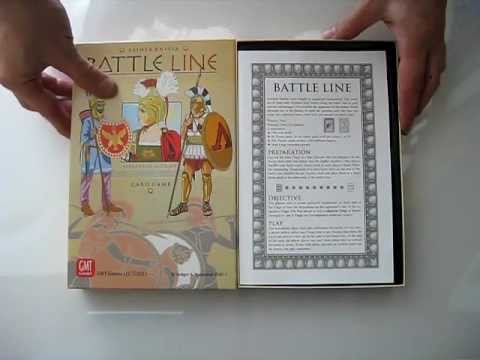 Unboxing the Game
-
 Board Game Review and Gameplay Demo - Battle Line
-
 █ █ █ HOW TO PLAY - quick video w/ Doron █ █ █
-
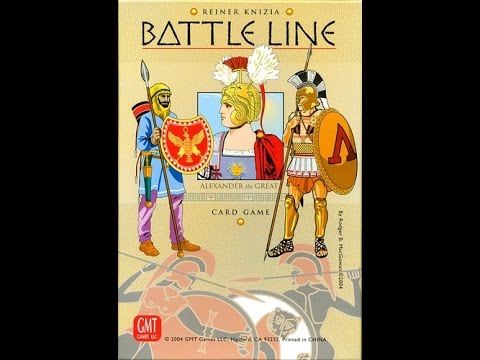 Benjamin Blabs about Battle Line
-
 Rules refresher and play-throughs with commentary
-
 Quick intro to the game
-
 Battle Line by GMT | Game Overview
-
 How to play overview, unboxing by AmassGames
Rules manual
Official PDF file
