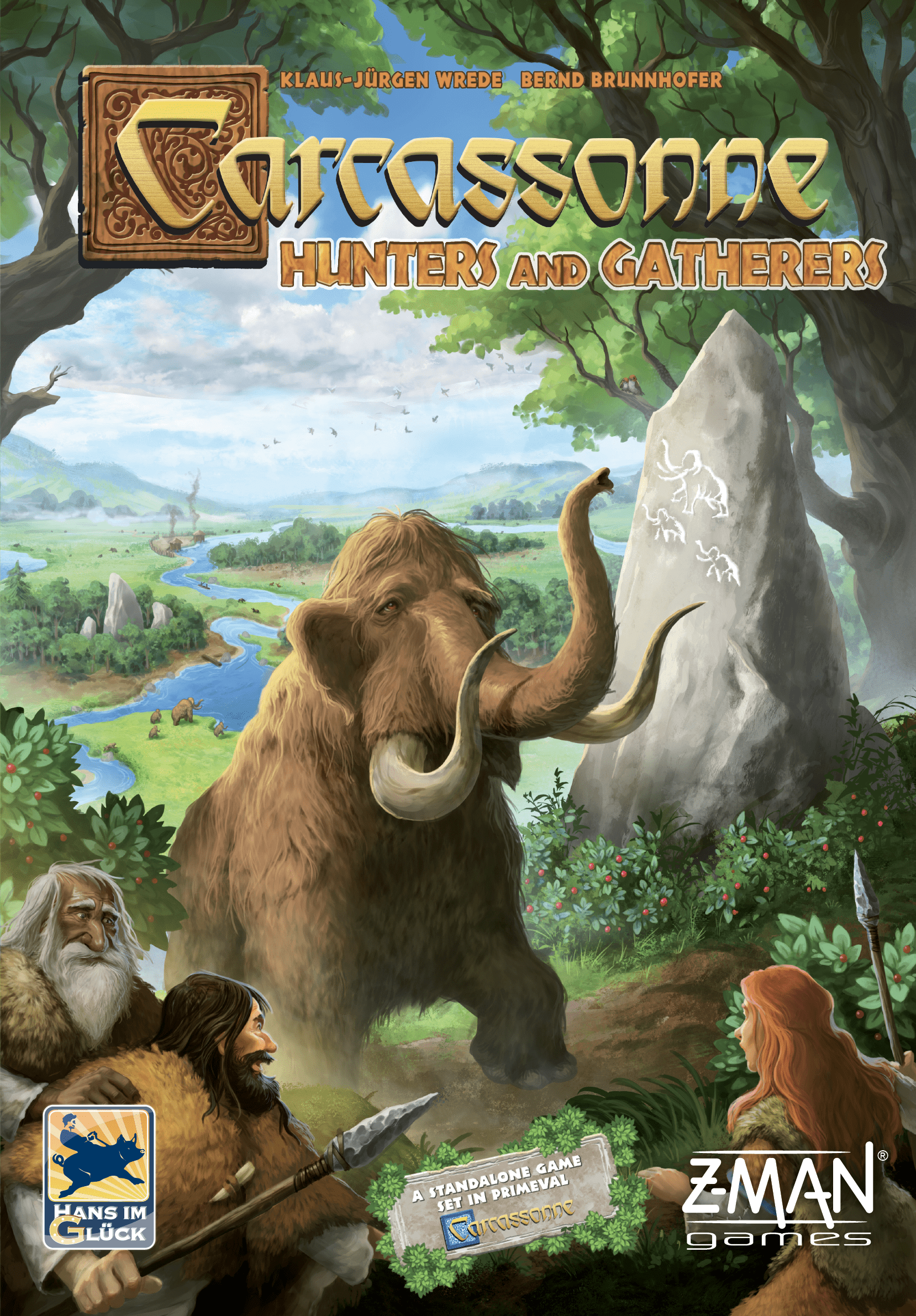
How to Play Carcassonne: Hunters and Gatherers
Hans im Glück, 999 Games, Albi · Board game · 2002What do you want to do now
Ask anything about Carcassonne: Hunters and Gatherers: rules, setup, components, complexity, price, or whether it fits your group.
Video: How to Play
Start here, then follow the written guide
Step by step
Game Objective: The Stone Age in Your Hands!
Prepare for a journey millennia before the great city of Carcassonne! In Carcassonne: Hunters and Gatherers, you and your Stone Age tribe will have the mission to explore and dominate the wilderness. Your objective is simple, yet challenging: expand your territory, hunt animals, gather seeds and fruits, and fish to ensure your tribe's subsistence.
Throughout the game, you will place land tiles to create lush meadows, dense forests, and winding rivers. In these environments, you will strategically position your tribe members and your huts to accumulate points. Scoring happens both during the game and at the end, so the excitement lasts until the very last moment! Who will be the chief of the most prosperous tribe?
Setup: Setting Up Your Primitive Camp
Let's set up the table and prepare the ground for your Stone Age adventure:
- Start by placing the starting tile (the one with the volcano!) face up, right in the center of the table. It will be the starting point of your world.
- Shuffle the remaining 78 land tiles and form several face-down stacks, distributing them around the table so everyone can easily reach them.
- The 12 bonus cards also need to be shuffled and placed in a separate face-down pile.
- Position the scoring track in a corner of the table and the scoring cards (marking 50 and 100 points) next to it.
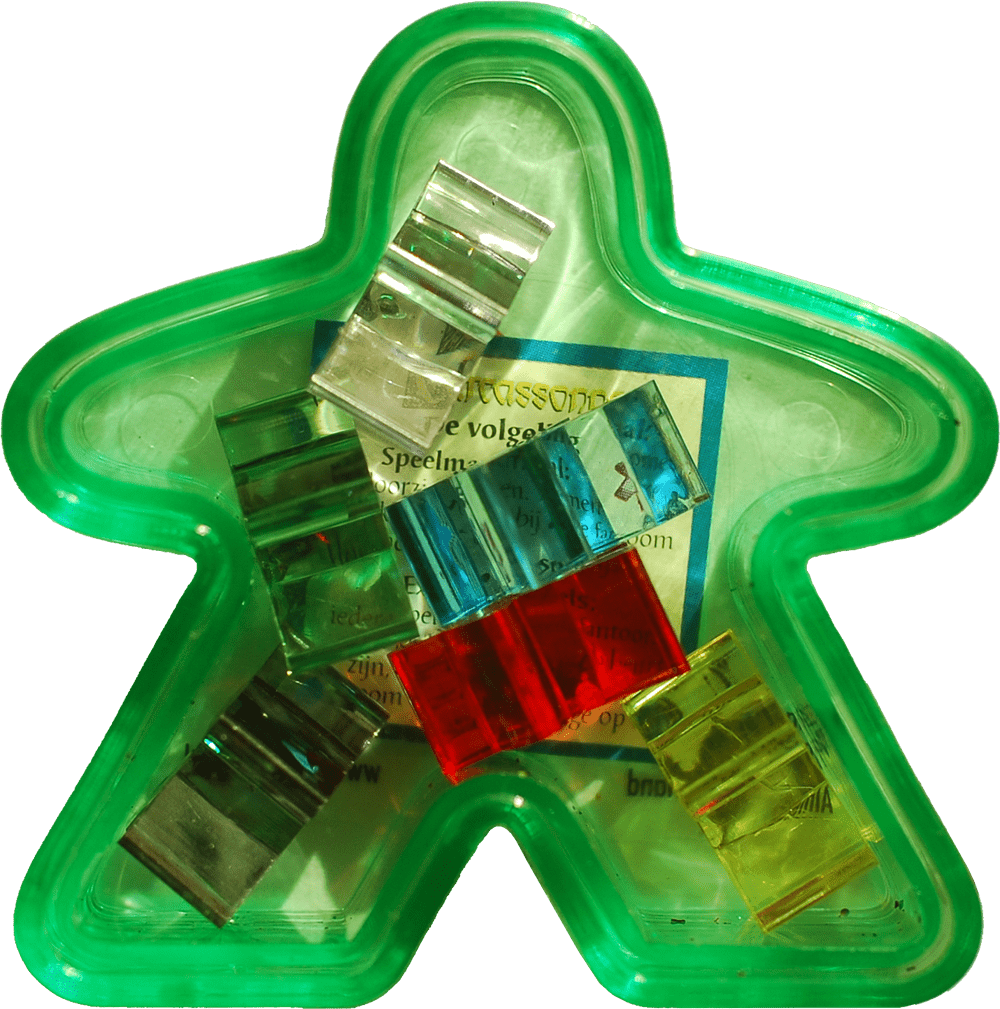
- Each player chooses a color and takes their six tribe members and the two corresponding huts.
- Place one of your tribe members on the "zero" space of the scoring track. The remaining tribe members and huts stay in front of you, forming your personal supply.
- The youngest player has the honor of choosing who starts the game. From then on, the game order proceeds clockwise.
The Game Turn: Building Your Territory
Your turn in Carcassonne: Hunters and Gatherers is divided into three actions that you perform in this order:
- Draw and Place a Land Tile:
- You must draw a land tile from one of the stacks (not from the bonus cards!). Show the tile to everyone, so your friends can even give you some "advice" on where to place it!
- Then, place the tile face up on the playing area, following these rules:
- The new tile must be placed adjacent to one or more tiles already on the table, with one or more of its sides touching. No corner placement allowed!
- The segments of the new tile (meadows, rivers, forests) must match the segments of the tiles already in play.
- If, in a very rare case, you cannot find a good place to place the tile, discard it (return it to the box) and draw a new one.
- Place a Tribe Member or a Hut (Optional):
- After placing the tile, you may place a tribe member or a hut from your supply on the newly placed tile. Remember: only one per turn!
- The tribe member or hut must be clearly placed on the segment it is occupying (river, forest, meadow).
- You can place your tribe members as:
- Gatherer: in a forest segment.
- Fisherman: in a river or lake segment.
- Hunter: lying down on a meadow (to differentiate, as they do not return to the supply!).
- Important: You cannot place a tribe member or hut in a forest, river, or meadow that already has another tribe member (yours or an opponent's). This applies to the entire connected segment, no matter how far!
- If you run out of tribe members or huts in your supply, you continue playing normally, placing tiles and scoring, but without being able to add more figures.
- Score Completed Forests or Rivers:
- If the placement of your tile (or the bonus card, if applicable) completed a forest or a river, scoring happens immediately!
- Completed Rivers: A river is completed when it has a lake with fish or a waterfall at each end, or if it forms a complete circuit.
- The player with the only fisherman in the completed river scores 1 point for each river segment and 1 point for each fish in the lakes at its ends.
- If there is a tie in the number of fishermen, all tied players score the total points of the river.
- After scoring, the fishermen in the completed river return to their owners' supply.
- Completed Forests: A forest is completed when it is completely surrounded by meadows, has no open sides, and no open spaces within it.
- The player with the only gatherer in the completed forest scores 2 points for each forest segment.
- If there is a tie in the number of gatherers, all tied players score the total points of the forest.
- After scoring, the gatherers in the completed forest return to their owners' supply.
- Beware of Gold Nuggets! If the completed forest has one or more gold nuggets, the player who placed the tile that completed the forest draws and plays a bonus card immediately.
- They can place a tribe member or hut on this bonus card, following the normal rules.
- If this bonus card completes another river or forest, they are scored, but do not generate a new bonus card (no chain reaction!).
- Regardless of the number of gold nuggets, only one bonus card is drawn and played.
- If the bonus card pile runs out, no more are drawn!
- Marking Points on the Track: Move your marker on the scoring track. If you pass the 0 space, take a 50-point scoring card. If you pass again, flip it to 100!
After scoring (or if nothing was completed), your turn ends and the next player takes over!
Huts: Dominating the Rivers
- Huts are always placed on a river or lake segment.
- A hut controls the entire connected river system where it is located.
- You cannot place a hut in a river system that already has another hut (yours or an opponent's).
- Huts remain in play until the end and are scored only at game end.
- Huts and fishermen do not affect each other in placement.
The Meadow: Where Hunters Reign
- A meadow is formed by several connected meadow segments, surrounded by forests, rivers, and the edge of the playing area.
- Meadows and their segments are not scored during the game. They serve exclusively for hunters.
- Hunters, once placed, never return to the supply. Therefore, they are placed lying down on the meadows, to differentiate them from gatherers and fishermen.
- Hunters are scored only at game end.
Special Abilities of Bonus Cards
Bonus cards are played as land tiles and can have special effects:
- Fire: Scares away all tigers from a meadow, ensuring that all deer there are scored.
- Mushrooms: Each card with mushrooms adds 2 points to the score of a completed forest.
- Sacred Circle: If you place a hunter in a sacred circle, only you score points for the animals in that meadow, even if other players have more hunters there!
- Aurochs: Each aurochs adds 2 points to the hunt count.
Game End and Scoring: Who Dominates the Stone Age?
The game ends when the player places the last land tile (bonus cards do not count for this!).
At this point:
- All incomplete forests and rivers are worth nothing, and their gatherers and fishermen are removed from the playing area.
- Huts in rivers and hunters in meadows remain on the table for final scoring!
Final Scoring: The Great Count!
Scoring Huts
- The player who has the only hut in a river system scores 1 point for each fish in that system.
- If several players tie with the most huts in a river system, everyone scores the total points given by the system.
- It does not matter if the river system is complete or not. All river systems with huts are scored.
Scoring Hunters in Meadows
- The player who has the only hunter in a meadow scores the following points: 2 points for each deer, mammoth, and aurochs.
- Beware of Saber-toothed Tigers! For each tiger in the meadow, one deer is "hunted" and not scored. To make it easier, you can use the green wooden discs to cover the tigers and deer in pairs. The remaining deer, mammoths, and aurochs are worth 2 points each.
- If there are more tigers than deer, the extra tigers do not generate negative points.
- If several players tie with the most hunters in a meadow, each scores the total points for the meadow. If one player has more hunters, they score alone.
- It does not matter if the meadows are complete. All meadows with hunters are scored.
The player with the highest total score is the grand winner and leader of the most successful tribe!
Tips for Winning: Stone Age Strategies
- Keep an Eye on Others' Rivers and Forests: Remember that you can score a river or forest that another player completed, as long as you have the only tribe member there. Always be on the lookout to "steal" those points!
- Manage Your Tribe Member Supply: Your tribe members are valuable resources. Try to complete them and bring them back to your supply as quickly as possible, especially gatherers and fishermen, to be able to use them in new areas.
- Plan Your Hunters Wisely: Hunters stay in the meadow until the end of the game, so each placement is crucial. Try to place them in meadows with many animals and few tigers, or use the fire bonus cards to protect your deer!
More videos
More rules explanations from the community

Rules manual
Official PDF file
Frequently Asked Questions
Quick answers about the rules
What is the objective of Carcassonne: Hunters and Gatherers?
How do you set up Carcassonne: Hunters and Gatherers?
How does Carcassonne: Hunters and Gatherers end, and how do you score?
What are some tips for winning Carcassonne: Hunters and Gatherers?
Expansions
Published additional content

Other Games You'll Like
Based on mechanics and theme