
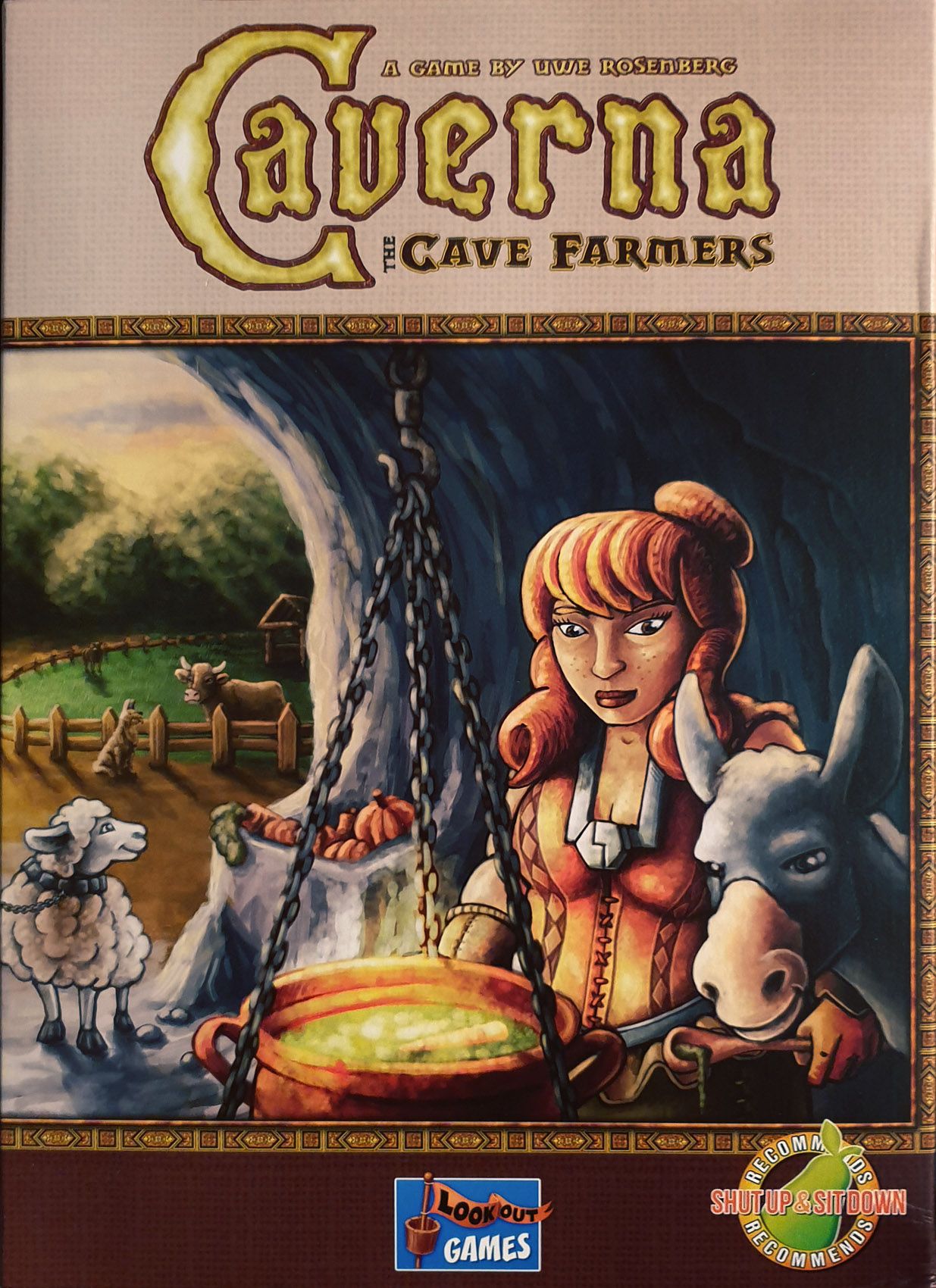
Caverna: The Cave Farmers
Lookout Games, 999 Games, CrowD Games · Board game · 20131. Objective of the Game
In Caverna: The Cave Farmers, you are a dwarf who digs, farms, trades, and explores to build a thriving mountain‑edge settlement. Each round you expand your home board, grow your family, and gather goods and animals. The game ends after Round 12 (11 rounds in a 2‑player game). The player with the most Gold points at the end of the final Harvest time wins.
2. Preparation (Setup)
- Choose a color and take the matching home board, 5 Dwarfs, 3 Stables, and 2 Overview cards.
- Place two Dwarfs in the Entry‑level dwelling on your home board; keep the rest aside as your personal supply.
- Determine the Starting player randomly and give that player the Starting player token.
- Give each player Food based on seating clockwise from the Starting player:
- Player 1 (Starting): 1 Food
- Player 2: 1 Food
- Player 3: 2 Food
- Players 4–7: 3 Food each
- Place the two game boards (Rounds 1–3 and Rounds 4–12) side by side. Add any additional boards that match the number of players (e.g., a 3‑player board for 3 players).
- Shuffle the Stage 1, Stage 2, Stage 3, Stage 4 action‑space cards face‑down and stack them from Stage 1 to Stage 4. The Wish for children card is always the fourth card in the stack.
- Shuffle the 7 Harvest markers face‑down (gray rune showing) and place them on the rune spots on the board. Place the Harvest Events card beside the board.
- Set up the supply boards for Furnishing tiles and keep all other goods (wood, stone, ore, rubies, animals, etc.) in a general supply visible to all players.
3. Flow of the Game
- Round Start – Add a new Action space card to the board and reveal the round’s Harvest marker (green leaf = full harvest, red question mark = harvest event).
- Replenish – Add goods to accumulating action spaces according to the rules on the board (e.g., +1 Wood each round, +2 Stone when empty, etc.).
- Work Phase – Players take turns clockwise, beginning with the Starting player. On your turn, place one of your Dwarfs on an unused Action space and immediately perform its Action(s). You must play your weakest‑weapon Dwarf first; you may trade a Ruby to place any Dwarf instead.
- Return Phase – Return all Dwarfs to their dwellings on your home board. You may rearrange them as you wish.
- Harvest Time – The round ends with a Harvest time that may be a full harvest, a partial harvest, or no harvest, depending on the Harvest marker and any Harvest events that have occurred. The Harvest time consists of:
- Field phase – Remove one Crop from each Field and place it in your supply.
- Feeding phase – Pay 2 Food to the supply for each Dwarf (1 Food for newborn Dwarfs). If you cannot pay, receive a Begging marker for each missing Food.
- Breeding phase – If you have at least two of the same Farm animal and space for another, gain one more of that animal from the supply.
Special rules:
- In a 2‑player game, the Ruby Mining action does not accumulate Rubies until Round 3, and Round 9 is omitted.
- When a Harvest event occurs, the first event is “No Harvest” (no Field, Feeding, or Breeding). The second event is “No Harvest, but pay 1 Food per Dwarf.” The third event is a full Harvest but you must skip either the Field or Breeding phase.
4. Actions and How to Play
Each Action space offers one or more of the following actions. You may perform any subset of the actions shown, but you must perform at least one.
- Place a Meadow/Field tile and take one Wood (or take goods from the supply).
- Place a Cavern/Tunnel tile and take one Stone (or take goods).
- Take a Dog and furnish a Cavern.
- Build a Pasture or Stable (requires Wood or Stone).
- Sow Crops (Grain or Vegetable) on a Field.
- Furnish a Cavern with a Furnishing tile (pay its furnish cost).
- Family growth – Place a newborn Dwarf from your supply under the Dwarf that took the action.
- Forge a Weapon (Blacksmithing) – Pay up to 8 Ore to give the Dwarf a Weapon of equal Strength.
- Take an Expedition – If the Dwarf is armed, choose loot from the Expedition loot overview card up to the Weapon’s Strength.
- Ruby trading – At any time, trade a Ruby for a good shown on the Ruby overview card.
- Imitation – Pay the Food cost on the space to perform the same action as another player’s Dwarf on that space.
- Starting player – Take the Starting player token and any goods on the space (pay 1 Food).
Notes on specific actions:
- Blacksmithing – Place an unarmed Dwarf on the space, pay Ore, and give the Dwarf a Weapon. An armed Dwarf cannot take a forge action to change its Weapon.
- Expedition – The Action space shows a rank (number of loot items). The Dwarf’s Weapon Strength limits the total Strength of loot taken. After the expedition, the Dwarf’s Weapon Strength increases by 1.
- Ruby mine construction – Place a Ruby mine over a Tunnel or Deep tunnel; immediately take 1 Ruby.
- Ore mine construction – Place an Ore mine over two adjacent Tunnels; immediately take 3 Ore.
- Furnishing a Cavern – Pay the furnish cost from your supply and place the tile on an empty Cavern. The tile’s Gold points are scored at the end.
- Family growth – Requires a free dwelling space. The newborn Dwarf is placed under the Dwarf that performed the action and can be used in the next round.
5. End of Game and Scoring
The game ends after Round 12 (or after Round 11 in a 2‑player game) when the final Harvest time is completed. The final score is calculated as follows:
- 1 point per Farm animal and Dog (count all animals on your board and in your supply).
- -2 points per missing type of Farm animal (you lose 2 points if you have no Sheep, no Donkey, no Wild boar, or no Cattle). Dogs do not affect this penalty.
- 1/2 point per Grain (rounded up) – Count Grain in your supply and on your Fields.
- 1 point per Vegetable – Count Vegetables in your supply and on your Fields.
- 1 point per Ruby – Count Rubies in your supply.
- 1 point per Dwarf – Includes the two starting Dwarfs.
- -1 point per unused space – Count spaces in your forest and mountain that have no landscape tile or Stable (empty Meadows or Caverns do not count). The Entry‑level dwelling and the starting Cavern are not considered unused.
- Gold points from Furnishings, Pastures, and Mines – Add the Gold points printed on each tile. Small pastures score 2 points, Large pastures 4 points, Ore mines 3 points, Ruby mines 4 points.
- Bonus points from Parlors, Storages, and Chambers – Score as described on the tile (see Appendix).
- Gold coins – Add the value of each coin (e.g., 1‑Gold coin = 1 point, 2‑Gold coin = 2 points, 10‑Gold coin = 10 points).
- Begging markers – Lose 3 points for each marker.
The player with the highest total Gold points wins. In case of a tie, all tied players are winners.
6. Tips for Winning
- Plan your Harvest strategy early. Build Pastures and Stables to hold more animals, and sow Grain and Vegetables on Fields so you can feed your Dwarfs during Harvest time. This reduces Begging markers and keeps your score high.
- Use Ruby trading wisely. Rubies can be traded for high‑value goods (e.g., a Ruby for a Cattle or a Ruby for a Weapon). Trading a Ruby for a Cattle can give you extra animal points and a stable‑space bonus.
- Forge strong Weapons early. Armed Dwarfs can take Expeditions that yield multiple loot items. A high‑strength Weapon allows you to acquire valuable goods or animals that are otherwise hard to get, giving you a scoring advantage.
In English
-
 Caverna: The Cave Farmers Walkthrough
-
 How to Play Caverna - No BS Guide
-
 How to Play "Caverna" - The Dragon Table: Episode 27
-
 How to Play Caverna: The Cave Farmers - Nights Around a Table
-
 Organizing Caverna: The Cave Farmers
-
 Off The Shelf Board Game Reviews - Caverna (Part 1 How To Play)
-
 Uitleg & review door Nox' Spellenzolder.
-
 BGNserts - Build a custom insert for Caverna
-
 Caverna - Gameplay Runthrough - Part1
-
 Caverna (Solo) Game 01 - Rounds 01-06
-
 Caverna - Gameplay Runthrough - Part2
-
 Tantrum House Quick Setup Guide

