
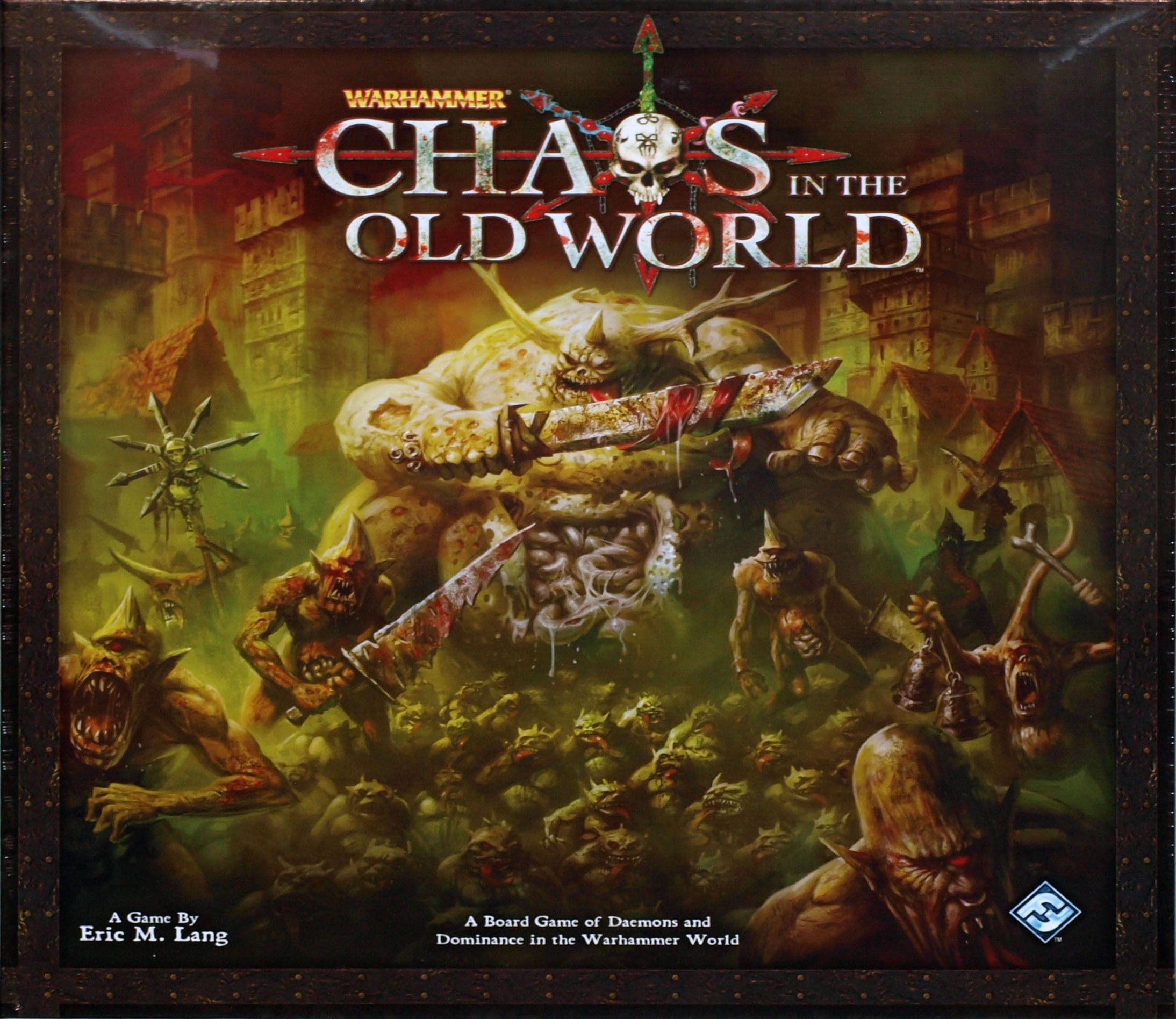
Chaos in the Old World
Fantasy Flight Games, Edge Entertainment, Galakta · Board game · 2009Game Objective: Corrupt, Dominate, and Destroy the Old World!
Welcome, herald of chaos! In Chaos in the Old World, you assume the role of one of the four fearsome Ruinous Powers: Khorne, the Blood God; Nurgle, the Plague Lord; Tzeentch, the Great Conspirator; or Slaanesh, the Prince of Pleasure and Pain. Your objective? Corrupt, dominate, and destroy the Old World, spreading your malevolent influence across all regions!
Victory can be achieved in two ways:
- Domination by Victory Points (VP): Accumulate 50 Victory Points by corrupting and dominating regions with your cultists and activities. If you reach 50 VP at the end of a game turn, victory is yours!
- Unique Threat: Each Ruinous Power has a specific Threat condition. For example, Khorne seeks destruction, while Tzeentch wants to infest regions with magic. Advance your Chaos Dial to a specific point to win by this condition. Each advance is called a POSITION.
But beware! If the Old World deck runs out and no one has won, the Old World itself triumphs, and all Ruinous Powers lose. Don't let that happen!
Preparation (Setup): Invoking Chaos on the Table
Let's set up the table for your ascent to power! Follow these steps:
- Place the game board: Position the board in the center of the play area. If it's your first time, assemble the Chaos Dials by inserting the plastic connectors into the board and the dials, pressing until they click. Adjust the dials so that the "Start" position is visible in the main window. Khorne is at the top, Nurgle to the right, Tzeentch at the bottom, and Slaanesh to the left.
- Separate the Power Tokens and distribute seats: Each player chooses (or draws) a Power token. If there are fewer than 4 players, unused tokens return to the box. Sit in clockwise order: Khorne, Nurgle, Tzeentch, and Slaanesh.
- Separate cards, tokens, and figures for each Power: Distribute the Power markers, Victory Point markers, Corruption tokens, Chaos cards, Upgrade cards, and plastic cultists to the corresponding players. Unused components return to the box. Place your unused Upgrade cards beneath your Power Token.
- Place the Power and Victory Point markers: Each player places their Power marker on the starting space of the dial on their Power token, and their Victory Point marker on the "0" space of the dial on the board.
- Arrange common tokens, prepare dice, and place Desolation cards: Separate the Dial Advancement tokens and Old World tokens into piles by type, accessible to everyone. Keep the dice handy. Organize the Desolation cards into a pile, with card "1" face up and "5" at the bottom, and place it in the indicated space on the board.
- Form the Old World deck: Shuffle all Old World cards. For 4 players, separate 7 cards; for 3 players, 8 cards to form the Old World deck (face down) in the indicated space on the board. Remaining cards return to the box.
- Place initial Old World tokens: Take 2 Noble tokens, 3 Warpstone tokens, and 4 Peasant tokens. Mix them and place one randomly in each of the nine regions on the board, following the established order for the regions.
- Shuffle and separate Chaos cards: Each player shuffles their Chaos cards, draws an initial hand of 3 cards, and places the rest of the deck next to their Power token and unacquired Upgrade cards.
Ready! The game begins with the Old World Phase of the first turn.
The Game Turn: Spreading Corruption
Each turn in Chaos in the Old World is divided into six Phases, always in the same order:
- Old World Phase
- Draw Phase
- Summoning Phase
- Battle Phase
- Corruption Phase
- End Phase
In many phases, players act in Power Order: Khorne, Nurgle, Tzeentch, and Slaanesh (clockwise on the Chaos Dials).
Old World Phase
In this phase, the player with the lowest Threat draws 1 card from the top of the Old World deck and immediately resolves its italicized instructions. If the card requires a decision (such as placing Old World tokens), the player with the lowest Threat decides.
After resolving, the card is placed face up in the left space (1) of the event zone. The card that was there moves to space (2), and the one that was in (2) is removed from the game. Some cards with the double-tailed comet symbol can be removed from the event zone by other cards.
Draw Phase
Players draw Chaos cards from their own decks, according to the instructions on their Power tokens and Upgrade cards. If a Chaos card deck runs out, shuffle the discards to form a new one. There is no limit to the number of cards in hand.
In this phase, players also move their Power markers to the highlighted number on their Power tokens (and consider Upgrade bonuses). Power Points do not accumulate from previous turns. All act simultaneously.
Summoning Phase
Here, players summon cultists and play Chaos cards in the nine regions of the board. Players take turns in Power Order, in a continuous circle, until all have their Power markers at 0.
On your turn, you can choose between:
- Summon 1 cultist figure:
- Choose one of your available figures (on the board or off it).
- Pay the figure's Power cost, moving your Power marker to the left. If you don't have enough Power, you cannot summon.
- Place the figure in a valid region: it must be a region where you already have figures, or a region adjacent to one you control. The only exception is if you have no figures on the board, you can place your first in any region.
- Play 1 Chaos card:
- Choose a Chaos card from your hand.
- Pay the card's Power cost, moving your Power marker to the left. If you don't have enough Power, you cannot play.
- Place the card in an empty space in any of the nine regions (there are two spaces per region). If both spaces are occupied, you cannot play a card there.
The effects of Chaos cards are applied immediately, unless otherwise specified. If two cards in the same region have simultaneous effects, the leftmost (easternmost) one is resolved first.
If you don't want to summon or play a card, your Power marker goes to 0 and your turn ends. If your Power marker is already at 0, your turn is skipped.
Battle Phase
In this phase, the cultists of the Ruinous Powers and the Peasant tokens clash region by region, following the established order. For each region with a battle:
- Calculate and roll battle dice: Sum the Attack values of all your figures in the region (downed figures also count). Add bonus dice from Chaos cards or other effects. Roll all battle dice. Each result of 4, 5, or 6 is 1 HIT. Each 6 EXPLODES, allowing you to roll 1 additional die (which can also explode).
- Assign hits: Declare which enemy figure (or Peasant token) receives each hit. All hits must be assigned to valid targets in the region. If a figure receives hits equal to or greater than its Defense value, it is laid on its side (destroyed, but only removed at the end of the phase). Peasant tokens are removed immediately after 1 hit and placed on the Power token of the player who destroyed them.
Anticipated Hits: Some cards allow battle dice to be rolled at the start of the phase. Figures destroyed by these hits are removed immediately, not laid down. These hits add to the player's normal hits.
You cannot assign fewer hits than necessary to destroy a figure. Excess hits are lost. If there are valid targets, hits must be assigned.
After all players have acted, downed figures are removed from the board. Then, the battle for the next region is resolved.
Corruption Phase
This phase has two steps:
1. Supremacy Calculation
In each region, in the established order, calculate each player's Supremacy Value by summing the summoning cost of all their Chaos cards played in the region and the number of figures they control there. The summoning cost of figures does not count, only the quantity.
The player with the highest Supremacy Value compares it to the region's Resistance. If Supremacy is greater than Resistance, the player gains Victory Points equal to the region's Conquest value. In case of a tie in Supremacy, no one gains VP for Supremacy in that region.
Remember: Resistance and Conquest Value can be modified independently by Old World tokens.
2. Placement of Corruption Tokens
In each region, in the established order:
Each player places 1 Corruption token in the region for each cultist they have there.
Then, count the total Corruption tokens of all players in the region (Warpstone tokens also count as Corruption tokens). If the total is 12 or more, the region is DESOLATED.
When a region is desolated, place the next Desolation card from the pile onto it. All players who placed at least 1 Corruption token in this region during this step immediately gain the Victory Points indicated in the header of the Desolation card.
If there are no more Desolation cards available (five regions have already been desolated), the region is not desolated and does not grant points.
End Phase
The End Phase has several steps:
- Remove Chaos Cards from the board: Players remove their Chaos cards from the board and place them in their discard piles.
- Resolve Hero tokens: In each region with a Hero token, the player with the highest Threat and with figures in the region must choose one of their figures and remove it from the board. This happens once per Hero token.
- Resolve Old World cards: Examine the event zone and resolve all effects of Old World cards that begin with "In the End Phase, when Old World cards are resolved...". Resolve in order of spaces (1, then 2).
- Scoring for Desolated Regions: For each Desolation card that was placed this turn (face up on the board), players gain VP based on the Corruption tokens they have in the desolated region. The player with the most Corruption tokens gains the first amount from the Desolation card's table. The second player with the most tokens gains the second amount. In case of a tie, points are summed and divided (rounding down). After scoring, the Desolation card is flipped face down, and all Corruption tokens in the region are removed.
- Rotate the Chaos Dials: Players with Dial Advancement tokens rotate their Chaos Dial one additional position clockwise and follow the revealed instructions. The player with the most Dial Advancement tokens rotates their dial one additional position.
- Check if any player has won the game: Check the victory conditions (50 VP or Chaos Dial advancement). If someone has won, the game ends!
End of Game and Scoring
The game ends immediately if, at the end of the End Phase, a player reaches 50 or more Victory Points on their tracker, or if a player has advanced their Chaos Dial to the specific victory point. If the Old World deck runs out and no one has won, the Old World wins, and all players lose.
Tips for Winning: Strategies for your Chaos Gods
- Balance VP and Threat: Don't focus solely on one victory condition! Keep an eye on both your Victory Points and the progress of your Chaos Dial. Your opponents may be focusing on one, and you can surprise them with the other.
- Manage your Power Points: Power Points are crucial in the Summoning Phase. Spend them wisely, as they do not accumulate. Decide whether it's more advantageous to summon cultists to control regions or play Chaos cards for powerful effects.
- Leverage your God's specificities: Each Ruinous Power has its own strengths and weaknesses. Khorne is a master of battle, Nurgle of corruption, Tzeentch of manipulation, and Slaanesh of seduction. Understand your god's Chaos cards and Threat conditions to maximize your efficiency and explore synergies.



