
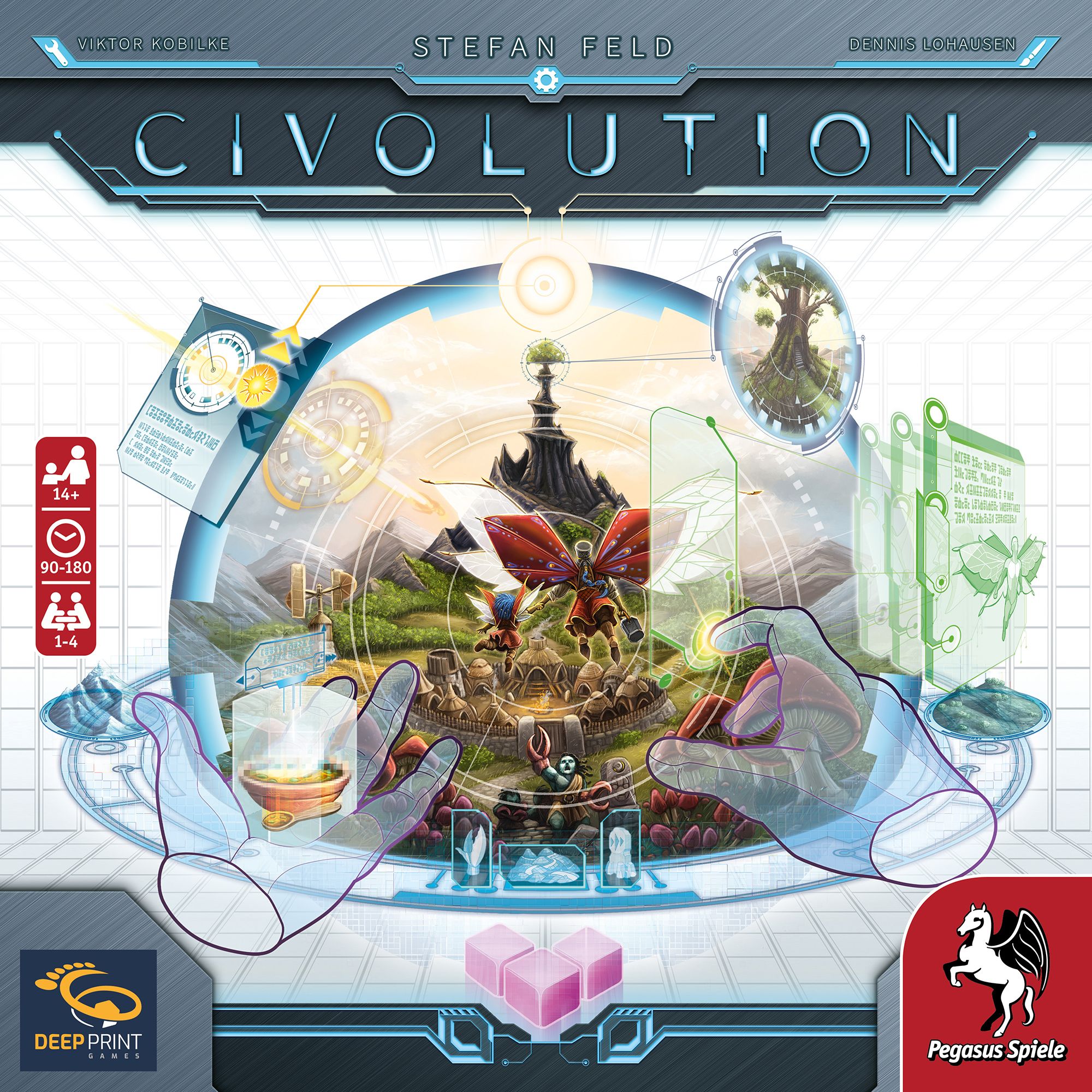
Civolution
Deep Print Games, DiceTree Games, Gémklub · Board game · 2024Step by step
1. Objective of the Game
In Civolution, each player is a deity guiding a civilization across a secluded continent. The goal is to accumulate the most success points by the end of the fourth era. Success points are earned through actions, research, and the development of your civilization’s stage partition and scoring categories. The civilization with the highest total after the final scoring phase wins.
2. Preparation (Setup)
Follow the step‑by‑step instructions in the manual to assemble the board, consoles, and all components. Key steps include:
- Assemble the score track, progress board, and sequence board.
- Shuffle and place the event cards, goal chips, income chips, and material tiles as described.
- Build the continent from the eight continent tiles and place the 24 site tiles face down in the octagonal recesses.
- Set up each player’s console, distributing settlements, farms, boats, tribes, markers, dice, and research cards according to the color‑coded instructions.
- Determine the starting civilization and give it the starting monolith.
- Deal each civilization its starting marker cards, chip cards, and research cards as outlined in the manual.
Consult the manual for any missing details or clarifications.
3. Flow of the Game
A game consists of four eras. Each era contains eight phases:
- Phase 1: New Cards – Reveal the top event card and the top card of each of the five research stacks.
- Phase 2: New Goals – In seating order, each civilization may take a goal chip from the display.
- Phase 3: Extra Find – Each civilization places a stored material marker onto a storage space that matches a territory type where it has a tribe.
- Phase 4: Action Phase – The main phase where civilizations take turns activating modules or performing a reset.
- Phase 5: Site Phase – (Details not provided in the context.)
- Phase 6: Feeding Phase – (Details not provided in the context.)
- Phase 7: Event Phase – (Details not provided in the context.)
- Phase 8: Income Phase – (Details not provided in the context.)
After the Income Phase of the fourth era, the game ends with the final scoring. The phase indicator on the sequence board moves sequentially through the phases, and the Action Phase ends when the indicator reaches the red reset end space.
4. Actions and How to Play
During the Action Phase, a civilization may either activate a module or do a reset. Activating a module requires two activation dice that match the module’s required values. If a required die value is missing, you may spend idea markers to change a die’s value by ±1, or use a planning marker of the same value.
Modules are divided into:
- Main modules (15 total) – can be upgraded to Level II or III.
- Feature modules – activated with two dice of a specific value and place a marker in the corresponding feature space.
- Sleep module – can be activated with any two dice.
Each module has a set of actions (e.g., Migration, Procreation, Production, Exploration, Building, etc.). The manual provides detailed rules for each action, including special conditions, success point rewards, and interactions with other game elements. For example:
- Migration – Move a strong tribe to an adjacent territory and settle on an encampment, earning success points from fire encampments.
- Procreation – Add a new tribe to a territory, possibly displacing another tribe into the wilderness.
- Production – Produce raw materials and optionally transport them to storage.
- Exploration – Reveal adjacent sites and gain success points.
- Building – Construct farms, boats, statues, or settlements, each with specific benefits.
All actions are described in the manual’s module sections; refer to those pages for exact rules, costs, and success point values.
5. End of Game and Scoring
The game ends immediately after the Income Phase of the fourth era. Final scoring is performed as follows:
- Stage Partition Scoring – Each card or chip installed in a column of the stage partition awards success points equal to the value shown on the stage in which it was installed. Only one type of card or chip can occupy a column, except for income chips, which are wild.
- Scoring Categories – The nine categories (Technology, Prestige, Knowledge, Construction, Culture, Evolution, Prosperity, Population, Expansion) are scored based on progress tracks and other criteria. The manual specifies how many points each category yields and how they are calculated.
- Sum the points from the stage partition and all scoring categories to obtain each civilization’s total success points.
The civilization with the highest total wins. In case of a tie, the manual’s tie‑breaking rules apply (consult the manual for specifics).
6. Tips for Winning
- Prioritize upgrading modules early. Upgraded modules often provide more powerful actions and higher success point rewards, giving you a competitive edge in later eras.
- Use the Favor track strategically. Advancing on the Favor of Agera track increases your chances of passing favor tests, which unlock additional actions such as extra migrations or procreations.
- Balance your resource management. Keep a steady flow of raw materials to storage and ensure you have enough food markers for the Feeding Phase to avoid losing tribes.
These tips are drawn directly from the manual’s recommendations. For deeper strategic insights, refer to the full rulebook.
Rules videos
Learn by watching before you open the box
In English
-
 How to Play Civolution - Official Tutorial video
-
 Civolution - Tutorial & Playthrough
-
 Civolution - Solo Playthrough
-
 Civolution - How to Play. Complete, Clear and Concise Board Game Tutorial. PLUS Tips
-
 Civolution - Solo Playthrough - GAME 2
-
 Preview of the game from reading the rules
-
 Civolution How to Play and Strategy Tips!
-
 Civolution | Part 1 | Solo Board Game Tutorial and Playthrough
-
 All the Games with Steph: Civolution - The Teach
-
 [4K] How To Play CIVOLUTION + Solo Playthrough [PART1/3]
Rules manual
Official PDF file
