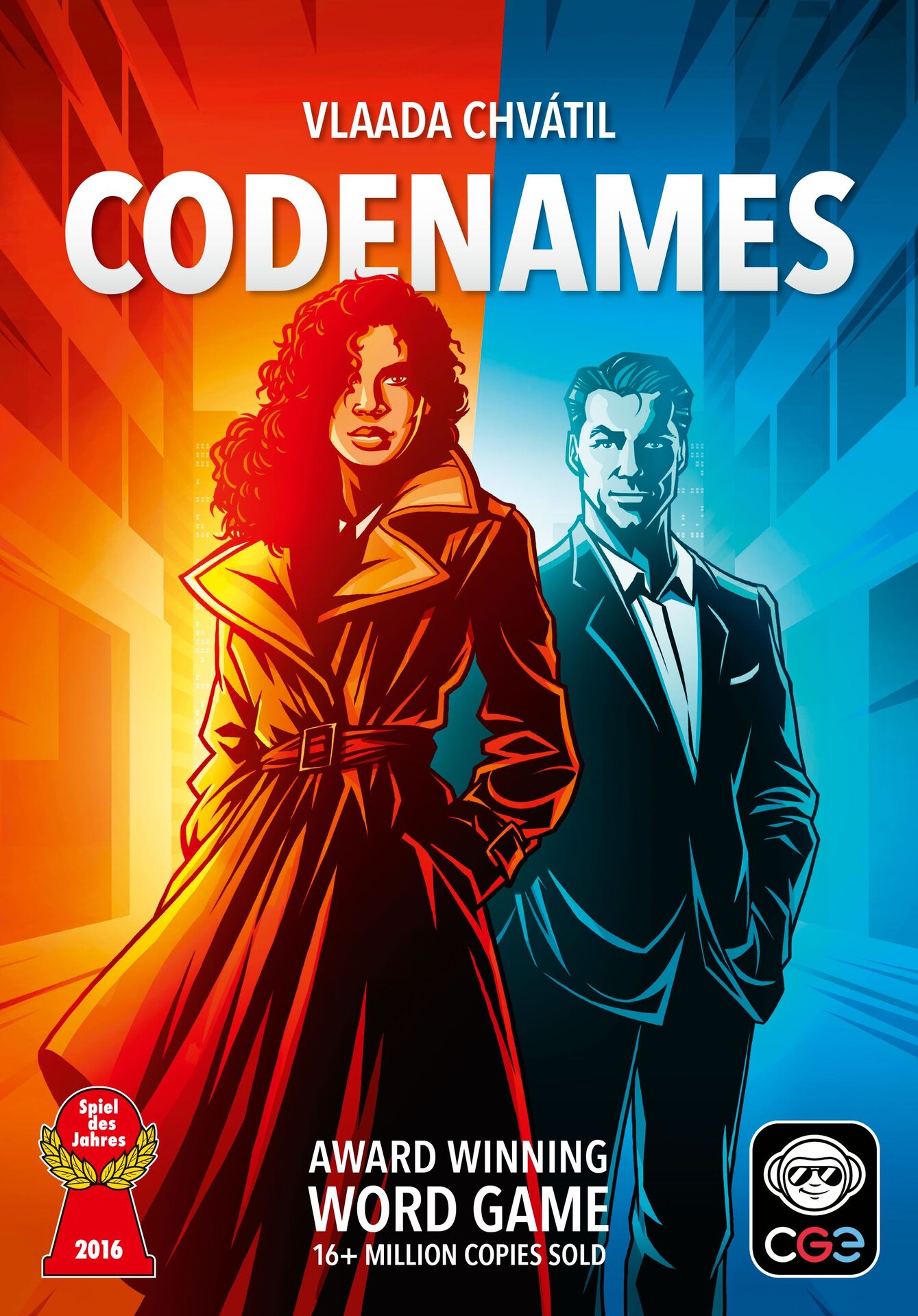
How to Play Codenames
Czech Games Edition (CGE), asmodee, Boardgame Space · Board game · 2015
2–8 · best 6
15 min
Weight 1.3/5
8.3
rating
Ludopedia
7.5
rating
BGG
What do you want to do now
Ask questions about the game
Ask anything about Codenames: rules, setup, components, complexity, price, or whether it fits your group.
Example questions
Continue this chat in the Assistant
Game page
Prices, ratings and our review
Rules manual
Official PDF file
Video: How to Play
Start here, then follow the written guide
Better 2-player variant!
Step by step
Objective of the Game
Welcome, aspiring Spymasters and Field Operatives! In **Codenames**, your mission, should you choose to accept it, is to be the first team to make contact with all your secret agents. But beware! The urban landscape is full of innocent bystanders, and lurking in the shadows is a dangerous assassin. One wrong move, and your mission could be compromised, leading to immediate defeat. Work together, decode your Spymaster's cryptic clues, and claim victory for your agency!Preparation (Setup)
Getting ready for a thrilling game of Codenames is straightforward. Here’s how you set up your spy network:- Form Teams: First, divide into two teams of similar size and skill. You need at least four players for a standard game (two teams of two).
- Choose Spymasters: Each team selects one player to be their **Spymaster**. These masterminds of espionage will sit on the same side of the table.
- Position Field Operatives: The remaining players are **Field Operatives**. They will sit across from their Spymasters.
- Lay Out Codenames: Randomly choose 25 **codename** cards and arrange them on the table in a neat 5-by-5 grid. (Tip: While shuffling, occasionally flip half the deck to ensure a good mix of words!)
- Reveal the Key: The Spymasters secretly choose one **key card** at random and slide it into the stand between them. Don't overthink it, just slide it in! Crucially, the Field Operatives must NOT see this card.
- Understand the Key Card: The key card is your secret map. It shows which words on the grid belong to which team (blue squares for Blue Team, red squares for Red Team), which are **innocent bystanders** (pale squares), and which is the deadly **assassin** (black square).
- Distribute Agent Cards:
- Place the 8 **red agent cards** in a stack in front of the Red Spymaster.
- Place the 8 **blue agent cards** in a stack in front of the Blue Spymaster.
- The **double agent** card belongs to the starting team. Flip it to match their color and add it to their stack. This means the starting team will have 9 agents to find, and the other team will have 8.
- Keep the 7 **innocent bystander cards** and the 1 **assassin card** between the Spymasters, easily accessible.
- Determine Starting Team: Look at the four lights around the edge of the key card. These indicate which team starts the game. The starting team will give the first clue.
The Turn of Play
Codenames unfolds in a series of turns, with Spymasters guiding their Field Operatives through the treacherous grid.Giving a Clue (Spymaster's Role)
If you're the Spymaster, your turn involves two crucial steps:- Think of a One-Word Clue: Your goal is to come up with a single word that relates to one or more of your team's **codenames** on the table. For example, if your words are NUT and BARK, you might say "tree."
- State the Number: After your clue word, you must state a number. This number tells your Field Operatives how many words on the table are related to your clue. So, for "tree" relating to NUT and BARK, you'd say "tree: 2."
Clue Restrictions:
- Your clue must be a single word. No extra hints or phrases!
- Your clue cannot be any of the codenames currently visible on the table.
- Your clue must be about the meaning of the words, not their letters or position. For example, "Gland" is not a valid clue for ENGLAND.
- You cannot say any form of a visible word on the table (e.g., if BREAK is visible, you can't say "broken").
- You cannot say part of a compound word on the table (e.g., if HORSESHOE is visible, you can't say "horse").
- The number you say after your clue cannot be used as a clue itself.
- Homonyms with different meanings and spellings (like "night" and "knight") are considered different words. You can't give knight-related clues for NIGHT. However, words spelled the same but with different pronunciations/meanings (like "bow" for a theater or a ship) are considered the same.
- You can use **0** as the number part of your clue (e.g., "feathers: 0"). This means none of your words relate to feathers, and your operatives can guess as many words as they want.
- You can also use **unlimited** instead of a number if you have multiple unguessed words from previous rounds you want your team to guess. This allows unlimited guesses but doesn't tell them how many words are related to the new clue.
- If you give an **invalid clue**, your team's turn ends immediately. As an additional penalty, the opposing Spymaster may cover one of their own words with an agent card before their next clue.
Making Contact (Field Operatives' Role)
Once the Spymaster gives a clue, the Field Operatives discuss among themselves to figure out which words on the grid match the clue. The Spymaster must keep a straight face and offer no further hints! To make an official guess, one Field Operative touches a **codename** card on the table. The Spymaster then reveals its secret identity by covering it with the appropriate card:- Your Team's Agent: If you touch a card belonging to your team, the Spymaster covers it with an agent card of your team's color. Great job! Your team may guess another word.
- Innocent Bystander: If you touch an **innocent bystander**, the Spymaster covers it with an innocent bystander card. Your turn ends immediately.
- Other Team's Agent: If you touch a card belonging to the other team, the Spymaster covers it with one of the other team's agent cards. This ends your turn and inadvertently helps the opposing team!
- The Assassin: If you touch the **assassin**, the word is covered by the assassin card. This is a catastrophic error! The game ends immediately, and your team loses.
Number of Guesses:
- Field Operatives must always make at least one guess.
- Any wrong guess (bystander or opponent's agent) ends the turn immediately.
- If you guess a word of your team's color, you can keep guessing.
- You can stop guessing at any time, but typically you'll want to guess as many words as your Spymaster indicated with their number.
- You are allowed one extra guess beyond the number given by the Spymaster. For example, if the clue was "tree: 2," you can make up to 3 guesses. This extra guess can be used to try and find another word related to the current clue, or even a word from a previous clue that you missed.
- Once Field Operatives say they are done guessing (or guess incorrectly), it's the other team's turn.
End of Game and Scoring
The game of Codenames can conclude in one of two ways:- Victory by Contact: The game ends when one team successfully covers all their **codename** words with their agent cards. That team wins! It's even possible to win on the other team's turn if they accidentally guess your last word.
- Defeat by Assassin: If a Field Operative makes contact with the **assassin**, their team immediately loses the game.
Tips for Winning
As a veteran Spymaster, here are a few pointers to help you navigate the tricky world of Codenames:- Spymasters, Think Ahead and Avoid the Assassin: Before you even utter a clue, quickly scan the board to ensure your brilliant connection doesn't inadvertently point to the **assassin** or too many **innocent bystanders**. A clever clue that leads to the assassin is a guaranteed loss!
- Field Operatives, Debate and Don't Make Eye Contact: Use your discussion time wisely to explore all possibilities for the clue. Don't make eye contact with your Spymaster while guessing; their poker face is part of the game, and you want to avoid unintentional nonverbal cues. Trust your collective deduction!
- Spymasters, Leverage the "One Extra Guess": Remember that your Field Operatives get one extra guess beyond the number you provide. This can be a powerful tool. If you give a clue for two words ("clue: 2"), your team can make up to three guesses. This allows them to potentially pick up a word from a previous round or take a calculated risk on a third word they feel confident about, even if it wasn't directly linked to your current clue.
More videos
More rules explanations from the community
In English
-
 How to Play Codenames [Official Video]
-
 How to Play Codenames online
-
 How to Play Codenames
-
 Learn to Play Codenames
-
 Codenames & Skeleton Revival - Tabletop & Brews Review and Tutorial
-
 How to play Codenames
-
 How to play Codenames in 3 minutes
-
 Nights Around a Table - How to Play Codenames
-
 Quick, Complete Rules Explanation for Codenames!
-
 Board Game Bakes: Create your own edible Codenames board!
-
 Code Names HINDI How to Play | Simple Explanation Code Names | Party Words Game // Chai & Games
Rules manual
Official PDF file
Prefer the Official PDF?
Download the official Codenames rulebook or browse it online with our AI rules assistant.
View Rulebook PDF
Frequently Asked Questions
Quick answers about the rules
What is the objective of Codenames?
Welcome, aspiring Spymasters and Field Operatives! In **Codenames**, your mission, should you choose to accept it, is to be the first team to make contact with all your secret agents. But beware! The urban landscape is full of innocent bystanders, and lurking in the shadows is a dangerous assassin. One wrong move, and your mission could be compromised, leading to immediate defeat. Work together, decode your Spymaster's cryptic clues, and claim victory for your agency!
How do you set up Codenames?
Getting ready for a thrilling game of Codenames is straightforward. Here’s how you set up your spy network: Form Teams: First, divide into two teams of similar size and skill. You need at least four players for a standard game (two teams of two). Choose Spymasters: Each team selects one player to be their **Spymaster**. These masterminds of espionage will sit on the same side of the table. Position Field Operatives: The remaining players are **Field Operatives**. They will sit across from…
How do you play Codenames?
Codenames unfolds in a series of turns, with Spymasters guiding their Field Operatives through the treacherous grid. Giving a Clue (Spymaster's Role) If you're the Spymaster, your turn involves two crucial steps: Think of a One-Word Clue: Your goal is to come up with a single word that relates to one or more of your team's **codenames** on the table. For example, if your words are NUT and BARK, you might say "tree." State the Number: After your clue word, you must state a number. This number…
How does Codenames end, and how do you score?
The game of Codenames can conclude in one of two ways: Victory by Contact: The game ends when one team successfully covers all their **codename** words with their agent cards. That team wins! It's even possible to win on the other team's turn if they accidentally guess your last word. Defeat by Assassin: If a Field Operative makes contact with the **assassin**, their team immediately loses the game. For standard competitive play, there is no numerical scoring beyond simply winning or losing.
What are some tips for winning Codenames?
As a veteran Spymaster, here are a few pointers to help you navigate the tricky world of Codenames: Spymasters, Think Ahead and Avoid the Assassin: Before you even utter a clue, quickly scan the board to ensure your brilliant connection doesn't inadvertently point to the **assassin** or too many **innocent bystanders**. A clever clue that leads to the assassin is a guaranteed loss! Field Operatives, Debate and Don't Make Eye Contact: Use your discussion time wisely to explore all possibilities…
Want to compare prices and check reviews?
Find where to buy at the lowest price, price history, and our full game review.
View Codenames
Expansions
Published additional content


Other Games You'll Like
Based on mechanics and theme