
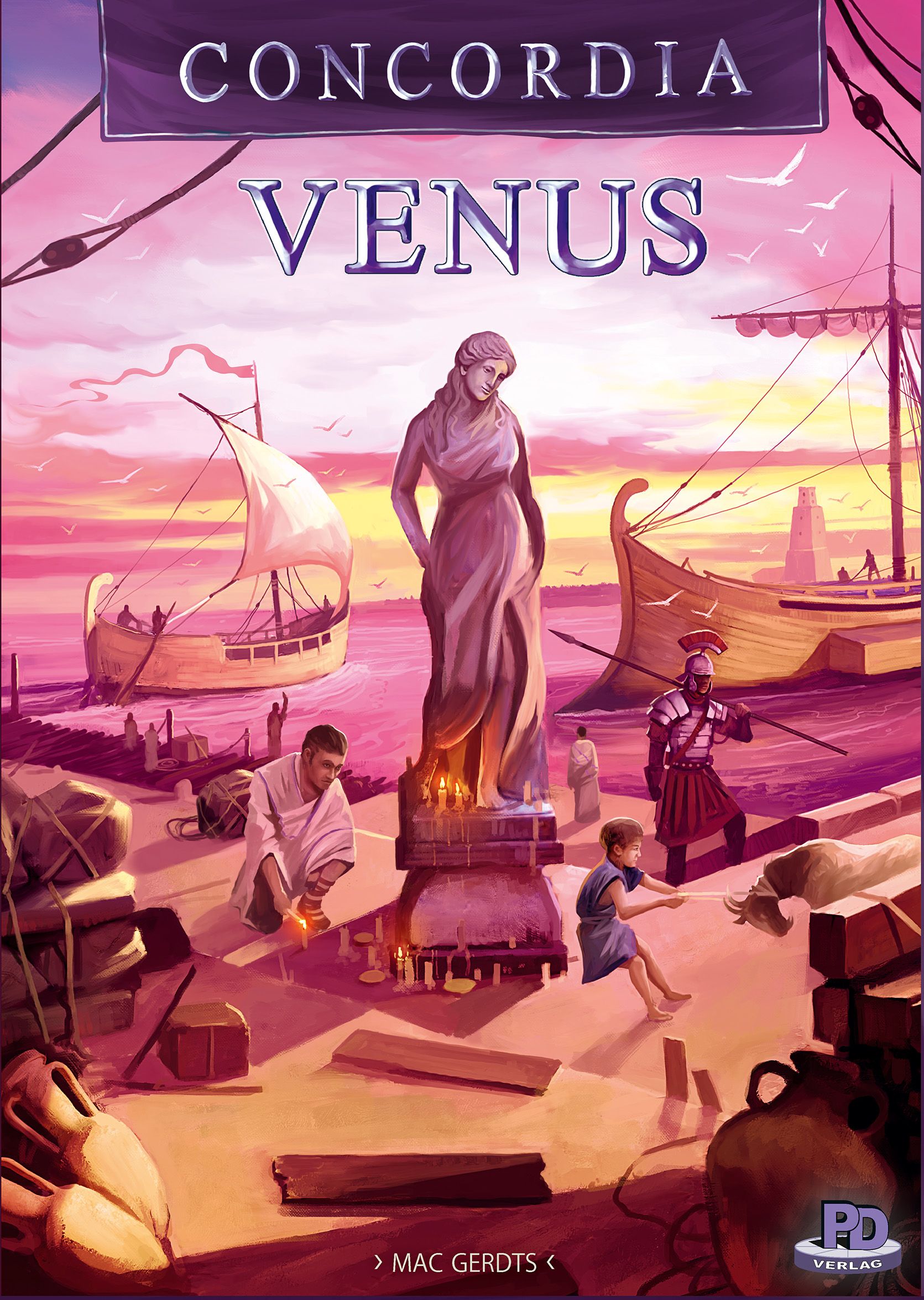
Concordia Venus
PD-Verlag, Matagot, New Games Order, LLC · Board game · 2018Step by step
Game Objective
In Concordia Venus, each player attempts to build the largest and most prosperous Roman civilization. The goal is to accumulate victory points (VP) throughout the game, earned through achievements in various areas: goods production, house construction, province colonization, trade, and character abilities. The game ends when one player draws the last personality card from the card display or builds their 15th house. The player who triggers the end condition receives the Concordia Card, worth 7 VP. After that, all other players (or teams) take one final turn, and then everyone totals their VP to determine the winner.
Setup
- Board: Place the chosen board (Ionia or Cyprus) in the center of the table.
- Player pieces: Each player receives:
- 3 land settlers and 3 sea settlers (placed in the capital city).
- 1 score marker.
- 15 houses (to build).
- 12 storage slots (4 occupied by settlers, 8 free).
- Coins of sestertii (initial quantity not specified in the context).
- Personality cards: In each variant, distribute the personality cards according to the purchase table (see the rulebook for pricing and replenishment details).
- Card display: Place the card display next to the board. If there is an expansion display, use it instead of the standard one.
- Turn marker: Position the turn marker (orange marker) on the first player.
- PRÆFECTUS M. marker: Place the PRÆFECTUS M. on the starting player.
Game Flow
- Player turn: Players play in clockwise order. On each turn, the player performs exactly one action by playing a personality card from their hand. The card is turned face-up in the player’s discard pile, showing only the most recently played card.
- Card execution: The player carries out the actions described on the card. If the player is in Team Mode, the partner also performs the same actions immediately after the player.
- PRÆFECTUS M.: If the player holding the PRÆFECTUS M. plays a Prefect card to make a province produce, they receive double bonus (2 units instead of 1). The PRÆFECTUS M. then passes to the player on their right.
- End of turn: When all players (or teams) complete their turns, the turn marker moves to the next player.
- Global events: No global events are described in the context; only card purchases and house construction can trigger the end of the game.
Actions and How to Play
Personality cards are the only means of action. Each card has a character name and a set of effects. Below are the cards that appear in the context, with their detailed actions.
Architect
- Moves settlers and builds houses.
- Movement: The number of steps a player can move equals the number of settlers they have on the board. Land settlers move only along the brown lines; sea settlers only along the blue lines.
- Construction: After moving, the player may build houses in cities adjacent to their settlers. The cost of each house is:
- 1 unit of food in brick cities, or
- 1 unit of brick + 1 unit of the city type in all other cities.
- The cost in sestertii varies by city type: 1 in brick, 2 in food, 3 in tool, 4 in wine, 5 in textiles. If the city already contains houses, the coin cost is multiplied by the number of houses that will exist after construction.
- Limit: A player can never have more than one of their own houses in a city and can never build in the capital city.
Prefect
- Choose between two alternatives:
- Province production: Choose an active province whose marker still shows the good symbol. The marker flips to the coin side, and the player receives 1 unit of the indicated good. All houses in the province, regardless of owner, produce 1 unit of the city’s good.
- Cash prize: The player receives 1 sestertius for each visible coin on the province markers. Then all markers return to the goods side.
Tribune
- Recovers all cards the player has already played, returning them to their hand. If the player recovers more than 3 cards (including the Tribune itself), they receive 1 sestertius for each card beyond the third.
- Optional: can purchase 1 new settler by paying 1 food and 1 tool and placing it in the capital city.
Mercator
- Receives 3 sestertii (or 5 if purchased).
- Allows swapping up to 2 types of goods with the bank. The player can sell, buy, or trade between types, limited only by free space in their storage (each unit occupies a space). Prices are fixed and shown at the top of the storages.
Colonist
- Choose between two alternatives:
- Place new settlers on the board by paying 1 food and 1 tool per settler. Settlers can be placed in the capital city or in any city where the player has a house.
- Receive 5 sestertii + 1 sestertius for each settler they have on the board.
Senator (Individual Only)
- Purchases up to 2 personality cards from the display, paying the sum of the goods indicated in the card’s red field and in the spaces below the card’s position on the display (the question mark allows choosing any good).
- After purchase, remaining cards shift left if there is empty space, and the display is replenished with new cards (if any remain in the stack).
Legatus (Team Only)
- Allows the player to request the partner to play a specific card from their hand. The partner may accept or decline. If accepted, the card is played and its actions are executed for both partners.
Proconsul (Team Only)
- Similar to Legatus, but the partner must play a card from their own hand (except Legatus) and the actions are executed only for them.
Praetor (Team Only)
- Functions like the Senator, but each partner can purchase at most 1 personality card. The display is only replenished after both partners finish their turns.
Consul (Individual Only)
- Purchases a personality card by paying only the goods indicated in the card’s red field.
Magister (Individual Only)
- Re-executes the actions of the last personality card the player played, except the Senator card.
Specialists (Mason, Farmer, Smith, Vintner, Weaver)
- Player houses that produce the corresponding good type generate 1 unit of that good.
End of Game and Scoring
The game ends when one player draws the last personality card or builds their 15th house. The player who triggers the end receives the Concordia Card (7 VP). Then all other players (or teams) take one final turn. After that, everyone totals their VP.
How to Count VP
VP are calculated based on the gods associated with the personality cards a player holds. The scoring order (from the rulebook) is: VESTA, JUPITER, SATURNUS, VENUS, MERCURIUS, MARS, MINERVA. Each god has specific rules:
- VESTA: The monetary value of all goods in storage is added to cash on hand. The player receives 1 VP for every 10 complete sestertii.
- JUPITER: 1 VP for each house in cities that are not brick (max. 15 VP per card).
- SATURNUS: 1 VP for each province that contains at least one of the player’s houses (max. VP per card = number of provinces).
- VENUS (Individual): 2 VP for each province that contains at least two of the player’s houses (max. 14 VP per card). Team: 1 VP for each province where both partners have at least one house (max. VP per card = number of provinces).
- MERCURIUS: 2 VP for each type of good the player produces with their houses (max. 10 VP per card).
- MARS: 2 VP for each settler the player has on the board (max. 12 VP per card).
- MINERVA: Each specialist grants VP as indicated on the card (e.g., Farmer gives 3 VP per house in a food city).
After totaling all VP, the player or team with the highest total wins. In case of a tie, the winner is the one who holds the PRÆFECTUS M. or would be next to receive it. If there is still a tie, the tiebreaker is who would have the PRÆFECTUS M. in the next round.
Tips for Winning
- Manage your storage: Keep free space to receive produced goods. If storage fills up, you cannot accept more goods, which can hinder house construction and VP.
- Use the Prefect strategically: If you hold the PRÆFECTUS M., always choose the province production option to get the double bonus. This maximizes good production and, consequently, MERCURIUS VP.
- Plan house construction: Build houses in cities that produce goods you already produce or can produce easily. This increases good production and MINERVA VP.
Rules videos
Learn by watching before you open the box


Rules manual
Official PDF file
