

How to Play Cosmic Encounter
Fantasy Flight Games, Arclight Games, Asterion Press · Board game · 2008What do you want to do now
Ask anything about Cosmic Encounter: rules, setup, components, complexity, price, or whether it fits your group.
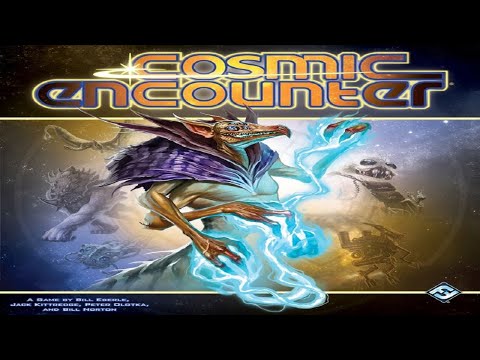
Video: How to Play
Start here, then follow the written guide
Step by step
Game Objective
Prepare for an intergalactic adventure in Cosmic Encounter! Here, each of you takes on the role of an alien leader with a clear objective: expand your empire and establish colonies on other players' planetary systems. The first player (or players, because victory can be shared!) to have five foreign colonies (i.e., on planets that are not their own) is the great cosmic winner! It doesn't matter if these colonies are all in the same system or spread across several. What matters is dominating the space of others!
But what is a colony? It's simple: one or more of your ships on a planet. Even if you have multiple ships on the same planet, it still counts as a single colony. And yes, a planet can have colonies from different players, but you can only have one colony per planet.
Setup
Let's set up the table for your space journey! Follow these steps:
- Setting up the Warp and Planets: Place the Warp (the central board) in the middle of the table. Each player chooses a color, takes their five planets, and arranges them as they wish. Then, each player places their colony marker on the zero space of the Warp.
- Placing Ships: Each player takes their 20 plastic ships of their color and places 4 ships on each of their planets, forming a stack.
- Prepare the Destiny Deck: Take the Destiny card deck and remove all cards of colors not being used in the game. Shuffle the remaining cards.
- Choose Aliens: Shuffle the Flare Cards and deal two to each player. Each player takes the Alien cards corresponding to the two Flares received and looks at them in secret. Choose one of the two aliens to play and place it face down in front of you. The other Alien card goes back into the box.
- Bot Tip: Aliens have skill levels (warning lights). Green for beginners, yellow for moderate experience, and red for experienced players looking for unusual strategies!
- Preparing the Flares: The Flare Cards you received are added to the cosmic deck. If there are fewer than five players, add extra Flares randomly until the cosmic deck has a total of 10 Flares. Shuffle the cosmic deck.
- Note: For the first few games, it might be better to play without Flares to understand the basic flow of the game. Remember that only one version of the Thief Flare card can be used.
- Starting Hands: Each player receives a hand of eight cards from the cosmic deck. The rest of the deck is placed in the center of the play area. You can look at your cards, but do not show them to other players.
- Select the First Player: Draw a card from the Destiny deck. The color of the card will determine who plays first. Shuffle that card back into the deck.
The Game Turn
A player's turn begins with the first player and proceeds to the left. Each turn consists of one or two encounters. The first encounter is guaranteed, but you will only have a second encounter if you win the first (or make a successful deal).
Starting the Turn
The current player (the attacker) first checks if they have at least one encounter card in hand. If not, they reveal the remaining cards, discard them, and draw a new hand of eight cards. This can only be done once, at the beginning of the turn. If the attacker runs out of encounter cards later, their turn ends.
Phases of an Encounter
Each encounter has seven crucial phases:
1. Regroup
One of your ships is recovered from the Warp and placed in one of your colonies (either in your home system or in a foreign colony). If you have no colonies, the ship goes directly to the Hyperspace Gate.
2. Destiny
The attacker draws a card from the top of the Destiny card deck. If there is only one card, shuffle the discard pile to form a new deck before drawing.
- If you draw a color: The color indicates the planet system where the encounter will occur. The player of that color becomes the defender. If you draw your own color, you can draw again (until you draw a different color) or try to expel a foreign colony from one of your home planets. If one of your home planets is without ships, you can automatically re-establish a colony there with up to four ships from other colonies, and this counts as a successful encounter.
- If you draw a wild: You can choose any player to be the defender. The encounter will occur in that player's system.
- If you draw a special: The special card will explain the conditions of the encounter. The player indicated on the card will be the defender, and the card will say where the encounter should happen.
3. Launch
The attacker takes the Hyperspace Gate and points it at one of the planets in the system indicated by the Destiny card. Then, they take 1 to 4 ships from any of their colonies (home or foreign) and place them at the end of the Hyperspace Gate. Be careful not to remove all ships from a colony, or you will lose it! The defender cannot add or subtract ships from the target planet, and can even defend with zero ships if they have none there.
4. Alliance
Now it's time to call for reinforcements!
- First, the attacker announces who they want as allies (cannot invite the defender).
- Then, the defender invites their allies (can invite any player except the attacker, even those already invited by the attacker).
- Starting with the player to the left of the attacker and proceeding clockwise, each player decides whether to accept or refuse the invitations. You may not ally with anyone.
- If you ally with the attacker (offensive ally), you select 1 to 4 of your ships and place them in the Hyperspace Gate.
- If you ally with the defender (defensive ally), you select 1 to 4 of your ships and place them next to the target planet.
- Only after a player chooses a side (or refuses) and selects their ships can the next player decide.
5. Planning
The attacker and defender secretly choose an encounter card (Attack, Negotiate, or Morph) from their hand and place it face down in front of them. If the defender has no encounter cards, they can discard all cards in hand and draw a new hand of eight before choosing. If the attacker has no encounter cards, their turn ends immediately.
6. Reveal
The attacker and defender simultaneously flip their cards to determine the winner.
- Both play Attack cards: Each main player adds the card's value to the number of ships on their side (including allied ships). The side with the highest total wins. In case of a tie, the defender wins.
- One plays Attack and the other Negotiate: The player who played Negotiate automatically loses the encounter but receives compensation, drawing cards randomly from the attacker's hand (one per ship lost to the Warp).
- Both play Negotiate: An attempt at a deal is made. All allies return their ships to their colonies. The main players have one minute to negotiate. They can exchange cards and/or allow the opponent to establish a colony on one of their planets. If no deal is reached within one minute, three ships from each main player go to the Warp.
- One plays Morph: The Morph card transforms into a duplicate of the opponent's card. The encounter is resolved normally as if both had played the same card. Afterward, the Morph card returns to normal.
7. Resolution
The effects of the encounter are resolved:
- If the attack wins: All ships in the Hyperspace Gate (attacker and offensive allies) are placed on the planet, establishing (or reinforcing) colonies. Each player advances a colony marker on the Warp. The defender's ships and defensive allies go to the Warp. Ships of other players on the planet (spectators) are not affected. If it was the first encounter, the attacker may have a second.
- If the defense wins: The colonies established on the planet remain. All ships in the Hyperspace Gate (attacker and offensive allies) go to the Warp. Defensive allies return their ships to their colonies and receive a reward: for each ship they contributed, they can draw a card from the cosmic deck or recover a ship from the Warp. If it was the first encounter, the attacker does not have a second, and the turn passes to the left.
- If a deal is made: The terms of the deal are fulfilled. If it was the first encounter, the attacker may have a second.
- If the deal fails: The main players each lose three ships to the Warp. If it was the first encounter, the attacker does not have a second, and the turn passes to the left.
- Compensation: (Already explained in phase 6.B)
- After resolution: The revealed encounter cards go to the discard pile. If the attacker won (or succeeded in the deal) and it was their first encounter, they may have a second. Otherwise, the turn passes to the left.
End of Game and Scoring
The game ends as soon as one or more players reach five foreign colonies. These players share the victory! Yes, it is possible for multiple players to win at the same time, especially through successful alliances and deals.
Losing Alien Powers
If you do not have at least three colonies in your home system, you lose your alien power and flip your Alien card face down. The loss is immediate. If you manage to re-establish colonies on at least three home planets, your alien power is restored.
Tips for Winning
- Manage Your Encounter Cards Wisely: You only draw a new hand of eight cards if you have no encounter cards at the beginning of your turn or as a defender in the planning phase. Use your Attack, Negotiate, and Morph cards strategically. A card that seems weak now could be the key to victory later!
- Alliances are Powerful: Don't underestimate the power of a good alliance! Invite other players to your encounters, both on offense and defense. Remember that offensive allies gain colonies with you, and defensive allies gain valuable rewards (cards or ships from the Warp) for helping to defend. The game is as much about negotiation and diplomacy as it is about combat.
- Know Your Alien (and Others'!): Each alien power breaks the game rules in a unique way. Understanding how your alien works and, more importantly, how your opponents' aliens can affect the game, is crucial. Pay attention to the "Player Prerequisites" and "Timeline" on the Alien cards to know when and how powers can be used.
More videos
More rules explanations from the community
In English
-
 How to Play Cosmic Encounter [Rum and Board]
-
 Learn to Play Cosmic Encounter in 7 Minutes
-
 Cosmic Encounter - Components and Set-Up
-
 The Gamer's Grind Show: Season 1 Episode 2
-
 Cosmic Encounter and Variants - Refresher on How to Play // Cosmic Tavern
-
 Cosmic Encounter "Shenanigans" Deck - Part 1
-
 Hand Mangement in Cosmic Encounter
-
 How to Play: Cosmic Encounter + Cosmic Eons
-
 The Warp looks at Reward Decks for Cosmic Encounter
-
 Cosmic Encounter "Shenanigans" Deck - Part 2
-
 The Warp showcases The Amazing Alien Database
Rules manual
Official PDF file
Frequently Asked Questions
Quick answers about the rules
