
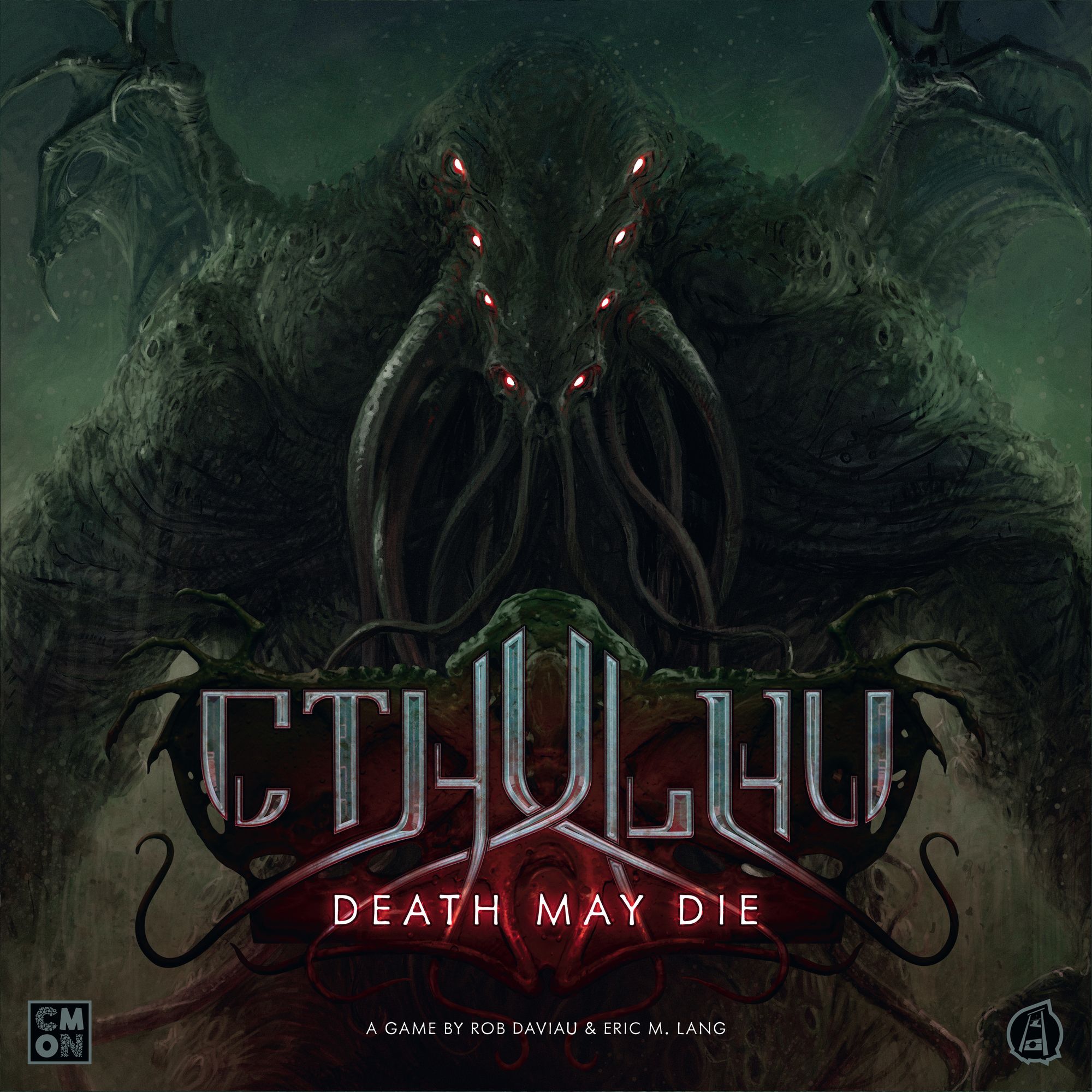
Cthulhu: Death May Die — How to Play
CMON Global Limited, Guillotine Games, Arclight Games · Board game · 2019What do you want to do now
Ask anything about Cthulhu: Death May Die: rules, setup, components, complexity, price, or whether it fits your group.
Video: How to Play
Start here, then follow the written guide
Step by step
Objective of the Game
Ever felt like the world was on the brink of cosmic horror, and only you and your brave (or perhaps just plain crazy) friends could stop it? Welcome to Cthulhu: Death May Die! In this thrilling cooperative board game for 1 to 5 investigators, your mission is clear, if not entirely sane: first, you've got to disrupt a terrifying ritual that's bringing an ancient evil into our world, and then, you need to kill the Elder One before it completely dominates everything!
It's a race against madness and monstrous entities, where every decision could be your last. Can you save humanity from unspeakable horrors, or will you succumb to the creeping insanity?
Preparation (Setup)
Alright, investigators, let's get this show on the road! Setting up Cthulhu: Death May Die is like preparing for a cosmic showdown – a few key steps to get you ready to face the Elder One:
- Gather Your Gear: Place the Story Board, all the shiny tokens, and those ominous dice within reach.
- Choose Your Doom (Elder One): Pick an Elder One box. Take its unique Elder One figure and place it on the starting space of the Summoning track on the Story Board. Lay out the Minions card (for Cultists and Monsters) on the Story Board. Grab its 8 Mythos cards and any special tokens, setting them aside for now. Finally, arrange the 4 Elder One Stage Cards faceup on the Story Board, with Stage 1 on top.
- Select Your Nightmare (Episode): Now, choose an Episode box. From it, take out its 8 Mythos cards, 15 Discovery cards, the Episode card, and any special tokens. Place the Monsters card on the Story Board.
- Enemy Lineup: Grab all the figures for the enemies shown on both the Elder One Minions and Episode Monsters cards. Any figures not placed on the map initially go into a reserve, ready to be summoned later.
- Map the Madness: Flip over the Episode card and follow its instructions to build the map using the various tiles. Place any initial enemy figures and tokens on their indicated spaces. Once the map is ready, flip the Episode card back over and place it on the Story Board.
- Shuffle the Mythos: Combine all 16 Mythos cards (from both the Elder One and Episode boxes), shuffle them thoroughly, and place them facedown as a single deck.
- Prepare for Discoveries: Shuffle the Episode Discovery deck and place it facedown.
- Choose Your Investigator: Each player selects 2-5 investigators (their board and figure). Attach a colored base to each figure and place them on the designated starting space on the map.
- Initial Sanity Check (or lack thereof): Place 6 tentacle markers of your investigator's color on their Investigator board: 3 on the first level of your investigator's skills, and the other 3 on the leftmost space of the Wound, Stress, and Sanity tracks.
- Embrace the Insanity: Shuffle the Insanity cards and deal 1 faceup to each investigator, placing it near their Investigator board. Discard the rest.
- First Blood (or first turn): Randomly determine the starting player. Play proceeds clockwise. There are no separate enemy turns; enemies act during player turns. The starting player takes the Mythos deck.
The Game Turn
A round of Cthulhu: Death May Die is a tense, four-phase dance with destiny (and unspeakable horrors). Here's how it breaks down for the active player:
-
Phase 1: Take 3 Actions
This is your time to shine, investigator! You get to perform 3 actions. You can repeat actions, and some actions can only be taken in a Safe space (a space with no enemies). Here are your options:
- Run: Move up to 3 spaces. Be careful! If you leave a space with enemies, ALL enemies in that space follow you to your new space. Also, if you leave a space with Fire tokens, you "catch fire" – place 1 Fire token on your Investigator board for each Fire token in the space you left.
- Attack: Target a single enemy in your current space and roll 3 standard black dice (plus any bonus green dice). Each Success deals 1 wound to your target. An enemy is defeated when its wounds equal or exceed its health. Remember, the Elder One cannot be attacked until the ritual is disrupted!
- Rest: If you're in a Safe space, you can reduce your stress and/or wounds by up to 3 points in any combination. You can rest multiple times per turn. Important: Lost sanity can never be regained!
- Trade: You and any other investigators in your space can trade any number of Items or Companions. You cannot trade Conditions.
- Episode Actions: Each episode has 2 unique actions on its Episode card. These function like standard actions and are crucial for disrupting the ritual or surviving the horrors.
-
Phase 2: Draw Mythos Card
Draw the top Mythos card from the deck and resolve its steps from top to bottom. These cards can have special effects, summon enemies, or even advance the Elder One's progress. If a card has the Elder One Summoning symbol, make sure it remains visible when discarded.
-
Phase 3: Investigate or Fight!
This phase depends on where you are:
-
Fight! You're being attacked! (If there are enemies in your space)
No Discovery card for you! Instead, each enemy in your space attacks you (in an order you choose). For each attack, roll the dice indicated on their reference card. Each Success gives you 1 wound, and each Tentacle costs you 1 sanity. You can use stress to reroll dice and your skills to mitigate damage.
-
Investigate! (If you're in a Safe space)
Draw a Discovery card and read its text aloud. Follow the instructions, choosing options if available. You can claim Companions, Items, or Conditions by sliding the card under your Investigator board. Companions can absorb wounds and provide benefits, while Items are part of your inventory, and Conditions affect your mental state. Using a Discovery card costs no action.
-
Fight! You're being attacked! (If there are enemies in your space)
-
Phase 4: Resolve End of Turn
Time to wrap things up and see what cosmic consequences unfold:
- End of Turn Effects: Resolve any end-of-turn effects (except Elder One effects) in an order of your choosing.
- Fire: If you're on Fire (have Fire tokens on your Investigator board), roll 1 standard die for each token. Each Success causes 1 wound, and each Tentacle costs 1 sanity. Then, discard all Fire tokens from your board.
- Check The Mythos Discard Pile: Look at the discard pile. If there are 3 cards with the Elder One Summoning symbol, or one card with 3 of these symbols, the Elder One advances on the Summoning track. Resolve any effects from the revealed Elder One Stage cards. After advancing, reshuffle all discarded Mythos cards back into the deck.
- Check The Elder One Summoning: The Elder One is summoned if it enters the first red space on the Summoning track OR if the ritual was disrupted this turn. If summoned, move the Stage 1 card aside to reveal Stage 2, resolve its reveal effects, and place the Progression token on the Summoning track where the Elder One figure was. The Elder One cannot be attacked until the ritual is disrupted!
- Elder One End of Turn Effects: Resolve any "End of Turn" effects on the revealed Elder One Stage cards, in order from Stage 1 onwards.
End of Game and Scoring
The fate of the world hangs in the balance, and here's how it all comes to a dramatic conclusion:
Winning the Game
You and your fellow investigators collectively win the game if you successfully kill the Elder One by defeating its Final Stage. Even if multiple end-game triggers happen simultaneously, winning conditions take precedence. You saved the world!
Losing the Game
Alas, not all stories have happy endings. You all lose the game if any of the following situations occur:
- An investigator is eliminated (killed or consumed by madness) before the Elder One is summoned to the board (i.e., only Stage 1 is revealed).
- All investigators are eliminated after the Elder One has been summoned (from Stage 2 onward).
- The Progression token reaches the last (8th) space of the Summoning track. This means the Elder One has fully manifested and dominates the world.
When an investigator is eliminated, discard all their Discovery cards and tokens. If the Elder One has not been summoned yet, the game is immediately lost. If it has, the remaining investigators can continue fighting for humanity.
Tips for Victory
Facing cosmic horror is tough, but a few pointers can help you stay sane (mostly) and alive:
- Manage Your Sanity and Wounds: These are your lifeblood! Remember, lost sanity can NEVER be regained, so be wary of those Tentacle results. Use the Rest action in Safe spaces to reduce wounds and stress. Reaching an Insanity Threshold on your Sanity track activates your unique Insanity card and lets you level up a skill, but it's a double-edged sword!
- Prioritize Ritual Disruption: You cannot harm the Elder One until the ritual is disrupted! Focus on completing the Episode Actions that advance this goal. The Elder One might be on the board, attacking you, but until that ritual is broken, your attacks are useless against it.
- Strategic Movement and Safe Spaces: Moving through spaces with enemies means they follow you, potentially leading to more attacks in Phase 3. Whenever possible, aim for Safe spaces to Investigate for valuable Discovery cards and to Rest. Sometimes, running away is the smartest move!
More videos
More rules explanations from the community
In English
-
 Learn To Play: Cthulhu Death May Die
-
 Easy Guide to Painting your Cthulhu Minis
-
 Cthulhu Death May Die - How to Play
-
 Cthulhu Death May Die - How to paint Cthulhu
-
 Cthulhu Death May Die - How to paint Hastur and friends (Live Stream)
-
 Cthulhu Death May Die Season 1 Episode 1 How to Play and Playthrough | The Game Warrior
-
 HOW TO PAINT #10 / CHTHONIAN
-
 ?️ Painting Cthulhu: Death May Die - Cthonian (the Toy of Painting Series)
-
 Cthulhu Death May Die - How to paint Shoggoth, Cthonian and Hunting Horrors (Live Stream)
-
 How to Paint Dimensional Shambler
-
 How to Paint Eddie Investigator
Rules manual
Official PDF file
