
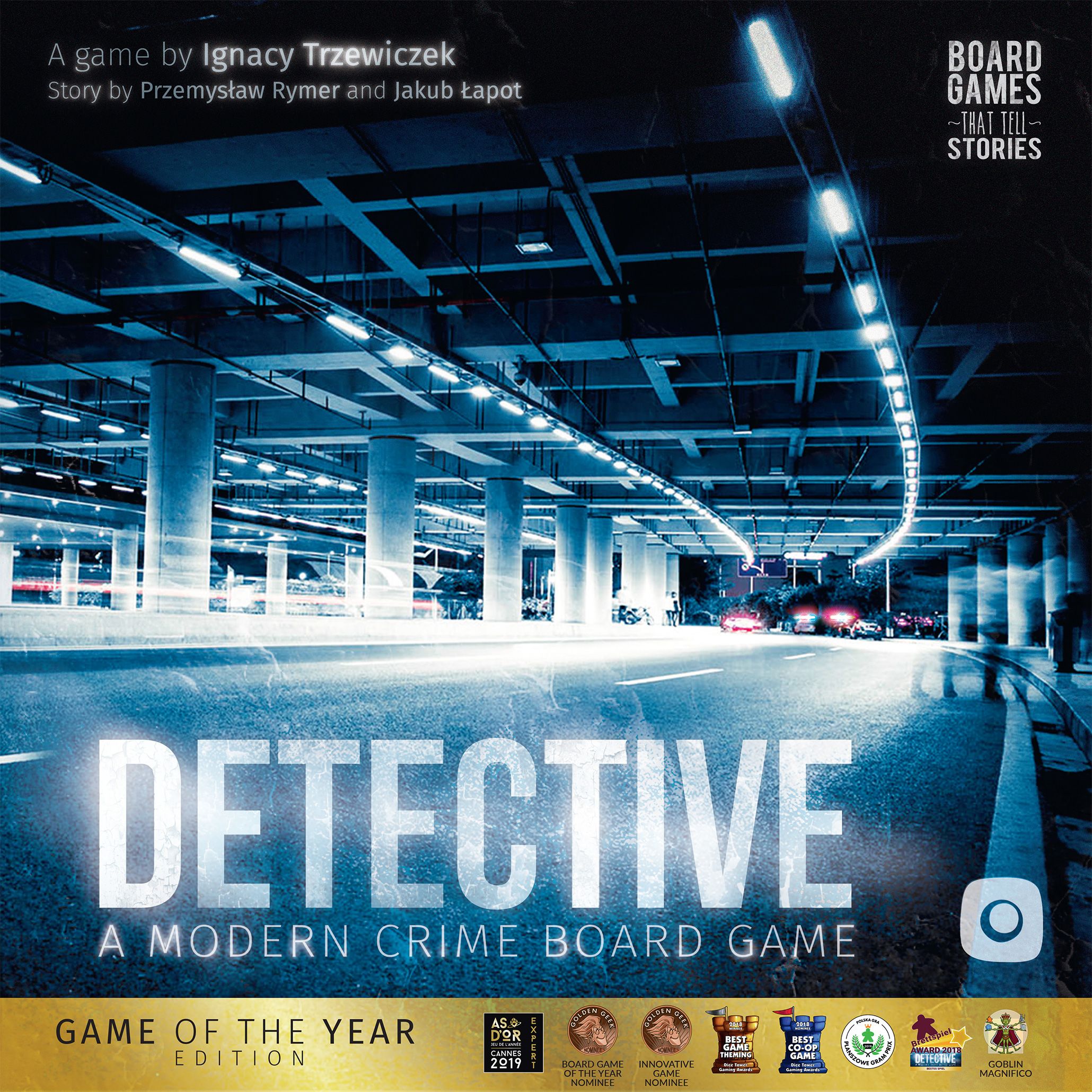
How to Play Detective: A Modern Crime Board Game
Portal Games, GaGa Games, Galápagos Jogos · Board game · 2018What do you want to do now
Ask anything about Detective: A Modern Crime Board Game: rules, setup, components, complexity, price, or whether it fits your group.
Video: How to Play
Start here, then follow the written guide
Step by step
Game Objective
Detective is a cooperative game of deduction where you and your team act as investigators for Antares, a high-tech agency. Your goal is to gather information, collect clues, and follow leads to solve a specific case. The objective is to piece together scattered information to answer questions in a Final Report. Your victory or defeat depends on the number of victory points earned based on the accuracy of your deductions.
Preparation (Setup)
- Place the Investigation Team (IT) marker on the Headquarters location.
- Place the Time marker on the 8:00 AM space of the Time track.
- Place the Day marker on the day 1 space of the Day track.
- Each player chooses an investigator tile, places it face up, and collects the Skill token depicted in the bottom right-hand corner of that tile.
- Turn any unused investigator tiles to their Consultant side and collect the Skill tokens depicted on those tiles.
- Log into the Antares website at antaresdatabase.com and select the campaign and case.
- Place the case deck next to the board.
- Open the casebook to read the case introduction, special rules, and any set-up changes.
- Prepare a space for notes or a mind map and ensure an internet browser is available.
Game Flow
The game is played over a limited number of days (game rounds). Each Day is divided into eight working hours (8:00 AM to 4:00 PM). There are no individual player turns; the team acts together, discussing and performing actions as a single unit.
Daily Cycle:
- Working Hours: The team performs actions, advancing the Time marker as required by the actions taken.
- End of Day: When the Time marker reaches 4:00 PM, the team must decide whether to work Overtime or End the Day.
- Ending the Day: If you End the Day, you must:
- Move the Day marker to the next day.
- Reset the Time tracker to 8:00 AM.
- Move the IT marker back to Headquarters.
- Remove all Used Ability tokens from the investigator tiles.
- Sort notes and list available leads.
Actions and How to Play
The team can perform the following actions in any order:
- Follow a Lead: Search the case deck for the specific lead card number. If you are not at the card's Location, move the IT marker and advance the Time marker by one hour for travel. Then, advance the Time marker by the card's hour value. Read the card aloud and follow all instructions.
- Dig Deeper: If a lead card has a Dig Deeper section, you may spend the required Skill token to flip the card and read the back side for additional information. This must be decided immediately before moving to another lead.
- Browse the Antares Database: When you encounter the "@" symbol, use the website to input names or numbers. This action costs no hours and can be done at any time.
- Browse the Internet: When you see the wifi icon, you may use a search engine (Google, Wikipedia, etc.) to research underlined phrases. This costs no hours.
- Use an Investigator’s Ability: Each investigator has a unique ability that can be used once per day. After use, place a Used Ability token on the tile.
- Write a Report: Once per day, spend one working hour at any location to add one Authority token to the Token pool. This cannot be done during Overtime.
- Spend Authority Tokens: Some instructions may require you to discard Authority tokens to perform specific actions (e.g., acquiring an arrest warrant).
Technical Terms & Components
- Token Pool: A shared pool containing Skill tokens (Research, Technology, Questioning, Perception, and Wild), Stress tokens, and Authority tokens.
- Lead Cards: Cards representing evidence or witnesses. They have a front side and sometimes a back side (accessible via Dig Deeper).
- Stress Levels: During questioning, you will see LSL (Low), MSL (Medium), or HSL (High), indicating the likelihood that a witness is lying or reacting emotionally.
- Signatures: 12-character codes (Dactyloscopic, DNA, or Material) that must be entered into the Antares Database to match evidence.
End of Game and Scoring
The game ends when the final day's time limit is reached and the team decides to End the Day. The team then navigates to the Final Report on the Antares website.
Scoring Criteria:
- Main Questions: Worth the most points.
- Matched Evidence: Points are awarded for evidence matched in the Antares Database (worth more than additional questions, less than main questions).
- Additional Questions: Worth the least points.
- Wrong Answers: Each wrong answer results in -1 point.
- "I don't know" Answers: Worth 0 points.
- Stress Penalty: For each Stress token collected, the team loses 1 point.
Victory/Defeat: Each case has a predetermined point total. If the team reaches this total, they win the case. If not, they lose.
Immediate Failure: If the team collects Stress tokens equal to or greater than the Stress limit (defined in the case introduction), the investigation ends immediately, and you must proceed to the Final Report.
Tips for Winning
- Cast a Wide Net: Following several different leads to build a broader picture is often more effective than focusing on a single path.
- Take Detailed Notes: Because this is a campaign, creating a mind map and writing down names and relations is crucial, as information from earlier cases may be needed later.
- Manage Your Tokens: Skill tokens do not refresh at the end of the day; they are a limited supply for the entire case, so choose when to Dig Deeper carefully.
More videos
More rules explanations from the community
In English
-
 Detective: A Modern Crime Board Game - Rules
-
 Get the Game - Detective: A Modern Crime Board Game
-
 Detective: A Modern Crime Board Game - Experience
-
 How to play Detective online
-
 Detective: a Modern Crime Board Game - future of the line explained
-
 Playing Detective on Zoom
-
 Detective: Season One. Learn about the game and see it in action during th
-
 Detective line explained
Rules manual
Official PDF file
Frequently Asked Questions
Quick answers about the rules
