
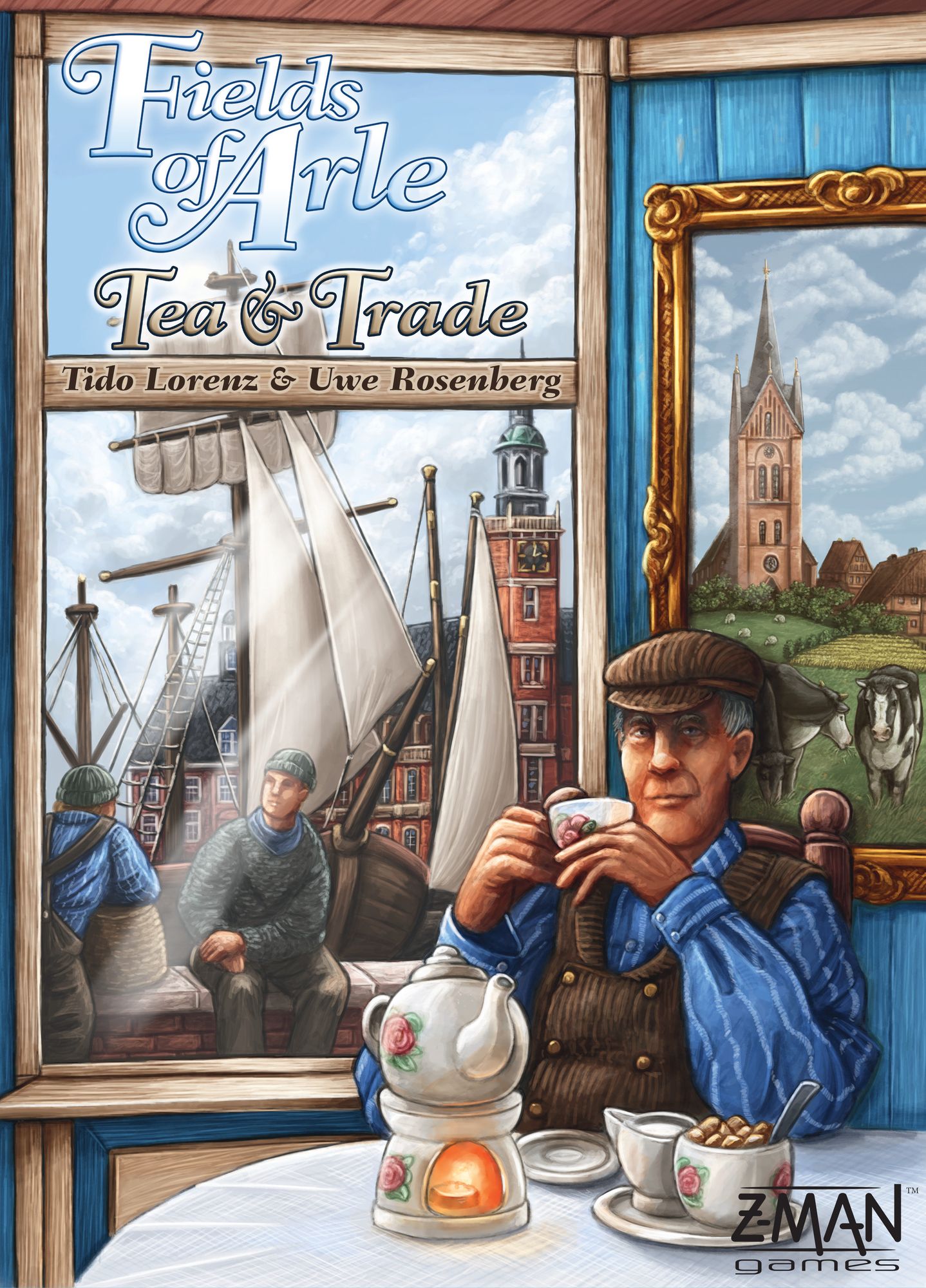
Fields of Arle: Tea & Trade
Feuerland Spiele, Games Factory, Games Factory Publishing · Board game · 2017Step by step
Game Objective
Welcome to East Frisia! In Fields of Arle: Tea & Trade, you take on the role of a farmer in a region famous for its immense love for tea. Your goal is to develop your land, manage resources, and expand your operations through trade and infrastructure. You will strive to increase your productivity by draining moors and trading with distant lands to accumulate the most victory points by the end of the game.
Preparation (Setup)
Set up the game components as normal for the base game, then add the following expansion elements:
- Action Board: Enlarge the action section of the main board by placing the Overlay Board (containing the Schloot Digger action) above it. Use the side corresponding to the number of players (2 or 3). Place two Tool Markers on the leftmost spot of the Shovel track.
- Building Boards: Place the Building Boards next to the main board.
- Place the nine Major Craft Buildings (orange) and four Large Buildings (red) as indicated.
- Fill the remaining spaces with a combination of green, yellow, and blue buildings from the base game or expansion.
- Swapping Buildings: Replace the base game versions of the Smokehouse and Smithy (yellow) and the Zum Waldhof and Zum Fährhaus (blue) with the new versions marked with an asterisk (*).
- Harbour Board: Each player takes a Harbour Board and places it above their Travel/Barn Board.
- Starting Resources: Each player begins with three Clay, three Wood, three Peat, and three Tea.
- 3-Player Variant:
- Use the Overlay Board with Imitate Actions, Temporary workers, and Rounds.
- Place Worker discs on the month spots in clockwise order.
- Each player receives a Harbour tile, a Handcart in their Barn, and all Goods markers (Food, Grain, Flax, Wool, and Skins) are moved one step higher.
- Players use a small Boardwalk tile with only two Peat spaces instead of four.
Game Flow
The game follows the base game's structure, with the following additions:
- Rounds: In a 3-player game, the game is played over seven rounds.
- Specialisations (First Round): Before the game starts, players (starting from the last player to the first) select two specialisations:
- Improve a Tool level: Move a Tool marker up one level (where no other player has moved). Other players receive the resources that the upgrade would have cost.
- Buy a Small House (green): Costs double the normal price (two Lumber and two Grain). Only one may be bought as a specialisation.
- Special Actions (3-Player): Two players may pick Special Actions. If two players do so, the start player token moves to the person who did not take a Special Action.
- Imitate Actions (3-Player): Three Imitate Actions are possible every half year. Each player can take only one. The first costs one Food; subsequent ones cost two Food.
Actions and How to Play
New Action Spaces
- Schloot Digger: Allows a player to lay down Schloote (drainage channels) on their Home Board. The number of Schloote placed (between 3 and 6) depends on the Spade level.
- Sail Maker: Take 1 Linen and 1 Peat. Build 1 Cutter or 1 Peat Boat by paying the appropriate cost.
- Boat Builder: Build a Trading Ship or Peat Boat (and a Cutter in 2-player games) by paying the appropriate costs.
- Grandmother: Take 1 East Frisian Tea and 4 Food.
- Temporary Worker (3-Player): Pay 2 Food to build either 1 Vehicle/Trading Ship or 1 Building.
- Vehicle Master (3-Player): Take 1 Clay per Peat Boat and 1 more for every 3 Schloote on the Home Board.
The Schloote System
Schloote are brown wooden pieces placed between land spaces. The first must touch the Dike line, and all subsequent Schloote must connect to at least one other. If the Dike line moves, the gap can be closed with a Schloot from the supply for free.
Benefits of Drained Fields (2+ Schloote along edges):
- Raising Sheep: Drained fields can hold up to three sheep. In the May Inventorying phase, fields with two sheep produce an offspring.
- Farmer Action: You can plough two drained fields (instead of one) per plough to plant Flax or Grain.
- Draining Moors: If two Schloote border a large Moor tile, it can be flipped and four Peat placed on it.
Ships and Trade
- Cutters: If not completely filled with goods to upgrade, they can undertake fishing. In May and November Inventorying phases, take one Food for each empty space.
- Trading Ships: Empty spaces are used for trade during the Vehicles and Ships emptying phase:
- India: Pay 3 Food to fill the ship with Tea.
- England: Pay 1 Tea (or East Frisian Tea) to place 1 Winter Clothing tile (Large Trading Ship only).
- Norway: Pay 3 Flax or Grain to fill the ship with Wood.
- Finland: Pay 1 Winter Clothing tile to fill the ship with Timber.
Building Types
- Minor Craft Workshops (yellow): Provide IMMEDIATE ACTIONS used once when bought.
- Small Buildings (green): Provide ANYTIME ACTIONS that can be used multiple times in a row.
- Large Craft Buildings (orange): Provide IMMEDIATE ACTIONS used once when bought.
- Inns (blue): Provide specific abilities (e.g., Zur alten Bierstube gives Wool and Food per Large Craft Building).
- Large Buildings (red): High-cost buildings providing powerful abilities (e.g., Mennonite Church provides a large Trading Ship and trade actions).
Tea and East Frisian Tea
Tea and East Frisian Tea can be spent to strengthen actions. For example, spending East Frisian Tea can increase Clay yield or allow the Master action to be used twice (moving Tool markers six spaces). However, more than one level of improvement is not allowed for a single action (except for the Master action).
End of Game and Scoring
The game ends according to the base game rules. Points are calculated normally, with the following additions from the expansion:
- Tea: ½ point each.
- East Frisian Tea: 1 point each.
- Cutters and Trading Ships: 2, 3, or 4 points (depending on the type/size).
- Schloot Digger Tool Scale: 0, 2, or 3 points.
Tips for Winning
- Optimize Land Productivity: Prioritize placing Schloote to drain your Moor tiles and increase sheep capacity, as this boosts your resources during the May Inventorying phase.
- Strategic Trading: Use Trading Ships to acquire rare materials like Winter Clothing from England or Timber from Finland, which are essential for high-tier buildings.
- Leverage East Frisian Tea: Use East Frisian Tea to double the efficiency of the Master action or to significantly increase the output of resource actions like the Clay Worker.
Rules manual
Official PDF file
