
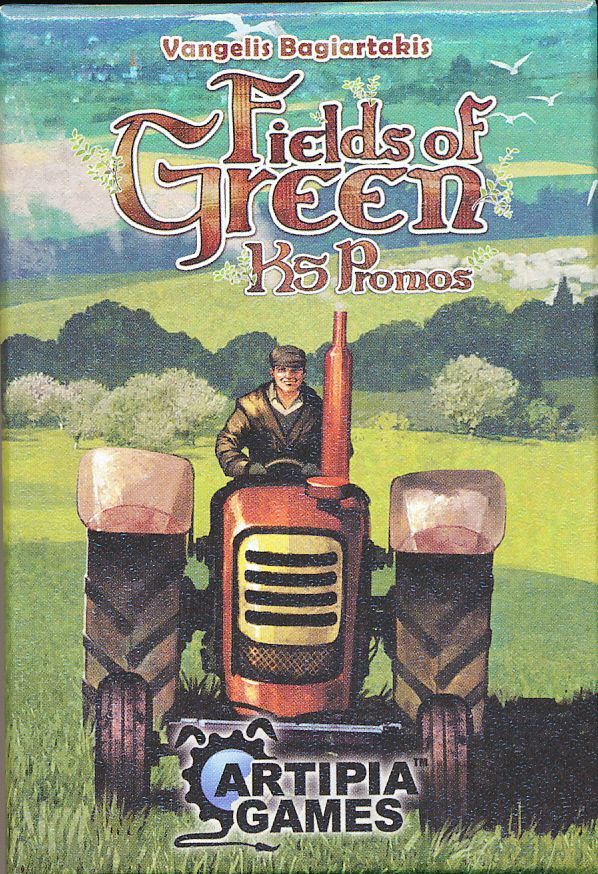
Fields of Green: Kickstarter Promo Cards — How to Play
Artipia Games, Czacha Games, Flick Game Studio · Board game · 2016Step by step
Game Objective
In Fields of Green, you take on the role of a farmer looking to develop your land. The goal is to create the most efficient farm possible by selecting and placing Location cards such as Plantations, Livestock, and various Buildings. After four years of gameplay, the player with the most efficient farm will be the winner.
You've decided to leave the big city, move to the countryside, and become a farmer! Funded by a government program, you've found a small plot of land and are now ready to plant, raise animals, and live the life of a farmer in the second half of the 20th century!
Setup
To set up the game, follow these steps:
- Separate all cards by type: Plantations, Livestock, Structures, and Buildings (4 main decks), plus Water Towers and Silos (2 additional decks).
- Shuffle the 4 main Location decks and place them face down in the center of the table. Place the corresponding Identifier token in front of each deck.
- Place the Water Tower and Silo decks face up near the other decks.
- Each player takes 15 coins.
- Each player places one Water Tower card and one Silo card in front of them.
- Place 3 Water markers on each starting Water Tower and 1 Food marker on each starting Silo.
- Place the remaining money and VP, Water, and Food markers in the center of the table as Supplies.
- Take and shuffle the Equipment tokens, forming a face-down deck next to the Supplies.
- The player who most recently visited a farm or rural area will be the first player and receives the First Player token.
Game Flow
The game is played over four years, each represented by a round. Each round is divided into three phases, performed in the following order:
- MAINTENANCE PHASE
- ACTION PHASE
- HARVEST PHASE
MAINTENANCE PHASE
This phase occurs at the beginning of each round (year).
- Move the Year Marker to the current year on the Year Track.
- The arrows around the year on the Year Track indicate the direction (clockwise or counter-clockwise) in which cards will be passed between players in the upcoming phases.
- Receive the new round's resources: 1 Food marker, 2 Water markers, and 3 coins. (Skip this step in the first round).
- Water markers must be placed on a Water Tower on your farm. Each Water Tower stores up to 3 Water markers. If the towers are full, additional Water is lost.
- The Food marker must be placed in a Silo. Each Silo stores up to 4 Food markers. If the silos are full, new Food is lost.
- Each player, starting with the First Player and proceeding clockwise, draws 6 cards from the 4 main Location decks.
- Cards can be drawn in any combination, as long as they are from at least 3 of the 4 decks (e.g., 3-2-1-0, 2-1-1-2, 1-4-0-1). All cards are drawn at once, without looking at previous draws. The number of cards drawn from each deck is public information. If a deck runs out, no more cards of that type will be drawn for the rest of the game.
- These 6 cards form the initial hand for the round.
- For new games, the Introductory Mode suggests a specific card distribution per year.
Rules for 2 Players in the Maintenance Phase:
- After drawing the 6 cards, players do not look at them. They shuffle all 12 cards together and form a new face-down deck. They reveal the first 6 cards and place them face up on the table.
ACTION PHASE
This phase consists of 6 turns. In games with 3 or 4 players, everyone acts simultaneously.
- Each turn, choose a card from your hand, place it face down in front of you, and pass the remaining cards to the next player (as indicated by the arrows on the Year Track).
- When everyone has done this, simultaneously reveal the chosen card and perform one of the following actions:
- A) Build Location
- B) Build Water Tower
- C) Build Silo
- D) Go to Market
- E) Restore Location
A) Build Location
Locations can only be built adjacent to other existing Locations (side-by-side, horizontally or vertically). They are not adjacent diagonally.
- Initially, the only Locations are the first Water Tower and the first Silo. Any new Location must be adjacent to one of them.
- To build a Location, pay its cost in coins (top-left corner of the card). Some also require Water or Food (indicated below the coin cost).
- Water must be paid with Water from a Water Tower no more than 2 spaces away. Distance is calculated orthogonally, counting the built Locations along the path.
- Food must be paid with Food from your Silos. There is no distance limit for Food.
- If you cannot pay the cost (coins, Water, or Food), you cannot build the Location and must choose another action.
- After paying the cost and building the Location adjacent to an existing one, check the ability at the base of the card:
- Gray background: Immediate ability, resolved instantly.
- Green background: Harvest ability, resolved during the Harvest Phase.
- Yellow background: End Game ability, resolved at the end of the game.
Types of Locations:
- Plantations (Green): Types include Cereal, Fruit, Vegetable.
- Livestock (Red): Types include Dairy, Meat, Poultry, Wool.
- Structures (Yellow).
- Buildings (Purple).
B) Build Water Tower
- Discard the chosen card, pay 2 coins.
- Take a Water Tower card from the corresponding deck and build it adjacent to an already built Location.
- Place 3 Water markers on the new card.
- Water from the Water Tower can only be used for Locations built within 2 spaces.
- If there are no more Water Tower cards available or if the player does not have 2 coins, this action cannot be performed.
C) Build Silo
- Discard the chosen card.
- Take a Silo card from the corresponding deck and build it adjacent to an already built Location.
- The cost is 0 coins.
- Silos allow storage of Food. The initial Silo stores up to 4 Food.
- All Silos enter play empty. They increase storage space. Food can be moved freely between Silos, without exceeding the storage limit.
- If there are no more Silo cards available, this action cannot be performed.
D) Go to Market
- Discard the chosen card.
- Gain 2 coins.
- You may sell up to 2 of your Food to gain 2 coins for each.
- Reward Table:
- Discard: 2 Coins
- Discard + 1 Food: 4 Coins
- Discard + 2 Food: 6 Coins
E) Restore Location
- Discard the chosen card.
- Pay 1 coin.
- Flip a Location card that has been turned face down (made Wasteland) back face up.
Rules for 2 Players in the Action Phase:
- Players do not act simultaneously. They take turns.
- The First Player starts, choosing one of the 6 face-up cards and performing an action.
- The other player chooses one of the remaining 5 cards and performs an action.
- After both have performed their first action, 2 more cards are revealed from the deck and added to the face-up cards.
- Players continue choosing cards until the end of the round. When the draw deck runs out, they continue without adding new cards until all 12 have been chosen.
HARVEST PHASE
In this phase, you check the Locations on your farm with Harvest abilities (green background).
- Each Harvest ability has a cost indicated on the left. You must pay the cost to activate it.
- If you cannot or do not wish to pay the cost, the Location card will be turned face down and become Wasteland.
- You cannot build a new Location on Wasteland, but you can restore it later.
- You may pay the Harvest costs and apply the abilities in any order you wish.
- Place the resources paid onto the Harvest cost to indicate it has been paid.
- Restrictions:
- Water for payment must come from a Water Tower within range.
- A Silo cannot store more than 4 Food. If you are to produce more Food than you can store, use existing Food first to avoid losses.
- If a Harvest ability grants new Equipment, it can be used in the same Harvest Phase, if applicable.
- At the end of the Harvest Phase, remove the resources used to pay the costs from the cards.
- The player with the First Player token passes it to the player on their left.
Actions and How to Play
During the ACTION PHASE, players choose a card from their hand, place it face down, and pass the rest. Upon simultaneous reveal, they perform one of the following actions:
A) Build Location
This involves placing a Plantation, Livestock, Structure, or Building card in your play area. It must be adjacent to an already built Location. The cost in coins, Water, and/or Food must be paid. Immediate abilities are resolved immediately. Harvest and End Game abilities are resolved later.
B) Build Water Tower
Allows you to add a new Water Tower to your farm. It costs 2 coins. The new tower stores 3 Water markers and can supply Locations up to 2 spaces away.
C) Build Silo
Allows you to add a new Silo to your farm. It has no cost in coins. Silos increase your Food storage capacity.
D) Go to Market
Allows you to sell Food for coins. By discarding the chosen card, you gain 2 coins. You can sell up to 2 Food for 2 coins each.
E) Restore Location
Allows you to flip a Location card that has become Wasteland back face up. It costs 1 coin.
Equipment
Some cards allow you to install Equipment on your farm. Upon receiving an Equipment, choose one of the three, install it on a compatible Location (as indicated on the token), and return the other two to the bottom of the deck. If you cannot or do not wish to install it, you may keep it. A Location can have up to 2 different Equipment tokens. If a Location with Equipment becomes Wasteland, the Equipment is discarded.
Installed Equipment provides additional abilities. If there is no indication, the ability is applied once when the token is installed.
Stored and unused Equipment at the end of the game yields 1 VP each.
End Game and Scoring
The game ends after the fourth round (after the Harvest Phase). Players calculate their points:
- Sum the VP indicated on the cards in your farm and the VP markers received.
- Sum the VP provided by Equipment with End Game abilities. Add 1 VP for each Equipment obtained but not used.
- Score 1 VP for every 3 remaining coins.
- Score 1 VP for every 2 Food markers in your Silos.
- Score 1 VP for each empty Water Tower on your farm.
- Calculate the VP from Locations with End Game abilities.
The player with the most VP is the winner. In case of a tie, the winner is the one with the most Locations on their farm. If the tie persists, the player with the most money wins. If the tie still persists, the tied players share the victory.
Tips for Winning
- Create a point-generating machine: Make multiple
Rules manual
Official PDF file
