
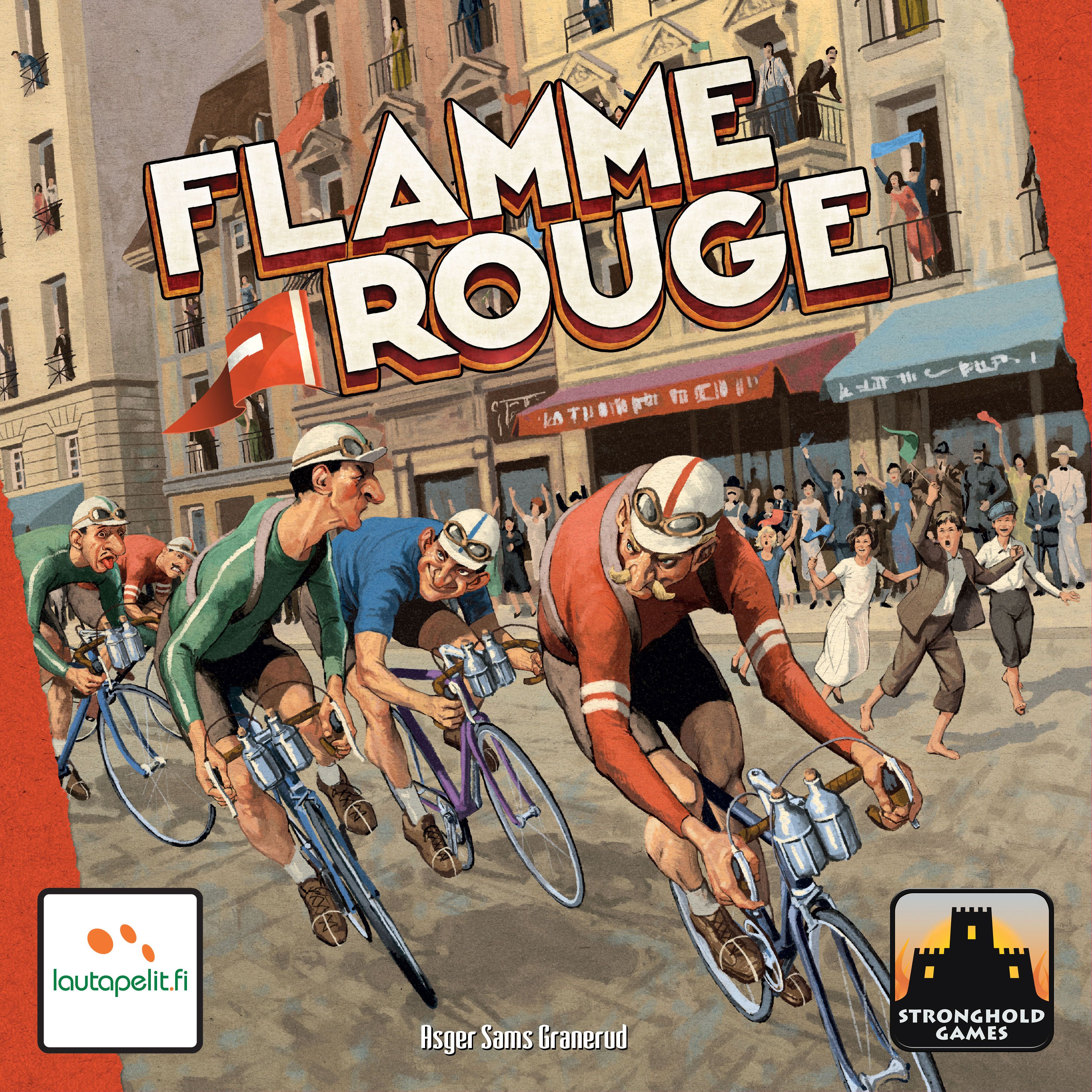
Flamme Rouge
Lautapelit.fi, Conclave Editora, Devir · Board game · 2016
2–4 · best 4
30–45 min
Weight 1.7/5
7.9
rating
Ludopedia
7.5
rating
BGG
Game Objective
Get ready for the adrenaline of the **Grand Race**! In Flamme Rouge, you take control of a team of two cyclists – a **Rouleur** and a **Sprinteur** – in an exciting tactical dispute. Your objective is simple, yet challenging: be the first to cross the **finish line** with one of your cyclists. Glory and fame await you! If the race is tight and more than one cyclist crosses the finish line in the same round, victory goes to whoever manages to go further. And if the tie persists, the cyclist in the right lane wins. Remember, a cyclist cannot go beyond the last square of the course tile, so every move counts!Setup
Setting up the Flamme Rouge track is the first step to victory. Follow this quick guide to get everything ready:- Build the Course:
- Choose one of the **Stage cards**. For your first race, we recommend the "Avenue Corso Paseo" stage.
- Build the course using the **course tiles** as indicated on the card. Tiles are identified by letters (lowercase for "Avenue Corso Paseo").
- The **start [START]** and **finish [FINISH]** tiles are marked with yellow lines. The start tile also has a "2".
- At the bottom of each Stage card, there is a sequence of letters that shows the correct order of the tiles.
- Choose your Team:
- Each player chooses a color and receives: a **Sprinteur** and a **Rouleur** (cyclist miniatures), their corresponding **Energy cards**, and a **player board**.
- Prepare the Card Piles:
- Shuffle your **Sprinteur's Energy cards** and form a face-down pile, placing it in the indicated spot on your **player board**.
- Do the same with your **Rouleur's Energy cards**.
- Place all **Sprinteur Exhaustion cards** in a face-up pile, within reach of all players. Repeat for the **Rouleur Exhaustion cards**.
- Starting Position of Cyclists:
- The last player to ride a bicycle (in case of a tie, the youngest) places their two cyclists in any **free squares** behind the **start line [START]**. First in the right lane, if not free, in the left lane.
- Clockwise, each player does the same, until everyone has positioned their cyclists.
- Remember: a cyclist, in a free square, is ALWAYS placed in the right lane (marked with a double line).
The Game Turn
The race unfolds over several rounds, and each one is divided into 3 crucial phases:1. Energy Phase [all players simultaneously]
This is the strategic phase where you decide the pace of your cyclists:
- Choose a Cyclist and Draw Cards:
- Choose one of your cyclists (the **Rouleur** or the **Sprinteur**) and draw 3 cards from the top of that cyclist's **Energy card** pile.
- Important: You cannot draw and choose cards for your second cyclist before doing so for the first.
- If a cyclist's Energy card pile runs out, shuffle the **recycled cards** from that pile and place them face down to form a new pile. Draw until you have 4 cards in hand (or all remaining, if fewer than 4).
- If there are no more Energy cards in your pile, draw an **Exhaustion card** and play normally.
- Choose a Card and Recycle the Others:
- From the 3 cards you drew, choose one and place it face down next to the respective **Energy card** pile. This card will determine the cyclist's movement this round.
- The cards you did not choose are **recycled**: place them face UP under that cyclist's **Energy card** pile. You can see your recycled cards at any time, but never those that have not yet been used (face down).
- Repeat:
- Now, repeat steps 1 and 2 for your other cyclist.
2. Movement Phase
It's time to see the action on the track!
- Reveal Chosen Cards:
- All players turn face up the cards they chose.
- Move All Cyclists:
- Starting with the cyclist furthest ahead in the race, move each cyclist the exact number of squares indicated by the card.
- You can change lanes (left or right) without movement cost.
- A cyclist arriving at an empty square is always placed in the right lane.
- A cyclist can move through others, but cannot end their movement where another cyclist already exists. If a cyclist ends their movement in a square with both lanes occupied, they must stop in the first square before the occupied one that has a free lane.
- Mountain Rules:
- CLIMBS: If a cyclist starts, passes through, or enters a red **CLIMB** zone, they can never move more than 5 squares. A card with a value greater than 5 can be played, but only 5 squares will be covered. If a movement allows entry into the first square of a CLIMB, the cyclist stops in the last free square before the CLIMB. Cyclists on CLIMBS cannot give or receive the **Slipstream effect**.
- DESCENTS: If a cyclist starts their movement in a blue **DESCENT** square, their Energy card will have a minimum value of 5. A card with a lower value can be played, but the movement will be 5. The **Slipstream effect** can be used normally.
3. End Phase
Adjustments and consequences of the round:
- Remove Played Cards:
- Remove the played cards to the game box.
- Apply the Slipstream Effect:
- A **Group** consists of one or more cyclists who have no free squares between them.
- Check if there is ONE free square between two groups. The trailing group moves one square forward, so that the two groups join, now forming only one group.
- Then, check if the **Slipstream Effect** applies to this "new" group. Do the same for all groups, starting with the furthest back group.
- During this phase, a cyclist can benefit from the **Slipstream Effect** multiple times.
- Remember: cyclists on **CLIMBS** cannot give or receive the **Slipstream effect**.
- Assign Exhaustion Cards:
- A cyclist is **exhausted** if they have a free square in front of them.
- Assign an **Exhaustion card** to all cyclists who have a free square in front of them.
- Only an empty line in front of a cyclist does not cause exhaustion; they are in the middle of the peloton.
- If your cyclist is exhausted, draw an **Exhaustion card** of the same type as your cyclist (**Sprinteur** or **Rouleur**) and recycle it. They will not be used again in this game.
End of Game and Scoring
The race ends as soon as a cyclist crosses the **finish line**. The player who achieves this feat is the winner! * If more than one cyclist crosses the **finish line** in the same round, the one who manages to go further wins. * If the tie persists, the one in the right lane wins. * A cyclist cannot go beyond the last square of the course tile.Tips for Winning
To master the roads of Flamme Rouge, consider these tactical tips:- Manage your Energy: **Energy cards** are your most valuable resource. Think carefully about which card to play and which to recycle. Sometimes, a low-value card can be strategic to position yourself for a **Slipstream effect** in the next round, avoiding **exhaustion**.
- Take Advantage of the Slipstream Effect: Drafting behind other cyclists is crucial. Try to keep your cyclists close to each other and to other groups to benefit from the **Slipstream Effect**, gaining extra movements and saving your higher-value cards.
- Mountain Strategy: **CLIMBS** and **DESCENTS** require planning. On CLIMBS, don't waste high-value cards, as movement is limited to 5. On DESCENTS, take advantage of the minimum movement bonus of 5 to gain ground, but remember that the **Slipstream effect** does not work on CLIMBS.
In English
-
 How to Play Flamme Rouge
-
 How to play Flamme Rouge
-
 Board to Death - Review Video (3 Min.)
-
 Hans Solo: Flamme Rouge
-
 Grand Tour Time Chart
-
 5 Quick Strategy Tips for Flamme Rouge- TCbH's Cardboard Academy
-
 Flamme Rouge: A "Walkthrough Review"
-
 Flamme Rouge - how to play (in English)
-
 Show Me How to Win Flamme Rouge
-
 A - Z Board Games - F - Flamme Rouge - Ludus Vulpes
-
 Flamme Rouge: Play Through & How to Play
-
 Flamme Rouge Gamesplained - Part 1
Prefer the Official PDF?
Download the official Flamme Rouge rulebook or browse it online with our AI rules assistant.
View Rulebook PDF
Want to compare prices and check reviews?
Find where to buy at the lowest price, price history, and our full game review.
View Flamme Rouge

