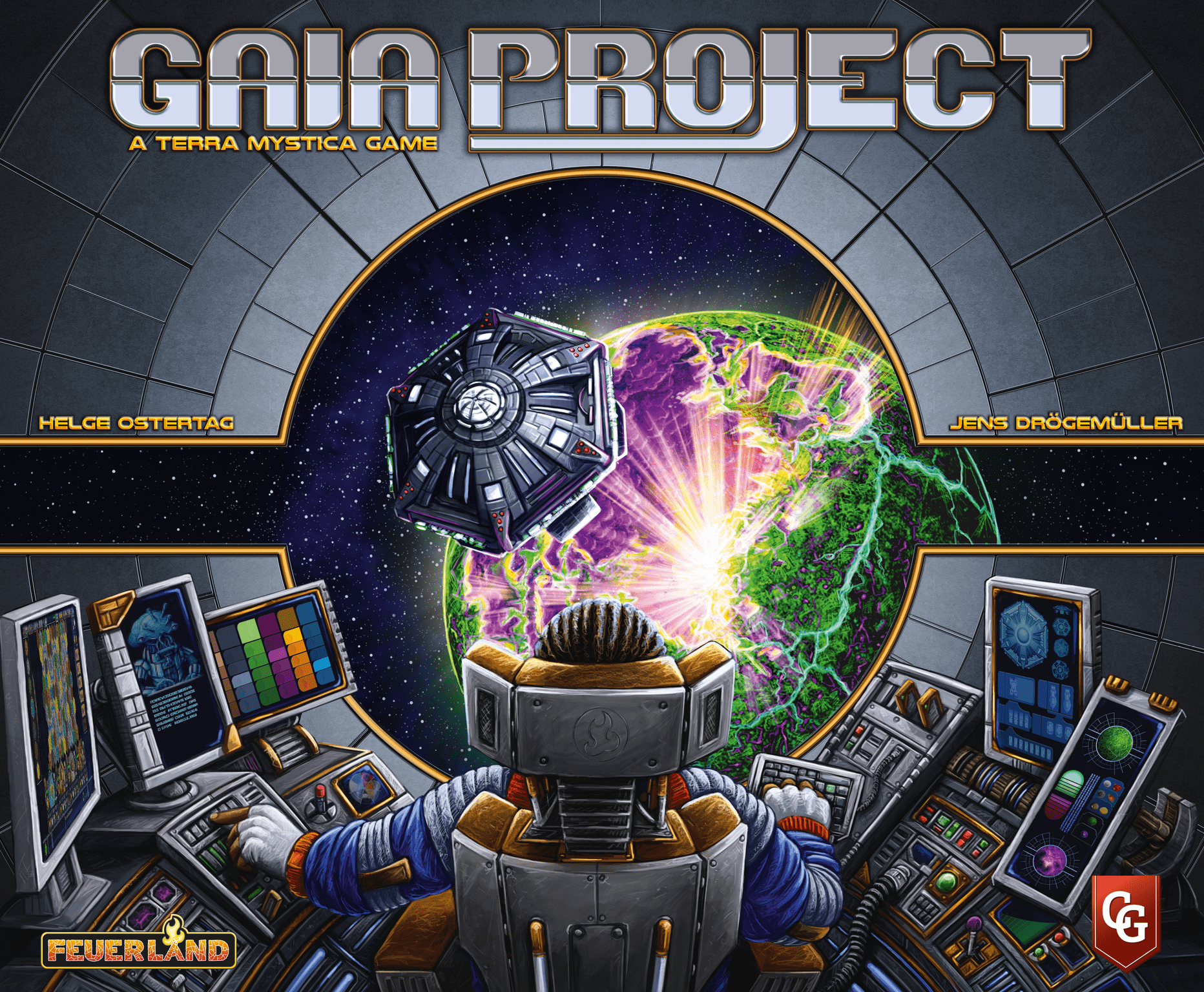
How to Play Gaia Project
Feuerland Spiele, Automa Factory, Capstone Games · Board game · 2017What do you want to do now
Ask anything about Gaia Project: rules, setup, components, complexity, price, or whether it fits your group.
Video: How to Play
Start here, then follow the written guide
Step by step
Game Objective
In Project Gaia, you take control of one of 14 factions with the mission to peacefully colonize the galaxy. The goal is to expand your influence through the colonization of planets, building and upgrading structures, researching new technologies, and forming alliances. Since each faction has distinct environmental needs, you will need to master the art of terraforming to make planets habitable. At the end of the game, the best-adapted faction, which accumulates the most VPs (Victory Points), will be the winner.
Setup
For the first game, it is recommended to use the basic settings and the suggested factions (1 player: Hadsch Hallas and Taklons; 2 players: Hadsch Hallas and Xenos; 3 players: Terrans, Taklons, and Geodens; 4 players: Terrans, Hadsch Hallas, Xenos, and Taklons). The First Player is determined by free choice.
Board and Component Setup
- Space Board:
- 3 or 4 players: Use the 10 Space Sector Tiles (01 to 10), with tiles 05, 06, and 07 white side up.
- 1 or 2 players: Use tiles 01 to 07, with tiles 05, 06, and 07 black side up.
- Research Board: Position it next to the space board. Randomly distribute 9 Basic Technology Tiles (in stacks of 4) in the technology slots. Position 6 Advanced Technology Tiles randomly between levels 4 and 5 of each research area.
- Alliance Indicators: The indicator without VPs is exclusive to the Gleen faction. Draw a random indicator for level 5 of the Terraforming research area. Organize the others in stacks next to the board.
- Score Board: Position 6 Round Score Tiles (slots 1 to 6) and 2 Final Score Tiles in the slots to the right of the green bars.
- Round Bonuses: Randomly select a number of Round Bonuses equal to the number of players plus 3.
- Supply: Place Action Markers, Gaia Planet Tiles, Dark Planet, Power Markers, and Q.I.C.s (Quantum Intelligence Cubes) within everyone's reach.
Initial Player Resources
Each player receives their Faction Board and components of their color, organizing them as follows:
- Structures: Position the structures in the corresponding slots on the board.
- Resources: 2 Credit Markers, 1 Ore Marker, and 1 Knowledge Marker (Xenos start with 15 Credits, 4 Ore, and 3 Knowledge).
- Power: Position Power Markers in areas I and II as indicated on the faction board.
- Q.I.C.s: Take the amount indicated next to the faction name (Terrans start with 1).
- Research: Position 6 Player Markers at level 0 of each research area (some factions start at level 1, receiving immediate bonuses).
- Others: 3 Gaiaformers, 7 Player Markers, 25 Satellites, and the VP marker on space 10 of the track.
Start of the Game
- Initial Mines: Position your Mines according to the setup recommendations for the number of players.
- Round Bonuses: Starting with the last player and proceeding counter-clockwise, each player chooses one Round Bonus.
- Neutral Player: In 1 or 2 player games, a neutral player is added to the Final Score with 8 points to prevent automatic second places.
Game Flow
The game consists of six rounds. Each round strictly follows these four phases:
Phase I: Income
All players receive resources based on their Faction Board, Round Bonus, Technology Tiles, and progress on the Research Board. Resources from the same source must be collected entirely before moving to the next.
Phase II: Gaia
- Power Movement: Players with Power Markers in the Gaia Area move these markers to area I (Terrans move directly to area II).
- Transformation: Gaiaformers positioned on Transdim Planets transform these locations into Gaia Planets.
Phase III: Actions
Starting with the first player and proceeding clockwise, each player performs a single action at a time. This repeats until everyone chooses the Passing the Turn action. Actions can be repeated, except for Passing the Turn.
Phase IV: Ending a Round
Prepare for the next round by removing Action Markers and Q.I.C.s from the action fields, flipping the Round Bonuses face up, and removing the current Round Score Tile. This phase is ignored in the sixth round.
Actions and How to Play
The Power Cycle
Power moves clockwise between areas I, II, and III. New markers enter area I. When you receive Power, you move markers from I to II; if I is empty, you move from II to III. You can only spend Power that is in area III, moving them back to area I.
Main Actions
- Build a Mine: Costs 2 Credits and 1 Ore. The planet must be deserted, accessible (according to Navigation level), and habitable. If it is not of your Home Planet type, it must be Terraformed by paying Ore per step (cost reduced according to Terraforming research level). Gaia Planets can be made habitable by paying 1 Q.I.C..
- Starting Project Gaia: To transform a Transdim Planet into a Gaia Planet, you must have a Gaiaformer available, reach the planet, and move Power Markers to the Gaia Area (cost varies from 6 to 3 markers according to Project Gaia research level).
- Upgrading your Structures: Replaces existing structures with advanced versions by paying Credits and Ore:
- Mine $\rightarrow$ Trading Post: Cost reduced if an opponent is in the neighborhood (up to 2 spaces).
- Trading Post $\rightarrow$ Research Lab: Grants a Technology Tile and research progress.
- Trading Post $\rightarrow$ Planetary Institute: Grants a special faction ability or action.
- Research Lab $\rightarrow$ Academy: Grants a Technology Tile and a choice between a Knowledge income bonus or a Q.I.C. action.
- Forging Alliances: Groups colonized planets with a total Power Score of at least 7. Requires the use of Satellites to connect distant planets (cost of 1 Power Marker per satellite). Grants immediate VPs and resources and an Alliance Indicator.
- Research and Technologies: Pay 4 Knowledge to advance one level in a research area. To reach level 5, it is necessary to flip an Alliance Indicator to the gray side.
- Power Actions and Q.I. Actions: Global actions on the Research Board that cost Power (purple actions) or Q.I.C.s (green actions). These can be used only once per round.
- Special Actions: Orange actions (no cost) available on faction boards, technologies, or bonuses. Usable once per round.
- Passing the Turn: Ends the player's participation in the round. The player chooses a new Round Bonus and returns the previous one.
Passive and Free Actions
- Gaining Power (Passive): When an opponent builds or upgrades structures in your neighborhood, you may receive Power by paying VPs (e.g., 3 Power costs 2 VPs).
- Free Actions: Can be performed before or after the main action (e.g., exchange 1 Q.I.C. for 1 ore, spend Power for resources, exchange Ore for Credit).
End of Game and Scoring
The game ends after the action phase of the sixth round. Victory is decided by the sum of VPs:
Scoring Criteria
- Final Score Tiles: Two tiles are drawn. 1st place receives 18 VPs, 2nd receives 12 VPs, and 3rd receives 6 VPs. Possible conditions include:
- Highest number of structures in an Alliance.
- Highest total number of structures.
- Highest diversity of colonized planet types.
- Highest number of colonized Gaia Planets.
- Highest number of space sectors with at least one planet.
- Highest number of Satellites.
- Research: 4 VPs for each level 3, 4, and 5 reached in each research area.
- Resources: 1 VP for every 3 remaining Credits, Knowledge, or Ore (in any combination).
The player with the most VPs wins. In case of a tie, all tied players win.
Tips for Winning
- Power Management: Managing the Power Cycle is essential; remember that you can only spend what is in area III.
- Board Awareness: It is not necessary to monitor the score tracks in the first half of the game, but it is crucial to track opponents' progress in the second half.
- Alliance Efficiency: Generally, it is better to forge alliances efficiently, but keep an eye on the Final Score Tiles, which may incentivize creating alliances with more planets, even if they are less efficient.
More videos
More rules explanations from the community
In English
-
 Gaia Project - How to Play (12 minutes)
-
 Gaia Project Tutorial & Playthrough - JonGetsGames
-
 Gaia Project Beginner Strategy
-
 How to play Gaia Project. A complete video instruction
-
 Gaia Project Board Game – How to Play (Full Rules)
-
 Learn How to Setup and Play Gaia Project better and faster
-
 Gaia Project - Handholding Tutorial and 2-Player Playthru with Automa
-
 Learn How to Play Gaia Project better and faster
-
 Gaia Project with Lost Fleet expansion - Tutorial & Playthrough
-
 Learn how to setup Gaia Project
-
 Gaia Project Rules Overview
Rules manual
Official PDF file
Frequently Asked Questions
Quick answers about the rules