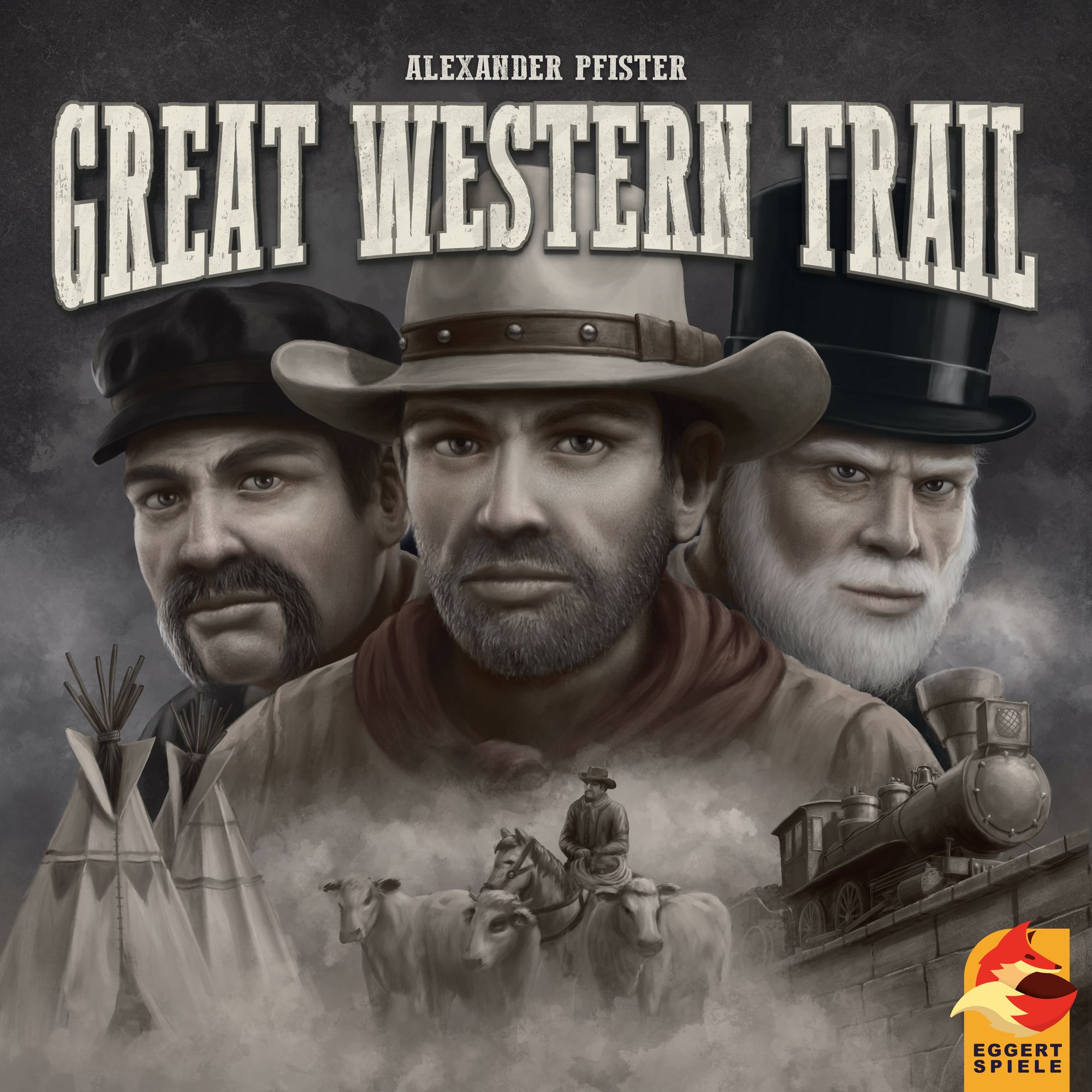
How to Play Great Western Trail
eggertspiele, 999 Games, Arclight Games · Board game · 2016What do you want to do now
Ask anything about Great Western Trail: rules, setup, components, complexity, price, or whether it fits your group.
Video: How to Play
Start here, then follow the written guide
Step by step
Objective of the Game
Howdy, rancher! Welcome to the wild, wild world of Great Western Trail, a game where you'll be herding your finest cattle from the dusty plains of Texas all the way to the bustling markets of Kansas City. Your goal? To become the most successful rancher in the West! This means earning the most **Victory Points** by skillfully managing your herd, building a thriving network of private buildings, hiring a top-notch crew of **Cowboys**, **Craftsmen**, and **Engineers**, and navigating the ever-changing landscape of the trail. Every time your cattleman reaches Kansas City, you'll be sending off your most valuable cattle by train, earning you cash and those precious victory points. The player with the most **Victory Points** at the end of the game wins!Preparation (Setup)
Alright, let's get this ranch ready! Here's how to set up your game of Great Western Trail:- Place the **game board** in the middle of your table.
- Take the 7 **neutral building tiles** (A to G). For your first game, place each tile face up onto its matching letter space on the board. In subsequent games, shuffle and place them randomly.
- Shuffle the 5 **station master tiles** and place one face up randomly onto each of the 5 station master spaces.
- Gather the 54 **worker tiles**, 22 **teepee tiles**, and 18 **hazard tiles**. Turn them face down and sort them into three separate piles according to the numbers on their backs (1, 2, and 3). Shuffle each pile individually and place them as three face-down stacks by the upper left of the game board (near Kansas City). This is your **Kansas City supply**.
- From the **Kansas City supply**, start revealing tiles with a "1" on their back.
- If it's a **teepee tile** (green or blue), place it in the **Indian trade section** onto the empty space with the lowest money value above it (starting at -3).
- If it's a **hazard tile**, place it in its corresponding **hazard section** (food, drought, or rockfall) onto the empty space with the lowest number (1 to 4). If there are no empty spaces, flip the tile face down and return it to the **Kansas City supply**.
- Now, reveal tiles with a "2" on their back (these will only be **worker tiles**). Place these **worker tiles** one after another into the **job market**. Start in the top row, placing the first tile directly beneath your player count sign. Continue rightwards, then move to the second row, placing tiles in line with your player count sign until you reach the space to the left of the **job market token**. Depending on your player count, you'll have between 3 and 7 worker tiles here.
- Place the **job market token** onto the top dashed round space in the **job market**.
- Fill the 6 **foresight spaces** in Kansas City with tiles from the **Kansas City supply**: draw 2 tiles with a "3" on their back for foresight spaces 1, 2 tiles with a "4" for foresight spaces 2, and 2 tiles with a "5" for foresight spaces 3.
- Shuffle the 36 **market cattle cards** and place them as a face-down **market cattle stack** beneath the lower left of the game board. Draw cards from this stack based on your player count: 7 for 2 players, 10 for 3 players, 13 for 4 players. Sort these drawn cards by color (yellow, red, blue, brown, purple from left to right) and place them face up in an overlapping row in the **cattle market**.
- Shuffle the 24 **objective cards** and place them as a face-down stack to the right of the game board. Reveal 4 cards from this stack face up in a column below it; this is the **general objective display**.
- Place the **coins** within reach of all players as the **bank**.
- Each player chooses a color and receives their matching **player board** (with 14 colored disc spaces). Place it in front of you. If playing with 3 or 4 players, each player also gets their double-sided **player count tile**, turning it to the appropriate side and covering Phase A of their player board.
- Each player takes their 10 **private building tiles**. For your first few games, turn all to their 'a-side' and display them in ascending order above your player board. (If you're feeling adventurous, one player can randomly determine the 'a' or 'b' side for each tile, and everyone copies their display.)
- Each player receives:
- 14 **player discs**: Place them onto the colored disc spaces on your player board (leaving the 2 gray spaces in the upper left empty).
- 1 **engine**: Place it onto the starting space (the red building) of the **railroad track** on the game board.
- 1 **certificate marker**: Place it onto the top space of your **certificate track** (next to the 0).
- 1 **cattleman**: Place it next to your player board for now.
- Shuffle the 4 **starting objective cards** and deal one to each player. Place it face up below your player board in your **personal objective area**. Return spares to the box.
- Each player receives their 14 **player cattle cards** (marked with their color's star). This is your **herd deck**. Shuffle it and place it as your face-down **personal draw stack** to the left of your player board.
- Finally, determine a starting player. They receive 6 **Dollars** from the bank. The next player clockwise receives 7 **Dollars**, the third player (if any) 8 **Dollars**, and the fourth player (if any) 9 **Dollars**.
- Each player draws 4 cards from their **personal draw stack** to form their hand.
The Turn of Play
A turn in Great Western Trail is a simple, yet strategic, three-phase dance. Players take turns clockwise, starting with the player who received 6 **Dollars**.On your very first turn, you'll place your **cattleman** onto any **neutral building tile** and then proceed directly to Phase B. After that, all turns follow these phases:
Phase A) Move your cattleman to another location along the trail
Your **cattleman** starts in the lower right corner of the board and moves towards Kansas City in the upper left. Think of the trail as a winding path with forks – you choose your route!
- You must move your **cattleman** at least 1 step.
- You cannot move more steps than your current **step limit** (which starts at 3 or 4, depending on player count, and can be increased).
- Each **location** (a tile on a space) counts as 1 step. Empty spaces are *not* locations.
- Always move forward along the trail's arrows.
- If the trail forks, pick a path!
- You must end your movement on a **location**. You cannot pass over Kansas City – if you reach it, you must stop there.
- Other players' **cattlemen** don't block your movement; multiple **cattlemen** can share a location.
- Attention: Some locations have green or black hands. If you move to or pass over such a location, you must immediately pay a fee!
- If it's a **hazard** or **teepee tile**, pay the fee to the bank.
- If it's another player's **private building tile**, pay the fee to that player.
- The fee varies by player count and hand color (e.g., in a 4-player game, a green hand costs 1 Dollar, a black hand costs 2 Dollars).
- Important: If you can't pay the full fee for a hand, pay as much as you can and keep moving. You never have to pay retroactively for hands. This applies *only* to hand fees; all other costs must be paid in full.
Phase B) Use the action(s) of your reached location
Once your **cattleman** stops, it's time to act! Your options depend on the type of location:
a) On a neutral building tile or a private building tile of your own color:
You have two choices here: either perform the **local action(s)** of that tile or take one **auxiliary action**.
- Use the local action(s): Most building tiles have one, two, or even three actions on their bottom half.
- You can perform each of the tile's **local actions** once, in any order.
- You don't have to perform all available actions. But if an action has a cost or requirement, you *must* meet it completely to get the reward.
- Some actions show two options separated by a white slash; you can only perform one of them.
- If a tile is on a risk action space, that risk action becomes part of the tile's local actions.
- Use one single auxiliary action: If you choose *not* to perform *any* of the local actions on the tile, you can instead perform one **auxiliary action** from the left side of your player board. Initially, only 2 are available; others unlock as you clear their disc spaces.
b) On a private building tile of another player, a hazard tile, or a teepee tile:
Your only option here is to perform one single **auxiliary action** from your player board. This is why you'll usually aim for your own or neutral buildings!
c) When you reach Kansas City:
Congratulations, rancher! Time for some serious business. You must carry out all 5 **Kansas City subphases** in order, moving your **cattleman** along the numbered spots to keep track:
- Foresight 1: Choose one of the 2 tiles in the foresight spaces below spot 1 and move it to its corresponding section (worker to **job market**, teepee to **Indian trade section**, hazard to **hazard section**). If the **job market token** moves along a yellow arrow, fill up the **cattle market** to its initial number of cards (7, 10, or 13 depending on player count). If the **job market token** moves along a red arrow from the bottom row, the game end is triggered!
- Foresight 2: Same as Foresight 1, but for the tiles below spot 2.
- Foresight 3: Same as Foresight 1, but for the tiles below spot 3.
- Income: Reveal your entire hand. Calculate your total **breeding value** by summing the breeding values of each *different type* of cattle you have (each type counts only once). You can increase this value by using **temporary certificates** from your **certificate track** (moving your marker back) and any **permanent certificates** from **station master tiles** you own. Take that many **Dollars** from the bank. Then, discard your entire hand to your **personal discard pile**.
- Delivery: Deliver your cattle to a city along the railroad.
- Choose a city whose **city value** is equal to or lower than your cattle's total breeding value.
- You cannot deliver to a city where you already have a disc, *unless* it's Kansas City or San Francisco.
- Place one of your **player discs** from your player board onto the chosen city's **city space**. Discs from white-cornered spaces can go anywhere; discs from dark-cornered spaces can only go to dark-cornered city spaces. Clearing disc spaces unlocks abilities (like increasing your **step limit**, **hand limit**, or **certificate limit**, or gaining **Dollars**).
- Placing a disc can trigger **delivery actions** (e.g., gaining an **objective card** if both adjacent crests have your discs) or gain/lose **victory points** at game end.
- Pay **transport costs** if your **engine** is farther down the track than your chosen city. Pay 1 Dollar to the bank for each cross between your engine's nose and the city value. Since you just got income, you can always pay!
After the Delivery subphase, perform these two final steps:
- Move your **cattleman** to the start of the trail (the horseman space in the lower right corner).
- Refill each of the 3 empty **foresight spaces** in Kansas City with face-up tiles from the **Kansas City supply**, matching the number on the tile's back to the space's number.
Phase C) Draw up to your hand limit
Check your current **hand limit** (you start at 4, but can increase it to 6). If you have fewer cards than your limit, draw cards from your **personal draw stack** until you reach your limit. If your draw stack runs out, shuffle your **personal discard pile** to form a new draw stack. If you just completed the Kansas City subphases, you'll be refilling your entire hand!
End of Game and Scoring
The game ends when the **job market token** is moved from the bottom row along the red arrow. Once this happens, finish the current round so all players have had an equal number of turns. Then, it's time for final scoring!
All **victory points** are awarded at the end of the game. You'll add up the victory point symbols on various components in front of you, as well as those marked with your color on the game board. The player with the most **victory points** wins the game!
Tips for Winning
Alright, greenhorn, here are a couple of pointers to get you started on the right hoof:
- Build Your Engine (Literally and Figuratively): Don't underestimate the power of your **engine** and the **railroad track**. Moving your engine forward reduces **transport costs** and allows you to upgrade **train stations**, which can grant you valuable **station master tiles** with **permanent certificates** or powerful immediate actions. Prioritize hiring **engineers** to move your engine efficiently!
- Diversify Your Herd and Your Actions: While high breeding values are great for income, having a *variety* of cattle types in your hand is crucial for maximizing your income in Kansas City. Also, don't just stick to one type of action. Explore placing your own **private building tiles** (especially with **Craftsmen**), hiring different types of **workers** to unlock new abilities, and completing **objective cards** for end-game points. A balanced approach will serve you well on the trail!
More videos
More rules explanations from the community
In English
-
 How to Play Great Western Trail
-
 How to play Great Western Trail
-
 Great Western Trail Walkthrough
-
 Great Western Trail - In Focus
-
 Learn How to Play Great Western Trail better and faster
-
 Great Western Trail Board Game – How to Play under 34 Minutes
-
 Great Western Trail - Part 2: how to play [JLTEI]
-
 How To Play - GWT
-
 Tom Teaches Great Western Trail (Setup)
-
 Great Western Trail - strategy blitz
-
 Great Western Trail Gamesplained - Part 1
Rules manual
Official PDF file