
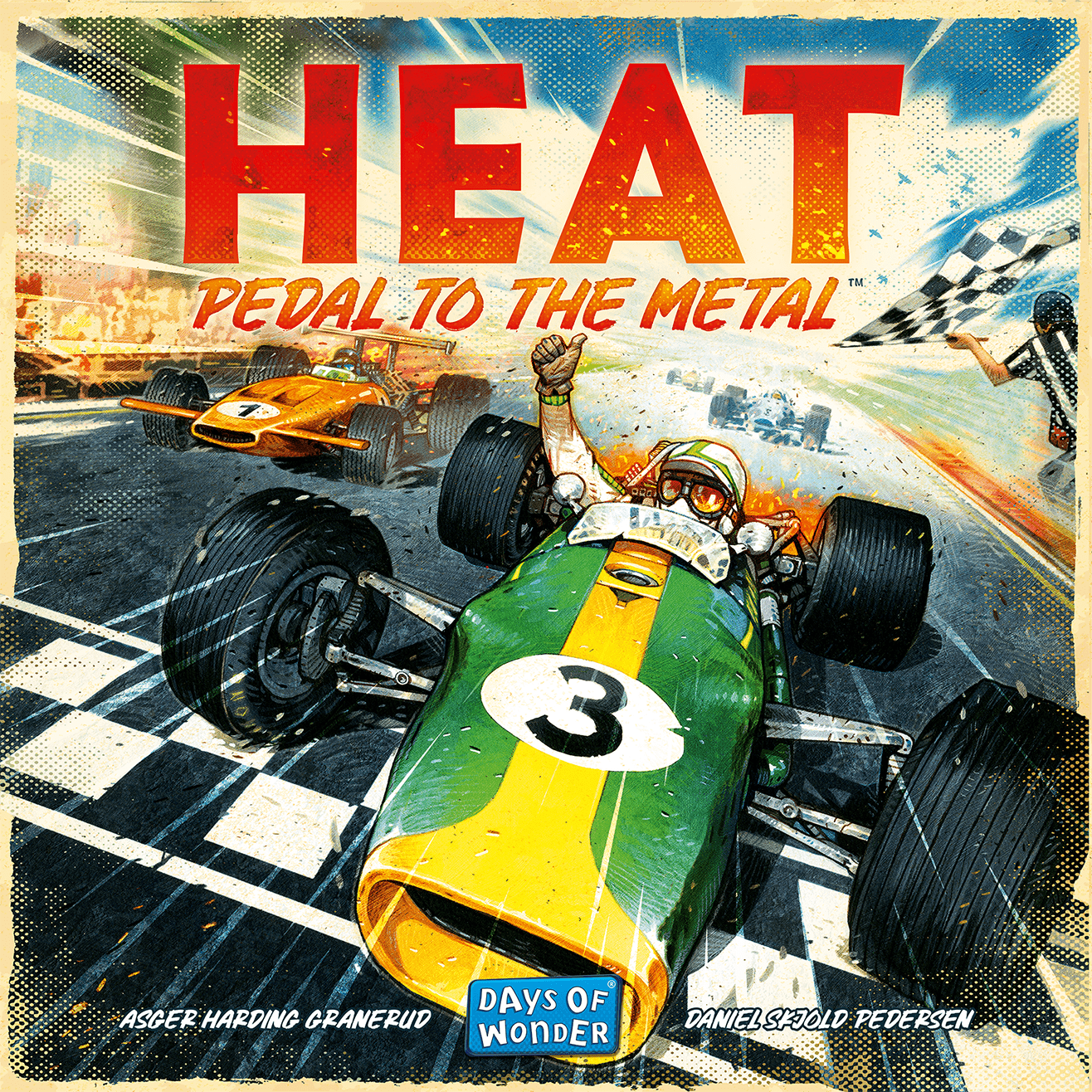
How to Play Heat: Pedal to the Metal
Days of Wonder, ADC Blackfire Entertainment, CoolPlay · Board game · 2022What do you want to do now
Ask anything about Heat: Pedal to the Metal: rules, setup, components, complexity, price, or whether it fits your group.
Video: How to Play
Start here, then follow the written guide
Step by step
Objective of the Game
Get ready to burn rubber and leave your rivals in the dust! In Heat: Pedal to the Metal (specifically, the "Darned Drivers" subvariant), your goal is to become the ultimate racing champion. You'll be battling against a field of "Darned Drivers" – AI opponents who are just as eager to win as you are, and who grow in skill and confidence throughout the Championship. Your ultimate aim is to conquer the F1 category, achieve "Darned" status, and prove your mettle on the asphalt, all while managing your finances and avoiding bankruptcy. It's not just about speed; it's about strategy, adaptability, and outsmarting your opponents over an entire season!
Preparation (Setup)
Setting up Heat: Pedal to the Metal with the Darned Drivers subvariant is crucial for a smooth race. While an Excel File (EF) is highly recommended for bookkeeping, you can also track everything manually. Here's a step-by-step guide:
- Championship Setup: Follow the Solo Variant (SV) rules strictly for setting up the Championship. This includes determining the level of the first season and the overall length of the Championship.
- Circuit Selection: Choose the circuits for your first season. If using the EF, you can select them in the "circuits!" tab and copy them to the "generator!" tab.
- Select Your Drivers: Decide who you'll be racing against. The EF's "drivers!" tab offers nine preselected Darned Drivers, but you're free to customize their names and star levels. The EF can also randomize their starting positions.
- Assign Initial Talents: Give each Driver their initial talents based on Chart 1: talents and points. For example, NC category drivers start with t0c0, F3 with t0c0, F2 drivers roll 1d10 (1-8 for t1c0, 9-0 for t0c1), and F1 drivers start with t1c1. All Drivers begin with ML1 (Morale Level 1) and 0 points.
- Generate LC and Checks Data (if using EF): If you're using the EF, it will generate the Legend Cards (LC) and various check data for the race.
- Track Driver Stats: Decide how you'll keep track of each DD's Morale Level (ML), Points, and growing Talents. You can use the EF, or physical means like dice for MLs and Hama beads for points and talents.
- First Race Setup: Refer to the HAPCS and SV rules for setting up the first race. Remember, all Morale Levels are set to 1 at the beginning of the race.
The Turn of Play
A race in Heat: Pedal to the Metal unfolds in rounds, with each driver activating in order from pole position to the tail. Here's how a round typically plays out:
- Start of the Round (First Round Only):
- If using EF v4_00+, copy the initial Morale Level and Points into the current (yellow) zone.
- Input the next Corner Speed Limit (CSL) for all Darned Drivers.
- Select "round 1" in the current round# yellow cell.
- As the Human Driver (HD), select your cards for your first move.
- Activate the Next Driver: Drivers activate in position order, from the lead car to the last.
- Human Driver (HD) Turn:
- Make your move: Play your cards and utilize your Adrenaline, Boosts, Garage, and Sponsor cards. These are your essential tools!
- Darned Driver (DD) Turn:
- Refer to the DD's Probability Level (PL): Compute it if you're playing manually.
- Determine Movement (S): Consult the DD EF data (or Chart 2) to determine S, the number of spaces the DD will attempt to move forward, using the Talent Check results (d1 and d2).
- Move the DD: Move the DD as far as possible using S. They can be blocked by other drivers or a Corner Speed Limit (CL) according to normal rules.
- Grant Points: If a point is granted (e.g., if a talent or skill is expressed by an increase in spaces moved compared to their LC), give it to the DD.
- Talent Acquisition: If a Chart 1 threshold is reached (e.g., +10 points for NC drivers), the DD acquires a new talent, often determined by a die roll.
- Wipe-Out Checks (WOC): If necessary, consult the Wipe-Out Checks (WOC) using d3 and d4 from the LC data. A WOC is ONLY made when a DD or HD clears a Speed Limit 5+ (SL5+) corner at a speed strictly exceeding its SL.
- If d3 > WO aspect (d3 > 1 for HD), no WO occurs.
- If d3 ≤ WO aspect (d3 = 1 for HD):
- HD checks d4 against 6: if d4 > 6, WO; otherwise, no WO.
- DD checks d4 against their ML: if d4 > ML, WO; otherwise, no WO.
- If a driver is blocked before a corner where they would WO, they DO NOT WO.
- Check Finish Line: If the HD has crossed the Finish Line, record their Lap Time (round number and spaces after the FL).
- Wiped-Out Drivers: Leave arrived and Wiped-Out (WO) DDs on the track until the end of the round.
- Next Driver: Proceed to the next driver in position order.
- End of the Round:
- Bring appropriate (WO and arrived) drivers to their Hall of Fame (HoF) Space. A WO car stays on the track until the end of the round, then moves to the lowest available position in the HoF.
- As the HD, select your gear level and cards for the next round.
- Make any necessary end-of-round ML adjustments. Morale Level (ML) reflects a DD's confidence and can vary based on performance (e.g., moving more spaces than their LC allowance increases ML, moving less can decrease it). ML1 is the lowest, ML5 the highest.
- Increment the current round# yellow cell by 1.
End of Game and Scoring
The game concludes at the end of a Championship, which consists of multiple races. Here's how the final reckoning works:
- Season Prizes: At the end of each race, prizes are awarded based on HoF position. These prizes are in a geometrical progression, meaning higher positions pay significantly more.
- Economic Balance: A positive net balance is mandatory at the end of a season. You can go into debt during individual races, but you must be solvent by the season's end. If you have a negative balance even after selling your car and receiving the Championship prize, you can sell upgrades. If you still fail to achieve a positive balance, it's Game Over – you're bankrupt!
- End of Championship Transactions: At the very end of the Championship, the Human Driver (HD) performs these mandatory steps:
- Sell their car.
- Sell all their updates back to "Initial."
- Restitute their initial allocation.
- Transfer the remaining amount to Career Points (CP) at a rate of 1 CP per 1,000€.
- Tie-Breakers:
- The sum of a Driver's HoF ending positions over a season is the first tie-breaker.
- Average lap times constitute a logical second tie-breaker if ending positions fail to break it. The Best Lap Time (BLT) Driver also gets 1 point, and the HD gets 1 Sponsor Card if they score the BLT.
Tips for Winning
- Master Your Morale: Pay close attention to your opponents' Morale Levels (ML). Low morale DDs are more susceptible to Wipe-Outs (WO), especially when checking d4 against their ML. Exploit their weaknesses! Conversely, be mindful of your own ML, as it affects your WO chances.
- Strategic Cornering: While speed is tempting, be cautious around Speed Limit 5+ (SL5+) corners. You only trigger a Wipe-Out Check (WOC) if you clear such a corner at a speed *strictly exceeding* its SL. This gives you a chance to weigh your risk against your current position. Sometimes, a slightly slower, safer line is the winning move.
- Economical Excellence: The economic balance is set at the 3rd step of the podium. Aiming for at least 3rd place consistently is key to maintaining your financial stability, especially in lower categories. As you rise to F1, the financial stakes become much higher, and you'll need amazing skills and some luck to avoid bankruptcy. Don't be afraid to sell upgrades if a season goes poorly to stay in the game!
More videos
More rules explanations from the community
In English
-
 MORE Content For FREE | HEAT: Pedal to the Metal
-
 How to Play Heat: Pedal to the Metal solo
-
 Heat - How to Play in 4 minutes - BoardgameNinja - Days of Wonder - Pedal to the Metal
-
 How to Win - Heat Pedal to the Metal
-
 Heat Pedal to the Metal: How to Play
-
 How to Play Heat: Pedal to the Metal - Advanced Module 1
-
 Heat - Pedal to the Metal - Board Game Rules - English
-
 How To Play Heat: Pedal to the Metal - First Game Rules
-
 How to Teach - HEAT: Pedal to the Metal
-
 How to Play Heat Pedal to the Metal
-
 Heat Pedal to the Metal. How to play
Rules manual
Official PDF file
Frequently Asked Questions
Quick answers about the rules
