
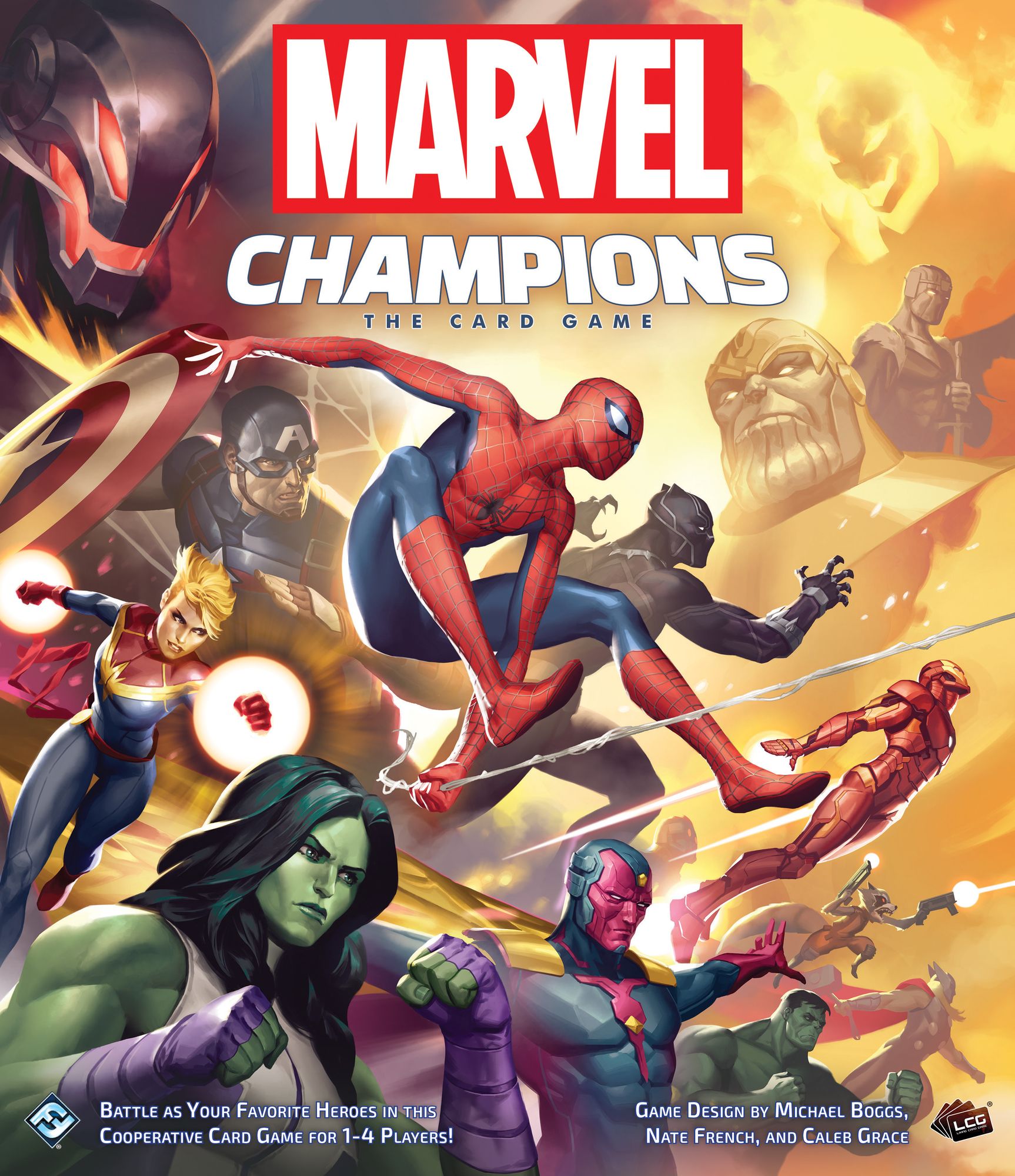
How to Play Marvel Champions: The Card Game
Fantasy Flight Games, ADC Blackfire Entertainment, Kilogames · Board game · 2019What do you want to do now
Ask anything about Marvel Champions: The Card Game: rules, setup, components, complexity, price, or whether it fits your group.
Video: How to Play
Start here, then follow the written guide
Step by step
Objective of the Game
Welcome, Champions! Forget everything you thought you knew about saving the world from a single villain. In this thrilling, experimental Player-vs-Player (PvP) mode for Marvel Champions: The Card Game, you're not just fighting a big bad; you're fighting EACH OTHER!
The main goal is to prove your hero's supremacy by either:
- Defeating your opponent's hero (reducing their health to zero).
- Winning the Conflict Scheme tug-of-war (moving all the threat to your side across all stages).
It's a race to the finish, a battle of wits and power where only one hero (or team!) can stand victorious!
Preparation (Setup)
Get ready for an epic showdown! Here’s how to set up your battlefield:
- Bring Your A-Game: Each player brings their own hero deck, just like in a regular game. Make sure it's finely tuned for hero-on-hero action!
- The Conflict Scheme Takes Center Stage: Instead of the usual Main Scheme, you'll use the special Conflict Scheme. This scheme starts with 21 threat on each player's side, divided into five stages. Think of it as a tug-of-war track!
- Optional Rule – Obligations: If you're feeling extra spicy and want to add another layer of challenge, each player hands their obligation(s) to their main opponent. Your opponent then shuffles these into their own deck.
That's it! Your heroes are ready, the Conflict Scheme is set, and the battle can begin!
The Turn of Play
The game flows much like standard Marvel Champions, but with a crucial twist: your opponent IS the villain! Here's how the turn works, keeping in mind the PvP interpretations:
Player Interaction and Card Interpretation
When you play cards or activate abilities, remember these key interpretations:
- Your opponent's hero is considered the villain. Their "villain stage number" is always 2.
- Your opponent's allies are considered minions.
- Your opponent's player side schemes are treated as regular side schemes.
- Your opponent's upgrades and supports are considered attachments.
- The currently active stage of the Conflict Scheme is your "current stage of the main scheme."
- Removing threat from "the main scheme" means you move threat from your opponent's side to your own side on the Conflict Scheme.
- Removing threat from an "opponent's side scheme" adds threat to that scheme (making it harder for your opponent to clear).
- When a card would deal encounter cards, your opponent instead draws cards from their own deck.
- When you empty your draw deck and reshuffle, your opponent immediately draws a card.
Attacking and Defending
Time to get aggressive!
- When you make an attack, you can target your opponent's hero or one of their allies. Remember, their hero is the "villain" and their allies are "minions" for targeting purposes.
- You are considered to be engaged with all your opponent's allies.
- If your opponent's identity is in alter ego form, you cannot attack their identity, and your hero cannot make basic attacks against their allies. This encourages them to scheme and you to mitigate that scheming!
- When your opponent attacks your hero or one of your allies, it's treated as an attack from the "villain" (if their hero attacks) or a "minion" (if an ally attacks). All your normal defending options apply!
The Conflict Scheme and Threat Movement
The Conflict Scheme is your main objective outside of direct hero combat:
- It replaces the main scheme and starts with 21 threat on each player's side, across five stages.
- When you thwart the "main scheme" or remove threat from it, you instead move threat from your opponent's side to your own side on the Conflict Scheme.
- Important: Extra threat movement does not spill over to the next stage.
- The active stage is any stage with threat on both players' sides. If no such stage exists, your active stage is the one closest to you that still has threat on your opponent's side.
- If a card mentions removing the last threat from the "main scheme" or the "main scheme having zero threat," you check your opponent's side of your active stage instead.
Optional Rule: Obligations
If you're using this rule, here's how obligations work:
- When you draw an obligation (from your opponent's deck!), you reveal it immediately.
- You then draw a replacement card.
- Obligations have no resources, cost 0, and cannot be targeted by effects in the discard pile (except reshuffling effects) or searched for in your deck.
End of Game and Scoring
The game concludes when one of the following conditions is met:
- A player successfully defeats their opponent's hero by reducing their health to zero.
- A player successfully moves all 21 threat from their opponent's side to their own side across all five stages of the Conflict Scheme.
The first player to achieve either of these conditions is the winner!
Multi-Player (Teams) End Game
If you're playing with teams (e.g., 2v2):
- There's one Conflict Scheme, with threat multiplied by the number of players on each team. All players on a team share the same active stage.
- To win by defeating heroes, you must reduce more than half of the opposing team's heroes to zero health.
- If a player's identity is reduced to zero hit points, they are not out of the game but face severe restrictions: they discard non-permanent allies, upgrades, and supports, cannot play them, cannot be healed, cannot use health-referencing cards/abilities, and their hand size is reduced by one.
- The player whose main opponent has been reduced to zero health is no longer restricted from attacking other opponents' identities.
Tips for Winning
To emerge victorious in this hero-on-hero brawl, keep these strategies in mind:
- Know Your Opponent's Form: Pay close attention to whether your opponent is in Hero or Alter-Ego form. If they're in Alter-Ego, you can't attack their identity or make basic attacks against their allies. This is your cue to focus on thwarting their side of the Conflict Scheme or dealing with their allies!
- Balance Aggression and Thwarting: Don't just tunnel vision on attacking your opponent's hero. The Conflict Scheme is a powerful alternate win condition. If your deck is good at thwarting, leverage that to shift threat to your side and secure a scheme victory!
- Ally Management is Key: Your opponent's allies are your "minions," and your allies are your "minions" to them. Use cards that interact with minions to your advantage, whether it's dealing damage or preventing them from attacking. Remember, your allies can defend against any attack, even from other opponents in team games!
More videos
More rules explanations from the community
In English
-
 10 Common Rules Mistakes in Marvel Champions | Beginner Guide to Win More Games
-
 Most Confusing Official Ruling in Marvel Champions Explained
-
 10 Deckbuilding Rules Every Player Should Know in RRG 1.7 for Marvel Champions
-
 Win More Games - 5 Easy Tips Marvel Champions Strategy Guide
-
 10 Common Rules Mistakes Beginners Make Resulting in Cheating!
-
 How to Play Marvel Champions
-
 How to Play Marvel Champions
-
 How to Store Marvel Champions in 2024
-
 Marvel Champions Learn to playthrough
-
 Who is "YOU" in Marvel Champions RULES QUIZ
-
 2023 Marvel Champions New Player Guide
Rules manual
Official PDF file
Frequently Asked Questions
Quick answers about the rules
