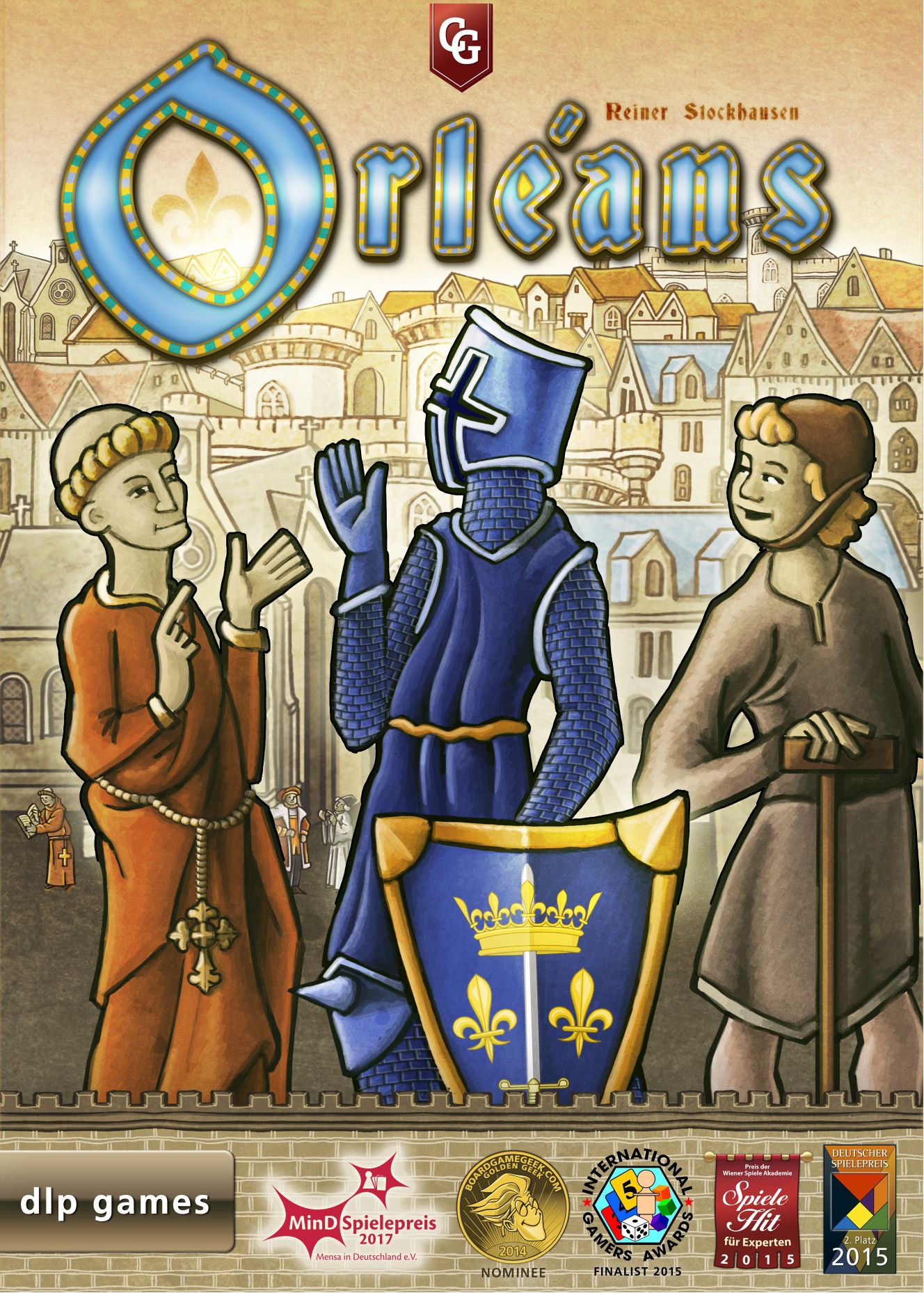
How to Play Orléans
dlp games, Arclight Games, Arrakis Games · Board game · 2014What do you want to do now
Ask anything about Orléans: rules, setup, components, complexity, price, or whether it fits your group.
Video: How to Play
Start here, then follow the written guide
Step by step
Objective of the Game
Welcome to medieval France, aspiring entrepreneurs! In Orléans, you're not just building a business; you're vying for ultimate dominance. Your goal is to accumulate the most Victory Points (VP) by the end of the game through clever production, shrewd trade, strategic development, and contributing to the common good. Will you be the most influential figure in Orléans? Only time, and smart worker placement, will tell!
Setup
Alright, let's get this medieval economy humming! Here's how to set up your game of Orléans:
- Place the large game board (showing places and terrain) and the “Beneficial Deeds” board on the table.
- Each player takes:
- 1 Player Board
- 1 Merchant Token
- 10 Trading Stations
- In their chosen player color:
- 1 Followers Bag
- 5 coins
- 1 set of initial Followers: a Farmer, a Boatman, a Craftsman, and a Trader
- 7 markers (wooden cubes)
- Put all remaining coins on the table within easy reach for everyone.
- Sort the neutral Character Tiles (those without a player color marking) by profession and place them on their corresponding buildings on the game board.
- Place 13 Citizen Tiles on the marked spaces on the game board and the “Beneficial Deeds” board. The remaining Citizen Tile goes on the table.
- Stack the Technology Tiles on their designated space on the game board.
- The manual mentions "Supply Spaces for Goods Tiles" – prepare these spaces for the upcoming goods.
- Remove the "Pilgrimage" Hour Glass Tile (the lighter hue) from the deck. Shuffle the remaining Hour Glass Tiles and place them face down on their space on the game board. Then, place the "Pilgrimage" Hour Glass Tile on top of this stack. The game will always start with the "Pilgrimage" event in the first round.
- Place 1 marker from each player on the first space of each of the Character Tracks (Farmer, Boatman, Craftsman, Trader, Knight, Scholar, Monk) as well as the Development Track.
- Shuffle the Goods Tiles face down. Then, place them face up on the Road and Waterway Spaces, one tile per space.
- In a 4-player game, every such space gets a tile.
- In 2- and 3-player games, some spaces remain empty:
- 3-player game: Do not place any Goods Tiles on spaces marked with "4". These spaces remain empty.
- 2-player game: Do not place any Goods Tiles on spaces marked with "3" or "4". These spaces remain empty.
- Sort the remaining Goods Tiles and place them face up on the appropriate spaces of the Goods Market (on the left side of the game board).
- Sort the Place Tiles by the Roman numerals on their reverse side and place them in separate stacks on the table.
- Player-specific setup:
- Place your Trading Stations and coins in front of you.
- Place your 4 initial Followers (Farmer, Boatman, Craftsman, Trader) of your color on the Market Spaces of your Player Board.
- Place your Merchant Token in Orléans.
- Adjustments for fewer players:
- 3-player game: Remove the Followers of the unused player color(s) from the game. Remove 2 each of the neutral Farmer, Boatman, Craftsman, and Trader Character Tiles from the game. Remove 3 each of the Knight, Scholar, and Monk Character Tiles from the game. Remove 6 Goods Tiles from the game at random.
- 2-player game: Remove the Followers of the unused player colors from the game. Remove 4 each of the neutral Farmer, Boatman, Craftsman, and Trader Character Tiles from the game. Remove 6 each of the Knight, Scholar, and Monk Character Tiles from the game. Remove 12 Goods Tiles from the game at random.
- The youngest player receives the Start Player Token.
You are now ready to play!
The Game Turn
Orléans is played over 18 rounds, with each round consisting of 7 distinct phases. Most phases can be played simultaneously, but the Action Phase and any payments proceed in turn order, starting with the Start Player and going clockwise.
Phase 1: Hour Glass
The Start Player draws the topmost Hour Glass Tile from the stack and turns it face up. This tile determines the length of the game (it ends when the 18th tile is drawn) and introduces an event that will affect the current round. Except for "Pilgrimage," events are resolved in Phase 6.
Phase 2: Census
It's time for a head count! Determine who has the most and who has the least Farmers (by checking the Farmers Track). The player furthest ahead receives 1 coin from the supply. If tied, no one gets a coin. The player furthest behind must pay 1 coin to the supply. If tied, no one pays. In a 2-player game, the player behind does not pay, but the player ahead still receives a coin.
Phase 3: Followers
Time to staff your operations! Draw Character Tiles from your Followers Bag and place them on your Market Spaces. The number of tiles you can draw is indicated by your marker on the Knights Track (starting at 4). You can draw fewer tiles if you wish, or if you don't have enough space on your Market. Remember, unused Character Tiles stay on your Market, taking up space!
Phase 4: Planning
This is where you strategize! Use the Character Tiles from your Market to activate actions in various Places. Each Place requires a specific set of Character Tiles. Place the required Character Tiles on the corresponding Action Spaces of the Place you want to activate. A Place is activated as soon as all its Action Spaces have a tile. You don't have to place all tiles in one turn; you can spread it out over multiple rounds. Activated actions can be carried out in a future Action Phase.
Phase 5: Actions
Now, put your plans into motion! Starting with the Start Player and going clockwise, each player may carry out 1 activated action or pass. If you pass, you're done with actions for the round. After playing an action, remove the Followers used (but not Technology Tiles!) and put them back into your Followers Bag. You can carry out your actions in any order and aren't required to use all activated actions. Unused activated actions remain activated for future rounds. The Action Phase ends when all players have passed.
The Actions/Places:
Your Player Board has common Places, and you can acquire more (see "Expanding the City"). Here are some key actions:
- Farm House: Take a Farmer Tile from the game board into your bag. Advance your marker on the Farmers Track and receive the depicted good.
- Village: Choose one:
- Boatman: Take a Boatman Tile into your bag. Advance on the Boatmen Track and receive coins (or a Citizen Tile on the last space).
- Craftsman: Take a Craftsman Tile into your bag. Advance on the Craftsmen Track and receive a Technology Tile.
- Technology Tiles: These replace a required Character Tile on an Action Space for the rest of the game. The first must replace a Farmer; subsequent ones can replace any Character Tile except Monks. You can't place more than one Technology Tile per Place, nor on a Place requiring only one Character Tile.
- Trader: Take a Trader Tile into your bag. Advance on the Traders Track and expand your city with a Place Tile.
- Expanding the City: The first time you advance, choose a Place Tile from stack I. Subsequent times, choose from stack I or II. Place it next to your Player Board to gain a new action or special ability.
- University: Take a Scholar Tile into your bag. Advance on the Scholars Track and receive Development Points, moving your marker on the Development Track.
- Castle: Take a Knight Tile into your bag. Advance on the Knights Track, which increases the number of Followers you can draw in Phase 3. (Getting your fourth Knight gives a Citizen Tile if you're first, but doesn't increase draw limit beyond 7.)
- Monastery: Take a Monk Tile into your bag. Monks are special: they can be used in place of any other Character Tile, but no other tile can replace a Monk.
- Ship: Move your Merchant Token along a Waterway to an adjacent town. If there's a Goods Tile on the way, you may take one.
- Wagon: Similar to Ship, but move along a Road.
- Guildhall: Build a Trading Station in your current town if one isn't already there (each town can only have one, except Orléans, where each player can build one).
- Scriptorium: Receive 1 Development Point, advancing your marker on the Development Track.
- Town Hall: During the Planning Phase, place 1 or 2 Character Tiles here. When using the action, move one or both from the Town Hall to free spaces on the “Beneficial Deeds” board, receiving coins (and potentially a Development Point for Canalization). Completing a Beneficial Deed earns you its Citizen Tile. You must use the exact Character Tiles shown; Monks or Technology Tiles cannot replace them. Your initial Followers (player-colored) cannot be used here.
- Note: Once your marker reaches the last space of a track, you can no longer take that corresponding action.
The Development Track:
Moving your marker onto or past spaces with coins grants you that amount. Being the first to move onto or past a Citizen Tile space earns you that tile. Your Development Status (indicated on the track) affects the "Income" event and end-game scoring for Citizen Tiles and Trading Stations.
Phase 6: Event
Resolve the event shown on the Hour Glass Tile drawn in Phase 1. (Remember, "Pilgrimage" is resolved in Phase 5.)
- Pilgrimage: You may not recruit Monks this round.
- Income: You receive a number of coins equal to your Development Status.
- Harvest: You must pay 1 food item (grain, cheese, or wine) to the Goods Market. If you can't, pay 5 coins. If you can't do that, you undergo Torture.
- Taxes: Count your goods. Pay 1 coin for every 3 goods you have. If you can't pay, you undergo Torture.
- Trading Day: You receive 1 coin for each Trading Station you have built.
- Plague: You lose 1 Character Tile. Draw one randomly from your Followers Bag and return it to the game board. Your initial player-colored Followers cannot be lost to the plague.
Torture (Bankruptcy):
If you ever can't pay something (like during Census or Taxes), you face Torture. You must replace every missing coin with items from a list: a Trading Station, a random Follower (not your initial player-colored ones), a Development Point (moving your marker left), a Goods Tile, a Place Tile, or a Technology Tile. Lost items are removed from the game, except Development Points can be re-gained.
Phase 7: Start Player
The current Start Player passes the Start Player Token to the player on their left.
End of Game and Scoring
The game concludes at the end of the round in which the 18th and final Hour Glass Tile is drawn. Before scoring, the player who has built the most Trading Stations receives the remaining Citizen Tile (if tied, no one gets it).
Then, it's time to tally up those hard-earned Victory Points (VP):
- Coins: 1 VP per coin you possess.
- Goods:
- Brocade: 5 VP each
- Wool: 4 VP each
- Wine: 3 VP each
- Cheese: 2 VP each
- Grain: 1 VP each
- Trading Stations and Citizen Tiles: Each Trading Station you've built and every Citizen Tile you've collected is worth a number of VP equal to your current Development Status. (Example: If you have 5 Trading Stations and 2 Citizen Tiles, and your Development Status is 4, you score (5+2) x 4 = 28 VP.)
The player with the most VP wins! In case of a tie, the player further ahead on the Development Track wins. If still tied, congratulations, you have multiple winners!
Tips for Winning
Ready to conquer Orléans? Here are a couple of pointers to get you started:
- Specialize and Diversify Your Followers: While it's tempting to grab every Character Tile, think about what actions you want to prioritize. Do you need more Knights to draw more Followers? Or perhaps a strong contingent of Traders to expand your city with powerful Place Tiles? Don't forget Monks – their versatility is a game-changer, allowing you to fill almost any action space!
- Mind Your Development Status: Your Development Status isn't just a number; it's a multiplier for your end-game points from Trading Stations and Citizen Tiles, and it boosts your income during the "Income" event. Investing in Scholars and the University early can pay off handsomely by the end of the game.
- Strategic City Expansion: The Place Tiles you acquire by advancing on the Traders Track can be incredibly powerful. Look for synergies with your existing Followers and your overall strategy. Do you need more production (Hayrick, Winery)? More coins (Brewery, Cellar)? Or perhaps a way to mitigate negative events (Sacristy)? Choose wisely to create an engine that fuels your victory!
More videos
More rules explanations from the community
In English
-
 Orléans Walkthrough
-
 Nights Around a Table - How to Survive the Plague
-
 How to play Orléans - Teach The Table
-
 Orleans - How to play
-
 Orleans: How to Play and Tips
-
 A Dicey "Walkthrough Review" of: Orléans!
-
 How to play Orleans
-
 Orlean - How To Play
-
 Orleans Gamesplained - Part 1
-
 Play through those of Orleans
-
 K.A.T.S.: the Musical
Rules manual
Official PDF file
Frequently Asked Questions
Quick answers about the rules
What is the objective of Orléans?
How do you set up Orléans?
How does Orléans end, and how do you score?
What are some tips for winning Orléans?
Expansions
Published additional content




Other Games You'll Like
Based on mechanics and theme