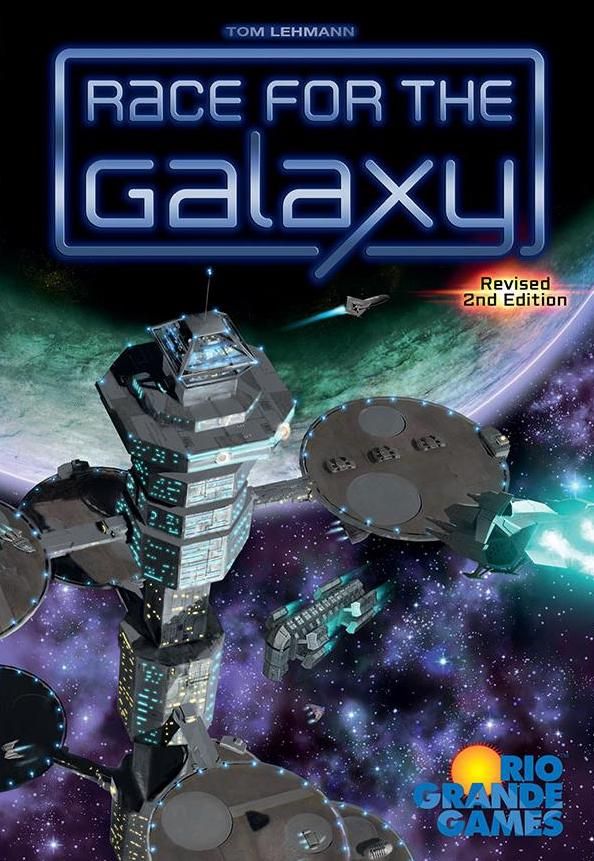
How to Play Race for the Galaxy
Rio Grande Games, ABACUSSPIELE, Albi · Board game · 2007
2–4 · best 2
30–60 min
Weight 3.0/5
8.3
rating
Ludopedia
7.7
rating
BGG
What do you want to do now
Ask questions about the game
Ask anything about Race for the Galaxy: rules, setup, components, complexity, price, or whether it fits your group.
Example questions
Continue this chat in the Assistant
Game page
Prices, ratings and our review
Rules manual
Official PDF file
Video: How to Play
Start here, then follow the written guide
Race for the Galaxy - Rules and Gameplay Tutorial
Step by step
Objective of the Game
Welcome, future galactic emperors! In Race for the Galaxy, you're not just playing cards; you're building a sprawling, powerful space empire. Your ultimate goal? To outmaneuver your rivals and amass the most **Victory Points (VPs)** by developing advanced technologies, settling valuable worlds, and creating a thriving economy. Will you be the one to dominate the galaxy?Preparation (Setup)
Let's get this galactic engine revving! Here’s how to set up your game:- Gather your **VP chips**: Place a total of **12 VPs per player** (using 1's and 5's) within easy reach of everyone.
- Each player takes a set of **7 different action cards**. (If you're playing the 2-player Expert Game, you'll take all 9 action cards).
- Find the **5 start worlds**. Deal one random start world to each player.
- Shuffle any unused start worlds back into the main deck with all the other cards.
- Deal **6 cards** from this shuffled deck to each player.
- Each player then discards **2 of their 6 cards**, keeping their starting hand of 4.
- If **Alpha Centauri** is in play (meaning it was dealt as a start world), place a **goods card** on it immediately.
Playing the Game
A round in Race for the Galaxy is a dynamic dance of simultaneous actions. Here’s how it unfolds:The Round Structure
At the start of every round:- Each player **secretly chooses one action card** from their hand. (For the 2-player Expert Game, players choose 2 cards).
- All players then **reveal their chosen action cards simultaneously**.
- Perform the selected phases in order (I through V), skipping any phase that no player chose.
- Each phase has two parts:
- An **Action**: Performed by **all players**.
- A **Bonus**: Performed only by the players who **chose that action card** this round.
- After all selected phases are complete, players must **discard down to 10 cards** in their hand.
- Finally, all players **take back their action cards** to prepare for the next round.
The Phases Explained
Phase I - Explore
- Action: All players draw 2 cards, keep 1, and discard the other. All explore draws happen before any discards.
- Bonus: Depending on the specific Explore card chosen: either draw 5 more cards, or draw 1 more and keep 1 more.
- Expert Game Note: A player choosing both Explore bonuses draws 8 cards and keeps 2 of them (plus any other bonuses).
Phase II - Develop
- Action: All players may place and pay for a **development card** from their hand. To pay, discard a number of cards equal to the cost shown on the development card. You can never have more than one of each development in your tableau.
- Bonus: If you chose Develop, you discard one card fewer than the indicated cost. The total cost can never drop below 0.
- Expert Game Note: If a player chooses two Develop cards, two complete sequential Develop phases occur. That player gets a bonus in each. Opponents get the bonus only for the first of these two phases. Powers placed in the first phase can be used in the second.
Phase III - Settle
- Action: All players may place and pay for a **world card** from their hand:
- Non-military worlds: Discard a number of cards equal to the cost on the world card.
- Military worlds (red circle): Instead, these must be conquered by having a total **Military** value greater than or equal to the world's defense value. (A **Contact Specialist** allows you to pay for a military world instead of conquering it).
- Bonus: If you chose Settle, draw one card after placing and paying for (or conquering) a world.
- Expert Game Note: If a player chooses two Settle cards, two complete sequential Settle phases occur. That player gets a bonus in each. Opponents get the bonus only for the first of these two phases. Powers placed in the first phase can be used in the second.
Phase IV - Consume
- Action: All players use their **consume powers** if possible, typically to discard **goods cards** for VPs and/or to draw cards. Discard goods face down without looking. A good doesn't have to be on the world consuming it. If multiple goods could be consumed, the player chooses which. Each consume power can be used only once per consume phase. Consume powers allowing "up to" a number of goods must be used to their fullest extent.
- Bonus: There are two possible Consume bonuses:
- $:Trade: If you chose this, you must sell one goods card (before applying other consume powers) by discarding it and drawing cards based on the good's type: Alien=5, Genes=4, Rare Elements=3, Novelty=2. Apply all relevant $:Trade special powers.
- 2xVPs: If you chose this, double the number of VP chips (but not any other effects) that your consume powers provide. Exception: VPs for discarding cards from your hand are not doubled.
- Expert Game Note: A player selecting both Consume bonuses must sell one good before consuming other goods for double VPs.
Phase V - Produce
- Action: All players place a **goods card** face down on each **production world** (those with a colored solid circle) without looking at it.
- Bonus: If you chose Produce, you may produce a good (if possible) on a **windfall world** that doesn't already have one.
End of Game and Scoring
The game isn't over until the last VP is counted!When Does the Game End?
The game concludes at the end of the round in which:- A player ends the round with **12 or more cards in their tableau** (the cards they've played in front of them), OR
- The initial supply of **VP chips runs out**.
Scoring Your Empire
After the final round, it's time to tally up your galactic might:- Each player totals **VPs from their tableau cards**.
- Add any **VP chips** they've collected.
- Add **VPs for any 6-cost developments** they have.
Tips for Victory
Ready to conquer the cosmos? Here are a few pointers to help you on your way:- Balance Your Actions: Don't get stuck always choosing the same phase! Watch what your opponents are choosing. If someone picks **Develop**, you can also develop a card for free, even if you didn't choose it. Smart players leverage the actions chosen by others to their advantage.
- Cards are Currency: In Race for the Galaxy, cards in hand are not just potential plays; they are your primary currency for paying for developments and non-military worlds. Don't be afraid to discard cards to play powerful new ones, but also be mindful of keeping enough for future turns.
- Specialize or Diversify: Consider focusing on a few powerful **consume powers** to generate VPs and cards, or build a broad empire with many different types of worlds and developments. Both strategies can be effective, but understand the synergies within your own tableau.
More videos
More rules explanations from the community
In English
-
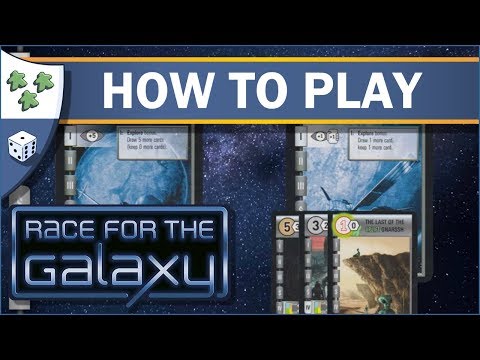 How to play Race for the Galaxy
-
 2GASCB - Race for the Galaxy Tutorial
-
 5 Ways to Win: Race For The Galaxy (RayReviewsGames)
-
 How to Play: Race For The Galaxy (RayReviewsGames)
-
 Race for the Galaxy - Solitaire overview
-
 Spiel mit Stan - Episode 01 - Race for the Galaxy
-
 Teach the Table: Race for the Galaxy
-
 Bestdanggames Video Overview by Cory Duplantis
-
 Tutorial by Wei-Hwa Huang,1/3
-
 Tutorial by Wei-Hwa Huang, 2/3
-
 Tutorial by Wei-Hwa Huang, 3/3
Rules manual
Official PDF file
Prefer the Official PDF?
Download the official Race for the Galaxy rulebook or browse it online with our AI rules assistant.
View Rulebook PDF
Frequently Asked Questions
Quick answers about the rules
What is the objective of Race for the Galaxy?
Welcome, future galactic emperors! In Race for the Galaxy, you're not just playing cards; you're building a sprawling, powerful space empire. Your ultimate goal? To outmaneuver your rivals and amass the most **Victory Points (VPs)** by developing advanced technologies, settling valuable worlds, and creating a thriving economy. Will you be the one to dominate the galaxy?
How do you set up Race for the Galaxy?
Let's get this galactic engine revving! Here’s how to set up your game: Gather your **VP chips**: Place a total of **12 VPs per player** (using 1's and 5's) within easy reach of everyone. Each player takes a set of **7 different action cards**. (If you're playing the 2-player Expert Game, you'll take all 9 action cards). Find the **5 start worlds**. Deal one random start world to each player. Shuffle any unused start worlds back into the main deck with all the other cards. Deal **6 cards**…
How does Race for the Galaxy end, and how do you score?
The game isn't over until the last VP is counted! When Does the Game End? The game concludes at the end of the round in which: A player ends the round with **12 or more cards in their tableau** (the cards they've played in front of them), OR The initial supply of **VP chips runs out**. Once either of these conditions is met, finish the current round. If you run out of VP chips during this final round, use the spare 10 VP chips. Scoring Your Empire After the final round, it's time to tally up…
What are some tips for winning Race for the Galaxy?
Ready to conquer the cosmos? Here are a few pointers to help you on your way: Balance Your Actions: Don't get stuck always choosing the same phase! Watch what your opponents are choosing. If someone picks **Develop**, you can also develop a card for free, even if you didn't choose it. Smart players leverage the actions chosen by others to their advantage. Cards are Currency: In Race for the Galaxy, cards in hand are not just potential plays; they are your primary currency for paying for…
Want to compare prices and check reviews?
Find where to buy at the lowest price, price history, and our full game review.
View Race for the Galaxy
Expansions
Published additional content
 Race for the Galaxy: Alien Artifacts
 Race for the Galaxy: Expansion and Brinkmanship
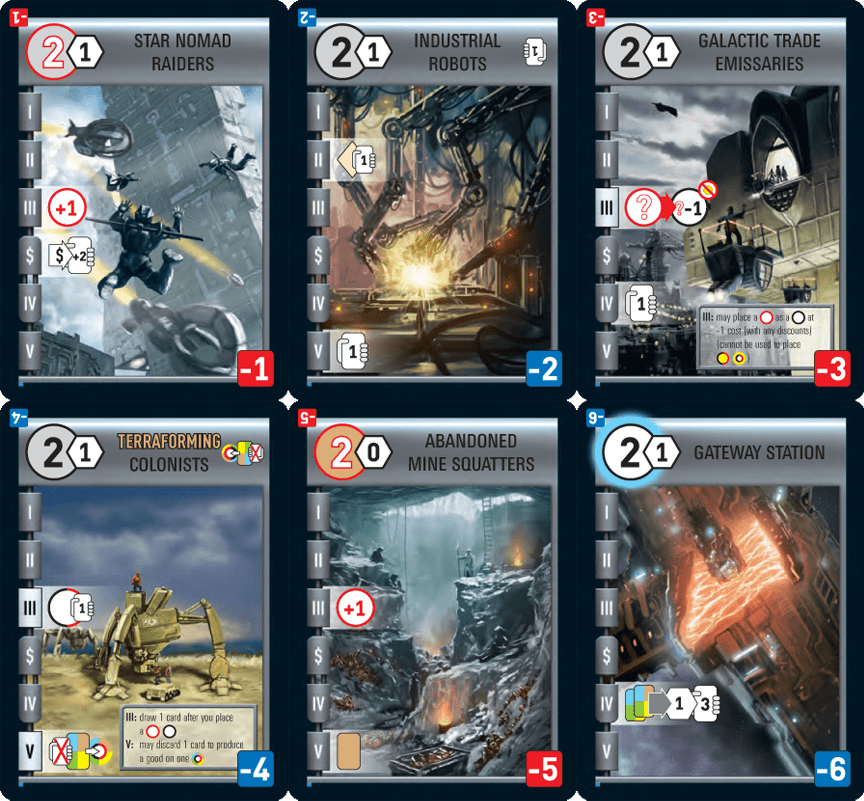 Race for the Galaxy: New Worlds Promo Cards
 Race for the Galaxy: Rebel vs Imperium
 Race for the Galaxy: The Brink of War
 Race for the Galaxy: The Gathering Storm
 Race for the Galaxy: Xeno Counterstrike
 Race for the Galaxy: Xeno Invasion
Other Games You'll Like
Based on mechanics and theme