
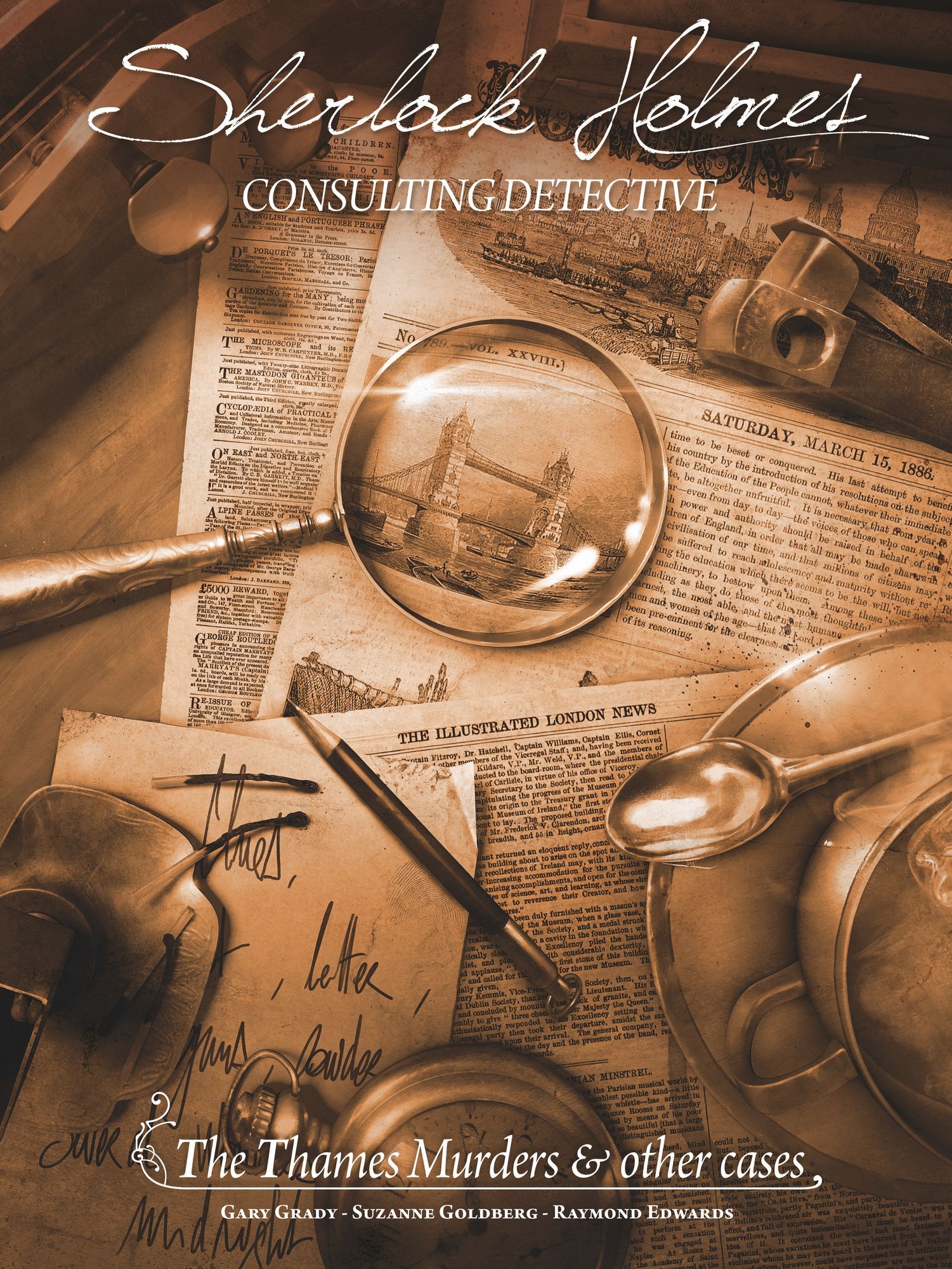
How to Play Sherlock Holmes Consulting Detective: The Thames Murders & Other Cases
Sleuth Publications, Space Cowboys, Angry Lion Games · Board game · 1981What do you want to do now
Ask anything about Sherlock Holmes Consulting Detective: The Thames Murders & Other Cases: rules, setup, components, complexity, price, or whether it fits your group.
Step by step
Objective of the Game
"When you have eliminated the impossible, whatever remains, however improbable, must be the truth?"
Welcome, aspiring detectives! In Sherlock Holmes Consulting Detective, you step into the shoes of a Baker Street Irregular, tasked with solving baffling mysteries and heinous crimes across Victorian London. Your mission, whether playing solo or with a group, is to sift through myriad clues, follow leads, and ultimately arrive at the correct solution to the case before the master detective himself, Sherlock Holmes!
The ultimate goal? To outsmart Holmes by solving the case with fewer investigative steps (clue points visited) than he did. The fewer leads you follow, the sharper your deduction!
Preparation (Setup)
Alright, gather 'round, everyone! Let's get our investigative tools in order before we dive into the murky depths of London's underworld.
- Lay out the Reference Map: Unfurl the detailed street map of Victorian London. Make sure everyone can see and use it easily. This map is your visual guide to the city, featuring approximately 500 numbered clue points (specific locations like Scotland Yard or general spots that change per case) and five police stations (though only Scotland Yard is active in Volume 1).
- Organize the Newspaper Archive: Place the collection of dated newspapers within easy reach of all players. Remember, these can be referred to at any time, as often as you wish! The Newspaper Archive for a case includes all papers dated the same as or prior to the case's date.
- Prepare the Case Book: Keep the Case Book handy. This is where you'll find the mysteries themselves (Cases) and, later, Holmes's own solutions.
- Keep the Clue Book Close: The Clue Book, containing the listings of clue points and their corresponding clues for each case, should be readily accessible.
- Have the Directory Ready: The Directory, an alphabetical listing of characters and places, is your London phone book. You can consult it at any time and as often as you like to find potential leads.
- Grab Paper and Pens: Players should provide their own paper and pens to keep track of game turns and take notes. Trust me, you'll want to jot down every detail!
- Holmes's Lecture (Optional but Recommended): If anyone hasn't read Holmes's Lecture at the beginning of Clue Book: Volume 1, we highly recommend reading it aloud to all players before starting. It provides valuable insights into the resources at your disposal.
The Turn of Play
Now that we're all set, let's talk about how you'll be unraveling these intricate plots. The core of the game revolves around following leads and gathering information. Each time you pursue a new lead, it counts as a game turn.
Solitaire Play
In the solitaire version, you're competing directly against Sherlock Holmes himself!
- Choose and Read a Case: Pick a case from the Case Book and read it carefully. This sets the stage for the mystery you're about to solve.
- Decide on a Clue Point: Based on the case information, decide which clue point you want to investigate first.
- Record and Read the Clue: Write down the current game turn and the clue point you've chosen. Then, turn to that listing in the Clue Book and read the clue for the appropriate case.
- End of Turn: Game turn one is now over.
- Repeat: Continue repeating steps 2 and 3 until you believe you've reached a solution.
- Solve and Quiz: When you've found a solution, note the game turn you just finished and complete the quiz for that case in the Quiz Book.
Two-Player Game
Similar to solitaire, but now you're competing against another player AND Holmes!
- Determine First Player: Decide who goes first. This player is responsible for tracking game turns.
- Choose and Read a Case: Pick a case from the Case Book. One player should read it aloud to the other.
- Player 1's Turn: The first player chooses a clue point, looks it up in the Clue Book, and reads the clue.
- Player 2's Turn: The Clue Book then passes to the second player, who chooses their own clue point and looks up its clue.
- End of Turn: Game turn one is now over. Both players should keep track of the clue points visited during each turn.
- Repeat: Continue repeating steps 3 to 5 until a solution is reached. Each player can submit a solution at the end of any game turn by completing the quiz. If one player submits a solution, the other can continue playing, but the first player cannot change their submitted solution.
Group Play
Playing as a group means you'll either work together for a single solution or individually within the group. Decide on your approach before you begin!
- Determine Play Order: Decide the order of play. The first player tracks game turns and clue points visited.
- Choose and Read a Case: Pick a case from the Case Book. One player reads it aloud to the others.
- Group Investigation: The first player chooses a clue point, looks it up in the Clue Book, and reads it aloud to everyone. The Clue Book then passes to the next player, who chooses the next clue and reads it aloud. You can consult with each other, but the final choice for that turn rests with the player whose turn it is.
- Clue = Turn: In Group Play, each clue read represents a game turn.
- Repeat until Solution: Continue repeating steps 3 and 4 until a solution is reached.
- Version a (Group Solution): When the group agrees on a solution, complete the quiz together.
- Version b (Individual Solutions): An individual player can submit a solution at the end of any game turn by completing the quiz and noting the turn. That player is then out of the game.
Important Rule for All Modes: Only one clue point may be referred to during each game turn. If you want to revisit a previously investigated clue point, you must do so during your current game turn.
End of Game and Scoring
So, you think you've cracked the case? Excellent! Here's how you'll find out if you're truly a master of deduction.
- Complete the Quiz: Once you've reached a solution (either individually or as a group), turn to the Quiz Book for the specific case. Answer the questions to the best of your ability.
- Scoring Instructions: The Quiz Book contains complete scoring instructions. You'll compare your answers and the number of clue points you visited to Sherlock Holmes's own solution.
- Holmes's Solution: The Answer Section of the Quiz Book not only provides the answers to the quiz questions but also lists the clue points Holmes used to solve the case. Your goal is to be as efficient, or even more efficient, than the great detective!
Tips for Winning
To truly excel in the art of deduction, keep these pointers in mind:
- Read Everything Carefully: Pay close attention to the initial case description and every clue you uncover. Sometimes the most innocuous detail can be the key to unlocking the mystery.
- Utilize the Newspaper Archive: Don't underestimate the power of the press! The Newspaper Archive can provide crucial background information, establish timelines, and even point you towards new leads. Refer to it often!
- Don't Be Afraid to Consult the Directory: If you hear a name or a type of business mentioned, check the Directory. It's designed to help you find logical next steps, even if a specific listing wasn't explicitly mentioned in a clue. Think like Holmes – if there's poison, check the chemists!
Rules manual
Official PDF file
Frequently Asked Questions
Quick answers about the rules
What is the objective of Sherlock Holmes Consulting Detective: The Thames Murders & Other Cases?
How do you set up Sherlock Holmes Consulting Detective: The Thames Murders & Other Cases?
How do you play Sherlock Holmes Consulting Detective: The Thames Murders & Other Cases?
How does Sherlock Holmes Consulting Detective: The Thames Murders & Other Cases end, and how do you score?
What are some tips for winning Sherlock Holmes Consulting Detective: The Thames Murders & Other Cases?
Expansions
Published additional content


Other Games You'll Like
Based on mechanics and theme
 Sherlock Holmes Consulting Detective: Jack the Ripper & West End Adventures
 Sherlock Holmes Consulting Detective: The Baker Street Irregulars
 Suspects: Claire Harper Takes the Stage
 Mythos Tales
 EXIT: The Game – Advent Calendar: The Missing Hollywood Star
 Detective: A Modern Crime Board Game – Season One
 Murder Mystery Party Case Files: Death in Antarctica
 EXIT: The Game – Advent Calendar: The Intergalactic Race
