
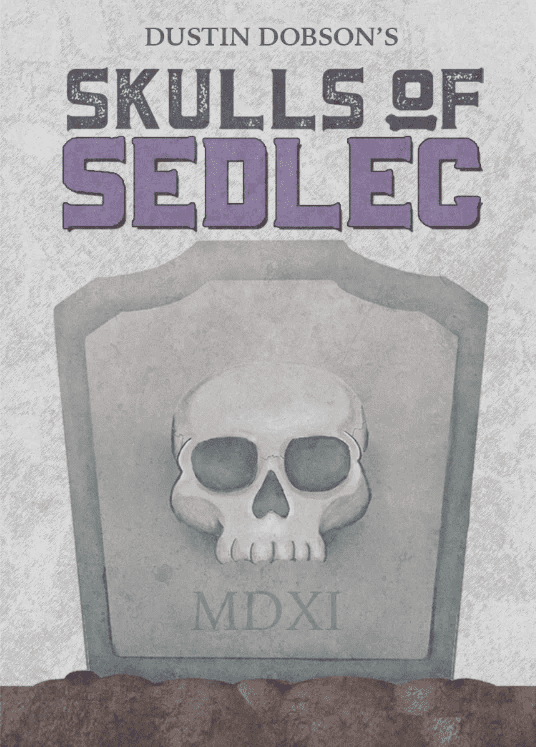
How to Play Skulls of Sedlec
Button Shy, Even Toys and Games, Frosted Games · Board game · 2020Video: How to Play
Start here, then follow the written guide
Step by step
Game Objective
In the 16th century AD, during the period of the Black Death and the Hussite Wars, the Sedlec Ossuary became overcrowded. You take on the role of a Bone Collector, a nearly blind monk, with the mission of exhuming bodies and organizing the skulls in the crypt. The goal is to build your own Ossuary (a pyramid-shaped arrangement) and score according to the wishes of the deceased to determine the winner.
Setup
- Shuffle the 18 game cards.
- Create a Graveyard consisting of 6 piles of 3 cards each, face down and arranged in a 2 x 3 grid.
- Choose one pile and reveal the top card.
- The player who most recently visited a cemetery goes first.
Game Flow
Players play in clockwise order. On each turn, the player must choose and perform one of the three available actions: Dig, Collect, or Stack.
Hand Rule: The hand limit is 2 cards. If a player starts their turn already holding 2 cards in hand, they are required to perform the Stack action to play a card.
Actions and How to Play
Turn Actions
- Dig: Reveal the top cards of any 2 piles in the Graveyard. If there is only 1 face-down card, reveal it. Choose one of the revealed cards and place it in your hand. Restriction: If there are no face-down cards on top of the piles at the start of the turn, you cannot perform this action.
- Collect: Take a card that is already revealed on top of one of the Graveyard piles and place it in your hand. Restriction: If there are no face-up cards on top of the piles at the start of the turn, you cannot perform this action.
- Stack: Place a card from your hand into your Ossuary, following the Placement Rules. Restriction: If you start your turn with no cards in hand, you cannot perform this action.
Placement Rules
- The first card can be placed anywhere to start the bottom Row.
- New cards can be added to the bottom Row, to the left or right of cards already placed. The bottom Row limit is 4 cards (in 2-player games) or 3 cards (in 3-player games).
- Construction always begins with the bottom Row, but it is not necessary to finish it before starting the one above.
- A card can be placed on higher Levels as long as it is centered directly over two cards from a lower Row.
- Cards cannot be rotated; they must always be oriented vertically relative to the owner of the Ossuary.
Skull Types and Scoring
- Nobles: Score 1 point for every Noble and Peasant located on Levels below them.
- Peasants: Score 1 point each, regardless of position.
- Clerics: Score 2 points for every Level where at least one Cleric is present.
- Romantics: Two Adjacent Romantics score 6 points (3 points each). Each Romantic can only score once.
- Criminals: Score 2 points if they are Adjacent to a Cleric. Otherwise, they do not score.
End of Game and Scoring
The game ends when all players have finished their Ossuaries. A complete Ossuary consists of 9 cards (for 2 players) or 6 cards (for 3 players).
Point Counting: Sum the scores for each type of skull according to the rules described above.
Tie-breaker: In the event of a tie, players compare their highest scores obtained with any single type of skull. If the tie persists, they compare their second-highest scores, and so on, until a winner is determined.
Tips for Winning
- Noble Positioning: Since Nobles score based on who is below them, try to position them on the highest Levels of your Ossuary.
- Cleric Synergy: Try to distribute Clerics across different Levels to maximize the "presence on all levels" score and simultaneously use them to give points to Criminals.
More videos
More rules explanations from the community


Frequently Asked Questions
Quick answers about the rules
