
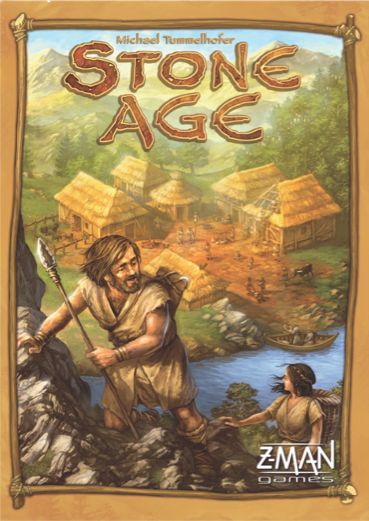
How to Play Stone Age
Hans im Glück, 999 Games, asmodee · Board game · 2008What do you want to do now
Ask anything about Stone Age: rules, setup, components, complexity, price, or whether it fits your group.
Video: How to Play
Start here, then follow the written guide
Step by step
Objective of the Game
Welcome to the Stone Age, a time of emerging agriculture, resource processing, and simple hut building! In Stone Age, you and your fellow players will guide your tribes through these challenges, striving to become the most successful civilization. There are many paths to victory, from skillful hunting to developing advanced tools and expanding your population. Your goal is to master all these challenges and find your own way to accumulate the most victory points by the end of the game. Will your tribe thrive and leave its mark on history?
Preparation (Setup)
Let's get your Stone Age world ready for action!
- Place the game board in the middle of your table.
- Separate the food tiles by value and stack them on the designated hunting grounds on the board.
- Place the 20 wood resources in the forest area.
- Place the 16 brick resources in the clay pit area.
- Place the 12 stone resources in the quarry area.
- Place the 10 gold resources in the river area.
- Separate the tool tiles by values (1/2 and 3/4) and place them in two stacks next to the tool maker space.
- Shuffle the civilization cards and place them face down as a stack next to the game board. Draw the top 4 cards and place them on the 4 spaces, from right to left.
- Shuffle the building tiles and create 4 face-down stacks of 7 buildings each.
- With 4 players, place all 4 stacks on the game board.
- With 3 players, place 3 stacks.
- With 2 players, place 2 stacks.
- Each player chooses a color and takes one of their markers to place on space 0 of the food track (lower left) and another on the scoring track (upper left).
- Each player takes 1 player board. On this board, place 5 people figures of your chosen color and 12 food. Your player board will help you organize your game material, provide game information, and assist with final scoring.
- Place the remaining 5 people figures of each color as a general supply next to the game board. Also place the 7 dice and the dice cup there.
- Choose a start player, who takes the start player figure. You're ready to begin!
The Game Turn
A round in Stone Age is divided into three exciting phases:
- The players place their people on the game board.
- The players use the actions of their placed people.
- The players feed their people.
Phase 1: Placing Your People
The start player begins by placing 1 or more of their people figures on a chosen space. Play then proceeds clockwise. Each player must place 1 or more people figures on an available space. This continues until all players have placed all their people figures.
- You cannot pass if there are still available spaces.
- You cannot place people figures on a space where you've already placed people figures this round.
Where can you place your people?
- Tool Maker: Exactly 1 people figure.
- Hut: Exactly 2 people figures of the same player. (If you choose the hut, you must place 2 figures here.)
- Field: Exactly 1 people figure.
- Hunt: No limit to the number of people figures, but you can only place figures here once per round.
- Forest, Clay Pit, Quarry, and River: Up to a total of 7 people figures across all players.
- Civilization Cards: Exactly 1 people figure per card. Cards can be filled in any order.
- Buildings: Exactly 1 people figure per building. Buildings can be filled in any order.
This phase ends when no player can place any more people figures.
Phase 2: Using Your Placed People
The start player begins by using all their placed people figures. Then, the next player in clockwise order uses all of theirs. The order in which a player uses their people figures is entirely up to them. As you use your people figures, return them to your player board.
What actions can you take?
- Tool Maker: Take 1 new tool. If you have no tools, take a value 1 tool. If you already have tools, you'll upgrade existing ones:
- For your 1st-3rd tools, place value 1 tools on your player board.
- For your 4th-6th tools, turn your value 1 tools to value 2.
- For your 7th-9th tools, replace value 2 tools with value 3 tools.
- For your 10th-12th tools, turn value 3 tools to value 4.
Tools can be used once per round to add to a die roll during hunting or resource procurement. To show a tool is used, turn it 90 degrees.
- Hut: Take 1 additional people figure of your color from the general supply and add it to your player board. You will have this extra person available for all future rounds!
- Field: Return your people figure to your player board and move your marker on the food track 1 space upward, increasing your food production for the end of each round.
- Hunt: Roll 1 die for each of your people figures placed here. Add all the pips on the dice. You can then add the value of any unused tools to this total. For each full 2 of the total, take 1 food from the game board.
- Forest (Wood), Clay Pit (Brick), Quarry (Stone), River (Gold): Roll 1 die for each of your people figures placed here. Add all the pips on the dice. You can then add the value of any unused tools to this total.
- Forest: For each full 3, take 1 wood.
- Clay Pit: For each full 4, take 1 brick.
- Quarry: For each full 5, take 1 stone.
- River: For each full 6, take 1 gold.
Resources are not limited; if a supply runs out, use a substitute.
- Civilization Cards: Pay the required resources shown above the card to the supply from your player board (you cannot use food). Take the card and add it face down to your player board. If you cannot or do not want to pay, return your people figure and leave the card.
Many cards have immediate effects (like gaining resources, food, tools, or moving on the scoring/food track) or allow you to roll dice for resources. Some cards offer a one-time use tool or two resources of your choice, which you can use immediately or later.
- Buildings: Pay the required resources shown on the building to the supply from your player board. Take the building and immediately move your scoring marker forward on the scoring track by the number of spaces shown on the building. Then, turn over the next building on that stack. If you cannot or do not want to pay, return your people figure and leave the building.
Some buildings require specific resources, while others allow you to choose the types and number of resources (up to 7), with points calculated based on the value of the resources paid (e.g., 3 stone and 1 wood for 18 points).
Phase 3: Feeding Your People
Once all players have returned their people figures to their player boards, it's dinner time! Each people figure requires 1 food.
- First, each player takes food from the supply equal to their marker's position on the food track.
- Then, each player returns 1 food to the supply for each people figure on their player board.
If you don't have enough food:
- You must return all the food you have to the supply.
- You may then pay the remaining food cost with any resources from your player board (1 resource = 1 food).
- If you cannot or do not want to pay with resources, you immediately move your scoring marker backward 10 points on the scoring track.
After everyone has fed their people (or taken the penalty), the round ends. The start player figure passes to the player on the left, and a new round begins.
Starting a New Round
Before the next round's first phase:
- Move any remaining civilization cards to the right to fill empty spaces.
- Fill any remaining empty spaces with new cards from the stack, from right to left.
- Turn any used tools back to their unused positions.
End of Game and Scoring
The game ends in one of two ways:
- If there are not enough civilization cards to fill the display at the beginning of a round, the game ends immediately. No new round is played.
- If at least 1 building stack is empty. In this case, the current round is played to its end (including feeding your people).
Final Scoring and Winner!
Once the game ends, it's time to tally up those points!
- Civilization Cards with Green Backgrounds: For cards with different culture symbols, multiply the number of different symbols by itself (e.g., 5 different symbols = 25 points).
- Civilization Cards with Sand-Colored Backgrounds:
- Farmers: Multiply the number of farmer symbols by your current position on the food track.
- Tool Makers: Multiply the number of tool maker symbols by the total value of your tools.
- Hut Builders: Multiply the number of hut builder symbols by the number of buildings you have acquired.
- Shamen: Multiply the number of shamen symbols by the number of people figures on your player board.
- Resources: Each resource remaining on your player board scores 1 point.
Move your scoring marker as you calculate your points. The player with the most points is the winner!
In case of a tie, the tied player with the highest total of food production (from the food track), tool values, and people figures wins.
Tips for Winning
To truly master the Stone Age, keep these strategic insights in mind:
- Don't Neglect Civilization Cards: These cards offer immediate gains and can be a huge source of points during final scoring. Look for cards that synergize with your overall strategy. For instance, if you're growing your population, prioritize cards with farmers and shamen!
- Invest in Growth: Acquiring more people figures, increasing your food production, and getting more tools are incredibly valuable because they benefit you for the rest of the game. A civilization card that costs only one resource but provides one of these benefits is often a steal!
- Strategic Blocking: Don't be afraid to block other players from "cheap" resources, forcing them to spend more valuable ones. Also, consider blocking a building stack with only 1 or 2 buildings left. If you don't want the game to end soon, place a people figure on such a stack with no intention of acquiring the building, effectively extending the game by a round or two.
More videos
More rules explanations from the community
In English
-
 Stone Age - In Focus
-
 Stone Age: How to Play
-
 How to play Stone Age
-
 BGN: How to Play Stone Age
-
 Stone Age: The solo Challenge
-
 is a Board Game Everybody Should°°°
-
 Learn to Play Stone Age
-
 Play BGA: Stone Age
-
 Stone Age- The solo Challenge (trailer)
-
 How to Play Stone Age
-
 Stone Age - Intro/Gameplay/Review by BnB
Rules manual
Official PDF file
Frequently Asked Questions
Quick answers about the rules
