
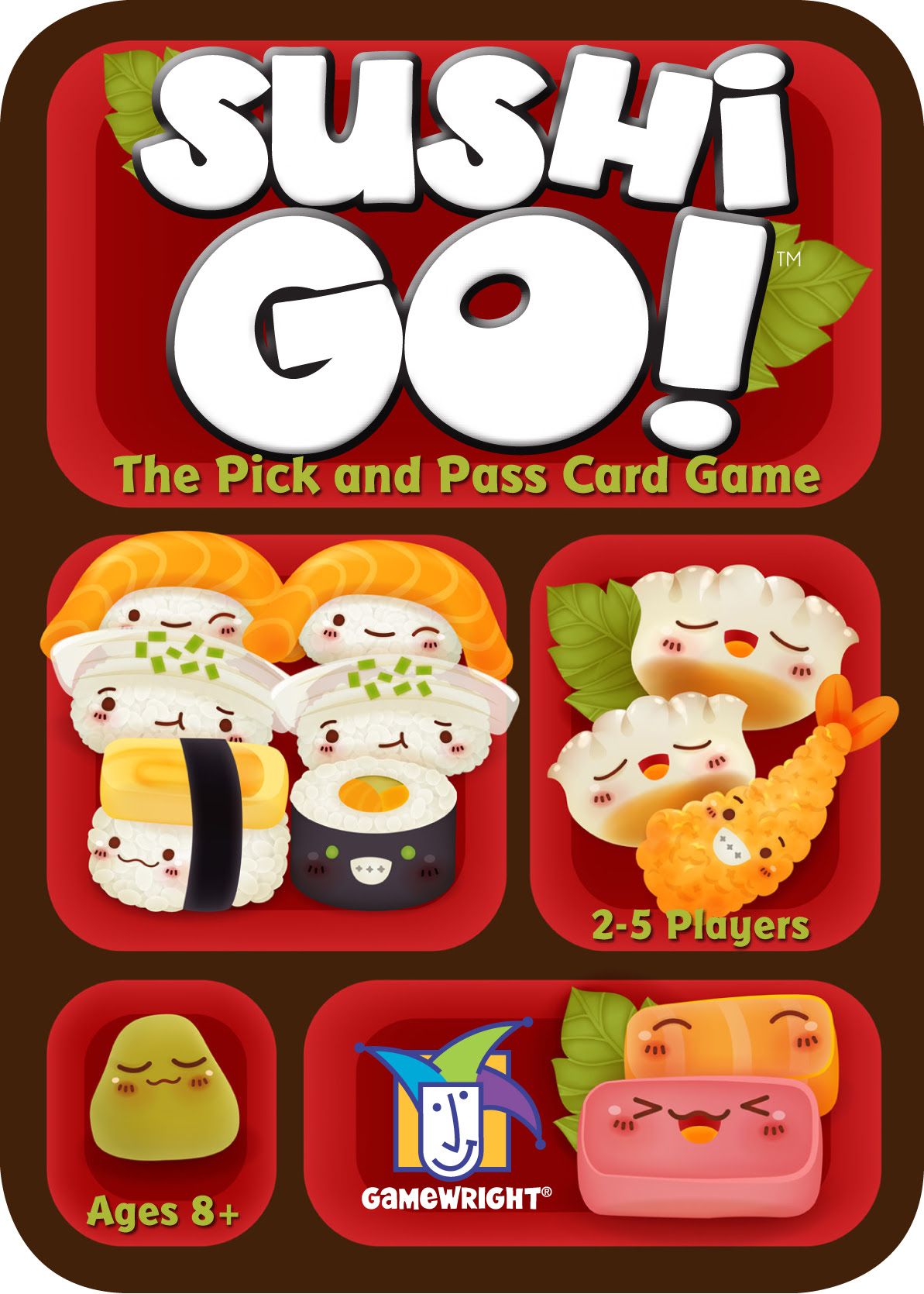
How to Play Sushi Go!
Adventureland Games, Gamewright, 64 Ounce Games · Board game · 2013What do you want to do now
Ask anything about Sushi Go!: rules, setup, components, complexity, price, or whether it fits your group.
Video: How to Play
Start here, then follow the written guide
Step by step
Objective of the Game
Welcome to the delightful world of Sushi Go!, where you'll be grabbing the best sushi dishes as they whiz by! Your goal is to collect the most valuable combinations of sushi cards over three delicious rounds. At the end of the game, the player with the highest total score is crowned the sushi master!
Setup
Getting ready for a sushi feast is quick and easy:
- First, take all 108 cards and give them a good shuffle.
- Next, deal cards to each player based on your group size:
- For a 2-player game, deal 10 cards to each player.
- For a 3-player game, deal 9 cards to each player.
- For a 4-player game, deal 8 cards to each player.
- For a 5-player game, deal 7 cards to each player.
- Place any remaining cards face-down in a draw pile in the center of your playing area.
- Grab a piece of paper and a pencil. Designate one player as the scorekeeper to track everyone's points.
That's it! You're ready to start drafting some delectable sushi!
The Turn of Play
Sushi Go! is played over 3 rounds. Each round follows a simple, fast-paced rhythm:
- Choose and Reveal: To start a round, all players simultaneously choose 1 card from their hand that they want to keep. Place this card face-down in front of you. Once everyone has chosen, all players reveal their chosen cards at the same time.
- Pass Hands: After revealing cards, pass your remaining hand of cards face-down to the player on your left. Everyone then picks up their new hand, and the next turn begins. You'll notice your hand gets smaller with each turn!
- Repeat: Continue choosing, revealing, and passing until all cards from the initial hands have been played. The cards you've chosen remain face-up in front of you until the end of the round, when they'll be scored. It's helpful to group cards of the same type together to keep things organized.
Special Card Actions:
- Using Wasabi: If you choose a Squid Nigiri, Salmon Nigiri, or Egg Nigiri card and you already have a Wasabi card in front of you, you must place the Nigiri on top of the Wasabi. This triples the Nigiri's value! You can have multiple Wasabi cards, but only one Nigiri can be placed on each Wasabi.
- Using Chopsticks: If you have a Chopsticks card in front of you, you can use it on a future turn to take two sushi cards! Here's how:
- Choose your first card as usual.
- Before anyone reveals their cards, shout "Sushi Go!" and pick a second card from your hand, placing it face-down on the table with your first choice.
- Then, all players reveal their cards.
- Important: Before passing hands, put your Chopsticks card back into your hand. This means it will be passed on, and another player might get to use it!
Ending a Round
A round ends when the final remaining card of each hand is played. Simply place it face-up with your other collected cards. Now it's time to score!
Announce your scores for the round, and the scorekeeper will record them. Then, discard all your collected cards face-up beside the draw pile, except for Pudding cards. Pudding cards are kept in front of you until the very end of the game.
To start a new round, deal everyone another hand of cards from the draw pile, using the same number of cards as the previous round.
End of Game and Scoring
After the third round is played and scored, the game concludes. Any remaining cards in the draw pile are ignored. Now, it's time for dessert!
Scoring Breakdown:
- Maki Rolls:
- Count the Maki Roll icons at the top of all your Maki Roll cards.
- The player with the most icons scores 6 points. If there's a tie, players split the 6 points evenly (ignoring any remainder), and no second-place points are awarded.
- The player with the second most icons scores 3 points. If there's a tie for second, those players split the 3 points evenly (ignoring any remainder).
- Tempura: A set of 2 Tempura cards scores 5 points. A single Tempura card is worth nothing. You can score multiple sets of Tempura in a round.
- Sashimi: A set of 3 Sashimi cards scores 10 points. A single Sashimi or a set of only 2 is worth nothing. You can score multiple sets, but it's tricky!
- Dumplings: The more Dumpling cards you have, the more points you score:
- 1 Dumpling: 1 point
- 2 Dumplings: 3 points
- 3 Dumplings: 6 points
- 4 Dumplings: 10 points
- 5+ Dumplings: 15 points
- Nigiri and Wasabi:
- Squid Nigiri: 3 points (9 points if on Wasabi)
- Salmon Nigiri: 2 points (6 points if on Wasabi)
- Egg Nigiri: 1 point (3 points if on Wasabi)
- A Wasabi card with no Nigiri on it scores nothing.
- Chopsticks: A Chopsticks card scores nothing.
- Puddings (Scored at Game End):
- The player with the most Pudding cards scores 6 points. If tied, players split the points evenly.
- The player with the fewest Pudding cards (including those with none) loses 6 points. If tied, players split the lost points evenly.
- If all players have the same number of Pudding cards, no one scores anything for them.
- Note: In a 2-player game, no one loses points for Puddings; only points for the most Pudding cards are awarded.
Determining the Winner
After all 3 rounds and the final Pudding scoring, the player with the most points is the winner! In case of a tie, the player with the most Pudding cards wins.
Tips for Winning
Want to become a true sushi master? Keep these tips in mind:
- Watch Your Neighbors: Since you're constantly passing hands, pay attention to what cards your opponents are collecting. If someone is going for Sashimi, consider taking a Sashimi card yourself to deny them their set of three!
- Balance Short-Term vs. Long-Term: Maki Rolls and Puddings are scored at the end of the round or game, respectively, meaning their value can change. Cards like Tempura and Nigiri offer more immediate, fixed points. Decide if you want to focus on securing immediate points or gamble on bigger end-of-round/game bonuses.
- Don't Underestimate Chopsticks: While Chopsticks score no points themselves, they offer incredible flexibility. Being able to take two cards in a single turn can be crucial for completing sets or grabbing a high-value card while denying an opponent. Just remember to pass them on!
More videos
More rules explanations from the community
In English
-
 Sushi Go! | HOW TO PLAY
-
 How to Play Sushi Go | Board Game Rules & Instructions
-
 How To Play - Sushi Go!
-
 How to Play Sushi Go! Complete Game Rules in 5 Minutes
-
 Sushi Go! Explained in 1 Minute
-
 How to Play Sushi Go in 4 minutes
-
 How to Play Sushi Go! | Good Time Society with Becca Scott
-
 How to play Sushi Go!: A 3D Animated Series
-
 Playthrough Tutorial on Board Game Arena - Sushi Go!
-
 HOW TO PLAY - Sushi Go!
-
 How to Play Sushi Go!
Rules manual
Official PDF file
