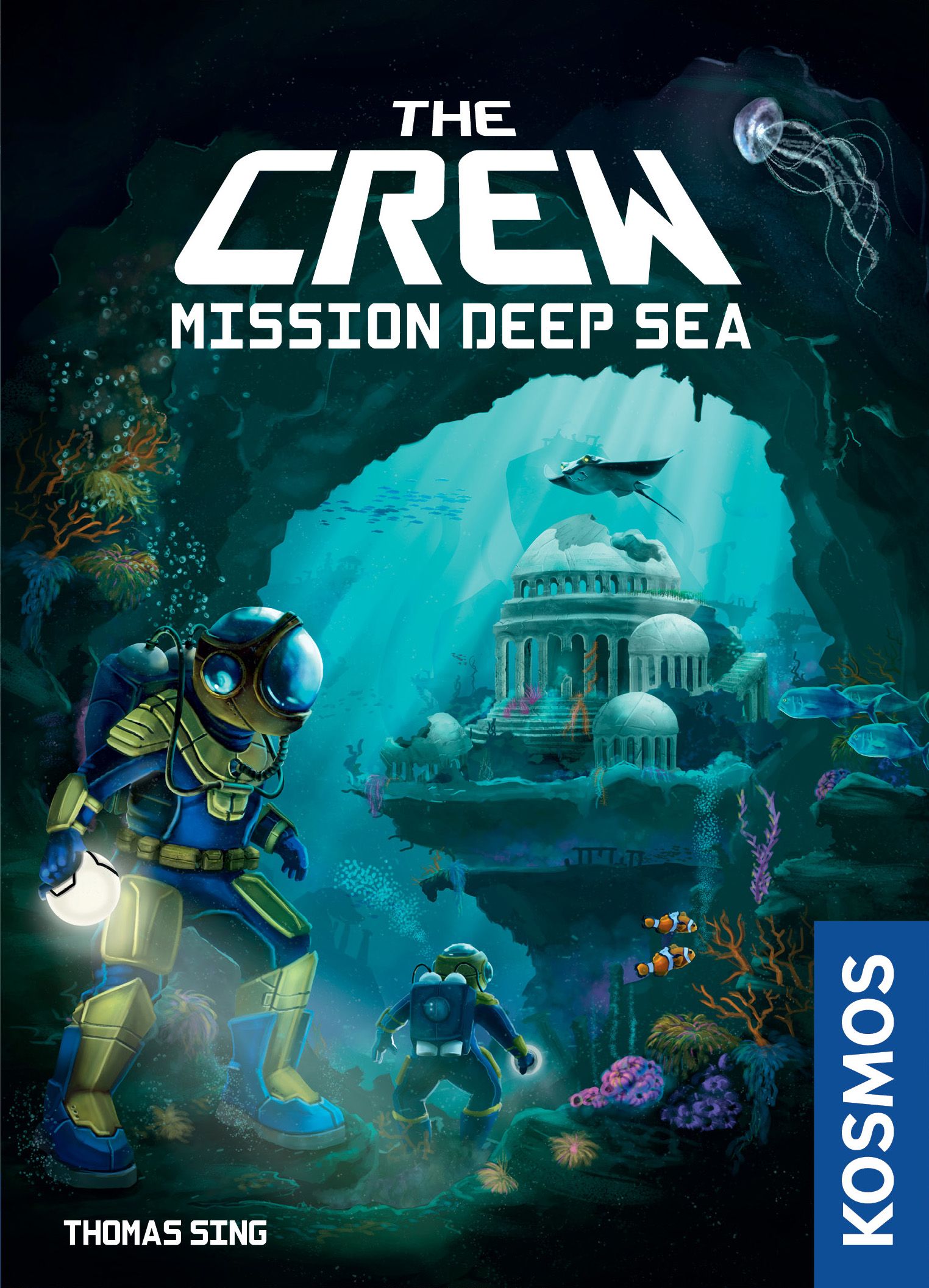
How to Play The Crew: The Quest for Planet Nine
KOSMOS, 999 Games, Black Sea Games · Board game · 2019What do you want to do now
Ask anything about The Crew: The Quest for Planet Nine: rules, setup, components, complexity, price, or whether it fits your group.
Video: How to Play
Start here, then follow the written guide
Step by step
Game Objective: Unraveling the Ninth Planet!
Prepare yourself, astronaut! In *The Crew: The Quest for Planet Nine*, you and your friends will embark on an epic cooperative adventure to unravel the mystery of a ninth planet. Your main objective is to complete 50 different missions, each with its own victory conditions. But beware: in space, communication is everything, and you will only succeed if you work together, because you win together or you lose together!
This is a cooperative trick-taking game based on missions. This means you will need to coordinate perfectly so that the right players win the right tricks and complete the assigned tasks. Missions are played consecutively, creating an engaging narrative, but you can also play them in any order you prefer. The first missions are quick, but the difficulty increases progressively, so prepare for increasingly greater challenges!
Setup: Ready for Launch!
Before each mission, follow these steps to prepare your space station:
- Game Cards: Shuffle the 40 large cards (game cards) and deal them equally, face down, among all crew members. If there are three players, one will receive an extra card.
- Communication and Reminder Tokens: Each player places a radio communication token in front of them, green side up, and a reminder card.
- Distress Signal Token: Place the distress signal token face down.
- Task Cards: Shuffle the 36 small cards (task cards) and form a face-down deck with them. Keep the task tokens handy.
- Task Distribution (if applicable):
- Draw the indicated number of task cards from the deck and place them, face up, in the center of the table. The rest will not be used in the current mission.
- If there are task tokens, place the indicated ones face up in the center of the table. Then, draw the task cards and place them from left to right, starting with the first task token. It is not allowed to assign more than one token to a card.
- Commander Identification: Examine the cards in your hand. Whoever has the 4 of rockets declares it and becomes the commander of the current mission. That crew member receives the commander token.
- Task Selection: The commander will be the first to choose a task card from the center of the table and place it in front of them. Then, all other players, in clockwise order, will draw a task card. A player may obtain multiple tasks, and not everyone will necessarily have the same number of tasks.
Setup for 2 Players (JARVIS)
If you are playing with only two crew members, a third member, JARVIS (an artificial intelligence system), will accompany you. The setup is slightly different:
- Separate the 4 of rockets.
- Using the remaining 39 game cards, place seven in a row, face down. Then, cover them with another seven face up. This is JARVIS's play area.
- Shuffle the 4 of rockets with the remaining cards and deal them equally, face down, to both crew members, so that each has 13 cards.
- Each crew member places a radio communication token in front of them, green side up, and a reminder card.
- Place the distress signals face down.
- Shuffle the 36 task cards and form a face-down deck with them. Keep the task tokens handy.
The commander (the player with the 4 of rockets) also manages JARVIS, choosing tasks and playing face-up cards for him, without discussion.
The Game Turn: The Trick and Communication!
The adventure begins! After the tasks are distributed, the commander starts the first trick. From then on, the person who won the previous trick always starts the next one.
Playing Tricks
In each round, in clockwise order, each crew member plays a card. These cards form the trick.
- The first card played sets the suit to follow in each trick. This applies to both color cards and rocket cards.
- You must follow suit, meaning play a card of the same type.
- If you cannot follow suit, you can play any card you wish.
- The trick is won by the highest value card of the designated suit at the beginning of the round.
- Rocket cards are trumps and win any trick, regardless of the cards in play. If there are multiple rockets in a trick, the highest value one wins it.
- If a rocket card is played first, it sets the suit and this must be followed, if possible.
- Won tricks are set aside, face down. Only the last won trick can be consulted.
- You are not obligated to win a trick. You can play a low-value card, even if you could win the trick with a higher-value one.
Strategic Communication
A crucial rule: you cannot talk about the cards in your hand. You cannot show, mention, or suggest to other crew members the cards you possess. But there is a way to transmit information:
- When to Communicate: Each participant has a radio communication token, which can only be used once per mission. It can be used at any time before a trick is played, but never during it.
- How to Communicate: Take one of your color cards (never a rocket card) and place it in front of you, face up, so everyone can see it. This card remains part of your hand and can be played normally.
- Additional Information: Then, place your radio communication token on the card, green side up, to give even more information:
- On the top side, if it is your highest value card of that color.
- In the center, if it is your only card of that color.
- On the bottom side, if it is your lowest value card of that color.
- Reminder: After communicating, add a reminder card to your hand. It serves to remind you that your communicated card is still on the table. If you play that card, you can discard the reminder card and flip the radio communication token to the red side, indicating that you have already made your communication in this mission.
Attention: The position of the radio communication tokens cannot be changed, even if the statement is no longer true.
Help Mechanic: Distress Signals
If things get tough, you can use a distress signal. At the beginning of each mission, after dealing the game and task cards, but before any communication, the crew can decide to use this assistance. Flip the distress signal token to the active side (satellite) and circle the corresponding symbol in the logbook.
If the distress signal is activated, each crew member can pass one card to their neighbor (right or left, all in the same direction). Rocket cards cannot be passed! The token remains active until the mission is completed and increases the number of attempts recorded in the logbook by 1.
End of Game and Scoring: Mission Accomplished or Restart!
The game ends (the current mission) when:
- Mission Successful: A task is completed when a crew member wins a trick containing the game card pertinent to one of their tasks. They then flip the corresponding task card face down. As soon as each player completes their corresponding tasks, the mission is successfully completed! Record the number of attempts required for its completion in the logbook.
- Mission Lost:
- If a player wins even one card corresponding to another player's task card, the mission is considered lost.
- If a crew member violates a special mission rule.
- If the condition of a task token is not obeyed.
Task tokens can add specific conditions for completing tasks, such as "The task must be completed first" or "The task must be completed at any time before [another task]". Failure to comply with these conditions results in immediate mission failure.
Tips for Winning: Strategies of a Space Veteran
- Silent Communication is Communication! Remember that "not communicating is also a form of communication." Often, the absence of specific communication can indicate that a player can complete their tasks directly. Use this to your advantage to save your precious communication tokens.
- Manage Your Rockets Wisely. Rockets are powerful trumps that can secure important tricks. Use them strategically to help yourself or others complete tasks, especially those with lower-value cards that would be difficult to win otherwise. The 4 of rockets is the highest and wins any trick!
- Optimize Task Selection. When choosing your task cards, think about the ability to complete multiple tasks at once. If you have strong cards that can win several tasks in a single trick, prioritize them. Additionally, when communicating, if you have, for example, an 8 and a 9 yellow, communicating the 8 as your lowest card is more informative, as it already implies that you also possess the 9.
More videos
More rules explanations from the community
In English
-
 The Crew - How to Play
-
 How to Play The Crew
-
 The Crew - Explanation and Review (English - Nederlandse ondertiteling) BoardgameNinja
-
 The Crew: The Quest for Planet Nine. Learning and Playthrough
-
 How to Teach - The Crew: Quest for Planet Nine
-
 How to Play The Crew: The Quest for Planet Nine
-
 The Crew - Tutorial & Playthrough on Board Game Arena
-
 Unboxing & Basics of How to Play THE CREW - THE QUEST FOR PLANET NINE
-
 The Crew Rules Explanation and Playthrough
Rules manual
Official PDF file
Frequently Asked Questions
Quick answers about the rules
What is the objective of The Crew: The Quest for Planet Nine?
How do you set up The Crew: The Quest for Planet Nine?
How does The Crew: The Quest for Planet Nine end, and how do you score?
What are some tips for winning The Crew: The Quest for Planet Nine?
Other Games You'll Like
Based on mechanics and theme