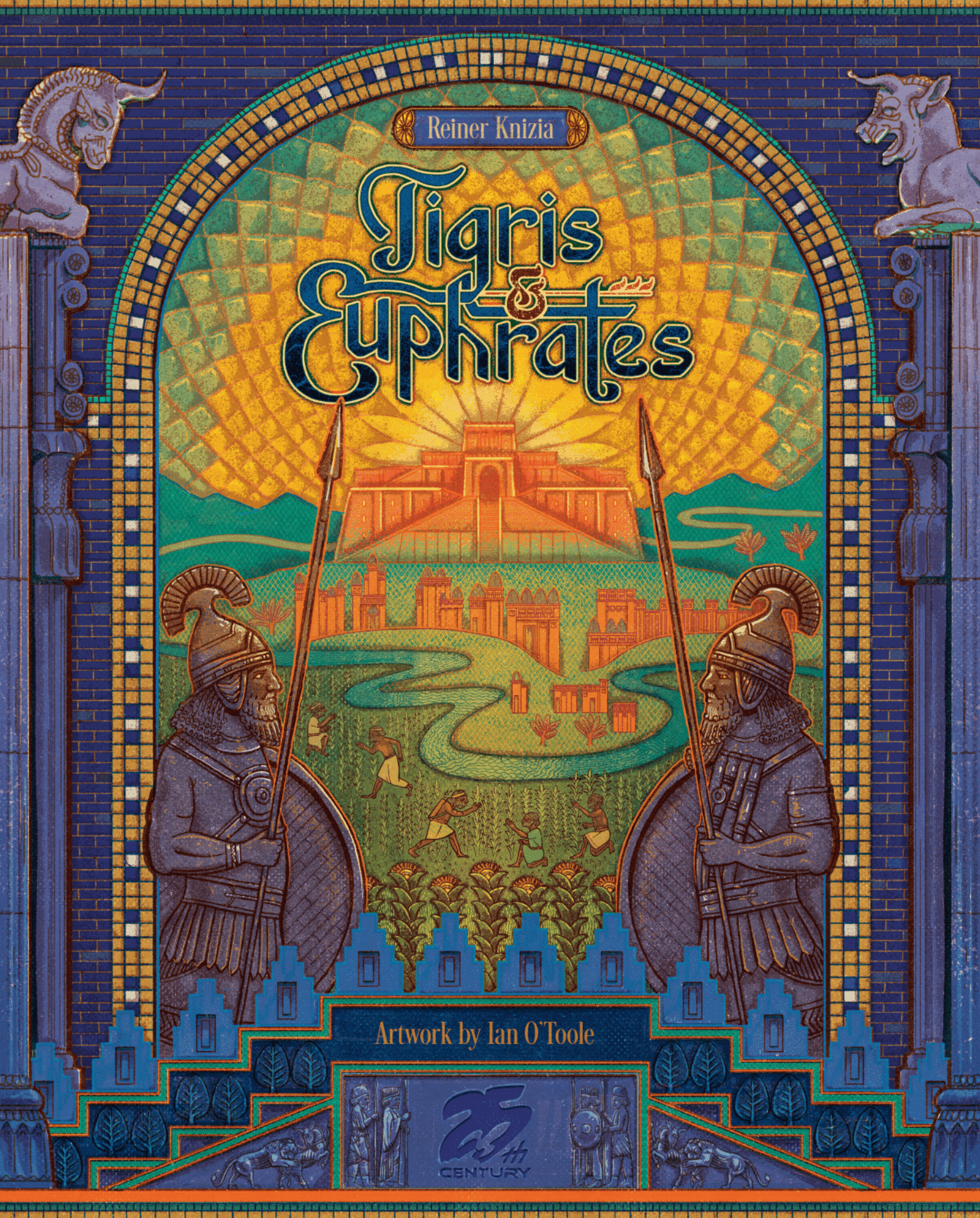
How to Play Tigris & Euphrates
Hans im Glück, 25th Century Games, 999 Games · Board game · 1997What do you want to do now
Ask anything about Tigris & Euphrates: rules, setup, components, complexity, price, or whether it fits your group.
Video: How to Play
Start here, then follow the written guide
Step by step
Objective of the Game
Welcome to Mesopotamia, the cradle of civilization! In Tigris & Euphrates, you'll step into the shoes of ancient leaders, guiding your dynasty through the fascinating development of civilization. Your goal isn't just to dominate, but to achieve a balanced growth across four crucial aspects: settlements, temples, farms, and markets.
You'll place your leaders, expand your kingdoms, construct magnificent monuments, and even navigate intense conflicts, all to earn precious victory points in each of the four civilizations. The ultimate winner isn't the one with the most points overall, but the player who demonstrates the most balanced development, ensuring no single civilization is neglected. Show no weakness, and claim your place in history!
Preparation (Setup)
Let's get this ancient world ready for action!
- Assemble Monuments: Before anything else, put together the monuments so they show two different colors.
- Choose Your Board: Pick a side of the game board. If this is your first time, we recommend the blue "classical" side.
- Place Initial Temples & Treasures: On the 10 spaces marked with a winged creature, place a temple tile. On top of each of these temples, place a natural-colored wooden cube, which represents a treasure.
- Prepare Civilization Tiles: All other civilisation tiles (settlements, farms, markets) go into the cloth bag.
- Sort Special Tiles: The catastrophe tiles and the unification tile are sorted out and placed beside the board, along with the assembled monuments and the various victory points (wooden cubes).
- Player Selection & Starting Hand: Each player chooses a dynasty and takes their four respective leaders (round wooden disks) and the matching screen. Then, each player draws 2 catastrophe tiles and 6 random civilisation tiles from the bag, keeping them hidden behind their screen.
- Stow Away Extras: Any spare leaders, screens, treasures, catastrophe tiles, and the 4 civilization buildings (unless playing with the expansion rules) are returned to the box.
Important Note: There are no "player colors" in Tigris & Euphrates. You'll be interacting with all colors of civilization tiles. Your identity is tied to your chosen dynasty symbol!
The Turn of Play
The player who last went on vacation starts the game (a fun way to pick the first player!). Play proceeds clockwise. On your turn, as the active player, you can perform up to two actions, in any order. You can even choose the same action twice!
Here are the actions you can take:
Position, Withdraw, or Move a Leader
- You have four leaders: a king (black), priest (red), farmer (blue), and trader (green).
- You can only place your own leaders.
- A leader must always be placed on an empty space.
- Leaders can be placed from off the board, or moved from one space on the board to another. You can also withdraw a leader from the board.
- A leader must be placed in the immediate neighborhood of a temple (sharing a common edge).
- Leaders cannot be placed on river spaces.
- You cannot place a leader in a way that connects two existing kingdoms together. However, connecting civilization tiles or regions without leaders to kingdoms using a leader is perfectly fine.
- Attention! If a leader loses its last neighboring temple (due to removal or being turned face-down), that leader is returned to its player. No victory points are awarded for placing leaders, but you need them on the board to earn points later!
Position a Civilization Tile and Receive a Victory Point
- At the start of your turn, you should have 6 civilisation tiles behind your screen.
- Take one tile from behind your screen and place it onto an empty space on the board.
- Blue farm tiles are special: they can only be placed on river spaces. No other color tiles can be placed on river spaces.
- Once placed, tiles cannot be moved or taken back.
- Receiving a Victory Point:
- You get a victory point if the tile is placed within a kingdom (meaning there's at least one leader in the connected region).
- If there's a leader of the same color as the placed tile in that kingdom, the player owning that leader receives a victory point of that color.
- If there's no leader of the tile's color, but there's a king leader in the kingdom, the player who owns the king receives the victory point.
- No Victory Points are Awarded:
- If the tile is not placed in a kingdom (no leader available).
- If the tile connects two kingdoms.
- Victory Point Management: Victory points are awarded immediately using small wooden cubes (1 point) or large wooden cubes (5 points). Exchange small cubes for large ones as needed to keep the supply flowing.
Position a Catastrophe Tile
- You start the game with two catastrophe tiles.
- A catastrophe tile can be played onto an empty space or on top of an existing tile. If placed on an existing tile, that tile is removed from the game.
- You cannot play a catastrophe tile on a tile supporting a treasure or a monument, nor on a leader.
- Catastrophe tiles disrupt connections between leaders or tiles, potentially dividing a kingdom or removing the last temple next to a leader (which returns that leader to its player).
- Once placed, catastrophe tiles block that space for the rest of the game and cannot be moved or covered.
Exchange Up to 6 Tiles
- You can choose to discard any number of civilisation tiles from behind your screen, face-down.
- Then, draw an equal number of new tiles from the bag to bring your hand back up to 6.
- The discarded tiles are out of the game. New tiles can be used immediately if this is your first action.
Events Discussed After Actions
After each of your two actions, check for potential "events." These must be resolved immediately before moving on. The manual details these, but here's a quick overview:
- Internal Temple Conflict: Happens if you place a leader in a kingdom that already has another leader of the same color. Strength is drawn from neighboring temples.
- External Supporter Conflict: Occurs when a tile connects two kingdoms, and the newly formed kingdom contains two leaders of the same color. This is forbidden if it connects more than 2 kingdoms. Strength is drawn from tiles of the leader's color in their original kingdoms.
- Building Monuments: If placing a tile creates a 4x4 square of like-colored tiles, you can build a monument of that color.
- Treasure Distribution: If placing a leader or tile causes a kingdom to contain more than one treasure, the player with a trader in that kingdom takes all but one treasure.
After your two actions and any resulting events, your turn ends. If monuments are present, you might earn bonus victory points. Then, the next player in clockwise order becomes the active player.
End of Game and Scoring
The game concludes in one of two situations:
- At the end of a player's turn, there are only 1 or 2 treasures left on the board.
- One player is unable to refresh their civilisation tiles to 6 (either through the "Swap up to 6 tiles" action or at the end of their turn).
When either of these conditions is met, the current turn finishes, and then the game ends immediately.
Determining the Winner
This is where Tigris & Euphrates truly shines with its unique scoring!
- Reveal Screens: All players remove their screens, revealing their accumulated victory points in the four civilization colors.
- Allocate Treasures: Each treasure you collected is considered a "wild" victory point. You can freely allocate each treasure individually to any of your four civilization colors to boost your scores. This is a critical strategic decision!
- Find Your Weakest Sphere: For each player, identify the civilization color in which they have the fewest victory points. This is your "weakest sphere."
- Compare Weakest Spheres: The player whose weakest sphere has the highest score is the winner!
- Tie-breaking: If there's a tie for the highest weakest sphere score, the involved players compare their second weakest spheres. If still tied, they compare their third weakest, and so on.
The game rewards balanced growth, not just accumulating a ton of points in one area. A strong weakest link can sink your entire empire!
Tips for Winning
To thrive in ancient Mesopotamia, keep these strategic insights in mind:
- Balance is Key: Remember the scoring! It's not about maximizing one color, but about ensuring your lowest score is as high as possible. Don't neglect any of the four civilizations, even if it means taking fewer points in a dominant area.
- Leaders are Your Lifeblood: You can't earn victory points without leaders on the board. Strategically place your leaders to claim points from newly placed tiles, and be mindful of where your opponents' leaders are. Protecting your leaders, especially your king (who can claim points for any color), is paramount.
- Master Conflicts (or Avoid Them!): Conflicts are inevitable and powerful. Understand the difference between internal temple conflicts (drawing strength from neighboring temples) and external supporter conflicts (drawing strength from all tiles of that color in original kingdoms). Sometimes, initiating a conflict to remove an opponent's leader is worth the risk, while other times, a well-placed catastrophe tile or a careful tile placement can help you avoid a costly confrontation.
More videos
More rules explanations from the community


Rules manual
Official PDF file
Frequently Asked Questions
Quick answers about the rules
What is the objective of Tigris & Euphrates?
How do you set up Tigris & Euphrates?
How do you play Tigris & Euphrates?
How does Tigris & Euphrates end, and how do you score?
What are some tips for winning Tigris & Euphrates?
Other Games You'll Like
Based on mechanics and theme