
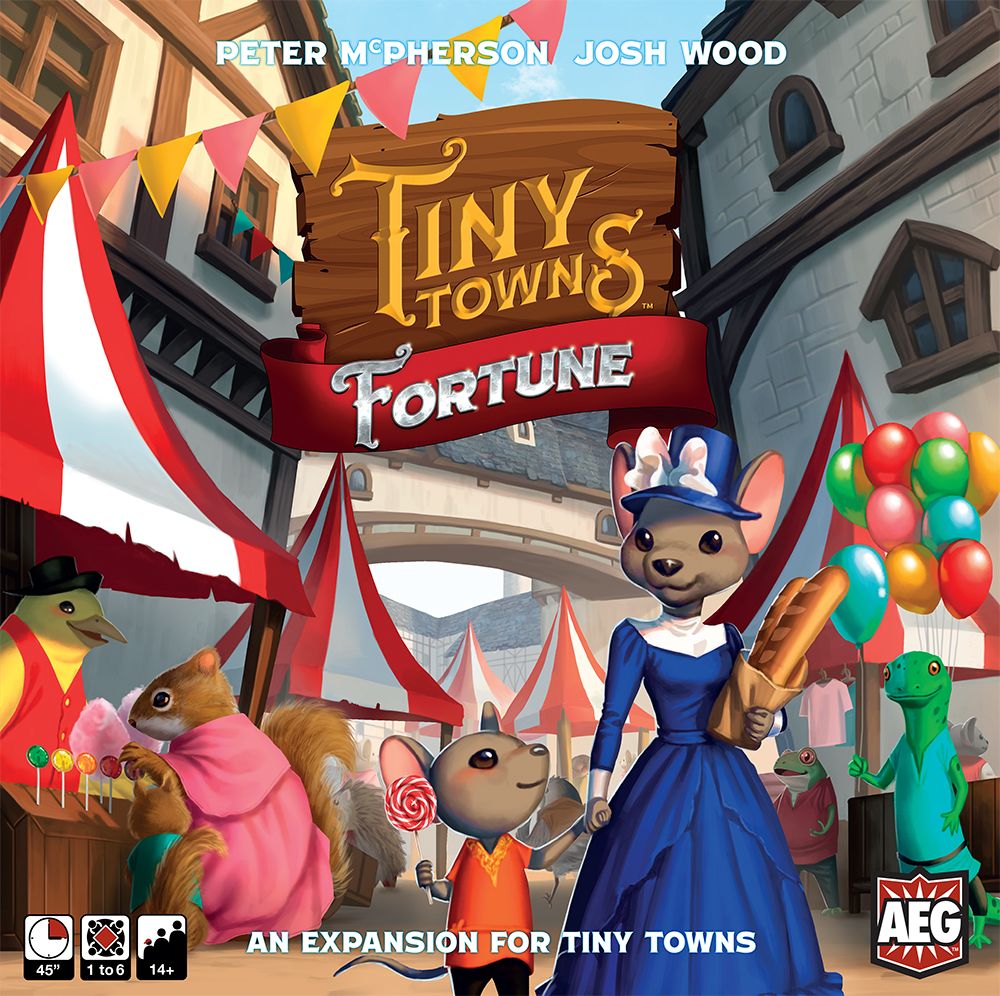
Tiny Towns: Fortune — How to Play
Alderac Entertainment Group, Broadway Toys LTD, GaGa Games · Board game · 2020What do you want to do now
Ask anything about Tiny Towns: Fortune: rules, setup, components, complexity, price, or whether it fits your group.
Video: How to Play
Start here, then follow the written guide
Step by step
Game Objective
In Tiny Towns: Fortune, the creatures of the forest have discovered the concept of "money" in the form of shiny metal bits called Quercs (commonly referred to as coins). Players aim to build their towns and manage these coins to gain advantages and increase the overall worth of their town. The goal is to accumulate the most points by the end of the game, with coins serving as both a resource for flexibility and a source of end-game points.
Setup
- Place the coins in a general supply accessible to all players.
- Each player receives a Chest board, which is placed next to their town.
- Separate the new Fortune Building and Monument cards by the symbols on their backs and shuffle them into the setup piles of cards from the base game. (For the best experience, it is recommended to use a maximum of 4 Fortune buildings, though more can be used).
- Follow the normal Tiny Towns setup rules.
Game Flow
The game progresses in rounds. Each round follows this specific sequence:
- The Master Builder names a type of resource.
- Resource Placement: All players must take a cube of the named resource and place it in an empty square in their town grid. Alternatively, a player may spend 1 coin to the general supply to place a different resource instead.
- Construction: Players may construct any buildings for which they have the matching resources in the correct shape. If constructing multiple buildings, they must be built one at a time, resolving each building's costs and effects separately in an order chosen by the player.
- Coin Gain: AFTER all buildings are constructed and effects are resolved, any player who constructed 2 or more buildings this round by removing resources (excluding construction via monument abilities) gains exactly 1 coin.
- Round End: A new round begins, and the Master Builder token passes to the player on the left.
Actions and How to Play
Gaining and Storing Coins
- Gaining: The primary method is constructing 2 or more buildings in a single round. Certain Building and Monument cards also allow players to gain coins.
- Storing: Players can store a maximum of 4 coins on their Chest board. If a player already has 4 coins, they cannot gain more unless a constructed Monument card provides an extra storage space.
Using Coins
- Resource Flexibility: A player can spend 1 coin to the general supply to place a different resource in their town than the one named by the Master Builder. This does not affect other players, and any number of players (except the Master Builder) may do this per round.
- Building Costs: Some buildings require coins as part of their construction cost. Even if a building is placed via monument abilities (like Architect’s Guild, Grove University, or Opaleye’s Watch), the coin construction cost must still be paid.
Specific Building and Monument Rules
- Root Cellar: At game end, you choose which rows or columns to spend coins to feed. You must spend coins to feed buildings if you can; you cannot hold onto coins if there are unfed buildings.
- Tithe Barn: A single building costs 1 coin to feed; 3 buildings cost 2 coins. If you lack enough coins, you choose which buildings remain unfed.
- Statue: A Statue being constructed counts toward the number of coins you have (e.g., building a third Statue grants 1 coin).
- Cathedral: A Cathedral adjacent to another Cathedral is worth 0. If you remove a Cathedral (due to lack of coins or choice) and construct a new building, you get that building's benefits.
- Parsonage: Worth 0 if not adjacent to a fed Cathedral. You only need 1 coin for each Cathedral in your town (you do not spend the coin).
- Jeweler: You must spend 1 coin if you have it. If you don't, all other players gain 1 coin at the end of the round.
- Teahouse: Does not count itself as a unique building type. The maximum gain from constructing a Teahouse is 3 coins.
- Museum: Regardless of the number of Museums, you may only return 1 resource to the supply for 1 coin per round.
- Oddity Shop: Instead of placing a resource on your board, you may place it on the Oddity Shop. The next Master Builder may take 1 resource from another player's Oddity Shop, place it on their board, and gain 1 coin before naming a resource.
- Masons’ Guild: You must spend the entire coin amount first, then construct buildings one at a time.
- Estival Festival: Cannot be constructed if you cannot spend 2 coins.
End of Game and Scoring
The game ends and is scored according to normal Tiny Towns rules, with the following additions:
- Leftover Coins: Each leftover coin is worth 1 point. (Note: Estival Festival makes leftover coins worth 2 points instead of 1).
- Feeding: Feeding buildings is resolved at the end of the game. Any coins required for feeding must be spent at game end. Players cannot keep coins if they have unfed buildings that could be fed.
Tips for Winning
- Strategic Delay: Because you only gain a coin for constructing 2 or more buildings in a single round, it is often better to wait and construct multiple buildings at once rather than building them immediately.
- Resource Management: Use the Oddity Shop to manage resources you don't need, though be aware that the next Master Builder can take those resources and gain a coin.
- Feeding Priority: Be mindful of the Root Cellar and Tithe Barn rules; ensure you have enough coins to feed your buildings to avoid losing points, as you are forced to spend coins to feed if you have them.
Rules manual
Official PDF file
