
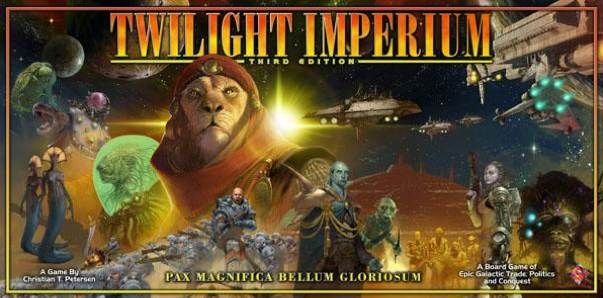
Twilight Imperium: Third Edition
Fantasy Flight Games · Board game · 2005Game Objective
Greetings, future galactic emperor! In Twilight Imperium: Third Edition, or simply TI, you and your friends (3 to 6 players) will dive into an epic saga of space conquest, trade, and intense politics. The ultimate goal is clear: claim the Imperial Throne on Mecatol Rex and guide your race to a new era of glory!
To win, you need to be the first to accumulate 10 victory points. These points are earned by fulfilling the requirements of Objective Cards, both public and secret, expanding your empire, forging alliances, and dominating the Galactic Council. The game ends as soon as a player reaches 10 victory points or when a specific end-game condition is triggered.
Preparation (Setup)
Let's set up the table for your intergalactic journey! Follow these steps to prepare TI:
- Choose your Race: Separate the 10 Home Systems from the other hexagonal tiles. Shuffle them, and each player draws one randomly. This defines your race! Take the corresponding Race Sheet, Control Markers, Trade Cards, and Command Markers for your race.
- Choose your Color: Each player chooses one of the six available colors and takes the plastic units (Dreadnoughts, Carriers, Cruisers, Destroyers, War Suns, Ground Forces, Fighters, Planetary Defense Systems - PDS, and Space Docks) and the Technology Deck of that color.
- Common Play Area: Designate a central space on the table as the "common play area." Shuffle the Action Card Deck and the Political Card Deck, placing them separately in this area. Also add the Supplementary Fighter Tokens and Ground Force Tokens.
- Planet Cards: Each player takes the Planet Cards that correspond to the planets in their Home System and places them face up in their play area. The remaining Planet Cards form the neutral Planet Deck in the common area.
- Trade Reserve: Place all Trade Goods Markers in a single pile in the common play area.
- Strategy Cards: Arrange the 8 Strategy Cards side by side, in numerical order, with the "active" side up, in the common play area.
- Objective Deck: Prepare the Public Objective Deck and distribute the Secret Objective Cards:
- Shuffle the 10 Secret Objective Cards and deal one face down to each player. Each player reads theirs and keeps it hidden. Any remaining cards are returned to the box.
- Take the 10 Public Objective Stage II Cards, remove the "Game End" card. Shuffle the remaining 9 and draw 3 randomly (hidden). Shuffle the "Game End" card with these 3. Place these 4 cards face down in a pile. Any remaining cards are returned to the box.
- Shuffle the 10 Public Objective Stage I Cards and draw 6 randomly. Place these 6 cards on top of the 4 Stage II cards, forming the Public Objective Deck with 10 cards.
- Victory Point Track: Place the Victory Point Track in the common area and a Control Marker from each player on the "0" space.
- Create the Galaxy:
- Find the Mecatol Rex system and place it in the center of the table.
- Randomly determine the "first player" and give them the Speaker Token.
- Shuffle the remaining 32 systems, remove 2 randomly (back to the box unseen), and deal 5 systems, face down, to each player. Players may look, but not show, their systems.
- The first player chooses a side of Mecatol Rex and places their Home System a hand's width away, in a straight line. The other players do the same, clockwise.
- Players, clockwise, begin building the galaxy, placing one system at a time, face up, adjacent to Mecatol Rex, forming rings (first ring, then the second, and finally the third). A Special System (red border) cannot be adjacent to another Special System, unless there is no other option. The placement order changes to counter-clockwise after a full round of placement, and then returns to clockwise.
- Connect your Home System to the galaxy when the correct space (3 systems away from Mecatol Rex) is available. This is automatic and does not cost a turn.
- Starting Units and Command Markers: Place your "organizational units" (Space Docks, Ground Forces, PDS) in your Home System, as indicated on your Race Sheet. Take your Starting Technologies and place them face up. Distribute your initial Command Markers as follows: 2 in the Strategy Allocation area, 3 in the Command Reserve area, and 3 in the Fleet Reserve area (with the "Fleet" side up).
Done! The galaxy is set up and your empire is ready for action!
The Game Turn
TI is played in rounds, and each round is divided into three main phases:
- The Strategy Phase
- The Action Phase
- The Status Phase
These phases repeat until a player declares victory. Victory points are usually claimed in the Status Phase, by fulfilling the requirements of the Public and Secret Objective Cards.
The Strategy Phase
This is the phase where you plan your moves for the round. At the beginning, there are 8 Strategy Cards available in the common play area: War, Politics, Trade, Initiative, Imperial, Logistics, Diplomacy, and Technology.
- The player who controls the Speaker Token (the "Speaker") chooses the first Strategy Card.
- The other players, clockwise from the Speaker, choose one of the remaining Strategy Cards. Each chosen card is placed in front of the player, with the "active" side up, and is no longer available.
- The chosen Strategy Card not only grants a special ability for the next Action Phase, but also determines the play order (indicated by the number on the card).
- After all players have chosen a card, two Strategy Cards remain in the common area. The Speaker places a Bonus Marker on each of them. If a card is not chosen for several rounds, it accumulates more Bonus Markers, making it more attractive.
- When a player chooses a Strategy Card with Bonus Markers, they can immediately exchange each marker for a Trade Good or an additional Command Marker, placing it on their Race Sheet.
- The Speaker Token remains with the player who last claimed it until another player chooses the Initiative card in a future strategy phase.
The Action Phase
The heart of TI! This is where the magic happens: you use the abilities of your Strategy Cards, build units, conquer planets, and move your fleets into battle.
The Action Phase is resolved in player turns, following the play order determined by the Strategy Cards. Each player performs a single action per turn, and the game continues until all players have "passed."
When it's your turn, you must perform one of the following actions:
- Strategic Action
- Tactical Action
- Transfer Action
- Pass
Strategic Action
Every player must perform a Strategic Action at some point in the Action Phase (except the player with the Initiative card, who does not have a Strategic Action of their own).
- When choosing this action, you read and resolve the Primary Ability of your Strategy Card.
- Then, the other players, clockwise, can spend a Command Marker from their Strategy Allocation area to perform the Secondary Ability of the same card. (Exception: Logistics does not require spending a Command Marker for its Secondary Ability). The active player can never perform the Secondary Ability of their own card.
- After everyone has completed (or passed on) the Secondary Ability, your Strategy Card is flipped to the "inactive" side and your action ends.
- You can only perform one Strategic Action per round and perform a Secondary Ability once (but can participate in several, if you have enough Command Markers).
Tactical Action
This is the action for moving your fleets, engaging in battles, and building new units. The Tactical Action follows the "Activation Sequence":
- Activate a System: Take a Command Marker from your Command Reserve and place it in a system. You cannot activate a system that already contains one of your own Command Markers, but you can activate one that has markers from other players. A system with your Command Marker is considered "activated" by you.
- Move Ships to the System: Move your "friendly" ships (your own ships) to the activated system, within the movement range of each ship (indicated on your Race Sheet).
- Carriers and War Suns can transport Ground Forces and PDS.
- Ships cannot move through systems occupied by enemy ships (except Fighters).
- Ships in a system already activated by you this round cannot move.
- All ships that move must end their movement in the activated system.
- PDS Fire: Enemy PDS within range can fire at your fleets in the activated system. Then, your PDS within range can fire at enemy ships.
- Space Battles: If you moved ships into a system with enemy ships, a Space Battle is initiated. You are the attacker, the opponent is the defender. The battle continues until only one player has ships in the system.
- Planetary Landings: After any space battle, you can land Ground Forces and PDS from your Carriers on planets in the activated system.
- Friendly Landing: On planets under your control.
- Neutral Landing: On planets without control. Land at least one Ground Force, take the corresponding Planet Card and place it "exhausted" (face down) in your play area. PDS alone cannot take planets.
- Hostile Landing (Invasion): On planets with enemy Ground Forces, resulting in Invasion Combat. If there are no enemy Ground Forces, the planet is taken without resistance: remove the opponent's Control Marker and take the Planet Card, placing it exhausted.
- Invasion Combat: If there are Ground Forces from two different players on a planet, Invasion Combat occurs. If there are multiple combats, you decide the order. Invading PDS do not participate in combat and are destroyed if all invading Ground Forces are destroyed.
- Produce Units: As a final step, you can produce new units in one or more friendly Space Docks in the activated system. It is also possible to build a new Space Dock on an eligible planet under your control.
After resolving all steps of the Activation Sequence, your Tactical Action ends.
Transfer Action
An action to reorganize your units between adjacent systems. The Transfer Action follows the "Transfer Sequence":
- Activate Two Systems: Spend one Command Marker to activate a system. Spend another Command Marker (from your reinforcements) to activate an adjacent system. Both systems must contain at least one of your units and no enemy units.
- Movement between Systems: Move friendly ships between the two activated systems. Fighters, PDS, and Ground Forces must be transported by Carriers/War Suns.
- PDS Fire: Enemy PDS within range can fire at your fleets in the activated systems. PDS within range of both activated systems can fire from only one of them.
- Planetary Landings: Land Ground Forces and PDS from Carriers on friendly planets in the activated systems. It is not possible to land on neutral or enemy planets with this action.
- Production (in one system): Produce units in your Space Docks in one of the activated systems (not both).
Pass
If you do not wish to perform any more actions, you can choose to "pass." You can only pass if you have already performed your Strategic Action (except the player with the Initiative card). Once you pass, you can no longer perform actions this round. On your turn, you are simply skipped. The exception is that players who have passed can still perform the Secondary Ability of other Strategy Cards, if they have Command Markers.
The Status Phase
After all players have passed, the Action Phase ends and the Status Phase begins. This is where victory points are checked and the game can end.
Victory points are usually claimed during this phase, when players fulfill the requirements printed on the Public and Secret Objective Cards. If a player reaches 10 victory points or if an end-game condition is triggered, the game ends immediately.
Game End and Scoring
The game of Twilight Imperium ends in two ways:
- When a player reaches 10 victory points.
- Immediately after any other end-game condition applies (such as the revelation of the "Game End" card in the Objective Deck).
In English
-
 Learn to play in 32 minutes
-
 2GASCB - Twilight Imperium Tutorial
-
 Twilight Imperium Walkthrough part 1
-
 Twilight Imperium Online Concept Part 2
-
 Twilight Imperium Online Concept Part 1
-
 Twilight Imperium Online Concept Part 3
-
 How to play Twilight Imperium (Third Edition) - Teach The Table
-
 TI3 Epic Tutorial Part 1
-
 TI3 - 2 PLAYER VARIANT!
-
 Twilight Imperium Walkthrough part 2
-
 Twilight Imperium 3 Tutorial
-
 Twilight Imperium Walkthrough part 3

