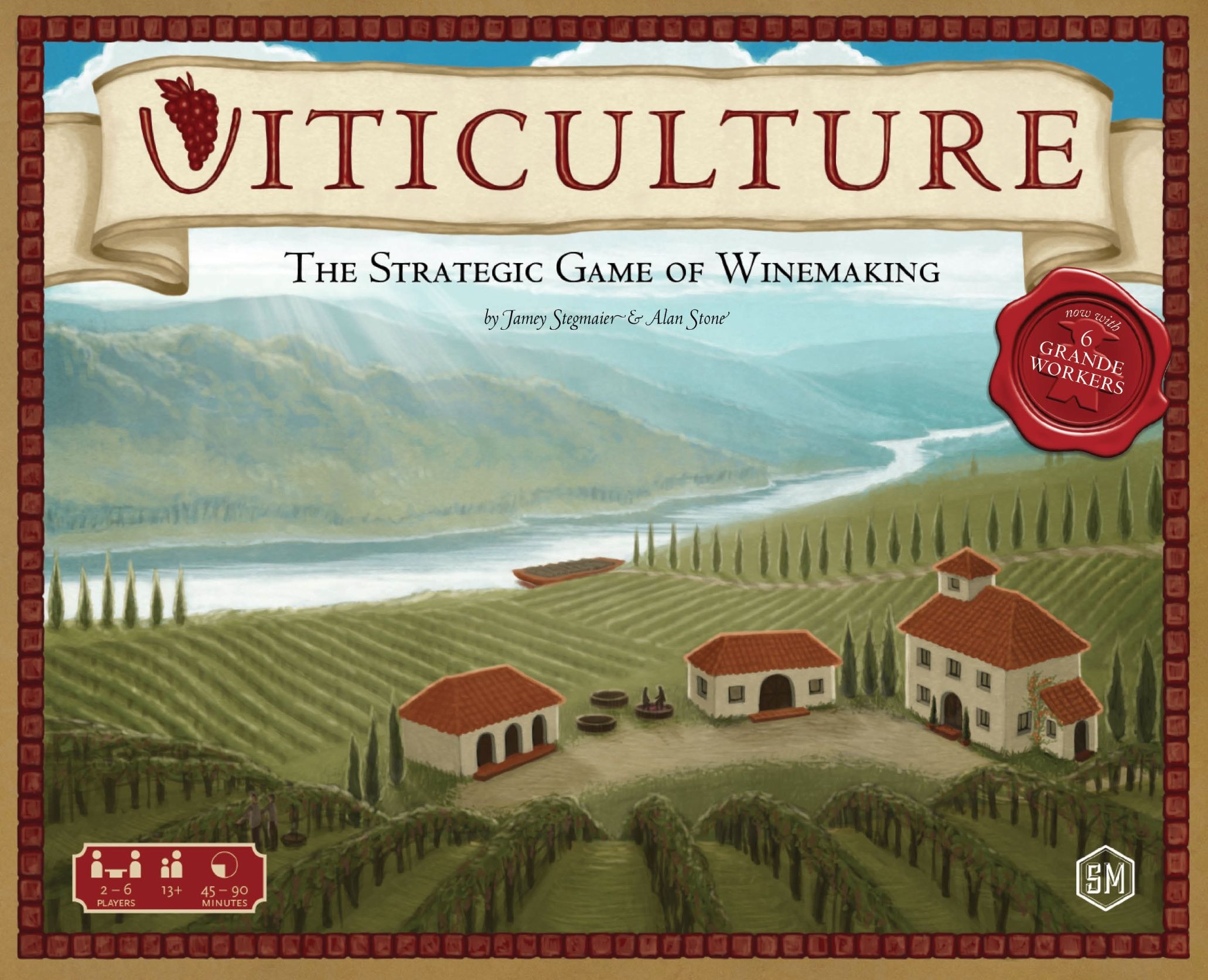
How to Play Viticulture
Stonemaier Games, One Moment Games, Regatul Jocurilor · Board game · 2013What do you want to do now
Ask anything about Viticulture: rules, setup, components, complexity, price, or whether it fits your group.
Video: How to Play
Start here, then follow the written guide
Step by step
Game Objective: Become the Greatest Vintner in Tuscany!
Welcome to sunny Tuscany, where the aroma of grapes and the promise of fine wines hang in the air! In Viticulture, you and your friends will delve into the challenging and rewarding world of winemaking. Your goal is to transform a small vineyard into a renowned winery by planting vines, harvesting grapes, aging wines, and, of course, fulfilling merchant orders.
The goal is simple, but the journey is complex: be the first to reach 20 victory points, which represent your reputation as a winery owner. The game continues until the end of the year in which a player reaches or exceeds 20 points. At the end of that year, whoever has the most victory points (up to 25!) will be crowned the master vintner of Tuscany!
Preparation (Setup): Setting Up Your Vineyard
Let's set the table and prepare your vineyards for harvest! Follow these steps to begin:
- Main Board and Vineyard Boards: Place the game board in the center of the table. Each player takes a vineyard mat (the side with labels is great for beginners!).
- Starting Tokens:
- Each player places their rooster token above the Wake-Up Chart.
- Your cork token goes on the starting space of the Victory Point Track.
- Your wine bottle token is placed in the middle of the Residual Payment Tracker.
- Starting Resources per Player: Each player starts with:
- A crush pad, a small cellar, and three empty fields (all on your vineyard mat).
- 3 lira (coins).
- 1 Pinot vine card (from the green deck) in hand.
- 1 random summer visitor card (from the yellow deck) in hand.
- 2 workers (meeples of your color).
- 1 grande worker (large meeple of your color).
- Card Decks:
- Remove the Pinot vine cards from the green deck (one per player) and distribute them. Then, shuffle the four card decks (green vine, purple wine order, yellow summer visitor, and blue winter visitor) and place them in the indicated spaces on the board.
- Grape and Wine Tokens: Keep the glass grape and wine tokens near the board, forming a general supply.
- Structure Tokens: Each player takes their 8 wooden structure tokens of their color.
- First Player: For the first round, take all players' rooster tokens, shake them in your hand, and randomly choose one. The player of the chosen color will be the first player and receives the first player token (grape cluster).
Ready! Your vineyard is waiting to be cultivated!
The Game Turn: A Year in the Vineyard
A year in Viticulture is divided into four seasons, each with its own actions and challenges. Each worker can only be used once per year, so plan carefully!
1. Spring: The Wake-Up Order
Spring is the planning season! Starting with the first player and proceeding clockwise, each player chooses the order in which their workers will "wake up" for the year, placing their rooster token on an unoccupied space on the Wake-Up Chart, on the left side of the board.
- Strategic Choice: Space 1 is the earliest, 7 the latest. The earlier you wake up, the earlier you act in subsequent seasons. However, waking up later offers increasing bonuses!
- Wake-Up Bonuses:
- Time 1: No bonus
- Time 2: Draw 1 vine card
- Time 3: Draw 1 wine order card
- Time 4: Gain 1 lira
- Time 5: Draw 1 visitor card (summer or winter)
- Time 6: Gain 1 victory point
- Time 7: Gain the temporary worker for the year (acts as a normal worker)
After all players have placed their roosters, the chart will show the action order for the rest of the year.
2. Summer: Expanding the Vineyard
In summer, players, in the order determined by the Wake-Up Chart, place their workers on yellow (summer) action spaces on the board and immediately perform the action. Remember:
- Each worker can only be used once per year.
- You must perform the action when placing the worker (e.g., if you choose "Sell Grapes," you must sell at least 1 grape).
- The grande worker can be placed on an already occupied action space, but you do not gain the bonus for that space.
- Action Spaces: In 2-player games, only the leftmost action space is available. For 3-4 players, the two leftmost spaces. For 5-6 players, all three spaces are available.
- Bonuses: Many action spaces have an optional bonus. You can take it if you place a worker on the space with the bonus icon and complete the action.
- Pass: If a player passes in summer, they cannot place any more workers until the start of winter.
Some important summer actions:
- Sell Grapes: Sell any number of grape tokens (at least 1) from your crush pad for the indicated price.
- Draw a Vine Card: Draw 1 vine card.
- Build a Structure: Build an unbuilt structure on your vineyard mat, paying the cost. You can only have one of each structure.
- Give a Vineyard Tour: Collect 2 lira.
- Play a Summer Visitor Card: Play a summer visitor card from your hand and resolve its effect.
- Plant a Vine: Plant a vine card in an empty field or stack it on an already planted one (maximum value of 6 per field).
- Gain 1 Lira: Place a worker on the cart at the bottom of the board to gain 1 lira. Multiple workers can use this space.
3. Autumn: Useful Visitors
In autumn, in the order of the Wake-Up Chart, each player draws one summer or winter visitor card and adds it to their hand. This action does not use workers.
- If you have built the Cottage structure, you can draw an extra visitor card (summer or winter). You must draw both cards at the same time.
4. Winter: Harvest and Production
In winter, players continue in the order of the Wake-Up Chart, placing their remaining workers on the blue (winter) action spaces. The worker placement rules are the same as in summer.
Some important winter actions:
- Harvest a Field: Choose a field and add grape tokens to your crush pad based on the yield of the planted vines. Each field can only be harvested once per year. If a grape icon already has a token, you must devalue the grape to the next lowest available icon.
- Gain 1 Lira: Just like in summer, you can use the cart space.
- Spend Lira to Train a New Worker: Pay 4 lira to train a new worker. They will only be active in the following year. You can have a maximum of 5 workers and 1 grande worker (not counting the temporary one).
- Draw a Wine Order Card: Draw 1 wine order card.
- Make Up to Two Wine Tokens: Convert grapes from your crush pad into wine tokens in your cellar.
- Red/White Wine: Move 1 grape token to the corresponding space in the cellar.
- Rosé (Blush): Combine 1 red grape and 1 white grape to make 1 rosé wine token with the combined value of the grapes. Requires a medium cellar.
- Sparkling: Combine 2 red grapes and 1 white grape to make 1 sparkling wine token with the combined value of the grapes. Requires a large cellar.
Attention: You need the appropriate cellars (medium for wines of value 4-6 and rosé; large for wines of value 7-9 and sparkling) to store and create higher-value wines.
- Play a Winter Visitor Card: Play a winter visitor card from your hand and resolve its effect.
- Fulfill a Wine Order: Fulfill the requirements of a wine order card, discard it, gain the victory points, and move your wine bottle token on the Residual Payment Tracker. You can use higher-value wines, but the difference is lost.
End of Game and Scoring
The game ends at the end of the year in which a player reaches or exceeds 20 victory points. The player with the most victory points (up to a maximum of 25) wins!
End of Year: Vineyard Maintenance
At the end of each year, players perform the following actions:
- Age Grapes and Wines: Increase the value of all grape tokens in your crush pad and wine in your cellar by 1. The maximum value is 9. Wines only age above 3 if you have the medium cellar, and above 6 if you have the large cellar.
- Return Workers: All workers (including the temporary one) return to their respective players.
- Collect Residual Payments: Each player receives lira equal to their position on the Residual Payment Tracker (maximum of 5 lira per year).
- Discard Cards: Each player must discard cards from their hand until they have a maximum of 7 cards.
- Rotate First Player Token: The first player token is passed to the player on the left (counter-clockwise). All rooster tokens are removed from the Wake-Up Chart.
Tie-breaking Criteria:
In case of a tie in victory points, the tie-breaking criteria are (in this order):
- Most lira.
- Total value of wine in the cellar.
- Total value of grapes in the crush pad.
Tips for Winning: Be a Shrewd Vintner!
To excel in Viticulture, it takes more than just luck. Here are some tips to get started on the right foot:
- Plan Your Wake-Up Order: The choice in spring is crucial! If you desperately need a specific action or a wake-up bonus, it's worth waking up later. But if initiative is key for you, be the first to act. Think about what your opponents might need and try to anticipate.
- Synchronize Vines and Wine Orders: A smart player maximizes the value of their vine cards by matching them with complementary wine orders. Don't plant vines randomly; keep in mind the types and values of wine you'll need to fulfill the most lucrative orders.
- Invest in Key Structures: Structures like the Medium Cellar and Large Cellar are essential for producing higher-value wines, rosés, and sparkling wines, which generally yield more points. The Cottage is also great for having more visitor options. Prioritize structures that boost your wine production strategy.
With these tips and good planning, you'll be on your way to building the most prestigious vineyard in Tuscany! Good luck and happy harvests!
More videos
More rules explanations from the community
In English
-
 Viticulture - How to play Solo with Automa Part 1
-
 Viticulture Summary, Strategy, and Highlights
-
 How to play Viticulture
-
 Viticulture - How to Play Solo with Automa Part 3
-
 Viticulture - How to play Solo with Automa Part 2
-
 Two-Player Gameplay Walk-Through
-
 Viticulture - How to Play Solo with Automa Part 4 - Final Episode
-
 The Teach "Viticulture"
Rules manual
Official PDF file
Frequently Asked Questions
Quick answers about the rules
What is the objective of Viticulture?
How do you set up Viticulture?
How does Viticulture end, and how do you score?
What are some tips for winning Viticulture?
Expansions
Published additional content
 Tuscany & Euphoria Crossover Structures
 Viticulture World: Cooperative Expansion
 Viticulture World: First Game Continent Promo Pack
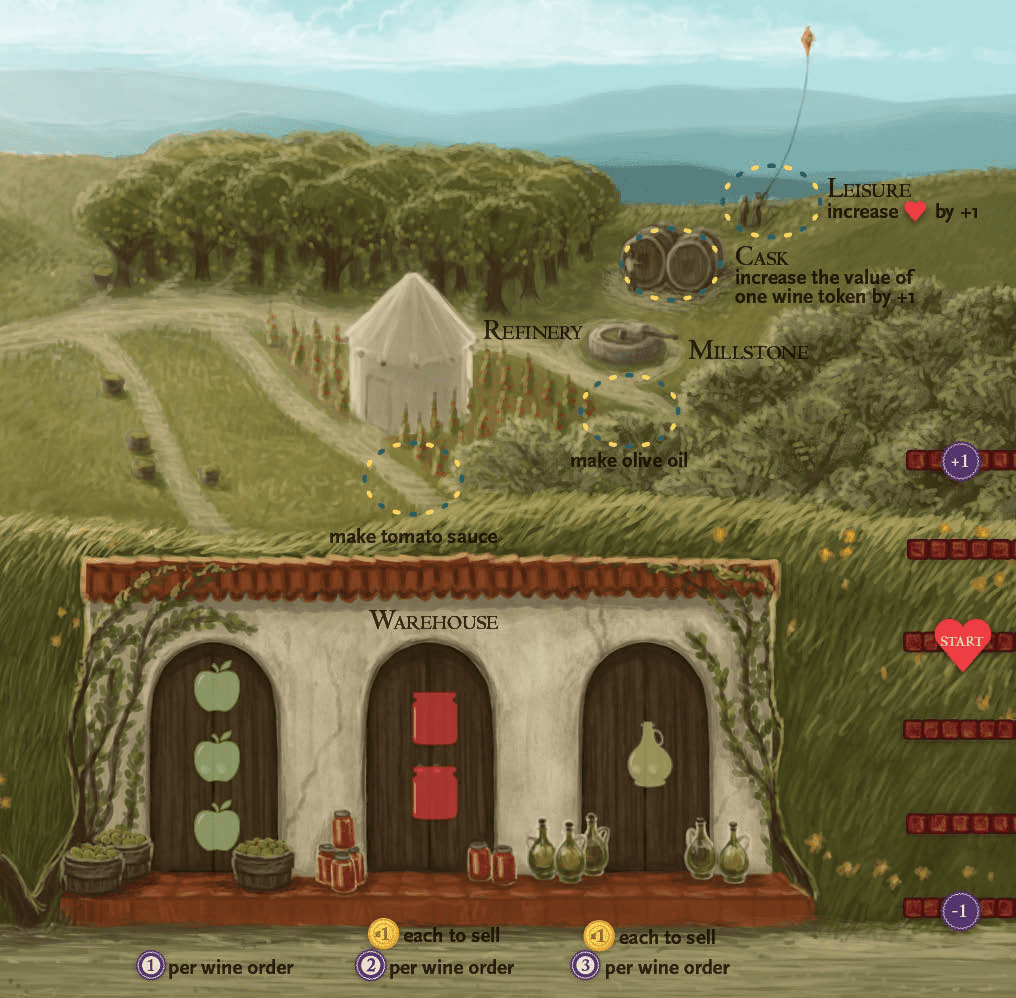 Viticulture: Arboriculture and Formaggio Expansions
 Viticulture: Bordeaux Expansion
 Viticulture: Kickstarter Promotional Cards
 Viticulture: Moor Visitors Expansion
 Viticulture: Tuscany
 Viticulture: Tuscany – Special Worker Promo Cards
 Viticulture: Tuscany Essential Edition
 Viticulture: Visit from the Rhine Valley
Other Games You'll Like
Based on mechanics and theme