
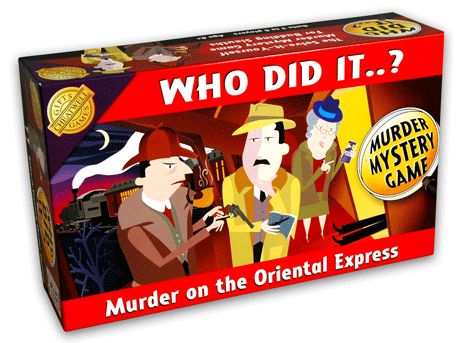
Who Did It...?
Cheatwell Games · Board game · 2004Game Objective
In Who Did It?, a big poop was found in the middle of the room and one of the pets was responsible. The objective is to prove the innocence of your 6 pets by getting rid of all the cards in your hand. To do this, you need to rely on your memory and quick reaction to avoid accusing a pet that has already been cleared. Each round, the owner of the pet declared guilty receives a poop token. At the end of the game, the player with the fewest poop tokens wins.
Setup
- Each player chooses a color and receives the corresponding 6 pet cards in their hand. Unused colors should be set aside.
- Separate the poop tokens and place them aside. They will be used to count the pets that have been declared guilty.
With this, you'll be ready to find out who made a mess in the room!
Gameplay Flow
The game proceeds in rounds. The youngest player starts the first round.
Start of Turn
The youngest player starts by placing one of their pets in the middle of the table and making an accusation. For example: "It wasn't my turtle that made a mess in the room, but I think it was a hamster."
Other Players' Actions
All other players must then rush to find their hamster cards and be the first to place it on top of the turtle card on the table, proving their hamster's innocence.
Continuing the Accusation
The first player to place their hamster card will then pass the blame and accuse another pet of making a mess in the room, saying, for example: "It wasn't my hamster that made a mess in the room, I think it was a fish." Everyone else rushes to find their fish card, play it first to prove their innocence, and choose another pet to accuse.
Turn Restrictions
The player who just accused a pet cannot play a card during the same turn.
End of a Round
A round ends when a pet is declared guilty. A pet is declared guilty when its owner cannot pass the blame to another player's pet, and the blame falls on their own pet(s). This can happen in two ways:
- Scenario 1: If a player tries to pass the blame to another pet, but no one else has that card in their hand (meaning all have already cleared their pets of that species), then there is no remaining pet to blame, and the pet of the card that was just played is guilty! Everyone must reveal their hands as proof, and the owner of the guilty pet receives a poop token.
- Scenario 2: When only one player has one or more cards remaining (meaning all other players have already gotten rid of all their cards), this player is the owner of the guilty pet, as there is no one else to receive the blame. Give them a poop token.
Actions and How to Play
The game unfolds through accusations and exonerations of pets.
Making the First Accusation
The youngest player starts by placing one of their pets in the middle of the table and saying, for example: "It wasn't my turtle that made a mess in the room, but I think it was a hamster."
Responding to an Accusation (Proving Innocence)
All other players must rush to find their accused pet cards and be the first to place it on top of the card on the table. By doing so, they prove their pet's innocence.
Continuing the Accusation
The first player to place their pet card to prove innocence then passes the blame and accuses another pet of making a mess in the room, saying, for example: "It wasn't my hamster that made a mess in the room, I think it was a fish."
Playing the Last Card
If a player plays their last card and manages to pass the blame to another pet, the game continues without them for the rest of the round; all their pets are considered innocent.
Accusing the Same Type of Pet
It is permissible to clear your pet of blame and then accuse another player's same type of pet. For example: "It wasn't my cat that made a mess in the room, but I think it was a cat."
End of Game and Scoring
The game ends as soon as a player has received 3 poop tokens.
Winning Condition
The player with the fewest poop tokens wins. If there is a tie, those players share the victory.
Tips for Winning
- Remember which pets have already been cleared so you don't accuse a pet that is already free of blame.
- Act quickly to be the first to play the right card and pass the blame to another player.
- It is permissible to accuse another player's same type of pet, even if you have just proven your own's innocence.

