
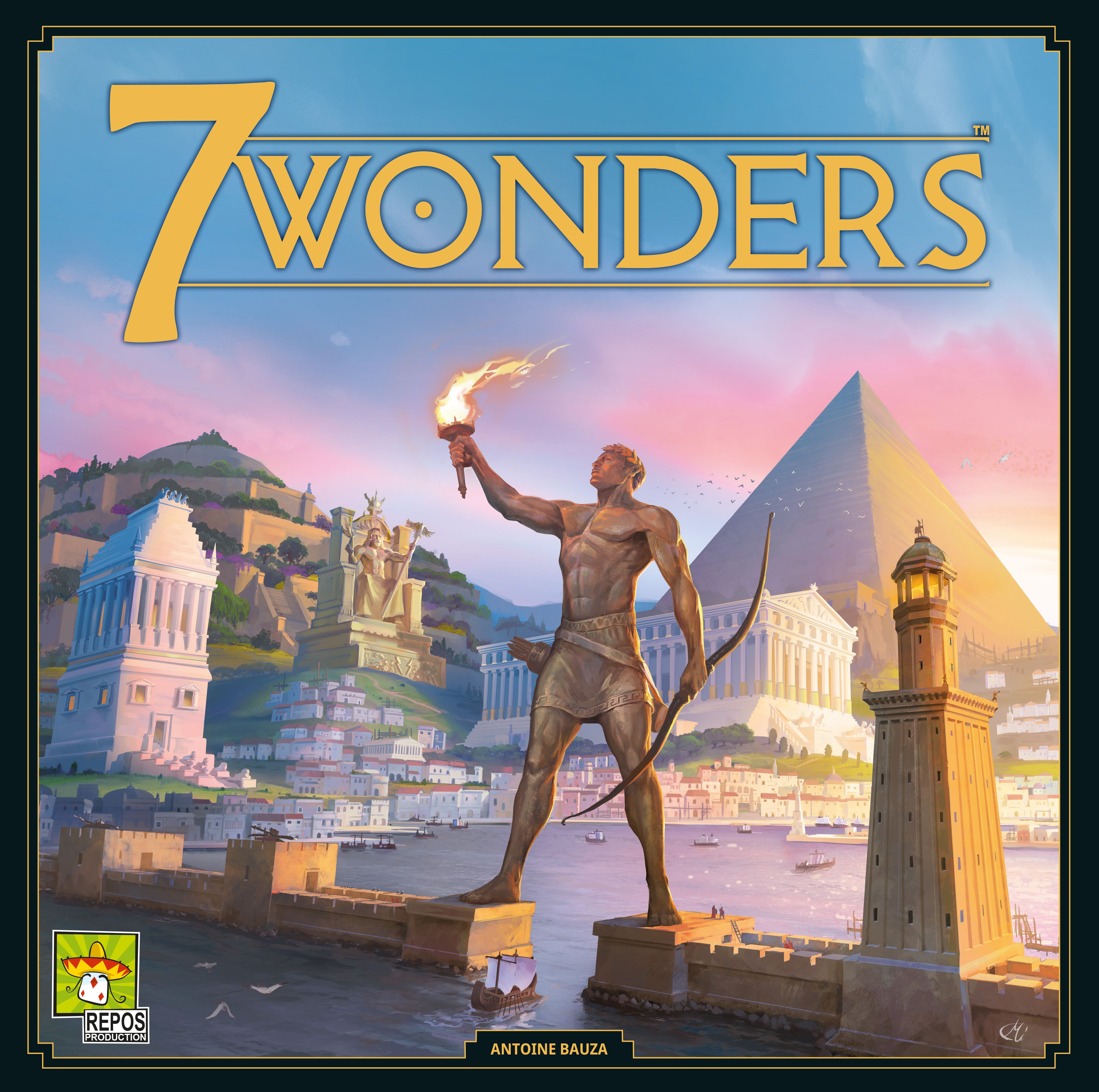
7 Wonders (Second Edition) — How to Play
Repos Production, ADC Blackfire Entertainment, Galápagos Jogos · Board game · 2020What do you want to do now
Ask anything about 7 Wonders (Second Edition): rules, setup, components, complexity, price, or whether it fits your group.
Video: How to Play
Start here, then follow the written guide
Step by step
Game Objective
In 7 Wonders: Second Edition, you take on the role of leader of one of the seven greatest cities of Antiquity! Your objective is to guide your civilization to glory, developing your city through scientific discoveries, military conquests, trade agreements, and prestigious structures. Over three Ages, you will build various structures and your own Wonder, always keeping an eye on your neighbors, who have similar ambitions.
At the end of the three Ages, the player with the highest victory point score, obtained through their City, Wonder, military prowess, and Treasury, will be the grand winner and will have their Wonder transcending the next millennium!
Preparation (Setup)
Let's set up the table and start building your civilization! Follow these simple steps to prepare your game of 7 Wonders:
- Each player takes a random Wonder board and places it in front of them. For the first few games, it is recommended to use the Day side. In future games, feel free to mix the sides or even choose the boards.
- Take 3 Coins (worth 1) and place them on your Wonder board. This is your starting Treasury. The remaining Coins form the Coin reserve in the center of the table.
- Place all Military Conflict tokens in the center of the table, forming the token reserve.
- Prepare the Age cards:
- Separate the Age cards into three decks: Age I, Age II, and Age III.
- For each Age, separate the cards according to the minimum number of players required. Keep only the cards that have a number less than or equal to the number of players in the game. The remaining cards are returned to the box.
- In the Age III deck, separate the Purple cards. Randomly draw a number of these cards equivalent to the number of players +2 and add them face down to the other Age III cards. The remaining Purple cards are returned to the box.
- Shuffle each Age deck separately and place them face down in the center of the table.
- Return all other components (score pad, effect description booklets, card list, and chaining list) to the box, as they are not used in the initial setup.
The Game Turn
A game of 7 Wonders is divided into three rounds, called Ages (Age I, Age II, and Age III). Each Age is played similarly and consists of 6 turns. The game is simultaneous, so everyone plays at the same time!
Age Overview
At the beginning of each Age, the corresponding deck is dealt, and each player receives 7 Age cards face down, forming their starting hand.
Each turn consists of three stages, which occur in the following order:
- Choose a card: Analyze the cards in your hand without showing them to other players. Choose 1 of these cards and place it face down in front of you. The remaining cards are set aside.
- Play the card: When everyone has chosen a card, they are revealed and played simultaneously. You can use your chosen card to complete a single action from the following:
- Build the Structure of your card: Pay the costs indicated on the card and place it face up above your Wonder board. The structure will remain in your City until the end of the game. Remember: you cannot have two cards with the same name in your City.
- Build a stage of your Wonder: Pay only the cost indicated on your Wonder board for the stage you wish to build. Place the chosen card face down under your Wonder board, covering half of it. The effect of this stage becomes available to you until the end of the game. Stages must be built from left to right (stage 1 before 2, and 2 before 3). Building stages of your Wonder is optional.
- Sell the card: To gain Coins, discard your card face down onto the discard pile in the center of the table and take 3 Coins from the reserve, adding them to your Treasury.
Tip for beginners: In the first few games, it is recommended that players pay attention to each other's actions, playing one after the other, to familiarize themselves with the game.
- Pass your hand: After all players have completed their actions, take the cards you did not choose and pass them to your left neighbor (during Ages I and III) or to your right neighbor (during Age II). The passing direction is indicated on the back of the Age cards. You will receive a new hand of cards from your neighbor for the next turn.
Construction in 7 Wonders
To build Structures or Wonder stages, you must pay the corresponding construction cost, indicated in the cost zone of the cards or on each Wonder stage. The types of cost are:
- No cost: If the cost zone is empty, the card is free.
- Coin cost: Some cards require Coins. Pay the indicated value from your Treasury to the reserve.
- Resource cost: Many cards and Wonder stages require one or more resources. You can use resources produced by your City and/or buy resources from your neighbors.
- Use resources produced by your City: You produce one resource per resource symbol displayed in your City (initial resource on the Wonder board, Brown cards, Gray cards, and Yellow cards, and certain Wonder stages). Each resource symbol can only be used once per turn.
- Buy resources from a neighboring City: If your City does not produce the necessary resources, you can buy them from your neighbors. For each resource purchased, pay 2 Coins to the owner of the resource. The neighbor keeps the card and can still use the resource. You can buy initial resources, from Brown cards and Gray cards from your neighbors. It is not possible to buy resources from Yellow cards or Wonder stages from neighbors.
- No cost with chaining: From Age II onwards, some cards can be built for free if you have already built a card with the same chaining symbol in the upper right corner. Otherwise, you can still build it by paying its resource cost.
Sixth and Last Turn
On the sixth and last turn of each Age, you will receive a hand of 2 cards. Choose 1 of these cards and discard the other face down onto the discard pile (without gaining Coins). Play your sixth and last card normally.
Military Conflict Resolution
Each Age ends with Military Conflict Resolution. Count all military symbols on your built cards and on your Wonder board to determine your military strength. Compare your strength with that of each neighbor:
- If military strengths are equal, no one takes a token.
- If your military strength is lower, take a Military Defeat token (-1 victory point).
- If your military strength is higher, take the Military Victory token corresponding to the current Age (+1, +3, or +5 victory points, depending on the Age).
After Conflict Resolution, the current Age ends, and you proceed to the next Age.
End of Game and Scoring
The game ends at the end of Age III, after Military Conflict Resolution. Proceed to tally victory points using the score pad. The player with the highest score wins the game. In case of a tie, the player with the largest Treasury wins. If the tie persists, all tied players share the victory.
Tallying Victory Points
Use the score pad to sum your points in the following categories:
- Wonder Board: Sum the victory points from built stages of your Wonder.
- Treasury: Receive 1 victory point for each complete set of 3 Coins in your Treasury.
- Military Conflicts: Sum the value of all your Military Defeat and Victory tokens (the total can be negative).
- Blue Cards: Sum the victory points from Blue cards in your City.
- Yellow Cards: Sum any victory points from Yellow cards in your City, as per the effects described on the cards.
- Green Cards (Scientific Structures): Count all science symbols in your City and on built stages of your Wonder. These symbols grant victory points in two ways that are summed together:
- Identical symbols: Check how many identical symbols you have for each type of symbol and consult the scoring table (1 symbol = 1 point, 2 = 4, 3 = 9, 4 = 16, 5 = 25, 6 = 36).
- Sets of 3 different symbols: For each complete set of 3 different science symbols, receive 7 victory points.
- Purple Cards (Guilds): Sum the victory points from Purple cards in your City, as per the effects described on the cards.
Tips for Winning
To start your journey in 7 Wonders on the right foot, here are some tips:
- Keep an eye on resources: Resource production and purchase are crucial. Make sure your City can produce the resources you need, or be ready to buy them from your neighbors. Remember that resources from Yellow cards and Wonder stages from neighbors cannot be bought!
- Plan your chainings: Cards with chainings can offer valuable free constructions from Age II onwards. Pay attention to the chaining symbols on the cards you build in Age I, as they can give you a huge advantage in future Ages.
- Don't underestimate the military: Military Conflict Resolution at the end of each Age can yield many victory points or painful losses. Evaluate the military strength of your neighbors and decide if it's worth investing in Red cards to secure victories or avoid defeats.
More videos
More rules explanations from the community
In English
-
 New edition of 7 Wonders all the changes
-
 How to Play and Tips for 7 Wonders 2 Edition
-
 7 WONDERS TUTORIAL VIDEO | Learn how to play 7 Wonders in 10 minutes!
-
 7 Wonders - How to play - Board game Arena (BGA) teach
-
 How to win - MORE Strategy tips from the World Series
-
 BoLS Overview | 7 Wonders | Asmodee
Rules manual
Official PDF file
