
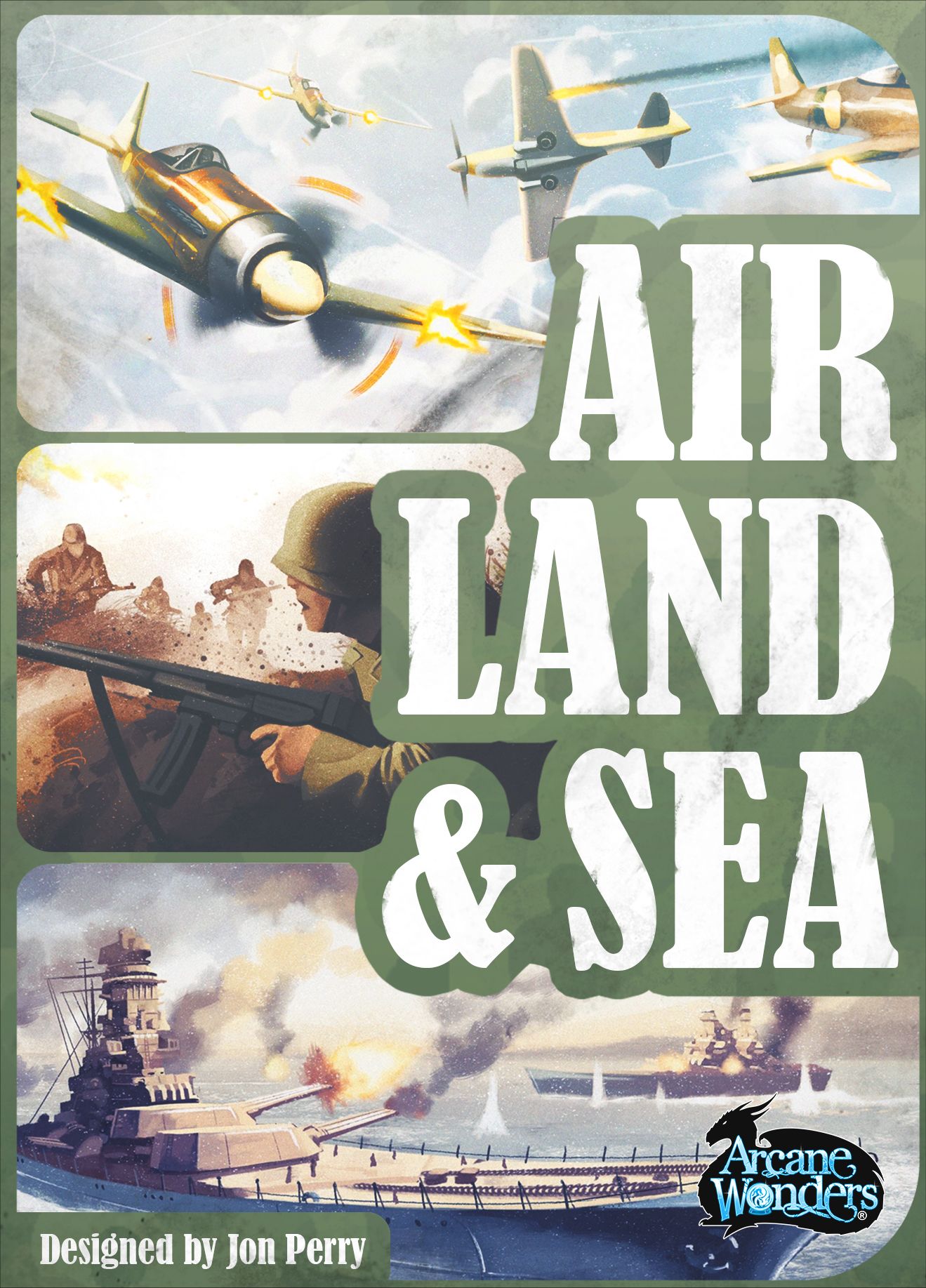
How to Play Air, Land, & Sea
Arcane Wonders, (Web published), FunMill.ru · Board game · 2019What do you want to do now
Ask anything about Air, Land, & Sea: rules, setup, components, complexity, price, or whether it fits your group.
Video: How to Play
Start here, then follow the written guide
Step by step
The Ultimate Guide: How to Play Air, Land, & Sea
Hey there, strategist! Ready for a war of nerves and tactics on a compact battlefield? Air, Land, & Sea is a tense and super smart card game for two players, where every decision counts. Forget luck, here it's pure strategy! Let's dive into the trenches and teach you how to dominate the skies, land, and sea.
Game Objective
In Air, Land, & Sea, your objective is simple but challenging: win Battles to accumulate Victory Points (VPs). The first player to reach 12 VPs (or 3 VPs in Beginner Mode) wins the war and is crowned the grand commander!
To win a Battle, you need to:
- Control more Theaters than your opponent after both players have played all their cards; OR
- Convince your opponent to retreat.
Setup
Let's set up the battlefield for your first mission:
- Take the three Theater boards (Air, Land, and Sea) and place them in a row, in any order you prefer. They will be the "columns" where cards are played.
- Shuffle the two Supreme Commander cards and deal one face down to each player. Then, flip them face up. The player with the red Supreme Commander (1st Player) card will go first.
- Shuffle the remaining 18 Battle cards and deal 6 cards to each player to form their starting hands. Keep your cards secret!
- Place the remaining cards (the Battle deck) aside, without revealing them.
- Make a pile with all the Victory Point tokens on the other side of the play area.
Gameplay Turn
Air, Land, & Sea is played in a series of Battles. During a Battle, players take turns playing one card at a time, trying to control the Theaters. Remember: you don't draw cards during a Battle, so each of your 6 cards is precious!
Theaters and Battle Cards
- Each of the three Theater boards (Air, Land, Sea) represents a column where cards are played.
- You own all the cards on your side of the Theater board.
- Each card has a Strength (the larger number) and, most of the time, a Tactical Ability.
- Cards also have a Type (color and icon): Gray for Air, Green for Land, and Blue for Sea. Normally, you can only play a face-up card in the Theater corresponding to its type.
- If the total Strength of your cards in a Theater is greater than your opponent's, you control that Theater.
- Cards played in a Theater that already contains other cards are placed so that they cover (partially overlap) the previous ones. A card that is not overlapped is uncovered.
Actions on Your Turn
On your turn, you must perform only one of these three actions:
-
Mobilize: Play a card from your hand, face up.
When Mobilizing, you must follow these rules:
- You can only play cards on your side of the Theaters.
- The card must be of the same type as the Theater you play it into (e.g., Air card in the Air Theater).
- If there are already your cards in that Theater, you must place the new card so that it covers the previous cards.
Important: When you play a card face up, any Tactical Ability on it takes effect immediately!
Example: You play a Strength 3 Sea card in the Sea Theater, covering your previous cards. Its Tactical Ability allows you to flip a card in an adjacent Theater.
-
Improvise: Play a card from your hand, face down, into any Theater.
Face-down cards are "wildcards" and can be played into any Theater, regardless of their type. However:
- They always have Strength 1 (even if the number on the card is higher).
- They do not have Tactical Abilities.
You can examine your own face-down cards at any time, but not your opponent's.
Example: You play a Strength 5 Land card face down in the Air Theater. It counts as Strength 1 and does not activate any ability.
-
Retreat: Give up the current Battle.
If you think you are losing, you can retreat. Your opponent immediately wins the Battle. Sometimes, it's a smart tactical move to deny Victory Points to your opponent!
Tactical Abilities
Tactical Abilities are the heart of the game and can change the tide of the Battle. They are activated when a card is played face up or revealed.
- Instant Abilities: Take effect immediately after the card is played or revealed. Once resolved, they have no further effect.
- Continuous Abilities: Take effect as long as the card is face up. If the card is flipped face down, the ability stops working.
Some key terms for Tactical Abilities:
- Flip: Change a card from face up to face down, or vice versa. You can flip your own or your opponent's cards, unless the ability specifies.
- Play: When a card is taken from hand and placed in a Theater. Follows the normal Mobilize rules.
- Mismatched Theaters: If a card ends up in a Theater different from its type (by a Tactical Ability), it suffers no penalty and its Strength still counts.
- Destroy: Remove a card and place it face down at the bottom of the deck. If a card is destroyed immediately after being played, its Tactical Ability is not activated.
- Occupied: Refers to the total number of cards (yours and your opponent's) in a Theater.
- Move: Change a card to a different Theater. The card remains on the same side and owned by the player. Moving is not the same as Playing.
End of Game and Scoring
Ending a Battle
A Battle can end in two ways:
- A player retreats: The opponent wins the Battle.
- Both players play all their cards: The player who controls more Theaters wins the Battle.
To control a Theater, your total Strength must be greater than your opponent's. In case of a Strength tie, the 1st Player wins the tie and controls the Theater. If there are no cards in a Theater, the 1st Player also controls it.
Example: The 1st Player controls Air (6 to 3) and Sea (tie, but the 1st Player wins). The 2nd Player controls Land (4 to 1). The 1st Player controls 2 Theaters and wins the Battle.
Scoring Victory Points
The number of VPs you earn depends on when and if your opponent retreats:
- If a player retreats, the winner scores the VPs indicated on the retreating player's Supreme Commander card, based on the number of cards they still had in hand. The later the player retreats, the more VPs the opponent gains!
- If the Battle ends because both players played all cards, the winner gains 6 VPs.
Preparing for the Next Battle
After each Battle:
- Collect and shuffle all cards to form a new deck. Deal 6 cards to each player and set the rest aside.
- Rotate the position of the Theater boards.
- Players swap Supreme Commander cards. The 1st Player from the previous Battle will be the 2nd Player in the next.
Winning the Game
After each Battle, check if the winner has reached the total VPs to win the war. The first player to reach 12 VPs wins the game!
Beginner Mode: To learn, the winner of each Battle gains 1 VP. The first to reach 3 VPs wins. Ignore the Retreat table on the Supreme Commander cards in this mode.
Tips for Winning
- Manage your hand wisely: You only have 6 cards per Battle and don't draw more! Each card is a valuable resource. Think carefully about where and how to play them, especially face-down cards, which lose their abilities.
- Observe your opponent and adjacent Theaters: Tactical Abilities that affect adjacent Theaters are powerful. Plan your moves to maximize the impact of your cards and nullify your opponent's, especially continuous face-up ones.
- Don't be afraid to Retreat: Sometimes, it's better to retreat early to limit the VPs your opponent gains. Evaluate the situation: if victory seems impossible and your opponent still has many cards in hand, a strategic retreat might be the best option for the war, even if you lose the Battle.
More videos
More rules explanations from the community
In English
-
 Air, Land, & Sea - Tutorial & Full Playthrough
-
 How to Play Air Land and Sea (Rules School) with the Game Boy Geek
-
 How to Play Air, Land, & Sea
-
 Air, Land, and Sea - See what a round looks like as my daughters and I check it out.
-
 All the Games with Steph: Air, Land, & Sea: Critters at War
-
 شرح لعبة Air, Land & Sea
Rules manual
Official PDF file
Frequently Asked Questions
Quick answers about the rules
