What is your question about Mosaic: Wars and Disasters?
Ask before downloading the manual: the assistant was trained on this file and answers instantly, citing the exact page.
Ask questions about the game
Ask anything about Mosaic: Wars and Disasters: rules, setup, components, complexity, price, or whether it fits your group.
Write your question first. You will create your free account to see the answer — it takes 20 seconds.
Full rulebook
Browse the manual or download the original PDFFull manual text available to read Open text
The story of civilizations is punctuated with wars and disasters. Civilizations either survived them and continued on their journey, or succumbed to them and faltered. Will your civilization be strong enough to weather the storm?
Note: Most of the additional content and rules in this expansion are modular, and may be used in part or in whole. The only elements that are essential when using the expansion are Naval Units and the two new Towns/Build Cards.
---
SETUP
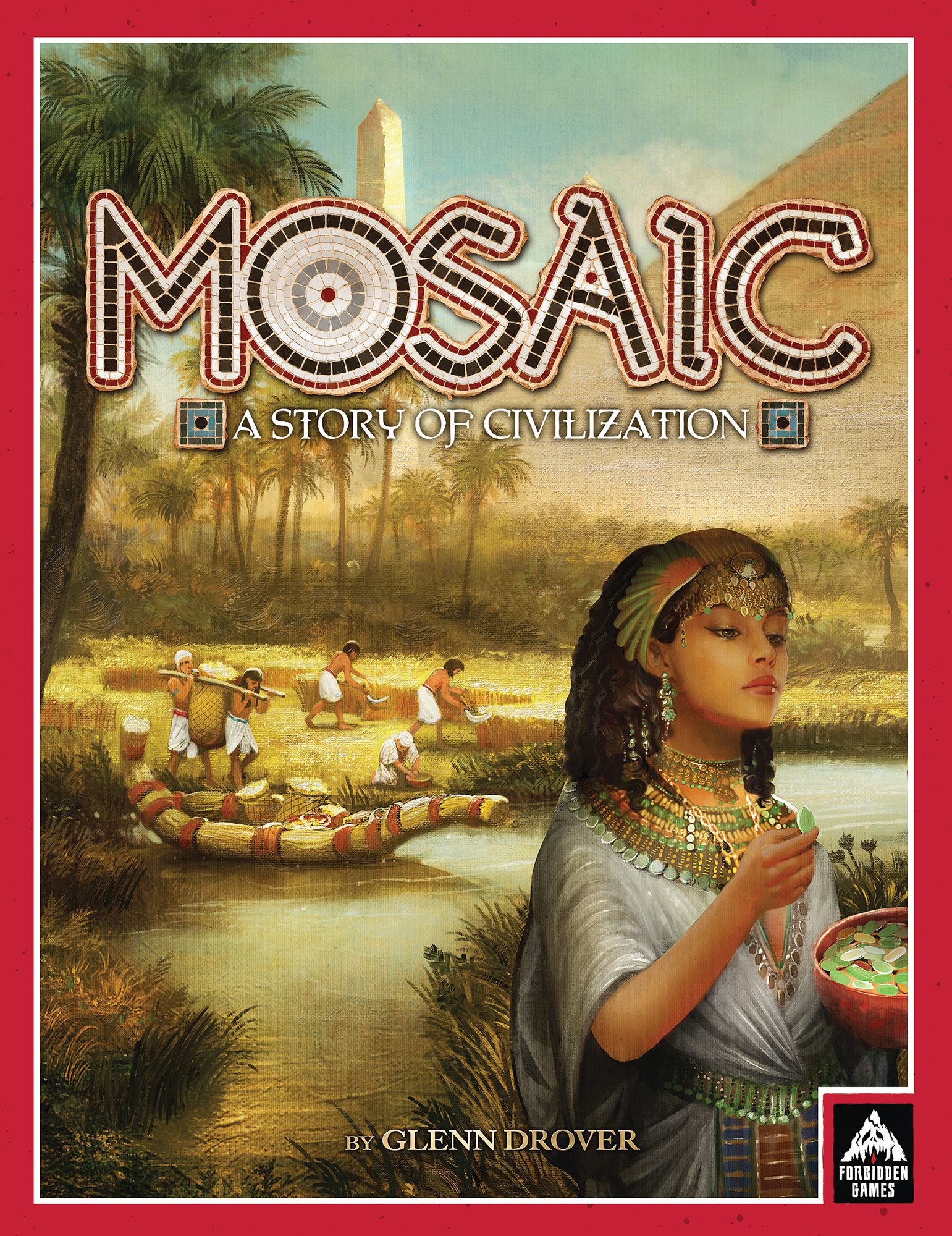
This expansion is not a ‘stand alone’ product. It requires MOSAIC™: A Story of Civilization to play.
When using the contents of the expansion, make the following changes to setup:
Wonders: Shuffle all of the Wonder Tiles and randomly select 9. Remove the rest out of play.
Civilization Achievements: Shuffle all of the Civilization Achievement Tiles and select 9. Remove the rest out of play.
Technology Deck: Add the new Technology Cards from the Expansion (marked with a star in the upper right corner). Prepare the Technology deck per the main rules. However, cut the finished deck into 4 roughly equal piles. Remove 1 pile out of play. For 4–6 players, shuffle the Empire Scoring Card for the Technology deck and 2 Disaster Trigger Cards into the bottom third of the deck. For 2–3 players, shuffle the Empire Scoring Card and 2 Disaster Trigger Cards into the middle third.
Population, Tax & Tariff, and Build decks: Prepare them per the main rules. The only difference will be that you will shuffle 2 Disaster Trigger Cards into each of the four decks in the same segment where the Empire Scoring Card is shuffled (total of 8 Disaster Trigger Cards).
National Powers: Each player (starting with the player to the right of the starting player and continuing counter-clockwise) selects a National Power Card AND a Leader Card.
NATIONAL POWERS
At the beginning of the game, at the same time that players select their Leader Card, they will also select a National Power Card and utilize that nation’s player board, color and pieces. This selection begins with the player to the right of the starting player and goes counterclockwise, finishing with the Starting Player.
National Powers take effect when an Empire Scoring Card is revealed, but before scoring occurs. Each Player, beginning with the starting player and going clockwise, will execute their National Power(s).
Note: The Greek Phalanx Power is always in effect.
Note: The Leader Power of the General occurs right after that player uses their National Power.
Romans
Legions: In each region where the Roman player has 2 or more Infantry Units, they may eliminate one enemy Military Unit.
Builders: In addition, if the Roman player has more Stone than any other player, they may take and play a Build Card from the offer for free.
Gauls
Sackers of Cities: In one region where the Gallic player has the most Military Units, they may remove 1 of their Military Units, remove an enemy City in that region, and gain 10 of any currency from the supply.
Carthaginians
Merchants: If the Carthaginian player has more Naval Units than any other player, they gain 20 Money.
Colony: In addition, in one region where the Carthaginian player has the most Military + Naval Units, they may add a free Town of any type.
Greeks
Phalanx: When the Greek player is attacked and forced to lose a Military Unit(s), the player that attacked them also loses the same number of Units (selected by the Greek player). (Note: This power is in effect at all times.)
Philosophy: In addition, if the Greek player has the most Cities on the board (or tied), they gain one free Technology Card from the top of the deck.
Assyrians
Satraps: If the Assyrian player has more Money than any other player, they gain 1 Population.
Empire: In addition, if the Assyrian player has more Military Units than any other player, they gain 3 Victory Points.
Egyptians
Monuments: If the Egyptian player has more Population than any other player, they get an immediate Work Action.
Chariots: In addition, in each region where the Egyptian player has the most Military Units, they gain 1 Cavalry Unit.
---
NAVAL UNITS
Ancient civilizations that built fleets dominated the trade routes of the Mediterranean and influenced the outcome of many wars of conquest. Naval Units may be purchased during a Military Action.
Cost: 10 Money per Naval Unit & 3 Money per Naval Unit moved.
Rules for Naval Units:
• Must own a Port City to purchase
• When purchased, must be placed in any region containing one of your Port Cities
• When purchased and placed, gain 1 Trade Good from that region for each new Naval Unit
• Naval Units each count as 2 Influence during Empire Scoring
• May be moved during a Military Action; cost is 3 Money to move; may be moved to any region on the board. You do not gain a Trade Good when moving your Naval Units to a new region.
• A maximum of 2 Naval Units may be built per Military Action. This counts toward the maximum Military Units that may be built that turn. (Example: A General can build a maximum of 3 Military Units, so that player could build a maximum of 3 Military Units, 1 Naval Unit and 2 Military Units, 2 Naval Units and 1 Military Units, but they could not build 3 Naval Units.)
• For all other purposes, when Military Units are referred to (usually on Technology Cards), the effect refers to Land Units only, not Naval Units.
WAR TILES (Military Action)
War Tiles are placed on the Military Action Space on the game board during game setup.
You may select and play a War Tile as a part of your Military Action as long as you meet the requirements on the tile and pay the cost. You may also Recruit and/or Move as part of that Military Action as normal, either before or after using the War Tile.
Each War Tile may only be used once per game. When used, they are removed from the game.
Siege!
Gain one Siege Engine Unit in a region where you have a City and Manufactory Town (see Siege Engine Technology for use). Cost: 15 Money
Annihilation Victory!
Eliminate all enemy Military Units in a region where you have at least 3 Infantry and 3 Cavalry. Cost: 15 Money
Conquest!
Convert one opponent City to yours in a region where you have at least 5 Infantry. Cost: 15 Money
Homeland Defense!
Eliminate up to 4 enemy Military Units in a region where you have at least 3 Cities. Cost: 10 Money
Naval Victory!
Eliminate all enemy Naval Units in a region where you have at least 3 Naval Units. Cost: 10 Money
Amphibious Invasion!
If you have more Naval Units than any other player, you may move any or all of your Military Units to one region of your choice and eliminate 2 enemy Military Units there. Cost: 15 Money
WONDERS
Statue of Zeus at Olympia
• 5 VP
• No Disasters affect you for the rest of the game
Mausoleum at Halicarnassus
• 5 VP
• Doubles Unrest for all other players (before negative Unrest is deducted)
---
Circus Maximus
• +2 VP/City & Wonder adjacent to each of your Amphitheatre Towns
• -4 Unrest
• If the Circus Maximus is placed in hexes from 2 regions, it adds 2 Influence to BOTH regions.
LEADER
CIVILIZATION ACHIEVEMENTS
Ceremonial Civilization
1 each: Culture, Wine, Bronze and Spices (6 VP)
Golden Civilization
3 Golden Ages (6 VP)
GOVERNMENT TILE
Confederation
• As long as you are a Confederation, you gain +5 Idea Production. During Empire Scoring, you will score 1 VP/Town that you own.
• Required: 1 Gov, 3 Culture
• Cost: 15 Ideas
---
4
TOWNS
There are 2 new Town types in this expansion:
Garrison Towns
• Build Deck: 6 Cards
• Same rules as other Towns
• Cost: Free
• Pillar Symbols:
• Gain 1 Military Unit in the same region as the Town
• Other Towns may be built adjacent to Garrison Towns as if they were a City
Amphitheatre Towns
• Build Deck: 6 Cards
• Same rules as other Towns
• Cost: Free
• Pillar Symbols:
• Gain 5 Ideas
• Amphitheatre Towns score 2 VP/City and Wonder that are adjacent when placed
DOUBLE PILLAR SYMBOL TOKENS
9 Double Pillar Symbol Tokens for use with the Great Library Wonder
SCORING TOKENS
There are 2 in each player color. These may be used to track scoring on the Scoreboard, or to show ownership of Wonders.
MILITARY ACTION OVERLAY TILE
This overlay may be placed over the Military Action space on the board to show the updated costs.
---
5
TECHNOLOGY CARDS
STARTING TECHNOLOGIES
Name | Benefit | Prerequisite | Symbol(s)
--- | --- | --- | ---
Pillars of Civilization | +2 VP/Wonder; -3 Unrest | – | –
Jewelry | +3 Tariff Production; Gain 10 Money | – | –
Lever | +2 Stone Production; Gain 5 Stone | – | –
Ramp | +2 Stone Production; Gain 5 Stone | – | –
Rope | +2 Stone Production; Gain 5 Stone | – | –
TECHNOLOGIES
Name | Benefit | Prerequisite | Symbol(s)
--- | --- | --- | ---
Pillars of Civilization | Archimedes Screw | +3 Food Production; Gain 10 Ideas | –
Bridge | +2 Tax and Tariff Production; Your Military Units may move 2 regions | – | –
Codex | Gain 10 Ideas and an immediate Work Action; +3 Idea Production | – | –
Corvus | Gain 1 Naval Unit in any region; Convert 1 enemy Naval Unit in that region to yours | – | –
Crane/Winch | Immediately take 2 Work Actions | – | –
Firefighting | Gain 1 Population per City (Max 5) | – | –
Furniture | Gain 1 Population; +2 Tariff Production | – | –
Garrisons | Gain 1 Military Unit; -3 Unrest per Garrison Town; -X Unrest | – | –
Gears | Immediately take 2 Work Actions | – | –
Glass | Gain 2 Population and 1 Trade Good Tile from the board | – | –
Hereditary Bureaucracy | Gain 15 Money and avoid one future Disaster of your choice | – | –
Hydraulics | Gain 3 Population | – | –
Maritime Trade | Claim 1 extra Trade Good when building a new Naval Unit with a Military Action; Gain 10 Money | – | –
Naval Ram | Gain 1 Naval Unit in any region and eliminate 1 enemy Naval Unit in that region | – | –
Paper | Technology Cards cost 2 Ideas for you for the rest of the game | – | –
Plantations | Gain 2 Farm Towns; place them in any hex in a region that contains at least one of your Cities | – | –
Roman Roads | Each time you gain your third Trade Good Tile of the same type (e.g., 3 Cloth), score 5 VP and gain 20 Money | – | –
Spice Trade | Gain 10 Money; Gain 2 Spice Trade Goods from the board | – | –
Timekeeping | Immediately take 2 Work Actions | – | –
Trireme | Gain 1 Naval Unit in any region; Your Naval Units negate the Influence of all enemy Naval Units in regions where you have at least 1 Naval Unit | – | –
Water Mill | Immediately take 2 Work Actions | – | –
---
6
DISASTERS
(12 Disaster & 8 Disaster Trigger Cards)
During setup, shuffle the 12 Disaster Cards, draw 8 of them and place them along the top of the board from left to right so that the players can see all of them. The remaining Disaster Cards are placed out of play.
Then shuffle 2 Disaster Trigger Cards into each of the four decks in the same segment in which the Empire Scoring Card is shuffled (total 8 Disaster Trigger Cards).
During play, when a Disaster Trigger Card is moved from the top of a deck into an empty Offer Space, the leftmost Disaster Card is “triggered” and affects the player(s) shown on the card. (For example: Barbarians affect the player(s) with the least number of Military Pillar Symbols.)
If the player(s) affected can pay the first cost listed, then that is all they lose. If they cannot, then they must pay the second cost listed (which is a harsher penalty). If they still cannot pay the second cost listed, then they must pay the third one. If they still cannot pay that, then they pay nothing.
Once the Disaster is triggered and cost paid, remove that Disaster Card and the Disaster Trigger Card from play.
If the affected player loses a Town or a City, they select which of their Towns or Cities to lose on the board (which goes back into their supply), but do not lose a Town or City Card. If they lose a Wonder, they choose a Wonder on the board to remove and the associated Wonder tile, which are placed out of play.
Barbarians
The Player(s) with the least number of Military Pillar Symbols loses:
1. 1 Military Unit
2. Garrison Town
3. City
Chaos
The Player(s) with the highest Production Bonus on their Player Board loses:
1. 10 Money
2. 6 Stone Production
3. City
Civil War
The Player(s) with the least number of Population Symbols loses:
1. 2 Population
2. 2 Towns
3. City
Cultural Dark Age
The Player(s) with the least number of Idea Symbols loses:
1. 5 Ideas
2. Amphitheatre Town
3. Project
4. Wonder
Earthquake
The Player(s) with the least number of Stone Production Symbols loses:
1. 5 Stone
2. Town
3. City
Economic Collapse
The Player(s) with the least number of Money Production Symbols loses:
1. 10 Money
2. Manufactory Town
3. City
Exodus
The Player(s) with the most Cities loses:
1. 2 Population
2. Town
3. City
Famine
The Player(s) with the least number of Food Production Symbols loses:
1. 5 Food
2. Farm Town
3. 6 Food Manufacturing
Flood
The Player(s) with the least number of Stone Production Symbols loses:
1. 5 Stone
2. Town
3. City
Overpopulation
The Player(s) with the highest Population loses:
1. 2 Population
2. Town
3. City
Plague
The Player(s) with the least number of Population Symbols loses:
1. 2 Population
2. Town
3. City
Technological Dark Age
The Player(s) with the least number of Idea Symbols loses:
1. 5 Ideas
2. 5 Idea Production
3. A Random Technology
---
TELLING YOUR
CIVILIZATION’S STORY
At the end of the game, each player may take a turn re-telling the history of their civilization.
What were the major events that caused your civilization’s rise to greatness, or its fall?
What type of civilization was it: Government, Golden Ages, or Production?
What great things did it accomplish, based on its Wonders, Projects, and Achievements?
Example:
Glenn’s Roman civilization, led by the Priestess of Jupiter, converted a Greek city in Egypt and spread Roman influence into Numidia, eventually ruling all of North Africa. Later, however, they fought a war against invaders from Gaul, losing Italia.
The Romans were unmatched builders, building The Pyramids, The Sphinx, and The Great Library in Numidia, and the great projects: Granary, The Forum, and City Walls.
They enjoyed great prosperity and health with several golden ages: Medicine, Food, and City States.
Rome was the greatest civilization in history, eclipsing the Greeks and Egyptians and leaving them mostly forgotten.
© 2023 University Games Corporation, San Francisco, CA 94110. MOSAIC: WARS & DISASTERS is a trademark of University Games Corporation. All Rights Reserved. U. Games Australia, Level 1, 10 Willoughby Rd, Crows Nest NSW, Australia 2065. University Games UK, 4 The Lanterns, 16 Melbourn Street, Royston, Hertfordshire, SG8 7BX. U Games Ireland Logistics Ltd, 15 Main Street, Raheny, Dublin 5. Retain this information for future reference. MADE IN CHINA. B013419 03/23
---
Why ask BoardGamesBot
Instead of flipping through the whole manual- Accurate answers Based exactly on this manual, with the source page.
- Save time Find the rule in seconds, without flipping 8 pages.
- Anytime Settle rules mid-game, straight from your phone.
- 100% free Create your free account and start using it now.
How it works
Three steps to the answer- 1 Ask your question Type your question about this game's rules.
- 2 Create your free account Takes 20 seconds — it only saves your history.
- 3 Get the answer The AI finds the exact rule and cites the manual page.
Expansion for
Published additional content
Manual published by the publisher · for rules reference only. More about the game on BoardGameGeek and Ludopedia .