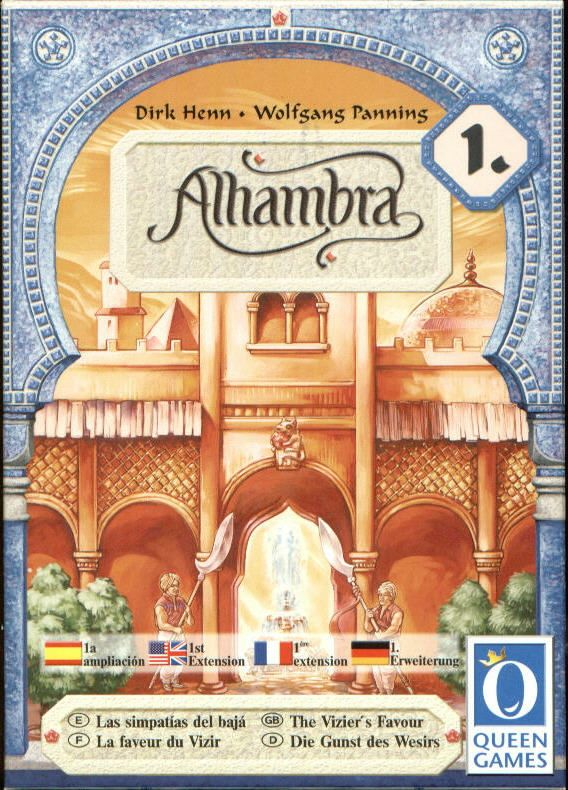
What is your question about Alhambra: The Vizier's Favor?
Ask before downloading the manual: the assistant was trained on this file and answers instantly, citing the exact page.
Ask questions about the game
Ask anything about Alhambra: The Vizier's Favor: rules, setup, components, complexity, price, or whether it fits your group.
Write your question first. You will create your free account to see the answer — it takes 20 seconds.
Full rulebook
Browse the manual or download the original PDFFull manual text available to read Open text
Equipment
6 wooden vizier pieces
in the players’ colours.
Getting ready to play
Before the game begins, each
player receives the vizier piece in
their colour which they place face
up in front of them. (You can only use the vizier piece when it is face up.)
The pieces which are not needed are removed from the game.
The Vizier’s favour
Each time a player has completely finished their turn, any of the players
may interrupt the normal order of play and make a Special Move by
buying a building tile from the building market and positioning it.
However, they can only do so on the following conditions:
• their vizier piece must be in play (face up);
• they must (be able to) pay for the building tile with the exact money.
A player who makes this special move does not have the extra go they
would normally get by paying exactly.
WINNING THE VIZIER’S FAVOUR
“Winning the
Vizier’s favour”
is a module
which allows the
normal order of
play to be interrupted
for a special move: the purchase of
a building tile.
But this has its
price.
The building must
be paid for with
the exact money
but you do not get an extra go!
This extension contains four additional modules for the original game
(the Palace of Alhambra); they can be used either singly or in any combination.
Play is still based on the rules of the original game. Rule changes, additional
rules and new equipment are explained on separate sheets for each module.
Spielregel Alh-Erw1 Layer22 03.08.2004 11:29 Uhr Seite 1
---
The player then turns their vizier piece over (face down) - it is now no longer in play. The player takes the building they want, pays the exact price and positions it according to the building rules or places it on their reserve board. The player does not have an extra go.
The building market is then refilled so that there are 4 buildings.
The normal order of play then resumes with the player who would have been next.
Bringing the vizier piece back into play
Each player normally has three different options when it is their turn (Take some money • Buy and position a building tile • Redesign their Alhambra). Now there is another option as well:
Bring the vizier back into play.
The vizier piece is turned over so that it is face up.
It can now be used at any time for the special move.
Notes
• If several players want to use their vizier at the same time, the player who would be next in the order of play comes first. (The player due to play next would be the first - the player who has just finished their turn would be last.)
• The other players may then decide again whether they want to use their vizier piece.
• When the last building tiles are being shared out at the end of the game, the vizier piece can no longer be used.
• Using the vizier piece does not allow a player to take a workers’ hut (See the “Workers’ huts” module)
Spielregel Alh-Erw1 Layer22 03.08.2004 11:29 Uhr Seite 2
---
THE BUREAUX DE CHANGE
“The bureaux de change” are six new playing cards which can be picked up like money cards. They make it much easier to pay exactly as if you hold one in your hand you can pay with two currencies instead of one. Unfortunately, you can only use a bureau de change card once. After that, it is placed on the discard pile.
Equipment
6 bureau de change cards: playing cards which each show two different currencies.
Getting ready to play
When the Palace of Alhambra money cards are divided into five piles at the start of a game, two bureau de change cards are concealed in the 2nd, 3rd and 4th piles.
How do you get the bureau de change cards?
When the top card taken from the money pile is a bureau de change card, you lay it (like any other card) face up next to the building market. There are always a maximum of four cards showing, no matter whether they are bureau de change cards or money cards. The player whose turn it is may now take a bureau de change card instead of money. You can have as many bureau de change cards in your hand as you like.
This extension contains four additional modules for the original game (the Palace of Alhambra); they can be used either singly or in any combination. Play is still based on the rules of the original game. Rule changes, additional rules and new equipment are explained on separate sheets for each module.
Spielregel Alh-Erw1 Layer22 03.08.2004 11:29 Uhr Seite 3
---
Pavillon
How do you use the bureau de change cards?
A building tile usually has to be paid for with the currency shown directly
next to the building tile in the building market.
If the bureau de change card also shows this currency it can be played
and the player can buy one building tile using any combination of the two
currencies on the card.
Notes
• When all the cards in the money pile have been used, the discarded
cards - including the used bureau de change cards - are shuffled and
placed face down to make a new pile.
• At the end of each turn any cards which have been removed are
replaced with new ones so that there are four in total - even if this
includes one or more bureau de change cards.
• When the last building tiles are shared out at the end of the game, the
bureau de change cards can no longer be used.
Example: a player has the following four cards in
their hand: 7 and 2 denars (blue), 9 florins (yellow)
and the blue-and-yellow bureau de change card.
With these cards he could buy either the garden
or the pavilion pictured.
He can now choose: either he pays 9 florins and
2 denars for the garden or he pays 7 denars which is the exact money for the
pavilion. In either of these cases
he plays his bureau de change card which he
must then discard. He is not allowed to use his bureau de change card twice.
Spielregel Alh-Erw1 Layer22 03.08.2004 11:29 Uhr Seite 4
---
Equipment
10 bonus cards: playing cards
which each show a picture of
a particular building tile.
Getting ready to play
The bonus cards are shuffled
and dealt face down to all the
players as follows:
with 2 or 3 players, each player receives 3 bonus cards;
with 4 or 5 players, each player receives 2 bonus cards; and
with 6 players, each player receives 1 bonus card.
Bonus cards which have not been dealt out are set aside face down.
How the bonus cards work
On each bonus card, there is a picture of a particular building tile. (Note:
The 10 cards show the building tiles which do not have a wall on them.)
A player who adds a building tile to their Alhambra during the game and
also has the matching bonus card can play this bonus card by laying it
face up in front of him at any time.
Once a bonus card has been played, it counts as an extra building of that
particular kind during the scoring rounds.
“Bonus cards”
which have been
played count as
building tiles in
the scoring rounds.
As they are not nor-
mally played until later in the game,
they can cause a few surprises when
the scores for the
buildings are
awarded.
However, you can
only play them
when you have
added the building pictured on the
card to your Alhambra!
THE BONUS CARDS
This extension contains four additional modules for the original game
(the Palace of Alhambra); they can be used either singly or in any combination.
Play is still based on the rules of the original game. Rule changes, additional
rules and new equipment are explained on separate sheets for each module.
Spielregel Alh-Erw1 Layer22 03.08.2004 11:29 Uhr Seite 5
---
GartenArkaden
Turm
Arkaden
Example: A player has the building tile showing the number 10 and a garden without a wall; the player has added it to their Alhambra and laid the matching bonus card face up in front of them. This player would now have two gardens in a scoring round.
Notes
• If a player removes a building tile from their Alhambra after having already played the matching bonus card, the player must pick up the bonus card again. Neither the bonus card nor the building tile on the reserve board would then count during a scoring round. Only when the building tile has been added to the Alhambra again can the matching bonus card be played and then count as an extra building in a scoring round.
• Once you have added the building tile to your own Alhambra, you can play a matching bonus card at any time, including during a scoring round.
• It may well be a good idea to only play a bonus card later on, for example to leave other players in the dark as to who really has the most of that particular kind of building. You may then perhaps be able to spring a surprise during the third scoring round when there are the most points to be won.
Spielregel Alh-Erw1 Layer22 03.08.2004 11:29 Uhr Seite 6
---
Equipment
24 building tiles which show six different workers’ huts. There are workers’ huts in the same colours as each kind of building in the original game.
Getting ready to play
The workers’ huts are sorted according to their colour, then each of the 6 piles is shuffled and placed face down next to the building market. Next, the top workers’ hut of each pile is turned face up.
How to play
Each player normally has three different options when it is their turn (Take some money • Buy and position a building tile • Redesign their own Alhambra). They now have another option: build a workers’ hut.
Building a workers’ hut
You can take any one of the upturned workers’ huts from the six piles. Then the next workers' hut in the pile is turned face up.
… 4 brown … 5 green … 3 red … 4 white and 5 purple workers’ huts.
There is a new kind of building for the Alhambra: the workers’ huts.
If a workers’ hut is positioned skilfully, it can count as a maximum of three buildings of the same kind. But the workers’ huts are not only important for getting the most buildings; they also help players to plan their walls better. Unfortunately, each player can only use a maximum of three huts.
This extension contains four additional modules for the original game (the Palace of Alhambra); they can be used either singly or in any combination. Play is still based on the rules of the original game. Rule changes, additional rules and new equipment are explained on separate sheets for each module.
There are 3 blue
THE WORKERS’ HUT
Spielregel Alh-Erw1 Layer22 03.08.2004 11:29 Uhr Seite 7
---
Arkaden
Turm
Garten
Arkaden
Arkaden
Turm
Garten
Arkaden
+1
+1
+1
+1
If all the tiles have been taken from a pile, this kind of workers’ hut is no longer available. A workers’ hut does not cost any money (and cannot therefore be paid for exactly, which means there is no extra go). At the end of a turn, the workers’ hut (together with other building tiles if the player has just bought them) is added to the player’s own Alhambra or placed on their reserve board according to the building rules. Each player is allowed a maximum of three workers’ huts, including those on their reserve board. The rules for redesigning the Alhambra also apply to the workers’ huts.
Scoring with the workers’ huts
• When scoring, a workers’ hut may count as nothing or as up to a maximum of three extra buildings of the same colour, depending on its position. If a workers’ hut is joined to one building of the same colour it counts as one additional building of this kind, if it is joined to 2 or 3 buildings of the same colour, it counts as 2 or 3 buildings of this kind, as long as in each case there is no wall between the workers’ hut and the neighbouring buildings of the same colour.
• The walls on the workers' hut tiles are scored in the same way as usual.
Example: The player has already used 3 workers’ huts and is not allowed to take any more.
The purple workers’ hut does not count as although it is joined to a tower, it is separated from the tower by a wall.
The upper brown workers’ hut has two neighbouring arcades without any wall in between and counts as 2 extra arcades when scoring.
The lower brown workers’ hut has one neighbouring arcade and therefore counts as 1 extra arcade.
This Alhambra consists of 1 garden, 1 tower and 5 arcades.
Spielregel Alh-Erw1 Layer22 03.08.2004 11:29 Uhr Seite 8
---
Why ask BoardGamesBot
Instead of flipping through the whole manual- Accurate answers Based exactly on this manual, with the source page.
- Save time Find the rule in seconds, without flipping 8 pages.
- Anytime Settle rules mid-game, straight from your phone.
- 100% free Create your free account and start using it now.
How it works
Three steps to the answer- 1 Ask your question Type your question about this game's rules.
- 2 Create your free account Takes 20 seconds — it only saves your history.
- 3 Get the answer The AI finds the exact rule and cites the manual page.
Expansion for
Published additional content
Manual published by the publisher · for rules reference only. More about the game on BoardGameGeek and Ludopedia .