What is your question about Haspelknecht: The Ruhr Valley?
Ask before downloading the manual: the assistant was trained on this file and answers instantly, citing the exact page.
Ask questions about the game
Ask anything about Haspelknecht: The Ruhr Valley: rules, setup, components, complexity, price, or whether it fits your group.
Write your question first. You will create your free account to see the answer — it takes 20 seconds.
Full rulebook
Browse the manual or download the original PDFFull manual text available to read Open text
Haspelknecht - The Ruhr Valley
Introduction
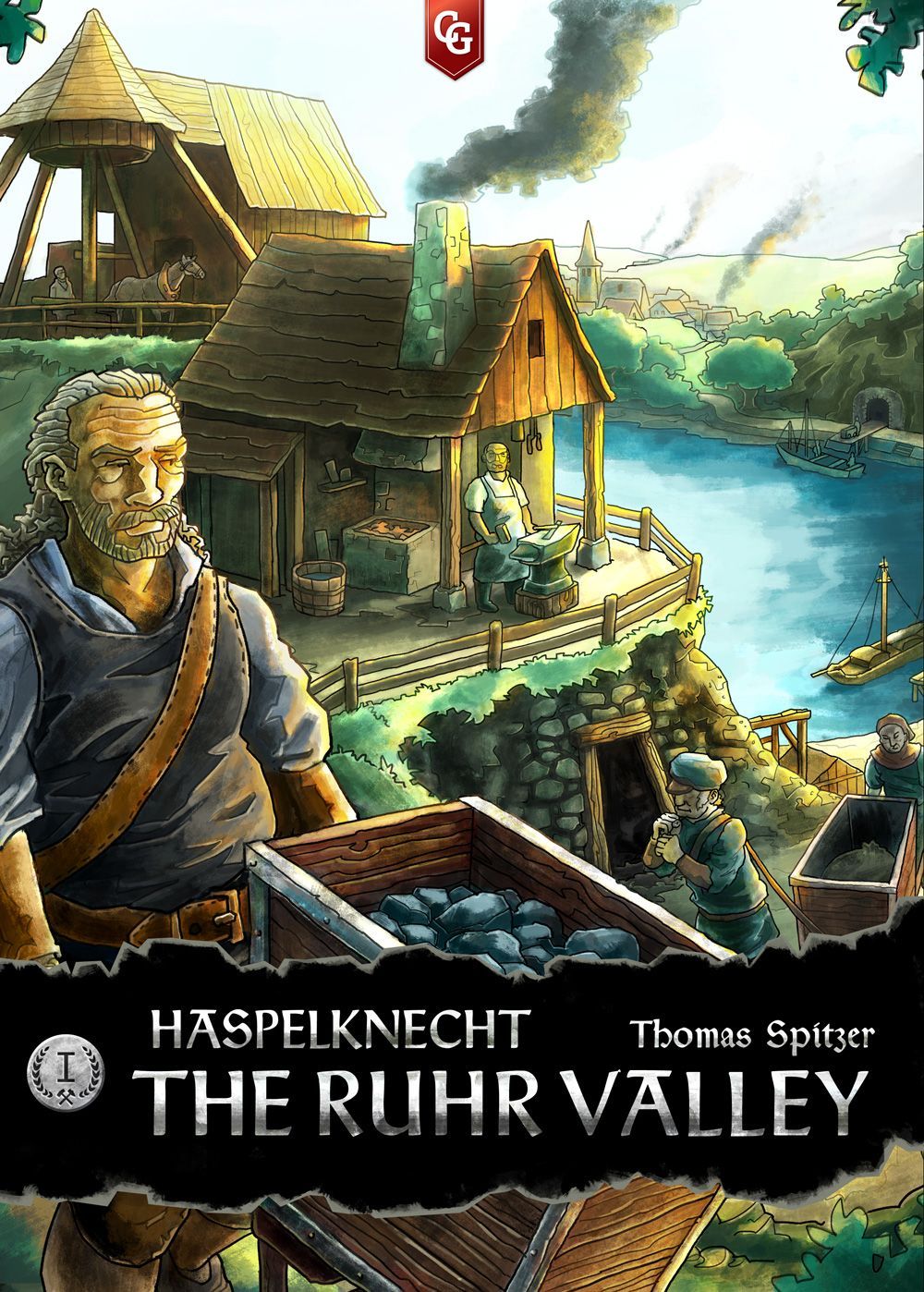
The Ruhr Valley is an expansion of Haspelknecht: The Story of Early Coal Mining. You need the base game in order to play with this expansion.
Coal mining has now become an inherent and lucrative business for farmers in the Ruhr valley and is prevalent between the settlements of Witten and Hattingen. Industrialization is slowly beginning in this region. The tunnels are dug deeper and longer, which is made possible by the use of iron. Water channels are implemented to help drain the pit water. A considerable part of the population earns their living exclusively by coal mining and delivering the “black gold“ to peddlers and first coal barges cruising the river which gives its name to the valley and the whole area – the Ruhr.
This expansion adds new challenges to Haspelknecht. 2 new modules and 13 new developments are waiting to be explored.
Ruhr Valley (south-east): The area between Witten, Sprockhövel, Hattingen, and Bochum, where coal mining initially began.
Haspelknecht - The Ruhr Valley Overview of this expansion
Haspelknecht - The Ruhr Valley introduces 2 expansion modules, and 13 new development tiles.
Each module may be added to the base game individually, or both modules may be combined and used together. We strongly recommend that you begin by experiencing the modules individually, one after the other. Then, try both modules together. Eventually, you may use both modules, either combined or individually, in combination with the 13 new developments.
13 New Developments – page 4
You may mix these new development tiles with the development tiles from the base game. This will not change playing time. However, we strongly recommend not using all these new developments at once.
Module 1 – Black Developments – page 7
The development board is expanded by a fifth level of developments of a new color. This will not change playing time.
Module 2 – Iron – page 9
The players need iron props for their Enhanced Tunnel, and after three game rounds, an additional fourth game round will be played. This extends playing time by about 45 minutes with 4 players (about 15 minutes with 2 players, and about 30 minutes with 3 players).
The Ruhr Valley expansion contains the following components:
* 21 Development tiles
* 26 Various markers
* 4 Workshop tiles
* 1 Assist tile for the fifth level
* 1 Thanksgiving tile
* 1 Winter payment tile
* 1 Extended year track tile for 4 game rounds
* 4 Farmer‘s Wife tiles (double-sided)
* 4 Enhanced Tunnel boards (double-sided)
* 4 Water channel markers
* 4 Victory point tokens
* 20 Grey iron props (wooden)
* This rules booklet
2 3
1X 1X 1X 1X 1X 1X 1X 1X 1X 1X 1X 1X 1X 1X 1X 1X 1X 1X 1X 1X 1X
16 17 18 19 26 27 28 29 30E 36 37 38 40E 46 47 51 52 53 54 55
1X 1X 1X 1X 1X 1X 1X 1X 1X 1X 1X 1X 1X 1X 1X 1X 1X 1X 1X 1X
1 = 2 +1 1 X 2X 1X 1X 1X 1X 1X 1X 1X 1X 1X 1X 1X 1X 1X
? ? 10E ? ? ? ? ? ? ? ? ? ? ? ? ? ? ? ? ?
3 2
---
These 13 new developments may be used in any combination you like, mixed with the development tiles from the base game for levels 1 to 4.
Furthermore, they can be used in combination with any module in this expansion.
Each development must be placed on the level matching its color.
Note: These 13 developments are marked with this icon so you can distinguish them easily from those of the basic game.
13 New Developments (for levels 1 to 4)
16 - Wicker Basket
The player immediately gains the corresponding action marker.
They may use it once during a future action phase. When using
this marker, the player may assign any number of different
action disks to the same worker in order to receive different
resources. After use, the action marker must be returned to the
general supply.
Note: A synergy bonus is not granted when using this marker.
17 - Pick & Shovel
The player immediately receives 1 coal cube and 1 Thaler from
the general supply. However, the player must add 1 pit water
token to their current mining area.
We recommend replacing the Carrying Pole from the base game
with the Pick & Shovel.
18 - Water Channel
The player gains the Water Channel marker and places it next
to their player board. From now on, when removing any pit
water tokens from their pinge and/or tunnel, the pit water is
placed on this tile. When 3 pit water tokens are added to this
marker, they are returned to the general supply, gaining the
player 1 victory point. This marker is used by the player for the
rest of the game.
If the player has acquired the Bucket development from the
base game, they take 1 pit water token during the spring and
autumn pit water phases and places it on this marker.
19 - Farmer’s Wife
The player immediately takes the additional Farmer‘s Wife
worker tile, and gains an additional facility for placing their
action disks during the planning phase. The player places the
Farmer‘s Wife tile on their player board just below the farm-
er, with the 1 black disk side face up. In order to activate the
farmer‘s wife, the player needs to assign exactly one black disk
to this tile. The farmer‘s wife can mine 1 coal cube, or haul up
1 coal cube from the pit, or remove up to 2 pit water tokens, the
latter both from the pinge as well as from the tunnel!*
If the player has acquired the Ladder development from the
base game, or acquires it later, they flip the Farmer‘s Wife tile
immediately. Placing a yellow disk on the Farmer‘s Wife pro-
duces one food from the general supply.
*Reminder of an easily forgotten rule of the base game:
The pit water icons of both the farmer and the farmhand apply
only to removing pit water from the pinge!
26 - Cottage
The player immediately gains the corresponding action marker.
They may use it once during a future action phase. The player
may use this marker only when acquiring new developments.
The marker is a substitute for the requirement of any 2 disks.
Subsequently, the action marker must be returned to the gen-
eral supply.
27 - Towpath Horse
When totaling the value of their action discs in order to deter-
mine the player order, the player may now choose to evaluate
the disks in their cart on space 1 or space 2.
28 - Kiepenkerl
Place 1 wood on this development during game setup. The
first player to acquire this development takes that wood, and
one more resource of any kind (that may be wood as well) from
the general supply. Additionally, they take the action marker.
In exchange they must place any 1 different resource from
their farmyard than those two taken on this development. All
other players to subsequently acquire this tile must place one
different resource from their farmyard on the Kiepenkerl than
the current resource.
If playing with Module 2 - Iron, you may take or place iron as
well.
The action marker may be used once during any future action
phase. This action marker counts as any action disk of the
player’s choice. After use, the action marker is returned to the
general supply.
Example: The first player takes the wood from the development tile and 1 food from the general supply. In exchange, they place 1 coal on the Kiepenkerl. The next player takes this resource
(coal) and puts back 1 wood (for example). Now, they could take 1
food, or 1 coal, or 1 iron (Module 2) from the general supply. The
resource taken from the general supply must always be different
than the one put back onto the Kiepenkerl!
take or place iron as well The action marker may be used once during any future action phase This action marker counts as any action disk of the player s choice After use the action marker is returned to the general supply Example The first player takes the wood from the development tile and 1 food from the general supply In exchange they place 1 coal on the Kiepenkerl The next player takes this resource coal and puts back 1 wood for example Now they could take 1 food or 1 coal or 1 iron Module 2 from the general supply The resource taken from the general supply must always be different than the one put back onto the Kiepenkerl
29 - Thanksgiving
The player immediately gains 1 food. During the autumn pit
water phase, the player may give 1 food to any player who has
not acquired this development. In return, the player gains 3
victory points and decides whether or not to take a pit water. If
all players own this development, the players pay 1 food to the
general supply instead (if they want to do so).
As a reminder, cover the autumn pit water phase space of the
year wheel board with the Thanksgiving tile.
36 - Weekly Farmers’ Market
You need 3 different action disks for the Weekly Farmers‘ Mar-
ket. Important: This means that you need at least 1 marker as
a substitute for one action disk! The player immediately gains
the corresponding action marker. The action marker may be
used once during a future action phase. The marker shows a
barter: If the player returns 1 food, 1 wood, and 1 coal to the
general supply, they receive 2 Thalers and 5 victory points in
return. Once used, the action marker must be returned to the
general supply.
Important! If the Weekly Farmers‘ Market is featured in a game, you must use at least 1 of the following: the Wheelbarrow, Ladder, or Hammer and Pick develop-
ments from the base game, and/or the Kiepenkerl from this expansion.
16 1X
17 1X
18 1X
19 1X
26 1X
27
28 1X
29 1X
36 1X
---
37 - Village Church of Stiepel
This 1000 year old church offers two options:
a) The player gives 1 coal cube from their farmyard to any other player of their choice. As compensation, the player gains 3 of the 4 depicted resources from the general supply (respectively receives 1 victory point);
or b) the player gives 1 coal cube from their current mining area to any player of their choice (this coal must not be mined and/or hauled up for this purpose). As compensation, the player gains 2 of the 4 depicted resources from the general supply (respectively receives 1 victory point).
In either case, if the player chooses to take the Thaler, they must take 1 pit water as well and place it on their current mining area.
38 - Community Tunnel
During setup, place 2 coal cubes per player on the community tunnel, from left to right. When mining this coal later during the game, it is done from left to right as well. A player acquiring this development must place 1 wood from their farmyard on the leftmost empty wood prop, and then take the 2 coal cubes above the empty space to the right of that wood. Next, the player must place one of these cubes on the farmyard of another player of their choice, and the second one on their own farmyard. Additionally, the player receives 1 Thaler and 1 food from the general supply or 1 Thaler, and they may return one debit chit.
Note: If playing with Module 2, the players may use iron instead of wood. (These two materials may be intermixed here.)
46 - Schultheiss
The player now ignores the usual payments to the nobility during winter. Instead, they now must pay exactly 1 coal, 1 wood, and 1 food during this phase.
Still, the player must take one debit chit for each commodity they cannot pay. At the end of the game, debit chits are worth negative victory points. Payment is mandatory; a player may not voluntarily refrain from payment and take a debit chit instead.
If both the Schultheiss and the Small Coal Mine (base game) are in play, we recommend adjusting the random placement by ensuring that these two developments are as far from each other as possible.
47 - Pit Car Tipple
The player immediately receives 1 Thaler from the common supply. Furthermore, the player gains 1 additional victory point for each future development they acquire, provided they gain at least 1 victory point at all for that acquirement.
Module 1 – Black Developments
Setup:
First, follow the setup instructions of the base game. Then, add the following new components:
When playing with less than 4 players, the players may agree which of these new developments they want to use. The black development tiles are placed in random order at the bottom row (fifth level from top) of the development board. Return any unused black development tiles to the game box. Disregarding the number of used black development tiles, all 6 markers for final scoring are always in play.
Place the black assist tile to the right of the black development tiles, as usual, just below the brown assist tile.
Note: The 5 special developments of this module are marked on their left side with this icon.
Special rule: Differing from development tiles of the other colors, each player is limited to acquiring only one black development.
Additionally, a player‘s disk on a black development tile blocks this development for all other players.
Instead of their wooden disks, the players now use their victory point markers to indicate their score on the victory points track. This means, that each player now has 10 wooden disks at their disposal that they may use for acquiring developments.
Victory points for black developments:
The first player acquiring a black development immediately scores 5 victory points; the second player acquiring a black development immediately scores 4 victory points; the third player scores 3 victory points, and the fourth player scores 2 victory points.
Immediate effects and bonus markers for final scoring by black developments:
Additionally, each player acquiring a black development immediately benefits from one of the two depicted, once-only immediate effects. The player also chooses one of the 6 bonus markers for final scoring (i. e., one of those still available), and keeps it face down in front of them.
Example: The first player acquiring a development on the first level would gain 1 additional victory point, if having acquired this development. Any further players acquiring a development of the first level do not gain any victory points, so they will not gain that additional victory point, even if having acquired the pit car tipple.
37
38
46
47
4-8
1. 2 players
2. 3 players
3. 4 players
4. 3 - 5 Black development tiles (number of players +1)
1. Assist tile for the fifth level
2. 6 Markers for final scoring
3. 1 Victory point marker per player
4. ?
52 51
5X
53
5X
54
?
55
=
2
+1
1
X
2X
1.
2.
3.
4.
1
6 7
---
51 - Coal Barge:
The player receives 1 Thaler from the common supply, and may remove 1 pit water token, or the player receives 1 food from the common supply and returns 1 debt chit to the common supply (if they have any).
52 - Mine Surveyor:
The player receives 1 Thaler from the common supply, and may remove 1 pit water token, or the player takes any one marker of their choice corresponding to a development from the base game that must have been acquired already by at least 1 player.
Historical Note: The mine surveyor is a land surveyor especially working in the mining industry.
53 - New Tunnel:
The player receives 3 coal cubes from the common supply, placing them on their farmyard, and may remove 1 pit water token, or the player may remove up to 5 pit water tokens.
54 - Horse Mill:
The player receives 2 food from the common supply, or the player may remove up to 5 pit water tokens.
Historical Note: The horse mill was a replacement of the clock reel.
55 - Haul Track:
The player may return 1 debt chit to the common supply and remove 1 pit water token, or the player takes any one marker of their choice corresponding to a development from the base game that must have been acquired already by at least 1 player.
Immediate, once-only effects of black developments
Bonus Markers for final scoring:
When scoring their buildings bonus, the player adds 1 building; players may have a maximum of 5 buildings now (instead of only 4). The player also gains 1 victory point for each completely mined section marked with the “Wheelbarrow“ icon (in addition to any victory points due to having acquired the Wheelbarrow development from the base game).
The player gains half as many victory points as the number of their player disks on developments (rounded down). (Example: The player has acquired 6 developments, they gain 3 victory points.)
The player gains 1 victory point for each completely mined section marked with the “Oil Lamp“ icon (in addition to any victory earned from acquiring the Oil Lamp development from the base game). Furthermore, they gain 1 victory point.
The player returns 1 debt chit to the common supply before these are evaluated, and they own 1 Thaler more when scoring victory points for cash.
The player returns 2 debt chits to the common supply before these are evaluated, and they ignore any remaining pit water during final scoring.
When scoring their buildings bonus, the player adds 1 building; players may have a maximum of 5 buildings now (instead of only 4). The player also gains 1 victory point for each completely mined section marked with the “Lorry“ icon (in addition to any victory points earned from acquiring the Lorry development from the base game).
When playing with this module, players now can gain victory points during final scoring for a maximum of 5 building icons instead of 4: 5 building icons = 15 victory points
Module 2 - Iron
Setup:
First, follow the setup instructions of the base game. Then, add the following new components:
1 Extended year track tile for 4 game rounds
1 Winter payment tile
1 Victory point marker per player
1 Workshop tile per player
20 Grey iron props (wooden)
1 Enhanced Tunnel board per player (double-sided, Side A or B, as of players’ choice).
Optional: These new, specific developments and their corresponding markers: Peddler; Village Smithy; Abandoned Farm
Setup (continued):
Using the three new, specific developments mentioned above is not mandatory, but recommended. However, in a 2-player-game you should only use one of them.
Cover the year track on the central year wheel board with the extended year track tile for 4 game rounds.
Each player places the Enhanced Tunnel board on their player board, leaving only the first two sections of the original board visible.
Note: In a 4-player-game, the number of included coal cubes will not be sufficient. Please fill the tunnel only after all coal cubes have been removed from the pinge.
Enhanced buildings bonus:
1 building icon = 1 victory point
2 building icons = 3 victory points
3 building icons = 6 victory points
4 building icons = 10 victory points
5 building icons = 15 victory points
? 52 51 5X 53 5X 54 ? 55 1X 10E 30E 40E
51 ? 52 5X 53 5X 54 ? 55 1X
Enhanced Tunnel board on player board
Extended year track tile for 4 game rounds
= 2 +1 1 X 2X
---
When setting up the development board, the players should ensure there are enough developments to generate at least 4 Thalers in order to pay the demands of the nobility.
Instead of their wooden disks, the players now use their victory point marker to indicate their score on the victory points track. This means, that each player now has 10 wooden disks at their disposal that they may use for acquiring developments.
Put the winter payment tile on the central board, covering the winter payment chart.
Keep as many workshop tiles in the common supply as the number of players.
Add the 20 (wooden) iron props to the general supply of food, wood, Thalers, and various markers.
Flow of the game
The game flow follows the pattern of the base game, except for the following modifications:
The game is played over 4 game rounds (instead of 3), thus each player performs a total of 12 action phases (compared to 9). Final scoring is done after the 4th game round, and implemented iron props will add additional victory points.
The new components:
The winter payment tile of the 4th year demands the payment of 1 food, 1 Thaler, and 1 iron by each player to the nobility.
As usual, payment is mandatory if the player owns the required resource. A player may not voluntarily refrain from payment, and take a debt chit instead.
A player must take one debt chit for each commodity they cannot pay. At the end of the game, debt chits are worth negative victory points.
By using the workshop, and the new particular iron-developments, the players can produce iron. Iron serves the same purpose as wood, but can only be used as props in the tunnel. Iron may not be used in the pinge.
Each iron prop implemented in the tunnel is worth 1 victory point during final scoring, provided the section to the right of the prop is mined completely.
* Place the workshop tile on the top right corner of your player board, just below the two cart spaces for the selected action disks, in such a manner that it fits the landscape perfectly.
Once a player clears their pinge, the player now receives their Workshop tile in addition to their “Coal Miner and Haspelknecht“ tile. During the planning phase, a player may assign exactly 1 yellow action disk to their workshop in order to produce 1 iron. During the winter storage phase, a player may store 1 iron in their workshop, immediately earning 1 victory point if doing so.
Important Note: The workshop is not counted as a building!
Each “Enhanced Tunnel“ requires the installation of two iron props where shown.
Any other prop, shown as wood on the player board, may be iron or wood, by player‘s choice. The “A“ side of all 4 Enhanced Tunnel boards is identical, while all “B“ sides are unique. The players should agree before the start of the game which side they want to use. Each tunnel requires a total of 9 props in order to be mined completely, at least 2 of which must be iron props.
The 3 special developments of this module are marked on the left side with this icon:
10E - Abandoned Farm:
The player immediately gains the corresponding action marker.
They may use it once during a future action phase. When using this marker, the player receives 1 wood and 1 iron from the general supply. After use, the action marker must be returned to the general supply.
We recommend using this development only when playing with 3 or 4 players.
30E - Peddler:
The player may
a) exchange 1 coal cube for 1 iron or 1 food or
b) exchange 2 coal cubes for 1 iron or 1 food, and receives 1 Thaler.
We do not recommend using the Peddler together with the Coal Sacks from the base game.
40E - Village Smithy:
If a player uses at least 2 black action disks when acquiring this development, they immediately receive 1 iron from the general supply.
A player having acquired this development scores 2 victory points for each iron prop in their tunnel during final scoring (instead of 1), provided the section to the right of the prop is mined completely.
1X
10E
30E
30E
40E
40E
40E
1X
Iron props - 20x
Winter payment tile
Workshop
Winter payment tile on the central board
1 Victory point marker
Workshop on player board
Extra bonus
Historical note:
Using iron for coal mining:
Historically, Haspelknecht is set in the 16th century in the southern Ruhr valley, though coal mining in the pinge was done even before. Iron was not widely used during this time, and, if so, it was mainly used for tools. In 1787 iron was mounted to wooden tracks for the first time to reduce deterioration during transport. In 1834, the manila rope was replaced with wire to efficiently haul coal up from the pit. Iron props were used later for deep mining.
In Haspelknecht, wood is used in the beginning as an auxiliary material, be it a ladder, plank, shelter, or prop.
On the player boards, we can only depict the use of wood as wooden beams to support deeper digging. With the addition of iron, it should be considered as a reinforcing material for wooden devices, such as fittings, nails, or improved tools, and much less as being a real iron prop, which did not exist in those times.
7 2
10 11
mounted to wooden tracks for the first time to reduce deterioration during transport In 1834 the manila rope was replaced with wire to efficiently haul coal up from the pit Iron props were used later for deep mining In Haspelknecht wood is used in the beginning as an auxiliary material be it a ladder plank shelter or prop On the player boards we can only depict the use of wood as wooden beams to support deeper digging With the addition of iron it should be considered as a reinforcing material for wooden devices such as fittings nails or improved tools and much less as being a real iron prop which did not exist in those times 7 2 10 11
---
Credits
Designer: Thomas Spitzer
Artwork: Johannes Sich
Graphic design and layout: Daniel Goll, Tobias Jochinke, Johannes Sich
German rulebook editor: Ferdinand Köther
English translation: Ferdinand Köther
Proofreading: Clay Ross
A big “thank you” from the designer to all his testplayers: Björn Schmale, Ralf Menzel, Kora Jöher, Naemi Jöher, Noah Jöher, Sonja Jöher, Thomas Fedder of NRW spielt!, Stephan Fabri, Andreas Molter, Bernd Rudi and Anja Emter of “Mengede spielt!”, Robèr Boonmann, Johannes Sich, Daniel Goll, and Karsten Höser (Autorentreffen Mittleres Ruhrgebiet) as well as all testplayers at the SPIEL ‘16 in Essen.
Special thanks to Stefan Wegner and Ralf Jöher.
Quined Games bv
P.O. box 1121
3260 AC Oud-Beijerland
Nederland
---
Why ask BoardGamesBot
Instead of flipping through the whole manual- Accurate answers Based exactly on this manual, with the source page.
- Save time Find the rule in seconds, without flipping 7 pages.
- Anytime Settle rules mid-game, straight from your phone.
- 100% free Create your free account and start using it now.
How it works
Three steps to the answer- 1 Ask your question Type your question about this game's rules.
- 2 Create your free account Takes 20 seconds — it only saves your history.
- 3 Get the answer The AI finds the exact rule and cites the manual page.
Manual published by the publisher · for rules reference only. More about the game on BoardGameGeek and Ludopedia .