
/pic376993.jpg)
What is your question about Race for the Galaxy: The Gathering Storm?
Ask before downloading the manual: the assistant was trained on this file and answers instantly, citing the exact page.
Ask questions about the game
Ask anything about Race for the Galaxy: The Gathering Storm: rules, setup, components, complexity, price, or whether it fits your group.
Write your question first. You will create your free account to see the answer — it takes 20 seconds.
Full rulebook
Browse the manual or download the original PDFFull manual text available to read Open text
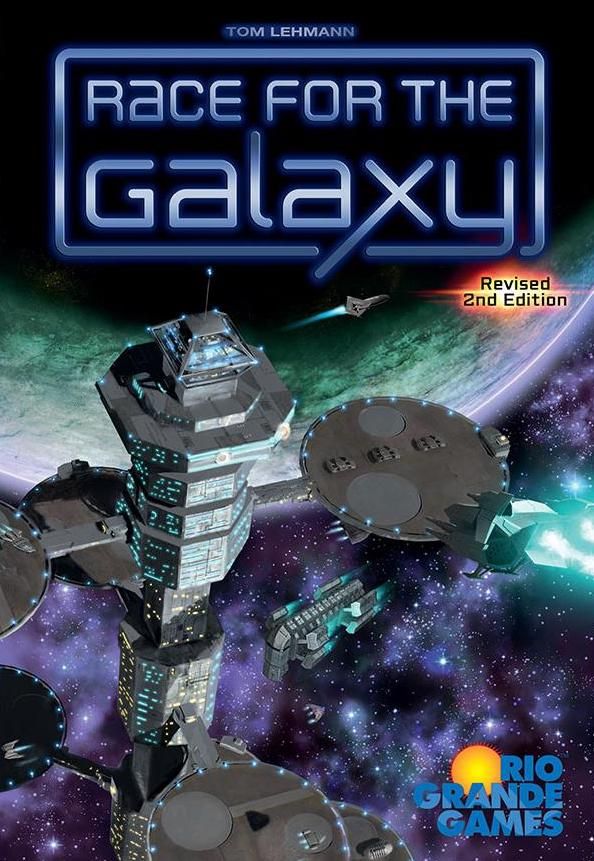
TOM LEHMANN
As knowledge of JumpDrive spreads, an ancient race stirs, while another flees a world doomed by a dying sun. The Imperium grows in strength, provoking further resistance and the hiring of mercenaries. Can you build the most prosperous and powerful space empire in a galaxy edging towards war?
OVERVIEW
Expansion #1:
The Gathering Storm
This expansion adds new start worlds and game cards, action cards and VP chips for a fifth player, and goals to Race for the Galaxy. A separate solitaire game, drafting variant, and some blank game cards – so players can design their own worlds and developments – are also provided.
CONTENTS
Some cards have been presorted for your first game (see Adding Cards).
Unpack the card deck carefully.
Carefully remove the VP chips, goal tiles, solitaire mat, and counters from their frames before your first game.
1 replacement Gambling World
4 start world cards (numbered 5-8)
7 action cards (for a fifth player)
18 game cards
2 2-player action cards (with )
17 blank game cards (see page 10)
1 contest entry card (see page 10)
9 victory point (VP) chips:
7 @ 1, 1 @ 5, and 1 @ 10
4 “most” goals (large tiles)
6 “first” goals (small tiles)
8 @ 3 VP goal chips
1 play mat (for solitaire game)
14 counters (for solitaire game)
2 custom dice (for solitaire game)
rftg_exp1_rules.indd 1 12.08.2008 18:30:54 Uhr
---
ADDING CARDS
Add the new game cards to the base set, replacing its Gambling World with the
Gambling World in this expansion (with an updated table that lists the number
of developments and worlds for each cost or defense).
Use the fifth preset hand (start world number 5 and the four game cards
with 5 in their corners) when playing with five new players.
A third Contact Specialist has been added for expansion play balance.
Most new card powers are variations on powers in the base set. Those that
aren’t have short text descriptions and are described in detail on page 11.
The start world Ancient Race has a setup power, requiring its owner to
discard down to three, not four, cards before selecting a first round action.
This power applies only when it is a start world.
Note that Improved Logistics can alter game tempo considerably.
Cards in this expansion have a mark below their card frames in
the lower left corner.
GOALS
Setup: shuffle the goal tiles face down. Select two of the “most” goals (the large tiles) and four of the “first” goals (the small tiles). Remove the remaining goals from the game. Place the selected goals face up in the center of the table to be claimed during play, next to the 3 VP goal chips. Then, continue setup normally.
Play: each goal’s upper left corner lists the phase(s) at the end of which it can be
claimed (or the end of a round in the case of Budget Surplus).
“First” goals: each of these tiles is worth 3 VPs and can be claimed once per game
by all players who first meet its condition. They can never be lost. If only one
player first satisfies a goal’s condition at the end of a phase, then he claims its tile,
placing it in front of him to mark 3 VPs earned. If more than one player first
satisfies a goal in the same phase (even if by differing amounts), then any one
of these players takes the tile, while the rest each take a 3 VP goal chip.
2
---
First to have 5 (or more)
VPs in chips (Galactic
Standard of Living).
Do not count any goal VP
chips.
“Most” goals: each of these tiles is worth 5 VPs and is held by the player
who satisfies its condition by the greatest amount. They can be lost. The first
player to satisfy (or exceed by the greatest amount) a goal’s listed condition at
the end of a phase claims its tile (returning it to the center if he ever fails to
satisfy its condition). If another player later exceeds the amount by which a
player holding a goal currently satisfies it, then he takes the tile.
Example: Alan plays a card that brings his Military in tableau to 6, which
satisfies the Greatest Military goal’s condition, so he claims its tile. (If Alan
later placed a -1 Military card, reducing his Military below 6, he would
return it.) Betty later obtains 6 Military, but since this doesn’t exceed
Alan’s total of 6, Alan retains this goal. Carol then reaches 7 Military and
takes this goal tile from Alan.
If more than one player satisfies or exceeds a goal (possibly held by another
player) by the same greatest amount, then that goal remains unclaimed (or is
returned to the center).
Example: Alan and Betty both reach 6 Military during the same phase.
Neither can claim the Greatest Military goal. Carol then reaches 7 Military
and claims it. Alan and Betty later both achieve 8 Military on the same
phase, so Carol then returns this goal to the center.
First to place a
6-cost development
(Galactic Status).
First to have at least one
power in each phase,
plus Trade, among his
tableau cards (Innovation
Leader).
First to discard at least
one card at round end
(Budget Surplus).
First to have at least one
production or windfall
world of each kind:
Novelty, Rare, Genes,
and Alien in tableau
(System Diversity).
First to have at least
three
ALIEN cards in
tableau (Overlord Discoveries).
3
rftg_exp1_rules.indd 3 12.08.2008 18:30:57 Uhr
---
At game end, for each “Most” goal, award a 3VP goal chip to each player
(satisfying the goal’s condition) who is tied for most and who does not currently
hold its tile, due to it either having been earlier claimed by another player or
being currently unclaimed (after several players satisfied or exceeded its
condition by the same greatest amount on the same phase).
Scoring: each player adds any goal tile VPs (3 or 5) and 3 VP goal chips
earned to their VP total. Goal VPs do not count towards Galactic Renaissance.
SOLITAIRE GAME
Use the experienced 2-player rules, without goals. You play against an “adaptable robot” opponent, whose actions are abstracted, and whose choices are determined by rolling custom dice. The robot’s start world determines how the two robot faces (on one of the dice) are read during play and which special mat counters modify or replace the robot’s standard actions and responses,
which are printed on the solitaire play mat.
The robot’s tableau is a stack of cards, without any goods, where only the
number of cards and their VPs matter. The robot’s tableau can contain 6-cost
development counters, representing additional developments placed during
play. The robot’s “hand” is a draw stack, from which cards are flipped over
during play and either added to the robot’s tableau or discarded. The robot’s
credit, used to acquire tableau cards in certain cases, and economy size,
used to gain VP chips during Consume phases, are tracked on the play mat.
4
At least four and the most
production worlds, of any
kind, in tableau
(Production Leader).
At least four and the most
developments in tableau
(Greatest Infrastructure).
At least six and the most
total military in tableau
(Greatest Military).
Count negative but not
temporary or specialized
military (as for New
Galactic Order).
At least three and the
most Novelty and/or Rare
production or windfall
worlds in tableau
(Largest Industry).
rftg_exp1_rules.indd 4 12.08.2008 18:30:59 Uhr
---
Setup: Set out 24 VP chips. Pick a difficulty (see chart) and set the appropriate number of 6-cost development counters to use nearby. Shuffle and deal one start world each to you and the robot. Shuffle the other start worlds into the deck. Use the black-edged credit, economy size, and (two) player action markers. Find the special mat and “robot =” counters to use (possibly on the reverse side of other counters) based on the robot’s start world, as shown on the back of the play mat. Remove the other counters from play. Flip the mat face up. Place any special mat counters used on top of the corresponding mat areas, matching them by color. Place the grey “robot =“ counter on its space (set the x2 “robot =“ counter nearby if the robot‘s start world is Old Earth). Place the credit marker on 1 (0 if the robot‘s start world is Ancient Race; 2 if it is Alpha Centauri); the economy size marker on 0 (1 if its start world is Earth‘s Lost Colony or Epsilon Eridani), and deal four cards (three if its start world is Ancient Race) face down to form the robot‘s initial draw stack (see diagram below). After setting up the robot mat, deal six cards to yourself. Choose four of them and discard the other two. Begin play.
Play: each round consists of the following steps:
1. Select your two player actions normally, but mark them with the player action markers on the play mat (instead of using action cards).
2. Roll and place the dice (the robot’s action selections) on the play mat.
3. Resolve actions for each selected phase, from left to right, player first.
Round end: discard down to 10 cards (the robot has no hand limit) and check for game end. If the game has not ended, repeat steps 1-3.
5
6-cost
difficulty counters
easy 1 @ 6 VPs
medium 2 @ 6 VPs
hard 3 @ 9 VPs
robot responses
to player actions
robot
dice row
military Settle
special mat counter
play mat
robot
draw
stack
credit
track
6-cost
counters
economy
size track
tableau stack
(with start
world)
player
action
markers
robot
actions
“robot =“
counter
rftg_exp1_rules.indd 5 12.08.2008 18:31:01 Uhr
---
Place dice: put them on their matching spaces in the dice row of the play mat; placing any single Explore, Develop, or Settle die face rolled on the left-most of these respective pairs of spaces on the play mat. Note that the grey Settle and Produce die faces match the colored Settle and Produce mat spaces.
If a face is rolled, read it as the face shown on the “robot =” counter.
Each “match” face rolled indicates a robot action that will match a player action this round. If “match” faces are rolled on both dice, put the dice on the spaces below the two player action markers. If only one face is rolled, put that die in the space below the right-most player action marker (unless this space already has a die in it, in which case this die goes below the other player marker). If both player action markers occupy a pair of Explore, Develop, or Settle spaces, then shift the die left so that it is below the first of this pair of spaces (unless the other die is already in that space).
Example: After you choose Consume x2 and Produce, the robot rolls Develop and ; put the first die on the left-most Develop space and the second die on Produce (the right-most unoccupied space below a player action). If, instead, you chose Explore twice and the robot rolled Produce and , put the first die on Produce and the second die on the left-most (first) Explore space.
Resolving Robot Actions / Responses
Resolve what the robot does for each selected phase according to the steps listed on the mat (and any special mat counters placed during setup) in two rows below the dice row. Use the top row if a die is present (a robot action). Use the bottom row if no die is present and the action was selected by you (a robot response).
Explore action: draw 1 card and increase the robot’s credit by 1 (draw 3 cards total and increase the robot’s credit by 1 if the robot selected both Explore actions).
Explore response: draw 1 card (even if the player chose both Explore actions).
Card Draws and Tracks: draw for the robot (in all phases) means shift the specified number of cards from the draw pile to the robot’s draw stack, without looking at them. The robot’s credit and economy size are marked by tracks; its maximum credit is 4 and its maximum economy size is 5 – increases beyond these numbers have no effect.
Separatist Colony ( ) draws more cards on Explore as shown on its special mat counter (which overlays the mat).
6
rftg_exp1_rules.indd 6 12.08.2008 18:31:11 Uhr
rftg_exp1_rules.indd 6 12.08.2008 18:31:11 Uhr
---
Develop action or response (for each selected Develop phase):
First, check to see if the robot has an unplaced chip and 2 or more credit (3 or more credit on response). If so, place this chip next to the robot’s tableau stack (where this chip will count as a card for determining end of game); decrease the robot’s credit by 2 (3 on response); and then skip the robot’s regular Develop action or response.
Otherwise, perform the robot’s regular Develop action or response:
Develop action: draw 1 card and then flip to find a development. If a 6-cost development is found and the robot has positive credit, decrease its credit by 1 and place it; otherwise discard it and continue flipping cards.
Develop response: if the robot has no credit, do nothing. Otherwise, flip to find a development. If one is found, whether or not it is a 6-cost development, decrease the robot’s credit by 1 and place it.
Flip to Find: means to flip over cards one at a time from the robot’s draw stack, discarding all non-matching cards, until either the desired type of card is found or the robot’s draw stack is exhausted. Place means to put the matching card in the robot’s tableau stack.
Example: Suppose you select Develop as one of your actions and the robot, with 1 credit and 2 cards in its draw stack, rolls Develop (plus some other action). After resolving your Develop, transfer 1 card to the robot’s draw stack and flip over cards from it, one at a time. On your second flip, you find a non-6 development and place it in the robot’s tableau stack. The robot ends with 1 credit and 1 card in its draw stack.
Later, you select Develop for both your actions and the robot matches your first Develop (and rolls some other action). The robot has 4 credit, 5 cards in its draw stack, and two unplaced 6-development counters. After resolving your first Develop, place one of its 6-development counters next to its tableau stack and decrease the robot’s credit by 2. Since it placed a 6-cost development counter, skip the robot’s normal Develop action and do not draw or flip any cards. After resolving your second Develop, resolve the robot’s response. Since it now has only 2 credit, do not place its other 6-development counter (this costs 3 credit on response), but instead begin flipping over cards (since the robot has positive credit). After finding a 2 cost development on its third flip, place it in the robot’s tableau stack and decrease its credit by 1. The robot ends with 1 credit and 2 cards in its draw stack.
7
action
on response
rftg_exp1_rules.indd 7 12.08.2008 18:31:13 Uhr
---
Settle action (for each robot-selected Settle phase): draw 3 cards and flip to find a non-military world, placing it if one is found.
Settle response (for each player-selected Settle phase): if the robot has no credit, do nothing. Otherwise, draw 2 cards and flip to find a non-military world. If one is found, decrease the robot’s credit by 1 and place it.
Example: You select Settle and the robot, with 0 credit, rolls two other actions. It does nothing.
Later, you select both Settle actions and the robot matches the first Settle action (and rolls some other action). The robot has credit 2 and a draw stack of 2 cards. After you perform your first Settle action, transfer 3 cards to robot’s draw stack and begin to flip them over. On its fourth flip, the robot finds a non-military world. Place it in its tableau. After you resolve your second Settle, transfer 2 more cards to the robot’s draw stack and, because the robot has positive credit on response, flip to find a non-military world. If it fails to find one after 3 cards, exhausting its draw stack, do nothing (the robot ends with 2 credit). If it does find a non-military world, place it and decrease its credit to 1 (since the robot is performing this Settle in response to your action choice).
Epsilon Eridani, New Sparta, and Separatist Colony, as indicated on their special mat counters, flip to find military worlds instead and do not need positive credit to Settle on response. New Sparta also receives extra Settle draws.
Doomed World’s first Settle action: flip from the draw pile (not its draw stack) until a 3 or more VP non-military world is found, place it, and increase its credit by 2 and its economy size by 1. Discard this mat counter and the Doomed World start world from its tableau.
Alpha Centauri receives extra draws on its Settle actions and does not need positive credit to Settle on response.
8
rftg_exp1_rules.indd 8 12.08.2008 18:31:14 Uhr
---
Consume: Trade action: increase the robot’s credit by 2 and give it VP chips equal to its current economy size.
Consume: 2x VPs action: give the robot VP chips equal to twice its current economy size and then increase the robot’s economy size by 1.
Both Consume actions selected by robot: give the robot VP chips equal to twice its current economy size and then increase its credit by 2 and its economy size by 1.
Consume response (if all Consumes chosen were selected only by the player): give the robot VP chips equal to its current economy size.
Example: You select Consume 2x VPs as one action and the robot rolls Consume: Trade as one of its actions. The robot has 3 credit and economy size 1. Increase the robot’s credit to 4 (its maximum) and give it a VP chip. The robot does nothing in response to your Consume 2x action, since it rolled a Consume action.
Later, you select both Consume actions and the robot rolls two other actions. The robot has economy size 3. Give it three VP chips. (Do so only once, despite the fact that you selected both Consume actions.)
Old Earth ( ), after its first Trade action: replace its “robot =” counter with and discard its mat counter.
Damaged Alien Factory ( ): after every Trade action, if its “robot =” counter is currently , flip it over to .
Produce action: increase the robot’s current economy size by 1.
Produce response: the robot does nothing.
Example: The robot rolls Produce as one of its actions. The robot has economy size 0. Increase its economy size to 1.
Later, you select Produce as one of your actions and the robot rolls two other actions. The robot does nothing.
Still later, you select Produce and the robot rolls Produce. The robot has economy size 2. Increase its economy size to 3.
Damaged Alien Factory ( ): after every Produce action, if its “robot =” counter is currently , flip it over to .
9
rftg_exp1_rules.indd 9 12.08.2008 18:31:16 Uhr
---
DRAFTING VARIANT (2-3 players)
After setting out the goals to be used, shuffle the odd and even start worlds separately and deal one of each, face down, to each player. Shuffle the unused start worlds into the game cards.
After looking at their start world choices, each player simultaneously draws five cards, selects one, and passes the rest to the left. From these cards, they each select one, and pass the rest left, until all cards drawn are taken. Repeat, drawing five cards, selecting one and passing the rest right. Continue, alternating directions, until players are unable to draw five cards apiece. Remove the remaining cards from play.
Each player shuffles his selected cards to form his own private deck and draws six, discards two of them and one of his start world choices, and then reveals his start world. Play normally, except that each player draws from his own deck of cards and discards to his own discard pile, reshuffling whenever his own draw deck is exhausted.
BLANK CARDS / CONTEST ENTRY
Blank game cards, of various types, are provided to allow players to add cards of their own design to the game. A black and a red marker (to mark costs, military, and powers) are needed to use them.
Use the contest entry card to send your best card idea to us for possible use in future expansions. See the entry card for further details.
Round end: discard down to 10 cards (the robot has no hand limit) and then check to see if the game has ended. If not, select actions for the next round.
Game end: the game ends normally, at the round end in which either the player’s or robot’s tableau is 12 or more cards (counting any placed 6-cost development counters as one card apiece towards the robot’s tableau total), or the 24 VP chips are exhausted (use extra VP chips to finish out the round).
Add the robot’s VP chips and tableau VPs, scoring each 6-cost development card or counter as 6 or 9 VPs, depending on the selected game difficulty. If a tie occurs, the robot’s final credit plus its economy size is its tie-breaker value (the player’s tie-breaker value remains cards in hand plus goods).
10
rftg_exp1_rules.indd 10 12.08.2008 18:31:17 Uhr 12.08.2008 18:31:17 Uhr
---
CARD POWERS (by phase)
Discard for Temporary Military
The player may discard up to 2 cards from his hand to gain +1 Military apiece until the end of this Settle phase.
As an optional power, this power need not be used fully.
Space Mercenaries also has a standard +1 Military power.
Settle a Second World
The player may place a second world ( ) in a Settle phase.
The second world is placed as part of executing Settle powers (after fully resolving settling the first world).
No powers from the first world placed may be used to settle the second one.
If the player chose Settle, do not draw a Settle bonus for the second world.
Specific Good and Worlds
Draw +1 card when selling a Genes good for each world in the tableau.
The Clandestine Uplift Lab is itself a world.
This World’s Good
Discard 1 Alien good from the world ( ) with this power to gain 2 VPs.
Discard to Produce Good
May discard 1 card to produce an Alien good on this world.
A player can discard a card gained from Diversified Economy to produce this good, but can not then gain a card for doing so (as one power can not interrupt another power).
Draw for Worlds
Draw 1 card for each military world ( ) in the player’s tableau.
11
III: SETTLE
$: TRADE IV: CONSUME
V: PRODUCE
rftg_exp1_rules.indd 11rftg_exp1_rules.indd 11 12.08.2008 18:31:18 Uhr 12.08.2008 18:31:18 Uhr
---
6-COST DEVELOPMENT POWERS
For these developments, score end of game VPs for every card in its owner’s tableau that satisfies one of the conditions listed on it, where a CARD TITLE refers to that card’s presence in the tableau.
CREDITS
Design, development, and rules: Tom Lehmann Original graphics and development assistance: Wei-Hwa Huang Graphics: Mirko Suzuki Illustrations: Martin Hoffmann and Claus Stephan
Playtesting and Advice
Corin Anderson, Andrew Conway, David Helmbold, Jay Heyman, Joe Huber,
Trisha Lantznester, Chris Lopez, Larry Rosenberg, Ron Sapolsky, Steve Thomas,
Jay Tummelson, Don Woods, and many others. Thank you all!
Special Thanks (especially for help on the solitaire version): Wei-Hwa Huang
If you have any comments, questions, or
suggestions, please write to us at:
Rio Grande Games, PO Box 45715,
Rio Rancho, NM 87174, USA
E-Mail: RioGames@aol.com
© 2008 Tom Lehmann
© 2008 Rio Grande Games
GALACTIC GENOME PROJECT IMPERIUM IMPERIUM L
IMPERIUM IMPERIUM card
(including this one)
other military
world
windfall world
TERRAFORMING TERRAFORMING card
(including this one)
TERRAFORMING TERRAFORMING GUILD
GENETICS LAB
Genes world
Note: there are no IMPERIUM IMPERIUM military
worlds in this expansion (or the base
set); this wording is for future
expansions.
rftg_exp1_rules.indd 12 rftg_exp1_rules.indd 12 12.08.2008 18:31:19 Uhr 12.08.2008 18:31:19 Uhr
---
Why ask BoardGamesBot
Instead of flipping through the whole manual- Accurate answers Based exactly on this manual, with the source page.
- Save time Find the rule in seconds, without flipping 12 pages.
- Anytime Settle rules mid-game, straight from your phone.
- 100% free Create your free account and start using it now.
How it works
Three steps to the answer- 1 Ask your question Type your question about this game's rules.
- 2 Create your free account Takes 20 seconds — it only saves your history.
- 3 Get the answer The AI finds the exact rule and cites the manual page.
Expansion for
Published additional content
Manual published by the publisher · for rules reference only. More about the game on BoardGameGeek and Ludopedia .
