
/pic1886437.jpg)
What is your question about Viticulture: Tuscany?
Ask before downloading the manual: the assistant was trained on this file and answers instantly, citing the exact page.
Ask questions about the game
Ask anything about Viticulture: Tuscany: rules, setup, components, complexity, price, or whether it fits your group.
Write your question first. You will create your free account to see the answer — it takes 20 seconds.
Full rulebook
Browse the manual or download the original PDFFull manual text available to read Open text
Stonemaier Games Presents
TUSCANY
EXPAND THE WORLD OF VITICULTURE
designed by Jamey Stegmaier, Alan Stone, & Morten Monrad Pedersen
art by Beth Sobel
Tuscany is a pack of expansions to Viticulture: The Strategic Game of Winemaking that
unlock game after game as determined by the previous game's winner.
What story will you tell as you seek to create the most successful vineyard in Tuscany?
1-6 PLAYERS AGES 14 & UP • 60-120 MINUTES
PLEASE READ THIS BEFORE OPENING ANY OF THE
EXPANSION COMPONENTS IN TUSCANY.
Tuscany is a legacy-style expansion pack, meaning
that each expansion in this box will be opened
("uncorked") one by one in an order determined
by the winner of the previous game. When all
expansions in Tuscany have been uncorked, you
have the option of starting over from the beginning
to explore Tuscany with a different group or in a
new way with the same group.
Some people like to do a "component check"
when they open a new game. We discourage that
for Tuscany, as the game is designed as a shared
experience of discovering and expanding the world
of Viticulture. If you eventually find that something
is missing, please fill out the replacement parts
form on our website and we will send you the
missing components.
stonemaiergames.com/replacement-parts
---
UNCORKING TUSCANY
WHAT STORY WILL YOU TELL AS YOU SEEK TO BECOME THE MOST SUCCESSFUL
VINEYARD OWNER IN TUSCANY?
HOW IT WORKS
1. If you are new to the world of Viticulture, please play a few games with the
original game before expanding into Tuscany. If you've been playing the first
edition of Viticulture and now have the second edition update pack or the full
second edition, first play a few games with it. Tuscany is fully compatible with
all editions of Viticulture.
2. When the time is right and the wine is poured, play one more game of
Viticulture. The winner of that game will decide which of the 1st-tier expansions
to uncork and include in the next game. We recommend playing 1-2 games
for each 1st-tier expansion. The winner of the last game will select the next
expansion to uncork. At the beginning of each game, make sure to clearly state
if it will be a game when the winner gets to choose a new expansion to uncork.
3. After ALL 1st-tier expansions have been uncorked and explored, the 2nd tier
of expansions becomes available to be uncorked in the same manner. When
all 2nd-tier expansions have been revealed, proceed to open the 3rd and final
tier. We recommend playing 2-4 games for each 2nd- and 3rd-tier expansions
before uncorking a new expansion.
Once all Tuscany expansions are uncorked, the winner of the previous game
chooses which 3rd-tier modular expansion (if any-see note to the bottom right)
will be included in the next game. You may also put all Tuscany expansions
in the box and start over with a clean slate. This allows players to uncork the
elements of each tier in a different order and provides a clean slate with a new
group. See page 24 for some variants to this uncorking mechanism.
DESIGNER NOTES
Other than the storytelling aspect of
uncorking each expansion separately
in a unique order, there is another
reason that we structured Tuscany the
way we did.
There are so many expansions in
Tuscany that if players were to add
them all to the game right out of
the box, it would be a frustrating,
overwhelming experience (so please
don't do that!). By adding expansions
one by one, players have the chance
to familiarize themselves with the
nuances of each expansion.
After a few plays, each of the
expansions will become second nature,
thus creating an opportunity to add a
new expansion without overwhelming
anyone.
As seen in this rule book, none of
the expansions are secret, but we
recommend that you save the surprise
of a new expansion until it is uncorked.
We attribute credit for the unlocking/
legacy mechanism in Tuscany to Risk
Legacy (designed by Rob Daviau).
1ST TIER
Mamas & Papas
Property
Patronage
Advanced Visitors
2ND TIER
New Visitors
Extended Board
(side 1)
Special Workers
Structures
(only after Ext. Board)
3RD TIER
Mafia
Arboriculture
Formaggio (cheese)
Automa
PAGE
4
5
6
7
8
9
12
14
15
16
18
20
NOTE: The 1st and 2nd tiers of Tuscany
are not modular-that is, when you
uncork a new expansion, it should be
included in every game of Tuscany
from then on. The 3rd-tier expansions,
however, are always modular-only one
expansion from that tier may be played
at a time (you may also choose to play
with none of the 3rd-tier expansions). So
if you play with Formaggio, you must
include all 1st- and 2nd-tier expansions,
but not Mafia or Arboriculture.
New Icons
GENERIC
GRAPE TOKEN
GENERIC
WINE TOKEN
---
Viticulture Second Edition Updates
ENHANCE, ELEVATE, AND EXPAND VITICULTURE: THE STRATEGIC GAME OF WINEMAKING BEYOND JUST
MAKING WINE AS YOU OPEN YOUR VINEYARD TO THE GREATER WORLD OF TUSCANY.
Viticulture Second
Edition Rules
If you've played or currently own a
first-edition copy of Viticulture, there
are a few rule changes you should be
aware of (and play with a few times)
before exploring Tuscany.
Updated Components
1 quick reference guide
6 grande worker meeples
30 grape and wine tokens (glass)
1 sheet of stickers for player
mats & board
11 updated visitor cards
(remove the originals)
SUMMER VISITORS
Entertainer
Handyman
Horticulturist
Vendor
Tour Guide & Novice Guide
(neither card triggers
the Tasting Room)
WINTER VISITORS
Mentor
Crush Expert
Crusher
Uncertified Oenologist
Jack-of-All-Trades
Overview
The following summarizes the rule changes in the second edition:
GRANDE WORKER: Start the game with 2 regular workers and 1 grande worker.
The grande worker acts as a regular worker, but it can be placed on an action on
the board even if all action spaces are full (that special ability doesn't apply on
private action spaces like the Yoke). The only way for a grande worker to gain a
bonus is to place it on an unoccupied bonus action space.
MAKING WINE: The old "crush grapes" action is now "make up
to 2 wine tokens." Using the grapes on your crush pad, make
2 wine tokens (the type of wine may be different for each
token). The bonus on that action now means that you can
make 1 extra wine token.
STARTING PLAYER: To select the starting player at the
beginning of the game, blindly select one rooster. That
player selects their wake-up time first, and then selection
continues clockwise.
YOKE: You can now use the Yoke to harvest or uproot in either
the summer or winter (or in any season when the extended
board is uncorked).
NO MORE FRIENDLY RULE: There is no longer a rule that
prevents players from choosing a bonus action space even if
they don't want to (or can't) use the bonus. When you place a
worker, you must still take the action, but the bonus is optional.
OBJECT OF THE GAME
Viticulture is primarily about making
wine. There are various paths to victory
that include the visitor cards, giving
tours with the Tasting Room in play,
and planting vines with the Windmill in
play, but the whole point of the game is
to make wine.
In Tuscany, there are many more ways
to improve your reputation (victory
points) as a vineyard owner. You're
building and improving your winery in
a variety of ways—you're buying and
selling property, satisfying the whims
of wealthy patrons, spreading your
influence, and much more. Wine is
still an integral part of Tuscany, but we
challenge you to think big as you unlock
and explore the expansion pack.
END GAME & GOAL
The last year of the game is still
triggered when a player reaches at least
20 victory points by the end of the
winter season, but there is no longer
a maximum point limit for neither
Viticulture or Tuscany.
New Icons
ONE-WAY
CONVERSION
RESIDUAL
---
TIER 1
MAMAS & PAPAS
YOUR BELOVED PARENTS BESTOW UPON YOU AN INHERITANCE TO INTRODUCE YOU TO THE WORLD OF
WINEMAKING: A MEDLEY OF VINES, WINE ORDERS, VISITORS, MONEY, AND STRUCTURES.
INTRODUCTION
The mama and papa cards introduce asymmetric starting resources. Players
won't begin the game with the standard set of workers, cards, and money;
instead, each player will start with a unique combination of those resources as
indicated by their Mama and Papa cards.
SETUP
After randomly selecting the first player, shuffle the mama cards and deal one
face-up to each player. Then shuffle the papa cards and deal one face-up to each player.
Every mama comes with 2 regular workers. Draw cards as indicated on your
mama card to form your opening hand. Do this before gaining resources from
your papa card.
Every papa card comes with 1 grande worker, and most come with a certain amount
of lira. Papa cards also give you a choice: start with a specific structure or gain a few
extra lira. Players make this choice in clockwise order starting with the first player.
Several papas offer an extra regular worker or a victory point instead of a structure.
After all starting resources are accounted for, discard the mama and papa cards.
They are only used while setting up the game.
EXAMPLE
You are dealt the following mama & papa cards:
Mama
ALAENA
Papa
MATTHEW
Card frame art credit: Dann May
DESIGNER NOTES
The original (and final) intent of
the mamas and papas is not to
pick players' strategies for them,
but rather to give players different
priorities during the first few years of
the game so they're not all going for
the same actions.
COMPONENTS
18 mama cards
18 papa cards
TEACHING THIS EXPANSION
Newer players may stumble over the
choice to start with a structure or the
extra lira. If it is a basic structure-a
trellis, irrigation, yoke, or medium
cellar, you can recommend they
choose the structure. If it is a more
advanced structure-a cottage,
windmill, or tasting room-you can
recommend they choose the money
instead.
Thus you will begin the game with
2 regular workers, 1 grande worker,
1 vine card, 1 summer visitor card,
1 wine order card, 1, and either a
windmill or an additional 5.
ADVANCED VARIANT
Some groups might prefer to let each
player draw 2 mamas and 2 papas,
then choose 1 of each.
The optional lira bonus for the
yoke and medium cellar are higher
in comparison to other structures
because those structures are rarely
useful until the third year of the
game.
STRATEGY TIP: Unless you want to
attempt a strategy that completely
conflicts with the structure given to
you by the papa, it is always more cost
effective to start with the structure. Not
only is it most often worth more money
than the lira alternative, but it also
saves you a precious worker placement
to build that structure during the game.
---
TIER 1
PROPERTY
YOU LOOK ACROSS YOUR VAST VINEYARD AND REALIZE THAT YOU DON'T NEED ALL OF YOUR FIELDS,
SO YOU PUT THEM UP FOR SALE TO GIVE YOUR CASH FLOW A NICE BOOST.
COMPONENTS
18 property tiles
(6 of each type)
1 "Sell Grapes or
Flip 1 Property" tile
GAMEPLAY
Vine cards are now planted on
property tile as if they were fields
(property tiles = fields). The total value
of all vine cards planted on a property
tile may not exceed the property's max
vine value rather than Viticulture's
standard max vine value of 6.
When taking the "Sell Grapes or Flip
1 Property" action in the summer, you
may sell a face-up property that has
no vine cards on it. The action has a
bonus of ① that is now available in a
2-player game. Gain the lira shown on
the bottom of the property tile and flip
the tile.
You do not own flipped properties
and thus cannot plant vines on them.
Visitor cards that refer to properties you
currently own. You can flip back property
tiles you don't own by placing a worker
on the "Sell Grapes or Flip 1 Property"
action and paying the price on the upper
left of the tile. That property is now
eligible for planting vines.
INTRODUCTION
Flipping properties is an easy way to earn some quick cash from unused fields to be
able to build structures and workers early in the game, and they can net you a victory
point or two if timed correctly.
SETUP
Each player receives the same three property tiles: ⑤, ⑥, and ⑦. Place those
tiles over the fields on your vineyard mat with the lira value visible on the bottom
of each tile. Also place the "Sell Grapes or Flip 1 Property" tile on the board over
the "Sell Grapes" action.
EXAMPLE
You want to flip one of your properties to gain some money. So you place a
worker on the "Sell Grapes or Flip 1 Property" action and select a property that
has no vine cards on it to flip:
Before you flip the ⑤ property, it
looks like this:
either of these properties can be flipped
You no longer own that property and can
only use it if you take the "Flip 1 Property"
action and pay ⑤ to flip it back.
SOLD
STRATEGY TIP: Be very selective
about which property tile(s) you flip
over, as you're not going to want to
use a worker to flip it back if you can
avoid it. Try to draw a few vine cards
before flipping your first property so
you can decide if you want to pursue
a small-vine strategy, a large-vine
strategy, or a multiple-vine strategy.
DESIGNER NOTES
One of the most common pieces of
feedback we received about Viticulture
is that money is really tight early in
the game and overly abundant late in
the game. The Property expansion is
intended to directly address both sides
of that issue.
---
TIER 1
PATRONAGE
As YOU BUILD YOUR REPUTATION AS A VINEYARD OWNER, YOU CATCH THE EYES OF A WEALTHY PATRON
WITH A TASTE FOR FINE WINE AND A PENCHANT FOR A GOOD CHALLENGE.
INTRODUCTION
Patronage cards give players both a short-term goal and an overarching strategy
to pursue over the course of the game. You cannot draw patronage cards, and
they do not count towards your hand limit.
SETUP
Shuffle the patronage cards and deal 1 to each player face-down. You may look
at your card. The "face" of the card is the side with the coins on the table and
a handwritten secret goal—the other side with the patron in the portrait is the
same for all cards.
GAMEPLAY
You activate a patronage card just like a normal wine order: Take a "Fill 1 Wine
Order" action, discard any wine token from your cellar with value 5 or greater
(type of wine is not specified on patron cards), and gain 3. Keep the portrait
portion of the patron card under your vineyard mat until you fill the order on it,
then move it to the left of your vineyard mat.
If you've activated your patronage card, you can also earn 2 bonus at the end of
the game if you achieve the secret goal on the face side of the card (only you can
gain points from your patronage card, not other players'). If the goal is relative to
other players, ties are acceptable.
EXAMPLE
This is an example of a patronage card with a secret
goal that you can accomplish without comparing
production to other players. If you activate this patronage
card and have at least 6 structures constructed at the end
of the game, you get the 2 bonus.
This is an example of a patronage card that is relative
to other players. If you're able to have the most total planted
wine cards on all of your fields (or tie for the most), you
get 3 bonus at the end of the game.
DESIGNER NOTES
The goal for the patronage cards was to add something for players to target early in the game when they might need
some direction, incentivize winemaking, and to add a secret element for end-of-game scoring uncertainty.
COMPONENTS
9 patronage cards
Example of an unactivated patronage card:
Example of
an activated
patronage card:
STRATEGY TIP: Your patronage card
probably shouldn't be the first wine
order you fill, as you won't get any
residual payments from it. But even if
you're nowhere close to achieving the
secret goal near the end of the game,
it's almost always a good idea to fill
the wine order on your patronage
card for a few extra points.
---
TIER 1
ADVANCED VISITORS
AS FIRST-TIME VISITORS BECOME REPEAT VISITORS, THEY DEVELOP SOME NEW SKILLS THAT CAN AID
THE GROWTH AND DEVELOPMENT OF YOUR VINEYARD
COMPONENTS
15 advanced summer
visitor cards
15 advanced winter
visitor cards
INTRODUCTION
Advanced visitor cards are distinguished from the original visitor cards by their updated
card frames (the backs are the same as the original winter and summer visitor cards).
All of the standard rules for visitor cards apply to the advanced visitor cards, and any
card or rule that refers to visitor cards also includes advanced visitor cards.
SETUP
Shuffle the advanced visitor cards into the decks of original visitor cards.
EXAMPLE
Many
advanced
visitors have
two separate
clauses
delineated by
the all-caps
word "OR".
These are two
completely
independent clauses. In the example
above, you choose to either (1) age
all wine in your cellar twice OR (2)
lose 1 to upgrade your cellar to the
next level.
The rules for training a new worker
apply to all visitor cards—unless the
card says otherwise, you can't use
the worker until the following year.
The icon on visitor cards reads
"any worker."
GAMEPLAY
Some advanced visitors introduce some new mechanisms and options:
Several advanced visitors let you pay to place a 1-value
grape on your crush pad. This is not a grape harvested
from your vines—rather, it is as if you are buying grapes
directly from a market. A 1-value grape slot on your
crush pad must be open to use this ability.
Several advanced visitors refer to a bonus you
get for structures of specific costs. The bonus
only applies to structures with that exact cost.
For example, the Advanced Blacksmith
gives you for building a windmill,
tasting room, or large cellar.
ADVANCED VARIANT
Instead of shuffling the original and advanced visitors together, you can
remove all original visitor cards except for the following: Entertainer,
Handyman, Horticulturist, Volunteer Crew, Peddler, Vendor, Promoter,
Mentor, Guest Speakers, Caravan, Harvest Expert, Innkeeper, and Jack-ofAll-Trades. Shuffle those cards in with the advanced visitor cards for
future games.
DESIGNER NOTES
In the original game, some visitors were
good only early in the game and some
only at the end of the game. The goal for
the advanced visitor cards was to make
every card immediately useful, whether
at the beginning, middle, or near the
end of the game.
NEW ICON
+
1 OF ANY CARD
---
TIER 2
NEW VISITORS
WORD HAS SPREAD ABOUT YOUR BEAUTIFUL VINEYARD, ATTRACTING NEW VISITORS
WITH SPECIAL SKILL SETS TO TUSCANY FROM AROUND THE WORLD.
INTRODUCTION
A number of the new visitor cards
break the rules of the game, opening
up doors for strategies that weren't
possible in the original game.
EXAMPLES & CLARIFICATIONS
CULTIVATOR Plant 1 You may plant it on a field even if the total value of that
field exceeds the max vine value. This is a one-time exception to the rules about
planting on fields up to a certain vine value. That is, you may not continue to
plant on that field in excess of the max vine value on future turns.
MANAGER Take any action (no bonus) from a previous season without placing
a worker. Any action on the board from those seasons are available, even if all
action spaces are full.
MOTIVATOR All players may retrieve their grande workers. Gain for each
opponent who does this. Opponents who have already passed their turn for
the season are not eligible to retrieve their grande workers.
ORGANIZER Move your to an empty row on the wake-up chart, take the bonus,
then pass to the next season. When you pass using the Organizer, you rooster
will stay in the new wake-up order you selected. On the extended board, you may
choose the first row of the wake-up track (if it's unoccupied).
PLANNER Place a worker on an action in a future season. Take the action at the
beginning of that season. Thus, if you place a worker on the "Fill 1 Wine Order"
action, you take that action before players take winter actions as normal in wake-
up order. For example, if you are first in wake-up order, you would take the Planner
action and then take your turn. This card only applies to action spaces on the board.
PRODUCER Pay to retrieve up to 2 from other actions. They may be
used again this year. "Other actions" refers to any action other than the "Play 1
summer visitor action" where you played the Producer. Retrieving those workers
may open up action spaces in the summer for you and other players to use.
SHARECROPPER Plant 1 even without the required structure(s) OR uproot
and discard 1 to gain. This card lets you bypass the normal "cost" for
planting vine cards-you don't need a trellis or irrigation to plant with the
Sharecropper's first ability.
ZYMOLOGIST Make up to 2 of value 4 or greater, even if you haven't upgraded your
cellar. Thus, if you use this card to make a 5-value red token, you may place it
on the 5-value space even if you don't have the medium cellar. For that token
to age past the 6-value, you need to build both a medium cellar and a large
cellar. (You cannot build a large cellar without a medium cellar.)
SETUP
Shuffle the new visitor cards into the
current decks of visitor cards.
COMPONENTS
16 new summer visitor cards
16 new winter visitor cards
GAMEPLAY
Some new visitors introduce some
new mechanisms and options:
BANKER, IMPORTER, MOTIVATOR,
GOVERNOR, SWINDLER: These cards
give opponents a choice when you play
the card. Each opponent should make
their choice in wake-up order.
AGRICULTURIST, DESIGNER, GROWER:
These cards all have a "Then, if"
statement. Thus you must take the
first action to be eligible for the bonus.
(Grower: Plant 1. Then, if you have
planted at least 6 total gain .)
TASTER: The Taster requires you to
discard the most valuable wine token
(no ties, including in your own cellar)
to gain the bonus .
BANKER
POLITICIAN
Gain
may lose
If you have less than
gain
Otherwise,
draw
and 1.
---
TIER 2
EXTENDED BOARD
YOU'VE GROWN YOUR VINEYARD AS MUCH AS POSSIBLE. IT'S TIME TO EXPAND YOUR OPERATIONS
TO ALL FOUR SEASONS AND SPREAD YOUR INFLUENCE OVER THE LAND.
COMPONENTS
1 game board
36 influence tokens ( )
in 6 player colors
NEW CONCEPTS
Four full worker-placement seasons
Adjusted and added bonuses
on actions
Extended wake-up chart
Grey "any card" icon
Influence map
Trade action
Sell wine action
Extended victory point track
End-of-year cleanup and
wake-up selection
INTRODUCTION
Why would we make the board bigger? Well, it's not so much about size. It's that we
wanted to enhance the flow of the game by adding spring and fall worker-placement
seasons to the game.
SETUP
Set the original board aside and replace it with the extended board. Make sure it's on
side 1; side 2 has spaces for orange cards on the upper right—that's for the structure
expansion, which can only be unlocked after the extended board's side 1 has been
used at least a few times. Each player begins the game with 6 of their color
among their pool of unbuilt structure tokens and untrained worker meeples.
GAMEPLAY
While the core gameplay is the same on the extended board as it was on the original
Viticulture board, there are some new actions and nuances to explain in depth.
Place the green grapes first-player token as shown on the lower right of the wakeup chart (instead of giving it to the first player).
FOUR SEASONS
There are now four seasons for worker placement in Tuscany, each with four actions.
All previous rules apply—you can only place each worker once per year, and the
player who wakes up the earliest chooses his first worker placement each season
before all other players. The only change is that you don't necessarily take a visitor
card in the fall—that depends on your position on the wake-up chart (see next page).
Credit to Justin Killam, the
winner of the Viticulture
expansion design contest,
for inspiring the creation of
the influence map on the
extended board.
ACTION SPACES AND BONUSES
Just like in regular Viticulture, the action spaces available depend on the number
of players. The opacity of the action spaces has changed, but their order is still
the same (see graphic on left). The action spaces may be selected in any order if
they're available.
Some bonuses have changed positions—they aren't necessarily on the middle
action space. Some actions even have 2 different bonuses. Remember that there
is no "friendly" rule anymore—you may place a worker on a bonus even if you
don't use it (you must take the action, but the bonus is optional).
9
2 PLAYERS
3-4 PLAYERS
5-6 PLAYERS
---
TIER 2
EXTENDED BOARD
WAKE-UP CHART
At the beginning of the game, randomly select one player's rooster token. That
rooster's player is the first player to choose his/her wake-up time, and wake-up
selection proceeds clockwise around the table. You may not choose to wake up
1st (the number 1 slot), and you do not gain any bonuses from the wake-up chart
when you place your rooster.
For the rest of the game, choose your wake-up time for the following year when
you pass out of the winter season. If you woke up 7th the previous year, you must
now wake up 1st—that is the only way to choose the first row of the wake-up chart.
When you place your rooster on the wake up track in the spring, you don't get an
immediate bonus. You're simply choosing your wake-up order for that year-your
rooster will remain on that same row for the rest of the year, gaining a bonus
when you pass to the next season.
END OF YEAR UPKEEP
When you use your turn to pass out
of the winter (which you may do even
if you have workers remaining), you
immediately do the following in
this order:
1. Retrieve your workers (including the
temporary worker if you controlled
it this year). This could open up
action spaces in the winter for
players who have not yet passed.
2. Age grapes and wine: Increase the
value of all grape and wine tokens
by 1. Wine tokens may not move
into cellars you haven't built.
3. Discard down to 7 cards in hand.
4. Collect residual payments.
5. Choose your wake-up position for
the upcoming year. You no longer
pass the first-player token for wake-
up selection (the token no longer
serves a purpose other than to
remind the player who woke up
7th the previous year to now wake
up 1st).
SPRING
In wake-up order, you may either (a) place 1 worker on a green action space on
the game board or a private action space you control (e.g., Yoke) or (b) pass to
the summer by sliding your rooster to the summer column of the wake-up chart
(the row does not change, and you may only pass to the next season-you can't
skip ahead to future seasons). Players may continue to take turns in this order for
the spring until everyone has passed to the summer.
When you pass into the summer, take the bonus (if any) as indicated in the
summer column on the wake-up track. For example, if your rooster token is on the
2nd row, when you pass to the summer, you gain 1. Any workers you placed in
the spring remain where they are—you only retrieve workers at the end of the year.
SUMMER
When all players have passed to the summer, players take turns in wake-up order
(the player with the earliest wake-up time takes the first turn each season) using
the yellow summer actions or, as in any season, private action spaces.
FALL
When you pass into the fall, take the bonus represented in the fall column.
Unlike Viticulture (in which all players would automatically draw a visitor card in
the fall), you only draw a card if you are in rows 3-7 of the wake-up chart. If you
own a cottage, draw a visitor card of your choice when you pass into the fall in
addition to any card you might draw from the wake-up chart (draw a card from
the cottage even if your rooster is on rows 1 or 2 of the wake-up chart). The 3 on
the chart means "draw 1 of any card."
WINTER
When you pass into the winter, again, take the bonus (if any). The star means
that you place or move 1 on the map, as explained on the next page. "Age
grapes" means that you immediately age all grape tokens on your crush pad
according to the usual aging rules (also age them at the end of the year).
---
EXTENDED BOARD
NEW ACTIONS
INFLUENCE ACTION
You now have the ability to use workers to influence the various regions of Tuscany.
Thus if you place a worker on the "Place or Move " action (or wherever you see an
influence token on the board, like on the wake-up chart or the "Sell One Wine Token"
action), place 1 of your 6 available influence tokens from your supply onto the map on
the lower left of the board and immediately gain the benefit listed below the name of
the region (e.g., place a star on Livorno to draw a summer visitor card). Once placed,
you cannot return a star to your supply.
After all of your stars have already been placed, you may still use the influence action to
move a star to any other region. You don't gain any immediate benefit from moving a
star-you only get the benefit when you place a star. You may only place or move your
stars, not other players' stars.
The bonus on the Place or Move action is to place or move an extra .
At the end of the game, the player with the clear majority of influence tokens in each
region (compared to each other player with stars in that region) gains the victory
points listed on that region. Thus, if Jamey has 2 in Arezzo and Jennifer has 1
Jamey gets at the end of the game. However, if Jamey and Jennifer each have
2 there, neither of them get any points.
TRADE ACTION
TRADE ONE FOR ONE
red grape token to gain a 1-value white grape token on your crush pad. You can trade
away a grape of any value; however, if you choose to trade for a grape token, it must
be a 1-value grape token. Also, the +1 bonus means that you may make an additional
trade. Ignore the grape prices on your vineyard mat (unless you play a visitor card that
says "sell grapes").
SELL ONE WINE TOKEN ACTION
This is a new way to get victory points
for wine. Discard a wine token from
your cellar and gain the corresponding
number of victory points. Only the type
of wine matters, not the value. The
bonus on this action lets you place or
move .
END GAME
The game is over at the end of a year in
which a player has reached 25 or more
victory points (not 20) by the end of
winter. After all players pass at the end of
that year's winter (each player must pass
because other players may be holding
out for the action spaces your workers
are on), add in victory points from
patronage cards and the influence map.
The player with the most victory points
is the winner. Lira is still the tiebreaker,
and the VP track goes to 40 (there is no
maximum point limit).
STRATEGY TIP: If the vine cards
and wine orders you draw aren't
matching up, use the trade action
to either (a) exchange cards in hand
for new cards or (b) trade for grape
tokens. You can also ignore wine
order cards and simply sell wine via
the "Sell One Wine Token" action.
---
TIER 2
SPECIAL WORKERS
AS YOUR VINEYARD GROWS, YOU BECOME MORE SELECTIVE ABOUT THE WORKERS YOU HIRE.
SOME WORKERS HAVE UNIQUE SKILL SETS THEY BRING FROM THEIR PREVIOUS OCCUPATIONS THAT MIGHT
HAVE A POSITIVE IMPACT ON YOUR VINEYARD.
INTRODUCTION
COMPONENTS
Employees aren't identical in real life, so why should workers in a board game
do the exact same thing? These new workers not only add a spark of realism to
Tuscany, but they also change the value of many action spaces in relation to other
players to add more variability.
11 special worker reference cards
66 special worker meeples
SETUP
LIST OF SPECIAL WORKERS
Randomly shuffle the 11 worker cards and place 2 on the table (in a 2-player game,
if you draw the Innkeeper card, discard it and draw another). Set the rest aside—
they will not be used this game. The 2 selected worker cards represent the only
special workers available to be trained in the current game.
Farmer
Mafioso
Chef
Innkeeper
GAMEPLAY
Professore
When training a worker, you now have the option to pay 1 additional lira to train
one of the available special workers instead of a regular worker. No matter the
cost offered to you elsewhere to train a new worker (1, 2, 1, 2, discount,
etc), you always have to add 1 extra lira to train a special worker instead of a
regular worker. The special workers are available to all players throughout the
game—the cards stay on the middle of the table. Each player may train no more
than one of each type of special worker.
Soldato
Politico
Oracle
Merchant
Messenger
Traveler
Each special worker has a unique, optional ability as described on the following
page and on the corresponding special worker reference card. If a worker's ability
involves something that happens when you place the worker or when another worker
is placed on the same action space, that ability triggers before anything else happens (unless a card says otherwise). Special
workers act just like regular workers in all other regards.
You are not required to train special workers—if you prefer to have regular workers, that's fine. But the maximum limit of 6
total workers is still in place. Just like regular workers, unless a card says otherwise, you cannot use a newly trained special
worker until the year after it is trained.
Just like regular workers, you may place special workers on private action spaces (your vineyard mat, any mat extensions,
and structures you've built), but most special worker abilities trigger when they're placed on the board (this is noted on their
cards). You may never place any of your workers on an opponent's private action spaces.
DESIGNER NOTES
When we created the grande worker
for Arboriculture and later added it to
the core rules of Viticulture, we knew
we had stumbled into an interesting
area of game design: Workers in a Euro
game that have vastly different abilities,
giving players not just the choice of
where they place their workers, but also
which worker to place.
As we started to develop the special
workers, we thought that each player
might have access to a different
special worker. So one player might
be the Chef, another the Politico,
another the Farmer. But we quickly
realized that some players might end
up with an advantage over other
players, and it would be hard to keep
track of so many abilities.
So we decided to make two of
the special workers available for
each player to train. This creates a
multitude of combinations of special
workers for players to explore.
We included 5 blank special worker
cards so you can make your own.
Feel free to share your ideas with
others on Board Game Geek!
---
SPECIAL WORKER ABILITIES
FARMER: When you place the Farmer on the board, you may gain one
bonus of your choice among all bonuses on that action even if the
Farmer is not on a bonus action space. All bonuses on each action are
available regardless of player count.
MAFIOSO: When you place the Mafioso on a non-bonus action space,
after you take the action, you may take the action again. You may not
break the rules of the game with the Mafioso—for example, you may
not harvest the same field twice in one year.
CHEF: You may place the Chef on an action space already occupied
by an opponent's worker by "bumping" that worker back to the
opponent's pool of available workers. Chefs can't bump Chefs.
INNKKEEPER: When you place the Innkeeper, you may pay 1 to an
opponent who has a worker on the same action to take 1 visitor
card at random from their hand (you may choose summer or winter
card type). Not available in a 2-player game.
PROFESSORE: When you place the Professore, you may retrieve 1 of
your regular workers from an action space on the board in the current
season. That worker is available to be placed again this year.
SOLDATO: If the Soldato is on an action space on the board,
opponents must pay you 1 to place a worker on the same action.
Opponents may place workers on the same action as your Soldato
even if all action spaces are full.
POLITICO: When you place the Politico on a bonus action space
on the board, after you take the action and gain the bonus, you may pay
1 to gain the bonus again.
ORACLE: When you draw cards with the Oracle, draw 1 extra card of
the same type and discard 1 of the cards you drew. You may not draw
more than 1 extra card per turn with the Oracle.
MERCHANT: If you place the Merchant on the board after all
opponents have passed to the next season, after you take the action,
you may draw 1 of any card.
TRAVELER: You may place the Traveler on any open action space in a
previous season, regardless of the action spaces available based on
player count. Immediately take that action.
MESSENGER: You may place the Messenger on an action space in a
future season. Take the action during your first turn that season (in
wake-up order as usual).
TIER 2
Pay a 1 surcharge
when training a special
worker instead of a
regular worker.
FARMER
When you place the Farmer on the
board, you may gain one bonus of
your choice among all bonuses on that
action even if the Farmer is
not on a bonus action space.
All bonuses on each action are
available regardless of player count.
MAFIOSO
When you place the Mafioso
on a non-bonus action space,
after you take the action,
you may take the action again.
MERCHANT
If you place the Merchant
on the board after all opponents
have passed to the next season,
after you take the action,
you may draw 1 of any card.
13
---
TIER 2
after unlocking the extended board
STRUCTURES
YOU'VE WORKED WITH THE SAME STRUCTURES FOR MANY YEARS NOW, SO WHEN A LOCAL CARPENTER STARTS
MENTIONING SOME NEW IDEAS, YOU'RE ALL EARS. IT'S TIME TO BUILD A BETTER VINEYARD.
INTRODUCTION
The structure expansion lets players make permanent additions to their vineyards
through a variety of structure cards.
SETUP
Place the construction mat extension to the left of your vineyard mat. Flip the
game board over to side 2 (the side with spaces for orange cards in the upper
right), shuffle the structure deck, and place it on the board.
GAMEPLAY
PLAYING (BUILDING) STRUCTURE CARDS
To build a structure card from your hand, place a worker on a "Build
1 Structure" action space. Pay the cost on the upper left corner of
the structure card and place it either (a) on an open space on your
construction mat or (b) on an empty field you own (empty means there
are no vines or structures on it). All structures give you 1 when built as
indicated on the bottom of the card.
DESTROYING STRUCTURE CARDS
If you build a structure card and later decide you don't want it, you may destroy
that structure card (remove and discard) by placing a worker on the action space
on your construction mat. You do not lose any victory points for destroying
a structure.
TYPES OF STRUCTURE CARDS
ACTION STRUCTURES: These have a private action space on them for you to place
one worker per year (any season). Most have a cost or an action to take, as well
as a benefit (shown in the middle of the action space). You must pay the cost to
gain the benefit. Grande workers cannot use their special ability to be placed on
an occupied action structure.
ENHANCEMENT STRUCTURES: These give you an ongoing bonus.
RESIDUAL STRUCTURES: These give you a residual bonus at the end of each year
(in addition to lira residuals or end-of-year actions like aging wine). They are
similar to the existing residual bonuses gained by filling wine orders, except they
give you other resources instead of money.
EXAMPLES
Action
Structure
Enhancement
Structure
Residual
Structure
COMPONENTS
36 structure cards (orange)
Extended game board (side 2)
6 construction mat extensions
DRAWING STRUCTURE CARDS
Structure cards are kept in hand just
like any other card, and they count
towards your hand limit. There are
several ways to draw structure cards:
* 4th or 7th row of wake-up chart
* Lucca region of the influence
map (this region is known for
construction and stone quarries)
* Trade One for One action in
summer
* Flip 1 Property bonus
* Sell One Wine Token bonus
* Gain 1 or Draw (formerly
"Gain 1 ")
STRATEGY TIP: All structure cards
give you something that will make an
impact on your strategy over the course
of the game, so draw them early and
let them guide your strategy a bit.
Visitor cards that help you build
structures apply to structure tokens
and structure cards, so use them to
your advantage.
NOTE: The Statue gives you a
victory point at the end of each
year, not during the year. Thus
that residual VP can't trigger
the last year of the game
by giving a player their 25th
victory point.
---
TIER 3
MAFIA
A NEW CAPO IS MOVING TO TUSCANY, AND ALL OF THE VINEYARD OWNERS ARE TRYING
TO GAIN HIS FAVOR IN A GAME OF DEDUCTION AND PROTECTION.
COMPONENTS
9 mafia cards
MAFIA CARDS
The mafia cards are inspired by goods
produced in Tuscany and Italy, listed
below from least to greatest value:
1. Pasta
2. Oranges and lemons
3. Cheese
4. Wine glass
5. Olive oil
6. Bottle of wine
7. Silk tie
8. White truffle
9. Leather shoes
Example of the silk tie
mafia card, one of the
better cards to have.
Art credit: Jacqui Davis
INTRODUCTION
With a new mafia boss building a summer home in Tuscany, you want to try to earn
his favor by offering him a welcoming gift. You give a package (mafia card) to your
finest worker (your grande worker) and ask him to protect it until the capo arrives.
You don't know what the other owners are giving the capo, so you ask your grande
workers to investigate. Whenever one bumps into another, he swaps the packages in
the hopes of giving the better gift. It's only after the swap that he takes a peek to see if
he came out a winner. At the end of the game, the vineyard owner who presents the
best gift to capo gains his favor in the form of 2, and the vineyard owner with the
worst gift loses 1.
SETUP
Shuffle the mafia cards, remove 1 at random from the deck face down, and deal 1
card face down to each player. You may look at your card. Mafia cards do not count
towards your hand size.
GAMEPLAY
When playing with the mafia expansion, you may place your grande
worker only on the game board, not on private action spaces.
You may not pass for the year without placing your grande
worker on the board.
Whenever you place your grande worker on an action NOT
shared by an opponent's grande, you MAY choose to discard
your mafia card face-down and then draw the top card of the
remaining mafia deck. This option is no longer available when the
mafia deck runs out (it does not get reshuffled).
Whenever you place your grande worker on an action that IS
shared by at least one opponent's grande, you MUST switch
mafia cards with one opponent of your choice who has a
grande worker on that action. The switched cards remain face-
down, and you may each look at your new card.
The mafia cards have no other in-game use.
At the end of the game, all players reveal their mafia cards. The player
with the highest-value card (9 is the best) gains a bonus 2. The player with the
lowest-value card (1 is the worst) loses 1.
---
ARBORICULTURE
THE MARKET IS BOOMING AND COMPETITION IS STIFF, SO YOU DECIDE TO EXPAND OPERATIONS TO INCLUDE
APPLES, TOMATO SAUCE, AND OLIVE OIL. YOUR WORKERS AREN'T HAPPY ABOUT THE EXTRA WORK, THOUGH...
INTRODUCTION
Having mastered the craft of running a vineyard, you can now diversify your
production to stay ahead of competitors by producing olive oil, tomato sauce, and
apples. Wine is still your primary product, so you will package the new goods with
wine orders, thus enhancing your overall reputation.
With the new arbors (trees), structures, and actions, workers start to grumble that
they are overworked. To maintain your excellent reputation, you can give workers
gifts at the end of the year to keep them happy.
Some of the rules of Arboriculture have slightly changed since the original version.
These are the current and definitive rules for Arboriculture.
SETUP
Place the arboriculture mat extension to the right of your vineyard mat, and place
a morale heart token on the START space on the morale slider. Shuffle the arbor
cards and place them face-down next to the board.
GAMEPLAY
MORALE
Whenever you place your grande worker, move your morale token down
one level on the morale slider. If the morale token descends to the -1
level, immediately lose 1. Placing a grande worker when your morale is
already at the bottom level has no effect (you don't lose further VPs).
At the end of the year when you retrieve your workers, you may discard
any number of glass tokens from your crush pad, cellar, or warehouse to
increase your morale by 1 level per token. If the morale token ascends to
the +1 level, immediately gain 1. Discarding a token when your morale
is already at the top level has no effect (you don't gain an additional 1).
DRAWING ARBOR CARDS
Whenever you would draw a vine card,
you may instead draw an arbor card.
This includes any vine cards granted by
mama cards.
USING ARBOR CARDS
PLANTING
Whenever you would plant a vine card
(action space, visitor card, structure
card, etc), you may instead plant an
arbor card on a field you own that does
not already have an arbor. Arbor cards
do not have structure requirements and
do not count towards the max vine value
of a field. Arbor cards count as vines for
planting bonuses (e.g., the Windmill,
visitor cards, Patronage cards, etc).
HARVESTING
When you harvest a field with an arbor,
move the appropriate grape(s) to your
crush pad and place either 1 apple
token on your warehouse (if there is
space), 1 tomato token on your refinery
(no limit), or 1 olive token on your
millstone (no limit), depending on the
arbor card. The arbor card—along with
the vine cards—remain on the field
after harvesting tokens from them.
UPROOTING
You may use a Yoke action or certain
visitor cards to return a planted arbor
card from your field to your hand.
---
COMPONENTS
18 arbor cards (6 each of apple
tree, tomato vine, and olive tree)
4 visitor cards
(wedding party, volunteer crew,
guest speakers, and caravan)—
these may be permanently added
to Tuscany
6 arboriculture mat extensions
6 morale tokens (hearts)
SCORING POINTS
SELL REFINED GOODS: You may use the
"Sell One Wine Token" to sell 1 tomato
sauce or 1 olive oil token (refined goods)
for the VP value indicated at the bottom
of the arboriculture mat (① for tomato
sauce, ② for olive oil).
WINE ORDER: When you fill a wine order,
you may also discard up to 1 tomato
sauce token and/or up to 1 olive oil token
to gain ① (tomato sauce) and/or
② (olive oil) in addition to the victory
points gained from the wine order.
Apples can't be sold this way.
NEW STRUCTURES
TIER 3
All structures on the arboriculture mat are pre-constructed (you don't have to
build them).
REFINERY: When you harvest a field with a tomato vine on it, place a tomato
token (glass token) on the refinery. The refinery can hold an unlimited number of
tomato tokens.
MILLSTONE: When you harvest a field with an olive tree on it, place an olive token
(glass token) on the millstone. The millstone can hold an unlimited number of
olive tokens.
WAREHOUSE: When you harvest a field with an apple tree on it, place an apple
token (glass token) onto one of the available spots on the far left section of the
warehouse. The warehouse has limited capacity for all three goods as shown by
the icons (3 apples, 2 tomato sauce, 1 olive oil).
NEW ACTIONS ON THE ARBORICULTURE MAT
These are private action spaces that may be used in any season.
CASK: Age 1 wine token in your cellar (increase the value of that token by +1 if you
have space in your cellar).
LEISURE: Move your morale token up one level on the morale slider. If the morale
token ascends to the ① level, immediately gain ①. Placing a worker on the
leisure action when your morale is already at the top level has no effect (you don't
gain ①). You may not place a grande worker on the leisure action space.
MAKE TOMATO SAUCE: Transfer up to 2 tomato tokens from the refinery to
the middle section of the warehouse (if there is space for those tokens—the
warehouse can hold no more than 2 tomato sauce tokens). These are now
tomato sauce tokens. Excess tomato tokens remain on the refinery.
MAKE OLIVE OIL: Transfer 1 olive token from the millstone
to the far right section of the warehouse (if there is space for
that token—the warehouse can hold no more than 1 olive
oil token). This is now an olive oil token. Excess olive tokens
remain on the millstone.
STRATEGY TIPS: It's important to decide if you want to
gain points from morale early in the game, because once
you start to lose morale, it becomes very difficult to get it
back up to the lucrative top level.
Because the arbor cards don't have any structure
requirements to plant them, it's really easy to plant them
early in the game. It's always good to find ways to plant
two vines with one worker, and the arbor cards increase the
chances for you to do that in the early game.
---
TIER 3
FORMAGGIO
BUSINESS IS BOOMING ON YOUR VINEYARD, SO YOU DECIDE TO EXPAND INTO AN EMERGING MARKET:
CHEESE. YOU START OFF WITH A DAIRY COW AND A PASTURE AND EXPAND THE OPERATION FROM THERE.
INTRODUCTION
The Formaggio expansion gives players new paths to victory by using cheese—
both by itself and with wine—to improve your reputation. To do so, you need to
influence local cheese experts who can control the aging process of your cheese
(cheese can go bad) and can help to market and sell your cheese.
SETUP
Place the formaggio mat extension to the right of your vineyard mat and put 1
cow token on your pasture. Also place a cow token on the "Trade One for One"
action to show that cows can be traded there.
GAMEPLAY
MAKE CHEESE
To make cheese, place a worker on the
"Make Cheese" action space on your
pasture in any season. For each cow on
your pasture, place a cheese token (glass
token) on an open space in the first
column of your small cheese cellar. You
choose the type of cheese you make, and
just like in the wine cellar, only one token
can occupy each space.
The bonus for placing a worker on the "Make Cheese" action space is to place or move
1 on a cheese expert or the influence map.
AGE CHEESE
At the end of each year, age cheese tokens just like you age wine tokens.
However, if a cheese token reaches , the cheese goes bad and you
immediately discard that token. Just like with the wine cellar, there is a
medium cellar upgrade that you can build (or upgrade using visitor cards
that refer to your cellar). Once you've built the medium cheese cellar, Reggiano and
Bitto cheese tokens skip the first in those rows when aging and go directly to the
medium cheese cellar.
COMPONENTS
18 cow tokens
6 cheese cellar tokens
(1 per player)
6 formaggio mat extensions
18 glass tokens
NEW ICONS
1
CHEESE ROTTEN
CHEESE
DESIGNER NOTES
The idea of a cheese expansion was conceived by backers during the original Kickstarter
campaign for Viticulture when Jamey revealed his love of cats. After spending a year
trying to design a cheese expansion that used cats (the closest we got was one where mice
threaten to eat the cheese, so you can stock up on cats to eat the mice), we opted for the
much more streamlined formaggio expansion found here.
Jamey's cats aren't impressed.
---
TRADING Cows
TIER 3
You may trade for cows or trade away cows like the other resources using the "Trade One for One" action.
1 cow = 3, 1, 1. Thus, since you start with 1 cow, you could trade it away without using it to make any
cheese. You may have at most 4 cows on your pasture, and the total number of cows available to all players is
limited to the 17 cow tokens (the 18th token remains on the trade action). You may not trade cheese.
INFLUENCING CHEESE EXPERTS
The Formaggio expansion mat includes 3 cheese experts that may be influenced in a manner similar to the influence map on
the main board. Whenever you choose an action, receive a bonus, or activate a visitor card that allows you to place , you
may place that on the influence map OR on one of your cheese experts in order to gain the ongoing benefit of that expert
(as long as the star remains on the expert). Unlike the influence map, there is no additional benefit for placing more than
1 on a single expert, and none of the cheese experts provide any additional victory points at the game's end.
After all your have been placed on the board and/or cheese experts, you may take the influence action to move influence
tokens to or from the experts (i.e., from 1 expert to another or to/from the influence map). When you move a from a cheese
expert to the map (canceling the cheese expert ability), it acts just like a star moved within the map (i.e., you don't gain an
immediate benefit).
CHEESEMONGER
AFFINATORE
AFFINATORE
control cheese aging
of 1 type of cheese
(age 0-2x)
CHEESEMONGER
sell for 1
(with or w/o wine)
FROMAGER
add to for
(max 1x per year)
FROMAGER
CHEESE EXPERTS
CHEESEMONGER: You may sell 1 cheese
token for on the "Sell One Wine
Token" by itself or with a wine token.
AFFINATORE: Choose 1 type of cheese
at the end of each year. Instead of
aging once, age all tokens of that type
once, twice, or not at all (i.e., if you
have cheese tokens on both Fontina
2-value spaces, you could choose to
use the Affinatore for Fontina and
age neither of them). All other cheese
tokens age normally.
FROMAGER: Once per year, you may
discard 1 cheese token when you fill a
wine order to gain victory points equal
to the value of that cheese token.
MAKE CHEESE
(1/cow token)
MOZZARELLA
FONTINA
REGGIANO
BITTO
SMALL CHEESE CELLAR
MEDIUM CHEESE CELLAR
STRATEGY TIP: There is no randomness to the cheese expansion, so you have
complete control over your strategy. Make sure to decide early if you're going to
pursue a short-term cheese strategy (selling mozzarella and fontina) or a long-
term cheese strategy (including reggiano or bitto with wine orders). Or ignore
cheese altogether and see if you can keep up!
19
---
VITICULTURE AUTOMA
THIS IS THE OFFICIAL SOLO VERSION OF VITICULTURE & TUSCANY.
INTRODUCTION
Sometimes getting your gaming group
together is hard, but that doesn't mean
that you can't play Viticulture. This
expansion provides rules for playing
Viticulture and Tuscany solitaire
against an artificial opponent called
the "Automa".
You can play one-off games or a
campaign against the Automa which
is represented by an Automa VP token
and Automa workers.
GOAL
Have more victory points (a better
reputation) than the Automa at the
end of the game, which consists of
7 years.
SETUP
Set up your own vineyard as usual.
1. Choose a player color for the
Automa and place that VP marker
on the win space on the victory
point track. This token doesn't move
unless there are end-game points to
account for.
2. Take the 6 Automa workers of
another player color and place them
within reach. They represent
Automa workers.
3. Place one glass token on each
of the 7 wake-up chart spaces (first
column).
4. Shuffle the Automa deck and place
it next to the wake-up chart. If, later
in the game, there are no cards
remaining in the Automa deck,
shuffle the discarded Automa cards
to create a new deck.
GAMEPLAY
The game plays out season by season
using the 2-player action spaces (the far-
left space on each action).
WAKE-UP CHART
Place your rooster token as usual except
that you can only place it on a space
where there is a glass token. Remove the
glass token and place it to the side of
your player mat. This becomes a bonus
action token.
AUTOMA CARDS
At the beginning of each season where
you are to place workers first draw
1 Automa card from the deck. Then
place either o, 1, 2, or 3 Automa worker
tokens on action spaces as indicated
in the current season as indicated on
the Automa card (match colors with
seasons on the extended board; on
the original board, both green/yellow
count as summer and red/blue count
as winter). Some actions are specific
to expansions from Tuscany. These
are marked with a "T" on the Automa
card and they should be ignored if
you're not using the corresponding
expansion.
Automa workers do not actually take
any actions, nor do they gain bonuses.
They simply block action spaces to
simulate an opponent.
If all 6 Automa worker tokens are placed
on the extended board in the spring,
summer, and fall, it's out of workers, so
you should not draw an Automa card
for the winter. If 5 Automa workers are
placed in those earlier seasons and the
winter Automa card would have you
place 2 Automa workers, select the first
winter on the card.
COMPONENTS
24 Automa cards
3 aggressive variant cards
GRANDE WORKERS
The grande worker is used just like in
multi-player games: You may use it
as a regular worker OR you may place
it on an action that already has your
worker or an Automa worker on the
action space.
BONUS ACTION TOKENS
Whenever you choose your wake-up slot
at the beginning of the year, remove the
glass token from the slot and place it to
the side of your vineyard mat. You may
accumulate these Bonus Action Tokens
from year to year. You may spend one
of those tokens per turn when you
place one of your workers on the board.
Discard a Bonus Action Token and in
addition to taking the action, also gain
any one bonus on any of that action's
spaces. If you do, you may take the
action and the bonus in any order.
If your worker was already going to gain
a bonus action that turn (e.g., on the
extended board there are some 2-player
action spaces with bonuses), you may
still discard at most one Bonus Action
Token to gain an additional bonus only
if it is a different bonus. For example,
on the extended board's summer visitor
action, you could place a worker to play
a summer visitor, gain a bonus lira, and
then discard a Bonus Action Token to
then play a second summer visitor.
YEAR END
In addition to the usual end-of-year
upkeep, retrieve all Automa workers
from the board.
---
DESIGN
Morten Monrad Pedersen
DEVELOPMENT
José M López-Cepero
Todd Schoening
Christopher Jerome Smith
Jamey Stegmaier
PLAYTESTING
John Baker
Joshua Dumont
Wil Gerken
Mike Hatke
Roslyn M. Jordan
Darren Kumasawa
Gordon Pueschner
David Studley
Brad Warren
Frank J. Wojcik
AUTOM A 2
DRAW
BUILD ONE
STRUCTURE
PLANT
MAKE UP TO TWO
WINE TOKENS
EXAMPLE
If you draw this card in the summer
on the original board, you would
place Automa workers on the
"Draw action, the "Build One
Structure" action, and the "Plant"
action. If drawn in the winter on the
original board, you would place an
Automa worker on the make wine
action. For the extended board, only
place Automa workers in the exact
season as indicated on the card.
GAME END & WINNING/LOSING
At the end of the 7th year, the game ends. First account for any end-game victory
points (Patronage Cards or Influence VPs). The Automa also gets VPs from
influence. If your VP marker is ahead of the Automa VP token, you win the game!
Otherwise you lose.
CAMPAIGN PLAY
We recommend you play Viticulture Automa in campaign mode. Start with
Viticulture and the Mamas & Papas expansion. If you win the game, unlock a new
Tier 1 expansion and add it to the game. If you lose, start with 1 extra Bonus Action
Token. If you lose again, start with 2 bonus action tokens and so on until you win,
at which point you unlock a new expansion and start again with no extra bonus
action tokens. Once you get to the Tier 3 expansions, only play with one at a time.
When you've won with all expansions, count up the number of games you played
to complete the campaign. That is your final score (lower is better).
NOTES ON COMPATIBILITY WITH TUSCANY EXPANSIONS
The solitaire game can be played with any combination of expansions based on
the tiered system in Tuscany, with the following exceptions:
PATRONAGE: Before shuffling, remove
the patronage cards with secret goals
that are relative to other players.
MAFIA: The Mafia expansion isn't
compatible with Automa.
SPECIAL WORKERS: These special
workers can be used in Automa:
Farmer, Mafioso, Professore, Politico,
Oracle, Messenger, and Traveler.
EXTENDED BOARD/STRUCTURES: At the
beginning of the game, place 1 Automa
(color doesn't matter) on each of the
influence map territories worth ① and
2 Automa tokens on each territory worth
②. Score points for both you and the
Automa at the end of the 7th year.
INCREASING THE DIFFICULTY
You may make Automa harder to beat with the Aggressive cards, which will
make the VP goal higher as you add expansions. During Setup, select a row of
buildings from the Aggressive cards according to the difficulty you want (Normal
or Hard) and the amount of expansions in the game (1 to 9). Place the Automa
VP marker in the number of VP stated beneath year 7 in that row instead of in the
win space. Play as normal otherwise (return the Aggressive cards to the box).
For even more of a challenge, use a moving VP marker. During Setup, choose a
row of buildings as above, set aside an extra vineyard mat for the Automa, and
place the Automa VP marker in the -5 VP position of the track. At the beginning
of each year, the Automa builds (places on its mat) the building, if any, stated by
the chosen row and then scores VPs for all structures it has built. The medium
cellar generates ② per year, the large cellar generates ④ per year, and all other
structures generate ① each per year. The Automa scores every year, even if no
new structure was built; as a reference, the correct amount of VP after scoring
each year is stated below the corresponding building of the row. If any year ends
with the Automa VP token ahead of yours, you lose the game.
21
---
GLOSSARY FOR VITICULTURE & TUSCANY
ACTION SPACE: A dashed oval where a
single worker can be placed. Workers
can only be placed in the current
season, and each worker can only
be placed once a year. Some action
spaces are private-they are on your
player mats or on structures you've
built. Only you can place workers on
your private action spaces.
AGE GRAPES & WINE: Increase the
value of all grape tokens on your crush
pad and wine tokens in your cellar.
Wine tokens cannot advance into
cellars that you haven't built.
BONUS: An extra benefit indicated
inside an action space. You may place
a worker on a bonus even if you don't
use it (you must take the action, but
the bonus is optional). Take the bonus
and the action in any order.
CRUSH GRAPES: See "Make Wine."
END-GAME THRESHOLD: When any
player reaches or exceeds the end-
game goal of 20 VP (or 25 VP with
the extended game board) during any
season, the current year is deemed the
final year of the game (even if the player
who reached the end-game threshold
subsequently loses victory points
that take him below the end-game
threshold). Play continues until all
players have passed at the end of that
year's season. Players still take
end-of-year upkeep after the final year.
FLIP 1 PROPERTY: Pay the cost in the
upper left of the property tile and gain
the bonus at the bottom. A property
cannot be flipped if it has a vine, arbor,
or structure on it, and you cannot
plant or build on a field if you do
not own it. Each property tile has a
different max vine value.
GAIN 1 ACTION SPACE: Place a
worker here in any season to gain
1. Any number of workers may be
placed here by any number of players
(1 worker per turn, as your action).
This action space is expanded to
"Gain 1 or draw 1" for the structure
expansion.
GRANDE WORKER: The grande worker
acts as a regular worker, but it can be
placed on an action even if all action
spaces are full (this ability can only be
used on the board). The only way for
a grande worker to gain a bonus is to
place it on a bonus action space. When
playing with the Mafia expansion, the
grande worker must be placed on the
board each year.
HARVEST: Choose a field on your
vineyard mat that you have not already
harvested this year (each field may only
be harvested once per year). Add up
the total value of all red vines on that
field and place a grape token on the
corresponding value on your
red crush pad. Then do the same
for white vines. The vine cards remain
planted on the fields (you're simply
plucking grapes from those vines).
INFLUENCE: When you place 1 on a
region on the map (extended board),
gain the non-VP benefit of that region.
After you've placed all 1, you may
still take the influence action to move a
star, but you do not gain an immediate
benefit (you may only move
stars after you have placed all 6 1).
At the end of the game, the player with
the most influence in each region gains
the victory points indicated there. No
one gains victory points in a region if
there is a tie for the most.
MAKE WINE: The first edition "Crush
Grapes" action is now "Make Up to Two
Wine Tokens." Using the grapes on
your crush pad, make 2 wine tokens
(the type of wine may be different for
each token). You cannot combine 2
same-color grapes to make a wine of
the same color-1 red grape token
becomes 1 red wine token of the same
value (devalue it if you don't have the
cellar space). To make 1 blush wine
token, combine 1 red grape token and
1 white grape token-add the values
of the 2 grape tokens to determine the
value of the blush wine token (must be
at least 4). To make 1 sparkling wine
token, combine 2 red grape tokens and
1 white grape token-add the values
of the 3 grape tokens to determine the
value of the sparkling
wine token (must be at least 7).
PATRONAGE: Each player has one
patronage card that they can activate
by filling a wine order with any wine
token worth 5 or more once per game.
When a Patronage card is activated,
you are eligible to fulfill the secret goal
on the back of your card. Gain 2 at
the end of the game if you achieve that
goal (ties are okay).
of the 2 grape tokens to determine the value of the blush wine token must be at least 4 To make 1 sparkling wine token combine 2 red grape tokens and 1 white grape token add the values of the 3 grape tokens to determine the value of the sparkling wine token must be at least 7 PATRONAGE Each player has one patronage card that they can activate by filling a wine order with any wine token worth 5 or more once per game When a Patronage card is activated you are eligible to fulfill the secret goal on the back of your card Gain 2 at the end of the game if you achieve that goal ties are okay
PLACE GRAPE TOKENS ON CRUSH
PAD OR WINE TOKENS IN CELLAR:
Some visitor cards, trade actions,
or special workers enable you to
"place" a specific type of token onto
your vineyard mat. This is distinctly
different than harvesting vines (to gain
grape tokens) or making wine tokens
(moving grape tokens to your cellar
to become wine tokens). When you
"place" a grape or wine token, it is as
if you are buying a grape or wine from
a source outside of your vineyard. So
you will take a glass token and place it
directly on your crush pad (grape) or
cellar (wine).
---
PLANT 1 VINE CARD: Choose a vine
card ( ) in your hand for which
you have already built the required
structure(s) indicated on the upper left
corner of the vine card. Place that vine
card on a field you own as long as the
total value of all vine cards on that field
would not exceed the max vine value
(standard is 6 value). Beyond those
requirements, you may plant any type
of vine card in any combination with
other vine cards. Once planted, vines
remain on that field for the duration of
the game unless intentionally uprooted.
PLAY 1 VISITOR CARD: Choose a visitor
card in your hand, pay the cost if necessary,
gain the benefit (you must be able to fully
pay the cost and fully gain the benefit), and
place it face-up on its discard pile.
PRIVATE ACTION SPACE: This is any
action space on your vineyard mat, player
mat extension, or structure card. Only you
may place workers on your private action
spaces. You may not use the grande
worker's special ability on private action
spaces to repeat an action you've already
taken. You may place the grande on a
private action space as a regular worker
(unless you're playing with the Mafia
expansion, in which the grande worker
must be placed on the board each year).
RESIDUAL PAYMENT: A payment—
usually money—that you receive at
the end of every year. Residual lira
payments do not reset each year—they
can only go up, not down (unless a
visitor card says otherwise).
SPECIAL WORKER: A worker with a
unique, optional ability. Two special
workers are selected at the beginning
of the game, and each player has the
option of training one or both of those
workers. Training a special worker is
exactly the same as training a regular
worker except there is a 1 surcharge
for training a special worker.
TEMPORARY WORKER: The player who
selects the last row of the wake-up
chart gets the grey temporary worker to
use that year. The temporary worker is
considered to be that player's worker
in all regards for the remainder of the
current year, including any reference
to "your workers" or "your regular
workers." When you retrieve workers
at the end of the year, retrieve the
temporary worker token and place it
back on the wake-up chart.
TIEBREAKERS: If, after all end-game
victory points are accounted for, two
or more players are tied, the winner
among those two is the player with
the most lira (including any lira gained
from residual payments after the final
year). If players are still tied, first look
at the total value of wine in the cellar of
the tied players, then (if still tied), the
total value of grapes on the crush pads
of the tied players. If you're somehow
still tied after that, each tied player
must submit a two-paragraph essay
to stonemaiergames@gmail.com on
the topic, "Why I deserve to win this
tiebreaker."
TIER: Each tier of Tuscany must be
completely uncorked (unlocked) before
any expansion in the next tier can be
uncorked. There are three tiers: the
first two are cumulative, and the third
is modular (only one of the third-tier
expansions can be included each time
Tuscany is played). If you've introduced
Tuscany to someone new after you've
already uncorked some of the more
complex expansions, you could choose
to include one of the more basic
expansions and then let that person
choose the next expansion to unlock in
the following game.
TRADING: There is no trading between
players in Viticulture/Tuscany. The
only trading that occurs is goods
conversion on the "Trade One for One"
action in the summer on the extended
game board.
TRAIN A NEW WORKER: Pay a certain
amount (standard cost is 4) to train
a new worker. Unless some element in
the game says otherwise, you can't use
the worker until the following year. Also
see "Special Worker."
UNCORK: Unlock a new expansion.
We recommend that every 1–4 games
of Tuscany, before you start the final
game of the set, state clearly that the
winner of that game will get to select
a new expansion to unlock at the end
of that game. After all expansions have
been uncorked, you could start over
from the beginning with a new group,
opening expansions in a completely
different order than the first time.
UNIVERSAL ACTION SPACE: This term
is used to describe an action space that
may be used in any worker-placement
season (the Yoke, action spaces on
player-mat extensions, the "Gain 1
action space on the board, and any
action space on a structure card).
UPROOT: This is an action you can take
by using the Yoke or some visitor cards.
Choose a planted vine card on your
vineyard mat and return it to your hand.
game will get to select a new expansion to unlock at the end of that game After all expansions have been uncorked you could start over from the beginning with a new group opening expansions in a completely different order than the first time UNIVERSAL ACTION SPACE This term is used to describe an action space that may be used in any worker placement season the Yoke action spaces on player mat extensions the Gain 1 action space on the board and any action space on a structure card UPROOT This is an action you can take by using the Yoke or some visitor cards Choose a planted vine card on your vineyard mat and return it to your hand
WAKE-UP CHART: The player at the
top of the wake-up chart takes the first
turn (i.e., place 1 worker or pass) each
season, followed by each other player
in wake-up order. Your wake-up order
stays the same throughout the year. Use
wake-up order when players must make
any sequential decision (e.g., drawing
cards in the fall or making a decision
based on an interactive visitor card).
---
LEGACY VARIANTS
As you can see on page 2 of the
rule book, we recommend a specific
method for unlocking and adding new
expansions to Tuscany. However, the
key is that we want to maximize the fun
people have with the legacy elements.
Here are some alternative methods
that might appeal more to your group:
THE QUICK UNLOCK METHOD: Unlock
each expansion in tiered order every
time you play, with the winner of the
previous game choosing the new
expansion to unlock.
LOCK AND KEY METHOD (BRADLEY
ZAKANY): The winner chooses a
new expansion to unlock for the next
game, and the loser may choose an
expansion to unlock (he/she can't lock
the expansion unlocked by the winner).
THE CAMPAIGN METHOD: Use any
of the other unlocking methods, but
at the end of each game, each player
chooses an element of their vineyard
from the following list to keep for the
next game with the same group. The
person with the fewest victory points
picks first, and the winner picks last.
The same element may not be kept by
more than one person.
* Keep a wine token in your
small cellar
* Keep a grape token on your
crush pad
* Keep a structure token you built
(you may not keep a large cellar)
* Keep a planted vine card (even
though you won't start the next
game with the required structure)
* Keep 2 cards in hand
* Keep all lira you have
* Keep a regular worker you have
THE NARRATIVE METHOD (RAHDO):
Trigger unlocks based on the
end-game condition of the winner's
vineyard as follows. If no expansion
unlock is triggered, the winner chooses
a new expansion to unlock.
MAMAS AND PAPAS: Unlock after a
game ends in a tiebreaker.
PROPERTY: Unlock if the winner has
planted vines on only one field.
PATRONAGE: Unlock if the winner has
1 residual or none.
ADVANCED VISITORS: Unlock if the
winner scores exactly 20 points.
NEW VISITORS: Unlock if the winner
was last in wake-up order the final year
of the game.
SPECIAL WORKERS: Unlock if the
winner only has 3 or 4 total workers.
EXTENDED BOARD: Unlock if the
winner has 15 lira or more.
STRUCTURES: Unlock if the winner
scores 35 or more points.
ARBORICULTURE: Unlock if the winner
built 9 or more structures.
FORMAGGIO: Unlock if the winner has 3
or fewer on the board.
MAFIA: Unlock if the winner ends the
game with at least 2 special workers (the
grande counts) on the "Gain 1 action.
THE MODULAR METHOD: Randomly
pick a few expansions to use each
game, or let each player pick one
expansion to use.
THE TIER-BY-TIER METHOD: Unlock
all expansions in Tier 1 at the same
time, play with them a few times,
then unlock all expansions in Tier 2,
followed by Tier 3 (which remains
modular).
PLAYTESTING
Katy Adams
Darren & Heather Anderson
Jason Aken
Michael Armalis
Marco Auer
Joe Babbitt
John & Suzie Baker
James Bauer
Vivi & Nicolai Broen
Thorning
Brad Brooks
Timothy & Jeanne Carlisle
Helena Cassidy
Jerry Chacon
Yun Choi
Helen Christie
Jasmine Chua
Jeremy Commandeur
Jeff Cornelius
Jon-Paul Decosse
Dominique & Olivia DeMille
Sean DePass
Ben Feldman
Duncan Fischley
Joe Geibel
Jason Gilby
Nathan Grange
Paul Hackman
Julius Howlett
Jens Huettenrauch
Michael & Barbara lachini
Mike & Falon Jordan
Frank Kallai
Doug Kirchhof
Luke Laurie
José M López-Cepero
GAME DESIGN
Jamey Stegmaier
Alan Stone
Justin Killam
(influence map)
Morten Konrad Pedersen
(Viticulture Automa)
ART
Beth Sobel
Jacqui Davis
(Mafia Expansion)
Dann May
(Mama and Papa card
frames)
GRAPHIC DESIGN
Christine Bielke
Jenny Westphal
Bryce & Jody Lyle
Ariel Lyons-Warren
Misung Kim
Mark & Christina Major
Dan & Allyson Martin
Adam Mitz
Adam Newkirk
Anthony Nguyen
Andrew Park
Hyun Park
Isabel Pascual
Tran Pham
Matthew Pilgreen
Chris Place
Will & Sarah Reed
Jeremy Riley
George Rizk
Debra Robertson
Leo & Rachel Rohr
Todd Schoening
Joe Sheehan
Craig Silvester
Rebecca Sinhaeve
Christopher Smith
Jay & Margot Stegmaier
Jessica Straatmann
Jon Underwood
Maarten van Meer
Miranda van Zeumeran
Peter & Janelle Vaughan
Alberto Vázquez
Adam Voyles
Vanessa Vrijdag
Joel & Emily Winbigler
Russell Woodland
Jason Wright
Mark Zaegel
PROOFREADING
Katy Adams
Fabien Allois
Russell Althey
David Armstrong
Angela Benford
Adam Buckingham
Jerry Chacon
Helen Christie
Gordon Dankberg
Kim Euker
Jen Freeman
Jerry Garcia
Scott Halvorson
Charles Hayes
Dan Licata
José M López-Cepero
Lawrence Myers
Jenny Sayward
Ian Tyrrell
Tyler van Mulligen
Justin Wertz
STONEMAIER
GAMES
WWW.STONEMAIERGAMES.COM
© 2014 STONEMAIER GAMES, LLC. VITICULTURE AND TUSCANY ARE TRADEMARKS OF STONEMAIER GAMES, LLC. ALL RIGHTS RESERVED.
---
Why ask BoardGamesBot
Instead of flipping through the whole manual- Accurate answers Based exactly on this manual, with the source page.
- Save time Find the rule in seconds, without flipping 24 pages.
- Anytime Settle rules mid-game, straight from your phone.
- 100% free Create your free account and start using it now.
How it works
Three steps to the answer- 1 Ask your question Type your question about this game's rules.
- 2 Create your free account Takes 20 seconds — it only saves your history.
- 3 Get the answer The AI finds the exact rule and cites the manual page.
Expansion for
Published additional content
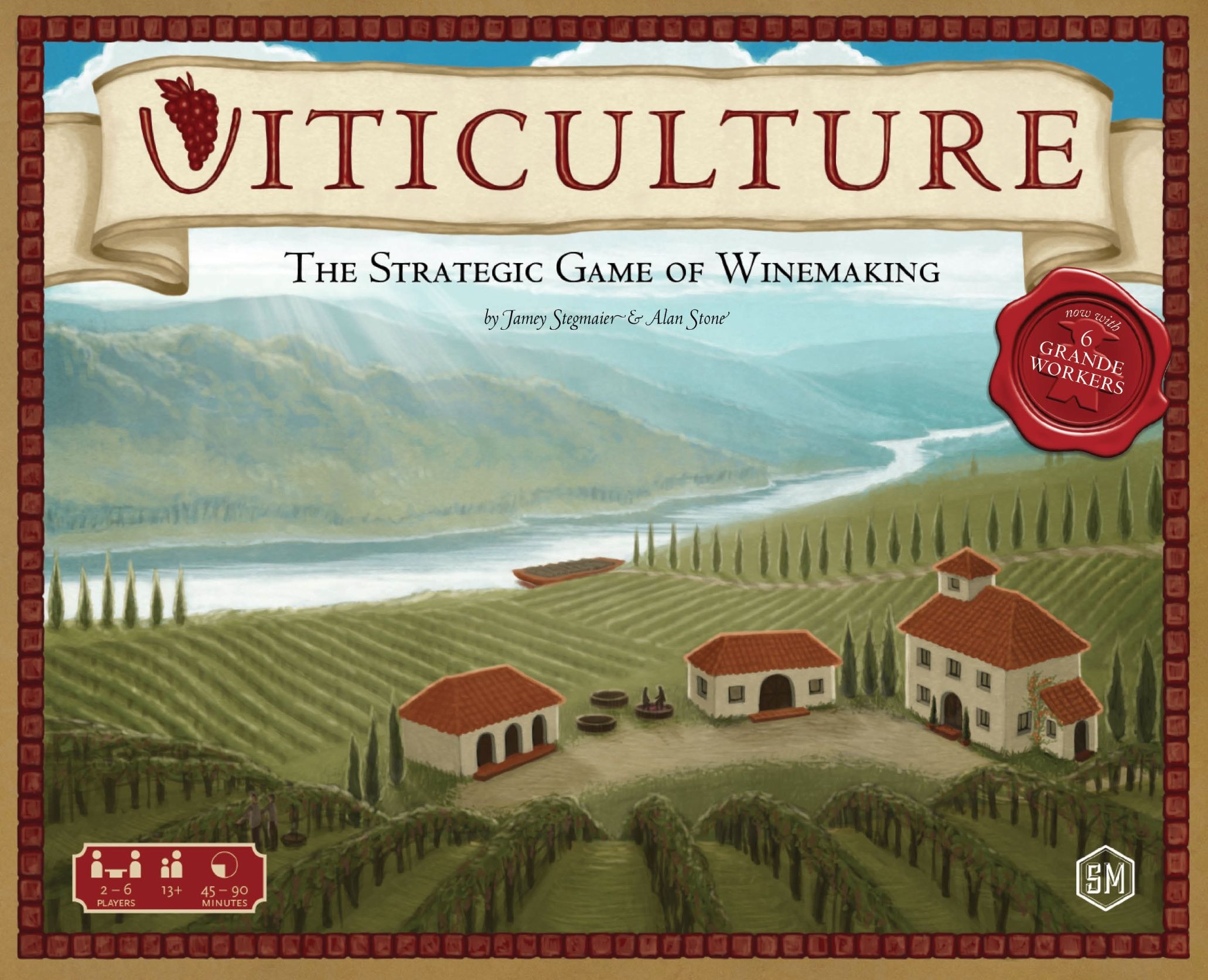
Manual published by the publisher · for rules reference only. More about the game on BoardGameGeek and Ludopedia .
