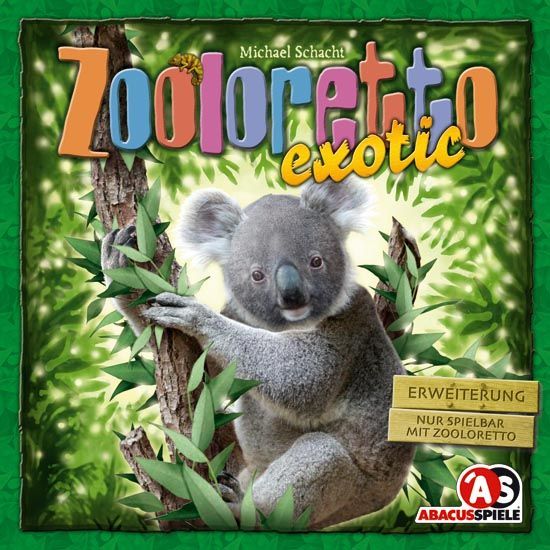
What is your question about Zooloretto Exotic?
Ask before downloading the manual: the assistant was trained on this file and answers instantly, citing the exact page.
Ask questions about the game
Ask anything about Zooloretto Exotic: rules, setup, components, complexity, price, or whether it fits your group.
Write your question first. You will create your free account to see the answer — it takes 20 seconds.
Full rulebook
Browse the manual or download the original PDFFull manual text available to read Open text
For 2 to 5 players, aged 8 and up
with 4 players, the tiles of one jungle animal type
with 3 players, the tiles of two jungle animal types
with 2 players, the tiles of three jungle animal types
OVERVIEW
Now the zoo becomes more exotic with the building
of a new jungle experience path with strange
animals from all over the world. These new exotic
animals attract a large number of curious visitors.
And the stands pay double because of the increased
business. Of course, the other zoos also have their
exotic animals to lure customers to them. The player
who creates exhibits that keep visitors in his zoo
earns bonus points at the end of the game.
CONTENTS
Before the first game, carefully remove the parts
from the frame.
The 9 blank tiles are not used for the game. They
offer players the option to create their own tiles.
40 visitors (8 each in 5 colors)
16 square jungle animal tiles (2 each of 8 types)
5 jungle boards (each with 3 parts)
5 visitor bonus tiles (1 each in each visitor color)
5 summary cards
Players need the components of the basic game
in addition to this expansion material.
Follow the normal Zooloretto rules except as
follows:
PREPARATION
● Place the visitor figures and the bonus tiles as
general supply in the center of the playing area.
As the yellow visitors and the yellow bonus tile
are needed only when playing with the
“Zooloretto XXL” expansion, return them to the
box when not using this expansion.
● Each player takes the three parts of a jungle
board and fits them together.
The players place
their zoo boards
to the left of the
jungle boards.
Return unused
jungle boards
back to the box.
● Each player takes a visitor
in each color and places
it on space 2 on the middle
path of his zoo board
(see figure).
● Each player takes a summary card.
● Mix the jungle tiles together with the tiles from
the basic Zooloretto game.
● Continue with the normal Zooloretto preparation
(15 tiles stacked for game end, etc.).
● In games with fewer than 5 players, remove
some jungle animal tiles from the game as with
the other animal types:
The path of the visitors: With the jungle board,
the zoo is expanded. The visitors enter the zoo
board at the top in the center and move
downward along the main path past the three
lookout points. Then, they move along the jungle
path past two more lookout points.
Finally, the path leads out of the zoo.
---
PLAYING THE GAME
B. TAKE A DELIVERY TRUCK AND
PASS FOR THE REST OF THE ROUND
●Jungle animal tiles
The background shown on the jungle animal tiles
differs from those of the animals in the basic game.
When a player puts a jungle animal into his zoo,
he must consider the following rules:
A player may only place a jungle animal tile on
an empty space on the jungle board.
Important: on a player’s jungle board, he may
place at most 3 jungle animal types.
If the player cannot or does not want to place a jungle animal tile on the jungle board, he must
place it in his barn.
●Move visitors
Each time a player places a vending stall or a
jungle animal in his zoo, one or more visitors
is moved as follows:
- When the player places a vending stall on
a stall space, he must move one visitor in the
color of the vending stall 2 spaces forward
along the path. The color allocation of
vending stalls and visitors is specified on the
summary cards.
The player may choose whether to move a
visitor that already is in his zoo or to take
a visitor of the appropriate color from the
general supply (if still available) and move it
2 spaces into his zoo.
Important: if the player places the stand into
his barn, or moves a vending stall from one stall space onto another one with a money action,
he may not move a visitor!
-When a player places a jungle animal in his
zoo, he may choose the color of visitor to move.
He may only choose a color of a visitor already
in his zoo or which there is at least one visitor
in the general supply. He follows the same rules
for moving the visitor as for the stand above.
Subsequently, each other player who has
a visitor of the same color in his zoo must
move this visitor backward 1 space.
If a player has several visitors of a color, he may
choose which one of this color he moves.
If the move places the visitor outside the
entrance, the player places it back in the
general supply.
When a player moves a visitor forward beyond
the last space on the jungle board, he takes
the bonus tile in the color of the visitor.
He places it face up in his play area. If the bonus
tile of this color has already been taken, the
player takes nothing.
When a visitor is moved outside the zoo,
the player returns it to the general supply.
When a player moves a visitor from the zoo with
the first of two moves, the second move is lost.
Example: Anna places a red vending stall into her
zoo. She moves her red visitor forward 2 spaces
(1). Since her red visitor left the zoo with this
move, she returns it to the general supply.
Anna’s reward is the red bonus tile, which she
takes and places in her play area.
Afterwards, she places a jungle animal into her
zoo. She decides to take for it a red visitor from
the general supply and to move it two spaces
into her zoo (2). Additionally, Scott and James
must each move one red visitor back 1 space in
their zoos.
C. CARRY OUT ONE MONEY ACTION
Exchange– cannot be executed with jungle
animals. All other money actions that involve tiles
(move, buy, and discard a tile) can be done with
jungle tiles as with other animal tiles.
---
GAME END
SCORING
● For the jungle animals, the player scores points as follows:
- For the jungle animals on the jungle board, the player scores 0 points.
- For each jungle animal type in the barn the player scores minus 2 points.
● For the visitors, the player scores as follows:
- The player scores 2 points for each color of visitor in his zoo; the number of visitors of a color gives no extra points.
- If a player has a visitor bonus tile, he scores 2 points for each visitor in his zoo of that color.
OTHER IMPORTANT RULES
- A player may only place jungle animals on the jungle board.
- Jungle animals may not be exchanged.
- Visitor movement may not be divided between two visitors.
- If a visitor leaves the zoo when it is moved backwards, the player takes no bonus tile.
- If a player places a vending stall of a color and has no visitor of that color in his zoo and there is no visitor of that color in the general supply, he does not move a visitor.
- The other players must move a same color visitor backward only when a player places a jungle animal, not when he places a vending stall.
- Even if the player moves the visitor only one space after he places a jungle animal, the other players must move a same colored visitor backwards.
COMBINING ZOOLORETTO EXOTIC WITH
OTHER EXPANSIONS AND VARIANTS
For recommendations for combining several expansions with the basic games, please visit www.zooloretto.com
ANIMAL ENCYCLOPEDIA
The Pygmy Anteater
These toothless animals typically have long tongues. The pygmy anteater lives in the trees of Central and South America.
The Scarlet Macaw
These social animals take their name from the sound they make. Inhabitants of Central and South America, they prefer to eat seeds and fruits.
The Bat
These flying mammals are found on all continents of the world except Antarctica. There are over 900 species – 40 in Europe alone. Europe.
The Koala
These marsupials live in the eucalyptus forests of Australia. They sleep for extremely long periods of time, but possess very good hearing and an extraordinarily sensitive nose.
The Orangutan
These great apes live in the rain-forests of the islands of Borneo and Sumatra. The name of this plant-eating primate comes from the Malay word for “Forest Person”.
The Baboon
These African monkeys spend most of their time on the ground but can also climb very well and prefer to return to the trees to sleep.
The Smooth Snake
These harmless snakes, found in Europe and West Asia, are often confused with the European adder and grow to lengths of up to 80 cm.
The Emerald Tree Monitor
Although one of the smallest monitor species, the emerald tree monitor still grows to lengths of up to 1 meter. They live in the rainforests of Australia and New Guinea.
Author: Michael Schacht, www.michaelschacht.net
Translation: Jay Tummelson
© 2009 ABACUSSPIELE Verlags GmbH & Co. KG, Dreieich
All rights reserved, Made in Germany.
www.abacusspiele.de
---
Why ask BoardGamesBot
Instead of flipping through the whole manual- Accurate answers Based exactly on this manual, with the source page.
- Save time Find the rule in seconds, without flipping 3 pages.
- Anytime Settle rules mid-game, straight from your phone.
- 100% free Create your free account and start using it now.
How it works
Three steps to the answer- 1 Ask your question Type your question about this game's rules.
- 2 Create your free account Takes 20 seconds — it only saves your history.
- 3 Get the answer The AI finds the exact rule and cites the manual page.
Manual published by the publisher · for rules reference only. More about the game on BoardGameGeek and Ludopedia .