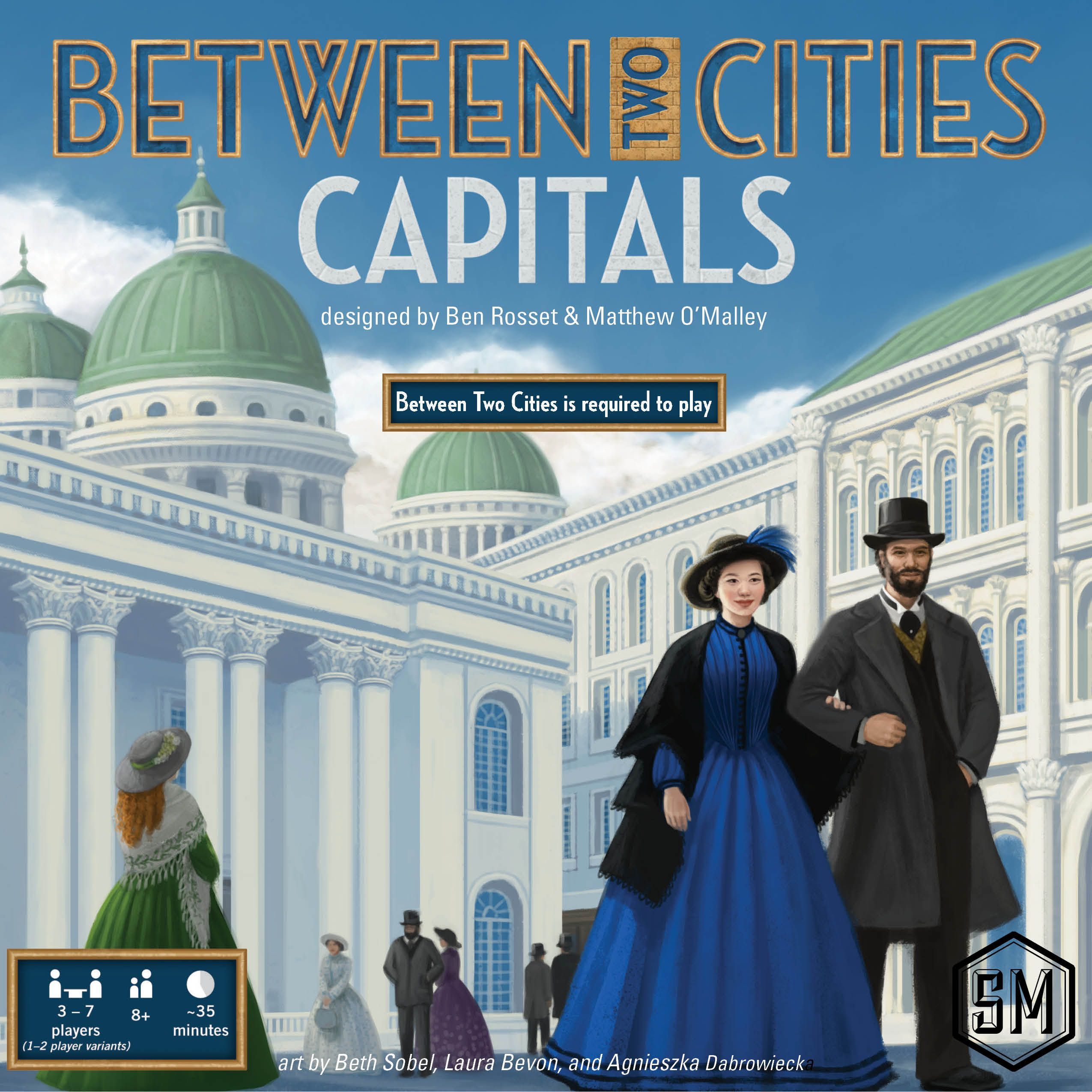
How to Play Between Two Cities: Capitals
Arclight Games, Ghenos Games, SD Games · Board game · 2017What do you want to do now
Ask anything about Between Two Cities: Capitals: rules, setup, components, complexity, price, or whether it fits your group.
Video: How to Play
Start here, then follow the written guide
Step by step
Game Objective
In Between Two Cities: Capitals, you are a renowned architect, sought after by two capitals to build their city centers. Your objective is not only to consider the natural reasons for the cities' founding but also to ensure that civic buildings are well-positioned and satisfy the citizens' aspirations. The game expands the base game by adding new challenges such as landscapes, districts, and civic buildings.
Setup
- Mix all civic building tiles with the building tiles from the base game.
- Give 1 landscape tile to each city (space between players) with the arrow pointing towards the center of the table.
- Place the 3 district scoring tiles in the center of the table.
- Randomly place 2 district cards on top of each of the district scoring tiles (forming 3 pairs of district cards). Discard the seventh district card.
- EXCEPTION: If any of the pairs is a house-factory pair, discard the second card of that pair and replace it with the seventh district card.
Game Flow
Refer to the manual for details on this section.
Actions and How to Play
Drawing Tiles
In rounds one and three, each player now draws 9 building tiles to their hand, instead of 7 tiles as in the base game. This creates an extra turn in rounds one and three, meaning each city will have a total of 20 building spaces used during the game instead of the 16 used in the base game.
Landscape Tiles
Each city's Landscape tile shows a fragment of nature within the city's borders. 5 of the spaces on the landscape tile cannot be built upon. At the end of the game, your city must form a 5x5 grid, instead of 4x4 as in the base game. You cannot place a tile in a position that breaks the 5x5 grid arrangement. The Landscape tile must be completely within the city's 5x5 grid. Remember that the Landscape tile is placed with the arrow pointing towards the center of the table.
The first building tile placed in a city must be placed in a free space on a landscape tile. Additional building tiles must be placed adjacent to at least 1 of the previously placed tiles, just like in the base game.
BRIDGES: Tiles are considered adjacent when connected by a bridge for tile placement or scoring purposes. For example, if a house and a factory are placed on opposite sides of a bridge, they are considered adjacent.
Districts
Each pair of district cards is a district that citizens want in their city. There are always 3 districts in each game of Between Two Cities: Capitals. Districts are regions of connected tiles of the same types. A district does not need to have both types of tiles to score. A city only counts its largest district of each type.
Civic Buildings
Civic buildings score points at the end of the game just like any other building. Each civic building shows two types of tiles that can benefit it when placed adjacent to it, and one type that can harm it when placed adjacent to it. These are different for each type of civic building.
End of Game and Scoring
Refer to the manual for details on this section.
Shop Scoring
There have been no changes regarding scoring compared to the base game. Five shops in a row score 18 points (a row of 4 shops scores 16 points and an additional shop scores 2 points).
District Scoring
Districts score points at the end of the game after individual tiles have been scored. Each District Scoring tile shows the score for that district. For each district type, the city with the largest district of that type scores first place points. The second city with the second largest district of that type scores second place points. A city cannot score both first and second place points for a district type.
- TIES: If there is a tie for first place of a district type, combine the first and second place points and divide them among the tied cities, rounding down. If there is a 3-way tie for first place, each tied city receives 4 points.
- If there is a tie for first place, there are no second place points for that district.
- If there is a tie for second place, the tied cities divide the second place points, rounding down. For example, if there is a two-way tie for a second place that gives 5 points, each tied city will receive 2 points.
Civic Building Scoring
At the end of the game, check each civic building and score points individually as follows:
- If it is not adjacent to buildings that benefit or harm it, it scores 1 point.
- If it is adjacent to only one of the types that benefit it, it scores 3 points.
- If it is adjacent to both types that benefit it, it scores 6 points.
- If it is adjacent to the type that harms it, it scores only 1 point, regardless of the other types surrounding it (like 1 factory next to 1 house).
When scoring points for a civic building, it does not matter if it is adjacent to multiple of one of the types that benefit it. For example, the Elementary School is only worth 3 points even if it is next to two houses but no park, and 6 points even if it is adjacent to two houses and two parks.
House Scoring
The presence of civic buildings in a city does not count as an additional tile type for houses.
Tips for Winning
- Remember that each city's boundaries are 5x5 (including the landscape tiles). Plan your city's expansion so that the Landscape tile is completely within the 5x5 grid.
- When placing civic buildings, try to position them adjacent to the tile types that benefit them and avoid the types that harm them to maximize scoring.
- Pay attention to the districts being formed in the cities. Try to create the largest district of each type to secure first place points, or at least the second largest for second place points.
Rules manual
Official PDF file
Frequently Asked Questions
Quick answers about the rules
What is the objective of Between Two Cities: Capitals?
How do you set up Between Two Cities: Capitals?
How do you play Between Two Cities: Capitals?
How does Between Two Cities: Capitals end, and how do you score?
What are some tips for winning Between Two Cities: Capitals?
Expansion for
Published additional content